3 Best Air Fryers for Fish in the UK (2026)
Fish is the food that separates an air fryer you can live with from one you have to fight. A salmon fillet goes from moist to chalky in a couple of minutes, thin haddock needs watching rather than timing, and getting a cooked fillet out in one piece depends as much on basket design as on cooking power. So this guide weighs up basket layout, temperature control and how easy each machine is to monitor, rather than treating litres and wattage as a proxy for good fish.
All three models below are widely sold in the UK and backed by proper manufacturer support. They are also genuinely different from each other, which matters more than a tight ranking: the right one depends on whether you cook fish on its own or as part of a bigger meal.
Quick verdict
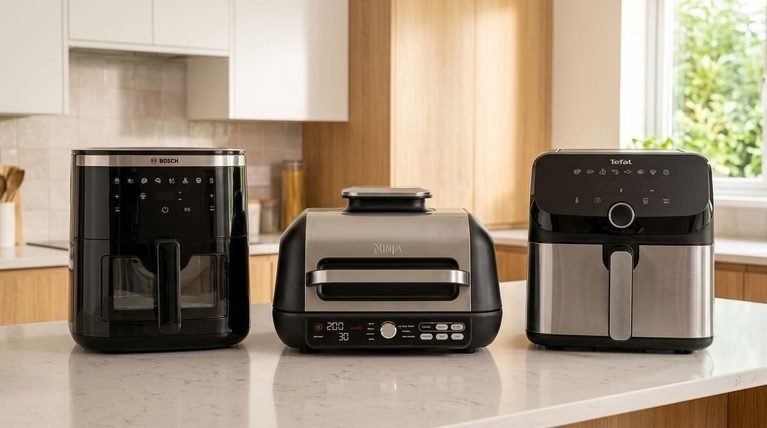
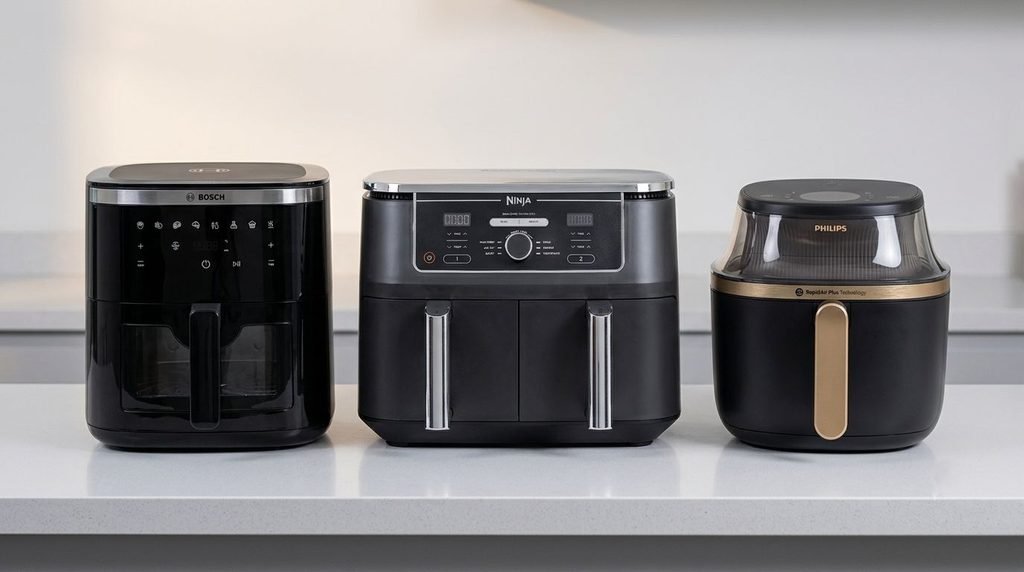
My top pick is the Bosch Series 6 MAF671B1GB. It combines a 7.2L single basket with a lit viewing window, a Fish preset and temperature control in 5°C steps from 40°C to 200°C. Bosch also says its dual heating elements remove the need to shake the drawer, which is exactly the right behaviour for something as fragile as a cooked fillet. It is the most compact machine here too.
The Philips 3000 Series NA342/09 is the closest alternative and takes second place. Same 7.2L single basket, same 40°C to 200°C range, same window, plus a Fish preset among 12 touchscreen presets. Philips quotes capacity as six pieces of salmon, which is a more useful number for this guide than the litre figure. It is a wider, deeper machine than the Bosch, so it gives you a slightly roomier cooking area at the cost of worktop space.
The Ninja Foodi MAX Dual Zone AF400UK is third, and the ranking needs explaining because it is an excellent air fryer. For fish on its own it is the weakest of the three: two 4.75L drawers give you less uninterrupted length than one 7.2L basket, there is no window, and there is no low-and-slow advantage over the others. For fish with something else, it is comfortably the best, because each drawer runs its own temperature and time and Sync finishes them together. If fish and chips is the meal you actually cook, buy the Ninja.
Price widens the gap further. At the time of writing the Bosch is £89.99, the Philips £159.99 and the Ninja £189.99, so the machine I would pick for fish is also the cheapest by a long way. Keep that in mind when you read the other two sections: each has to earn £70 or more of extra spend on something other than cooking a fillet well.
Best air fryers for fish: comparison
| Model | Best for | Score | Price | Capacity and format | Why it works for fish |
|---|---|---|---|---|---|
| Bosch Series 6 MAF671B1GB | Best overall for fish | 9.3/10 | £89.99 | 7.2L single basket | Lit window, Fish preset, 5°C temperature steps, no shaking needed |
| Philips 3000 Series NA342/09 | Best for several fillets at once | 9.0/10 | £159.99 | 7.2L single basket | Window, Fish preset, quoted at six salmon pieces |
| Ninja Foodi MAX Dual Zone AF400UK | Best for fish and chips | 8.8/10 | £189.99 | 9.5L total, two 4.75L drawers | Two independent zones with Sync, 240°C Max Crisp for frozen coated fish |
Prices correct at the time of writing and likely to move, particularly around promotions. Check before you buy.
What actually matters when you air fry fish
Control matters more than power. Salmon takes enough heat to crisp the skin while the middle stays translucent in the centre, whereas cod, haddock, pollock and other lean whites dry out quickly once they pass the point of flaking. Being able to nudge the temperature in small increments is more useful here than a 240°C top end you will rarely want for a fresh fillet.
A viewing window earns its place with fish in a way it does not with chips. Fillets often cook in eight to twelve minutes, so the margin between right and ruined is small, and opening a drawer to check drops the temperature every time. Being able to look at the colour of the skin instead saves you that.
Litres are a poor guide to whether a fillet will actually fit. A 7.2L single basket and a 9.5L dual-drawer machine are not comparable for a long fillet, because the dual-drawer capacity is split into two smaller compartments. Measure the fish you usually buy. A supermarket salmon fillet is fine anywhere; a side of salmon or a whole sea bass is a different question, and one worth reading our guide to the best large air fryers in the UK before you decide.
Then there is cleaning. Oily fish leaves residue on the plate, the drawer and, on window models, the glass. Dishwasher-safe removable parts make a real difference if fish is a weekly habit rather than an occasional treat.
How I chose these three
I started with air fryers that are well established in the UK, easy to buy and properly supported, then judged them on the things that change the result with fish: basket shape and usable length, how finely the temperature can be set, whether you can see what is happening, how easy the cooking surfaces are to clean after oily fish, and whether two foods can be cooked separately.
A dedicated Fish preset is a convenience, not evidence of better cooking. It cannot know whether you have loaded a thin haddock fillet or a thick tranche of salmon, so I have treated it as a sensible starting point rather than a reason to rank one machine above another. Customer ratings were used as a confidence check on build quality and reliability, not as a ranking factor.
1. Bosch Series 6 MAF671B1GB: best overall for fish
The Bosch takes first place because the details line up with the way fish actually behaves. The 7.2L drawer is a single uninterrupted space, so two or three fillets sit flat with air moving round them instead of being squeezed into a half-size compartment. The window is lit from inside and the light can be switched on mid-cook, so you can judge the colour of salmon skin without pulling the drawer out and losing heat.
Temperature runs from 40°C to 200°C and adjusts in 5°C steps, which is the most useful control feature here. Dropping from 200°C to 180°C is a blunt instrument with a thin fillet; 190°C is often the setting you actually want. Bosch also states that the dual heating elements mean food cooks evenly without shaking the drawer, and while that claim is aimed at chips, the benefit lands on fish: nothing about shaking a basket is kind to a cooked fillet.
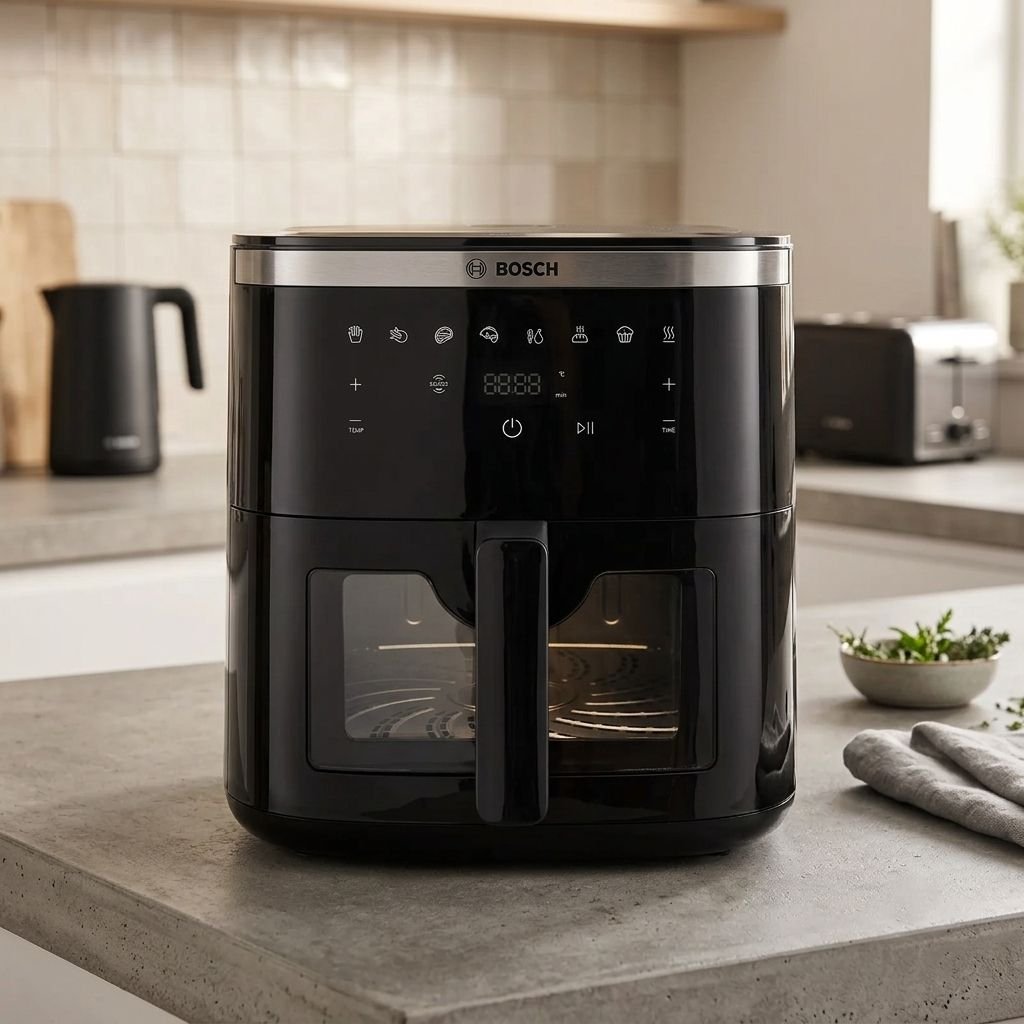
It is rated at 1800W, the lowest of the three, and it is by far the smallest machine, at roughly 31cm high and 31cm wide. That compactness has a trade-off worth knowing: the usable cooking plate is considerably smaller than 7.2L suggests, because the drawer tapers. It is fine for standard supermarket fillets and prawns, and awkward for anything long. The included grill set adds a second cooking level, and its skewers are more useful than they sound if you cook prawns or chunky fish kebabs.
There is no second zone, so fish and chips means cooking in sequence or accepting a shared setting. The window, useful as it is, needs wiping after oily fish or it clouds over. And it is not a quiet machine: Bosch rates it at 63 dB(A), enough to compete with a conversation in a small kitchen.
Key specifications
| Price at the time of writing | £89.99 |
| Capacity | 7.2L single basket |
| Power | 1800W |
| Temperature range | 40°C to 200°C, in 5°C steps |
| Presets | 8, including Fish, Meat, Poultry, French Fries, Vegetables, Bread, Small Pastries and Keep Warm |
| Dimensions (H x W x D) | 31.4 x 30.9 x 38.8cm |
| Weight | 5.6kg |
| Noise level | 63 dB(A) |
| Included | Grill set |
| Cleaning | Dishwasher-safe drawer and cooking plate |
| Guarantee | 2 years (manufacturer terms apply) |
Pros and cons
- Single 7.2L basket keeps fillets flat and uncrowded
- Lit viewing window makes it easy to judge browning without opening the drawer
- 5°C temperature steps give fine control over delicate fish
- Bosch says no shaking is needed, which suits fragile fillets
- Smallest and cheapest of the three
- Single zone, so fish and sides share one setting
- Usable cooking area is narrower than the 7.2L figure implies
- Noisy in use, at a rated 63 dB(A)
- Window needs wiping after oily fish to stay clear
Buy it if fish is a regular weeknight meal, you cook two to four fillets at a time, and you want the best combination of fine temperature control, visibility and a small footprint.
Skip it if your fish usually arrives with chips or roast vegetables that need a different temperature, or if you regularly cook long pieces of fish.
2. Philips 3000 Series NA342/09: best for several fillets at once
On paper the Philips and the Bosch are close relatives: 7.2L single basket, 40°C to 200°C, a cooking window and a Fish preset. The differences are in the body and the interface. The Philips is a bigger box, roughly 45cm deep, and that extra length buys a more generous cooking area. Philips quotes the basket at up to six pieces of salmon, which is the most directly useful capacity figure any of these manufacturers publishes for our purposes.
That makes it the pick for anyone cooking fish for four or more. Crowding is the most common reason home air-fried fish comes out steamed and pale rather than browned, so having room to leave gaps between fillets is worth more than another litre on the box. The window is large and lit, and the touchscreen carries 12 presets, Fish among them, plus a favourite button you can save your own settings to. If you cook the same salmon fillets most weeks, that saves genuine faff.
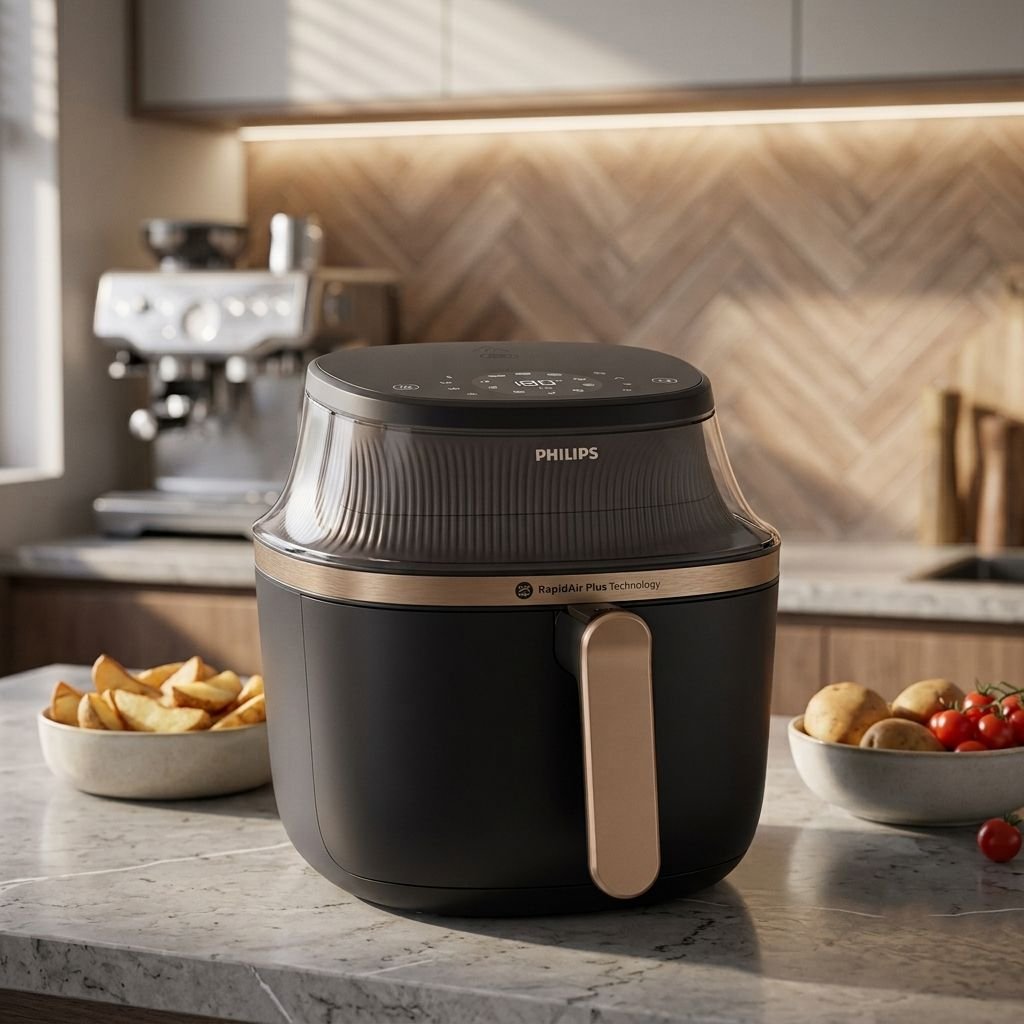
Philips describes the airflow as RapidAir Plus, using a star-shaped base to circulate heat. I would not read that as a promise of better fish than the Bosch, but the combination of a wide flat base and a single large chamber does make practical sense when several pieces need to cook at the same rate. The low end of the range is the other quiet advantage: settings go down to 40°C with long timers for dehydrating, which is not a fish feature but does add everyday usefulness.
The catch is price. At £159.99 against the Bosch’s £89.99, you are paying about £70 for a roomier basket, a savable preset and a bigger box on the worktop. If you cook fish for two or three people, that is difficult to justify, because the Bosch does the same job with finer temperature steps and less depth. For four or more, or if you regularly fill a basket, the extra room is the one thing here you cannot get from the cheaper machine.
Key specifications
| Price at the time of writing | £159.99 |
| Capacity | 7.2L single basket |
| Power | 2000W |
| Temperature range | 40°C to 200°C |
| Presets | 12, including Fish, plus a savable favourite; 16 cooking functions in total |
| Stated fish capacity | Up to 6 pieces of salmon (Philips figure) |
| Dimensions (H x W x D) | Approx. 30.5 x 33.3 x 45.3cm |
| Weight | Approx. 5.9kg |
| Cleaning | Dishwasher-safe removable parts, non-stick coating |
| Guarantee | 2 years (manufacturer terms apply) |
Pros and cons
- Roomiest single cooking area here, quoted at six salmon pieces
- Large lit window and a clear touchscreen
- Fish preset plus a savable favourite setting for repeat meals
- Wide 40°C to 200°C range with long timers for low-temperature functions
- Takes up more worktop depth than the Bosch for the same stated capacity
- Single zone cannot cook fish and sides at different settings
- 200°C ceiling, so less high-heat headroom than the Ninja for frozen coated fish
- Around £70 more than the Bosch for a very similar feature set
Buy it if you cook fish for four or more, want the largest single basket of the three, and the extra room is worth about £70 to you.
Skip it if you usually cook two or three fillets, worktop space is tight, or you want the finest temperature control available here. The Bosch covers all three for less.
3. Ninja Foodi MAX Dual Zone AF400UK: best for fish and chips
The Ninja solves a different problem, and it solves it better than anything else here. Its 9.5L splits into two 4.75L drawers with independent temperature and time control, so battered cod can run at one setting while chips run hotter and longer in the other. Sync works out the timings so both finish together, and Match copies one drawer’s settings to the other when you are cooking a single large batch. For the classic UK air fryer meal, that is the whole point.
Max Crisp runs up to 240°C, higher than either single-basket model and genuinely useful for frozen breaded and battered fish, where the aim is to drive moisture out of the coating before the fish inside overcooks. Ninja suggests it specifically for smaller quantities of frozen food, and the raised crisper plates let fat drain away from oily fish rather than sitting under it. Plain fillets are where the format starts to work against you. Each drawer is smaller than the single baskets above, so a long fillet is more likely to be bent to fit, and bent fish cooks unevenly. There is no window at all, so checking means opening a drawer and dropping the temperature, on the food where that matters most. The missing Fish preset bothers me far less: six functions with manual time and temperature are plenty once you know your usual settings.
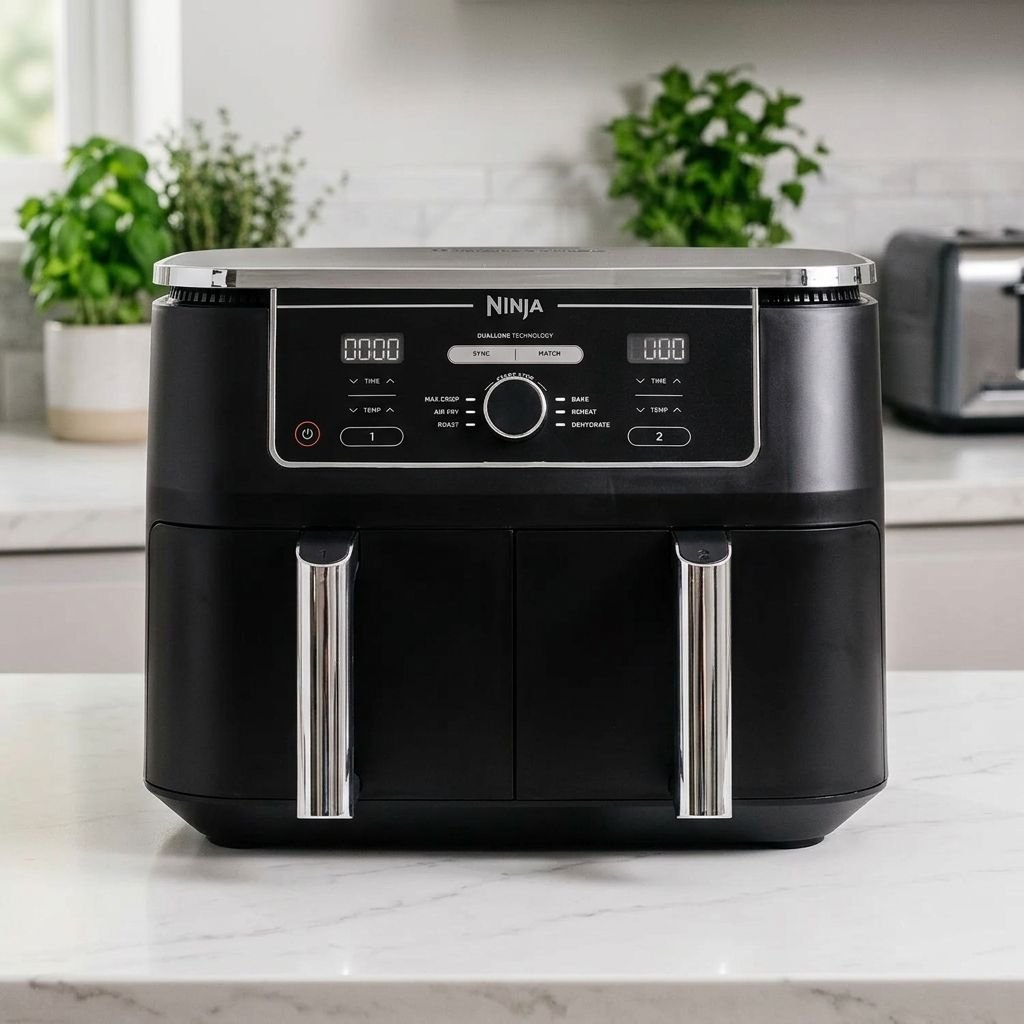
It is also the dearest here at £189.99, and the largest, at around 41.5cm wide and 32.5cm tall, weighing 8.8kg. If two zones are going to sit unused most weeks, that is £100 over the Bosch for flexibility you will not use, plus the worktop space to house it. If you want to weigh up that format properly, our guide to the best dual air fryers in the UK goes into it in more detail.
Key specifications
| Price at the time of writing | £189.99 |
| Capacity | 9.5L total, two 4.75L drawers |
| Power | 2470W |
| Temperature range | 40°C to 240°C (240°C on Max Crisp) |
| Functions | Air Fry, Max Crisp, Roast, Bake, Reheat, Dehydrate |
| Cooking zones | 2 independent zones with Sync and Match |
| Dimensions (H x W x D) | 32.5 x 41.5 x 27cm |
| Weight | 8.8kg |
| Cleaning | Dishwasher-safe drawers and crisper plates |
| Guarantee | 2 years on registration (manufacturer terms apply) |
Pros and cons
- Two independent zones with Sync, so fish and chips cook at different settings and still finish together
- Match copies one drawer’s settings to the other for a single large batch
- 240°C Max Crisp suits frozen breaded and battered fish
- Raised crisper plates drain fat away from oily fish
- No window, so checking a fast-cooking fillet means opening the drawer
- Each drawer holds less than the single baskets, so long fillets can be a squeeze
- Much larger footprint than either single-basket model, and the dearest here
Buy it if fish almost always shares the meal with chips or vegetables, and you want both ready at once without juggling batches.
Skip it if you mostly cook fish on its own, want to watch it through a window, or have limited worktop space.
Cooking different kinds of fish
The settings below are starting points, not rules. Thickness, whether the fish went in cold from the fridge or straight from the freezer, and how full the basket is will all shift the timing. Check early, and judge by the fish rather than the timer: it is done when the flesh has turned opaque, flakes with gentle pressure and is piping hot through the thickest part.
Fillets: salmon, cod, haddock, sea bass
Most fillets sit somewhere around 180°C to 200°C for roughly eight to twelve minutes, with thick salmon at the longer end and thin haddock at the shorter. Skin-on fillets go skin-side down on the plate and generally do not need turning, which is the easiest way to keep them intact. Lean white fish is the one to watch: it holds far less fat than salmon, so it goes from flaking to dry in a couple of minutes. A light brush of oil helps the surface colour and stops the flesh drying at the edges.
Whole fish
Be realistic about size. A whole sea bass, trout or mackerel is often 30cm or longer, and none of these machines gives you a 30cm flat run: the Bosch and Philips baskets are wide but taper, and the Ninja’s drawers are smaller again. Smaller whole fish fit, larger ones have to be curved to sit in the basket, and curved fish cooks unevenly. If whole fish or a side of salmon is a regular thing, this is one of the few cases where an oven still has the advantage over an air fryer. Where a whole fish does fit, slashing the thickest part of the flesh helps it cook through before the skin overdoes it.
Breaded and battered fish
Coatings need higher heat than plain fillets, and they need space. Crumb that touches its neighbour steams instead of crisping. Wet batter is the one thing air fryers handle poorly: it runs off before it sets, so shop-bought battered fillets designed for oven cooking work far better than a homemade batter. If you crumb your own, press the breadcrumbs on firmly, because a strong fan will lift loose crumb off the surface.
Frozen fish
Fish fingers, breaded fillets and other oven-ready frozen products generally go in from frozen, and the packet instructions are the best guide, especially where the manufacturer gives air fryer timings. Do not stack them, give them a turn halfway if the coating is thick, and make sure they are cooked through before serving. Plain frozen fillets are better defrosted first and patted dry, because the water that comes off them as they thaw will steam the surface rather than brown it.
Stopping fish sticking, and getting it out in one piece
Sticking is the single most common complaint about air-fried fish, and it is mostly solvable. Start with a clean, dry plate: residue from the last cook is what fresh fish grips onto. Brush the fish rather than the basket, so oil ends up where it is useful instead of smoking off the metal. Skin-side down on a perforated plate gives you a surface that releases more easily than bare flesh.
Give the fish a minute to settle after cooking before you move it, then lift with a fish slice rather than tongs, supporting the whole fillet. If you use paper liners, follow the manufacturer’s guidance on whether they are allowed at all, use perforated ones, keep them under the food so they cannot lift into the element, and never run the machine empty with a loose liner inside.
Clean up sooner rather than later with oily fish. Once the machine has cooled, wash the removable parts or run them through the dishwasher, and wipe the window while the residue is still soft. Leaving salmon fat to bake on over several cooks is how baskets end up permanently tacky and windows end up permanently cloudy.
What they cost to buy and to run
Purchase price is where the real difference sits. £89.99, £159.99 and £189.99 is a £100 spread, and none of the gap is explained by how well each machine cooks a fillet. It is explained by basket size in the Philips’s case and by a second cooking zone in the Ninja’s. Decide whether you need either of those before you decide anything else.
Using the Ofgem price cap for 1 October to 31 December 2026, which sets an average electricity unit rate of 26.32p per kWh, and assuming each machine drew its full rated power for a continuous 20 minutes, the 1800W Bosch would cost about 15.8p, the 2000W Philips about 17.5p and the 2470W Ninja about 21.7p. Run once a day for a month, that is roughly £4.74, £5.26 and £6.50 respectively.
Those figures overstate the real gap. Air fryers cycle their elements rather than pulling maximum power throughout, fish usually cooks in ten to fifteen minutes rather than twenty, and the Ninja only draws its full 2470W when both zones are working hard. A higher wattage does not mean every meal costs more. Over a year of daily use the gap between the cheapest and dearest to run here is around £20, which is less than a quarter of the difference in what you pay for them in the first place. If budget is the binding constraint, spend your attention there instead, and start with the best air fryers under £100 in the UK.
Buying guide: what to look for
Single basket or dual drawer?
A single basket is the simpler choice for longer fillets, larger portions and several pieces cooked at the same setting. Dual drawers earn their keep when the meal is mixed. The honest test is what you cooked last month: if fish nearly always arrived with chips or roast vegetables, two zones will pay off, and if it usually came with salad or rice from the hob, they will not.
A Fish preset is helpful, not decisive
Presets are a reasonable starting point if you are new to air frying, but they cannot account for thickness, coating or starting temperature. A thin cod fillet and a thick salmon tranche should not be treated the same simply because both are fish. Use the preset once, note what you had to change, and set it manually after that.
Judge capacity by shape, not litres
Litre figures describe the whole drawer cavity, including space above the food that no fillet will ever use. What matters is the flat area on the cooking plate and whether fillets can sit apart. Manufacturer claims like Philips’s six salmon pieces are more informative than volume, though they still describe maximum load rather than the amount that will brown best.
Think about the rest of what you cook
Very few households buy an air fryer only for fish. The features that suit delicate fillets, fine temperature steps and a window to watch through, are just as useful for chicken thighs and pastry, so a machine chosen for fish rarely becomes a compromise elsewhere. If poultry and joints are the bigger part of your cooking, our guide to the best air fryers for meat and chicken is worth reading alongside this one.
Frequently asked questions
What is the best air fryer for fish in the UK?
The Bosch Series 6 MAF671B1GB. A single 7.2L basket keeps fillets flat, the lit window lets you judge browning without opening the drawer, and 5°C temperature steps give you finer control than most air fryers at this size.
Which air fryer is best for salmon?
Either single-basket model. The Bosch if you cook two or three fillets and want the finest control, the Philips if you regularly cook for four or more, since Philips quotes its basket at up to six pieces of salmon. Both let you watch the skin crisp through a window, which matters with a fish that overcooks quickly.
Which air fryer is best for fish and chips?
The Ninja Foodi MAX Dual Zone AF400UK. Chips want more time and more heat than a fillet, and the Ninja is the only machine here that can give each its own setting and still have both ready at the same moment.
Do I need an air fryer with a Fish setting?
No. It is a convenience rather than a requirement, and the Ninja has no Fish preset at all without that being a real handicap. Manual time and temperature control works perfectly well once you know what suits the fish you usually buy.
Can you cook a whole fish in an air fryer?
Small whole fish, yes. Larger ones are a problem of length rather than capacity: a 30cm sea bass will not lie flat in any of these baskets, and curving it to fit means it cooks unevenly. Measure your basket before you buy the fish.
Can you cook frozen fish in an air fryer?
Yes. Fish fingers and breaded fillets usually go straight in from frozen, following the packet instructions and any air fryer timings the manufacturer provides. Plain frozen fillets do better defrosted and patted dry first, so the surface browns instead of steaming. Always check the fish is cooked through before serving.
Do you have to turn fish in an air fryer?
Often not. Skin-on fillets cooked skin-side down usually need no turning at all, which is the safest approach with delicate fish. Thicker breaded pieces benefit from a turn halfway for even colour. Use a fish slice and support the whole fillet if you do.
Bosch, Philips or Ninja: which should I choose?
Bosch for the best all-round fish machine in the smallest space. Philips if you cook fish for a family and want the roomiest single basket. Ninja if fish nearly always comes with chips or vegetables and you want both finished together.
Final verdict
The Bosch Series 6 MAF671B1GB is my pick for the best air fryer for fish. The basket is one uninterrupted space, the window is genuinely usable, the temperature moves in 5°C steps rather than 10, and Bosch’s design does not ask you to shake a cooked fillet halfway through. It is the smallest machine here and, at the time of writing, the cheapest of the three by some way.
The Philips 3000 Series NA342/09 is the one to buy if you are feeding more people. It shares the Bosch’s window, Fish preset and temperature range, and Philips’s own six-salmon-pieces figure tells you what the extra body depth buys you. The trade is worktop space, slightly coarser control and about £70, so it comes down to how often you actually fill a basket.
The Ninja Foodi MAX Dual Zone AF400UK is third on fish alone, and first on fish with sides. Two independent zones and Sync solve the timing problem that makes fish and chips awkward in any single-basket machine, and 240°C Max Crisp suits frozen coated fish better than a 200°C ceiling. You give up the window and some uninterrupted length, which is a fair trade if your fish rarely arrives on the plate by itself.
So the question is really which meal you cook more often: fish on its own, or fish with something else alongside it.
How we researched this guide
Capacities, power ratings, temperature ranges, presets, dimensions and guarantee terms were checked against current UK manufacturer information. Running-cost figures use the published Ofgem energy price cap for 1 October to 31 December 2026 and are illustrative rather than measured. Prices, stock and model availability change, so check them at the point of purchase.