
Are Air Fryers Safe? What You Need to Know
Are air fryers safe? They’re now a normal part of many UK kitchens, and that popularity has brought some fair questions with it. Can they catch fire? Is the non-stick basket a health concern? Does air-frying chips create anything harmful?
These are separate issues with quite different evidence behind them, so this guide takes them one at a time, using current UK guidance from electrical safety, fire and food safety bodies.
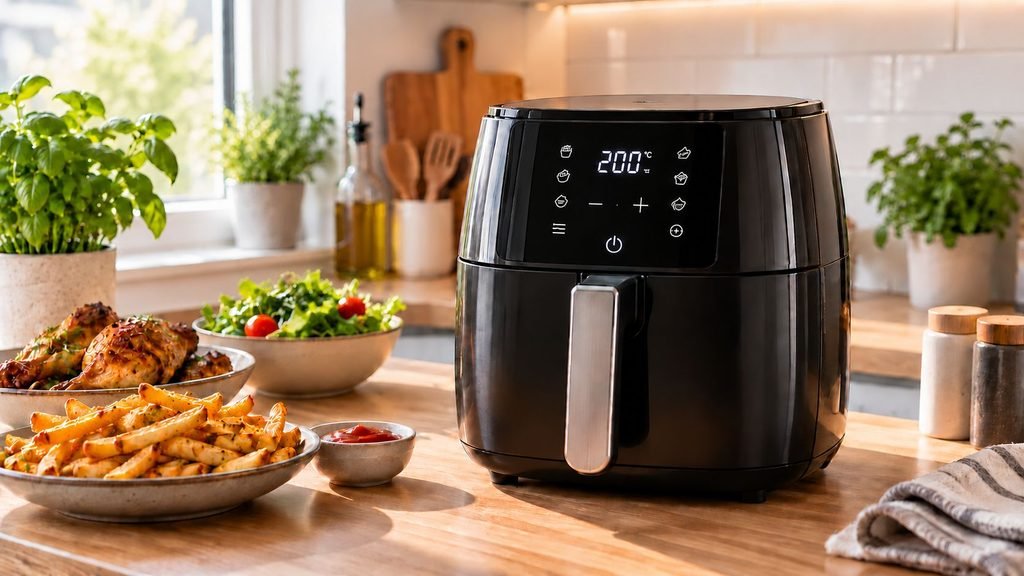
Quick answer: For normal household use, a genuine air fryer from a reputable retailer is generally considered safe when it’s used and looked after as the manufacturer intends. The risks that matter most day to day are fire (usually down to how or where it’s used rather than a fault), burns from hot baskets and steam, and undercooked food. Non-stick coatings and acrylamide are worth understanding, but the evidence doesn’t point to air fryers being uniquely dangerous.
Air fryer safety at a glance
| Concern | What the evidence says | What you can do |
|---|---|---|
| Fire | UK fire services have linked many air fryer fires to avoidable mistakes. | Use it on a clear worktop, never on a hob, and stay nearby. |
| Electrical faults | Specific models have been recalled, and counterfeit units have been stopped at the border. | Buy from a reputable retailer and check for recalls. |
| Burns | The drawer, basket and steam get very hot. | Open the drawer slowly and keep children away. |
| Undercooked food | Hot air doesn’t make food safe on its own. | Cook until steaming hot all the way through. |
| Non-stick coatings | PTFE cookware is thought to add only a small amount to overall PFAS exposure. | Look after the coating and replace a damaged basket. |
| Acrylamide | Forms in starchy foods cooked at high temperatures by any method. | Aim for golden rather than dark brown. |
So, are air fryers safe?
UK safety guidance doesn’t treat air fryers as especially hazardous. Its focus is on buying a properly made appliance, using it correctly and keeping it in good condition. The useful distinction is between an air fryer used as intended, and problems caused by misuse, poor maintenance, electrical faults or individual unsafe products.
Electrical Safety First, the UK’s electrical safety charity, points out that any electric air fryer sold here must have a UK three-pin plug with a fuse. It also suggests looking for features such as automatic shut-off, a cool-touch exterior, non-slip feet and overheat protection.
How an air fryer works, and why it matters
Despite the name, an air fryer doesn’t fry. It’s essentially a compact fan oven, with a heating element (usually above the food) and a fan that moves hot air quickly around the basket. Our air fryer vs oven comparison covers how that differs from your main oven in practice.
That design explains most of the safety advice. The element sits close to the food and the air moves fast, so loose paper or an overfilled basket can end up very near the element. A light coating of oil on the food is fine for most models, but the drawer shouldn’t be filled with oil like a deep-fat fryer. Check your manual for what yours allows.
Can an air fryer catch fire?
Yes, and what stands out in UK fire service reports is how often the cause is avoidable.
West Yorkshire Fire and Rescue Service has reported a rise in fires caused by things left on hobs, including air fryers sitting on a hob that was switched on by accident. Its advice is never to put an air fryer on a hob, even when it’s off. Nottinghamshire Fire and Rescue Service has also dealt with fires caused by packaging left inside new air fryers, and by baking paper.
So before anything else: take all the packaging out before first use, keep the air fryer off the hob, don’t go over the maximum fill line, and stay in the kitchen while it’s running.
Where to put it
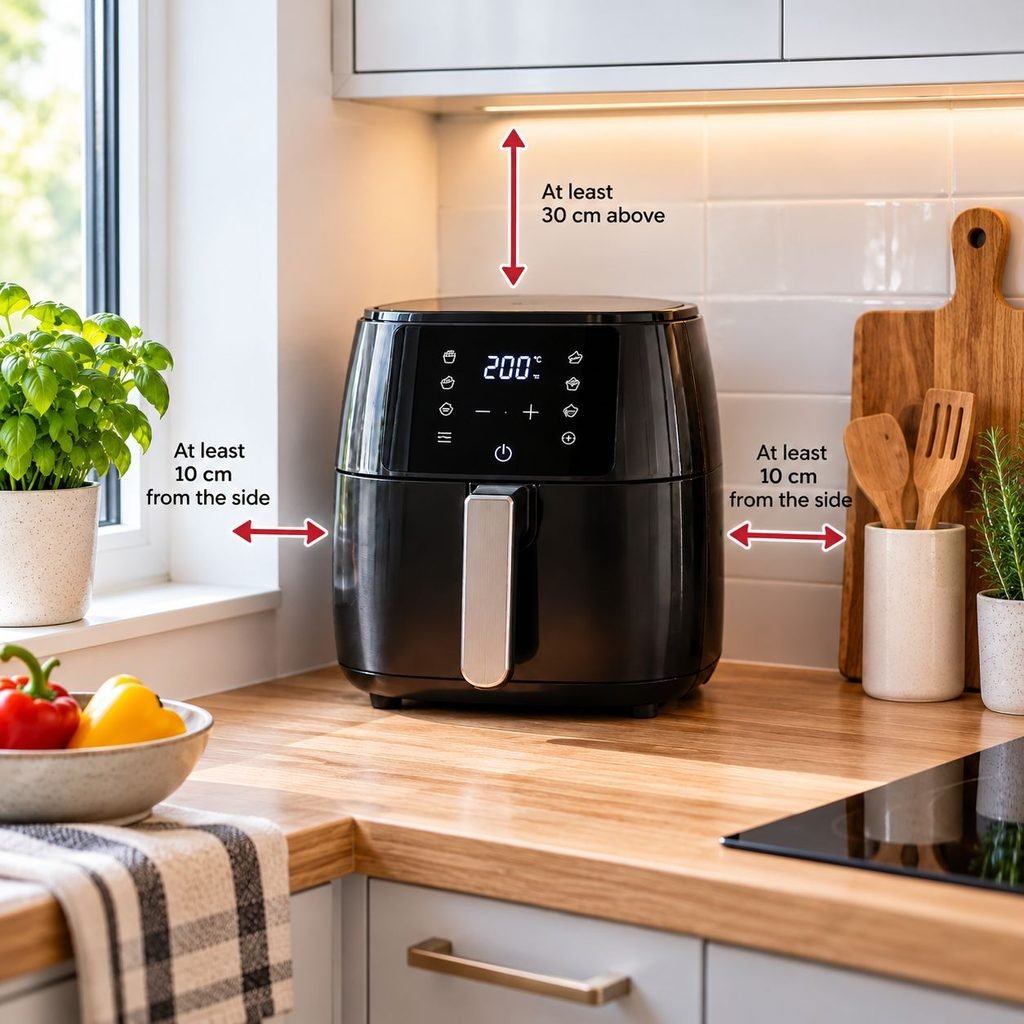
A clean, stable, heat-resistant worktop works best, away from walls, wall cupboards and anything that could catch fire. Most air fryers push hot air out of a vent, so make sure it isn’t blocked or aimed at a wall or plug socket. Keep the cable away from hot surfaces and back from the worktop edge. Recommended clearances vary between models, so the manual is the place to check.
Plugs, sockets and extension leads
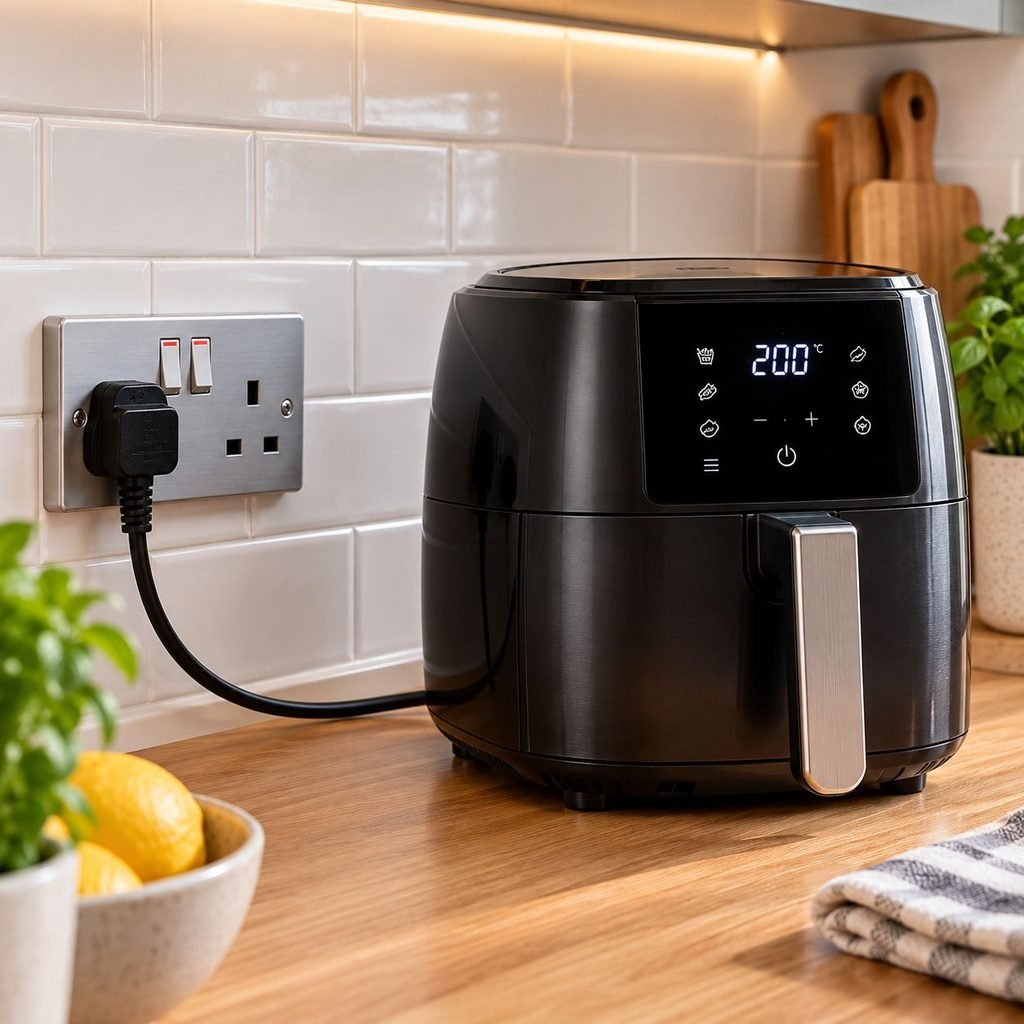
Electrical Safety First recommends plugging an air fryer straight into a wall socket, because extension leads can easily be overloaded when several high-powered appliances share one. It’s also worth glancing at the plug and socket now and then for scorch marks, and listening for any buzzing or crackling. An RCD in your fuse box (or an RCD plug, if you don’t have one) adds protection against electric shock if an appliance develops a fault.
Baking paper and liners
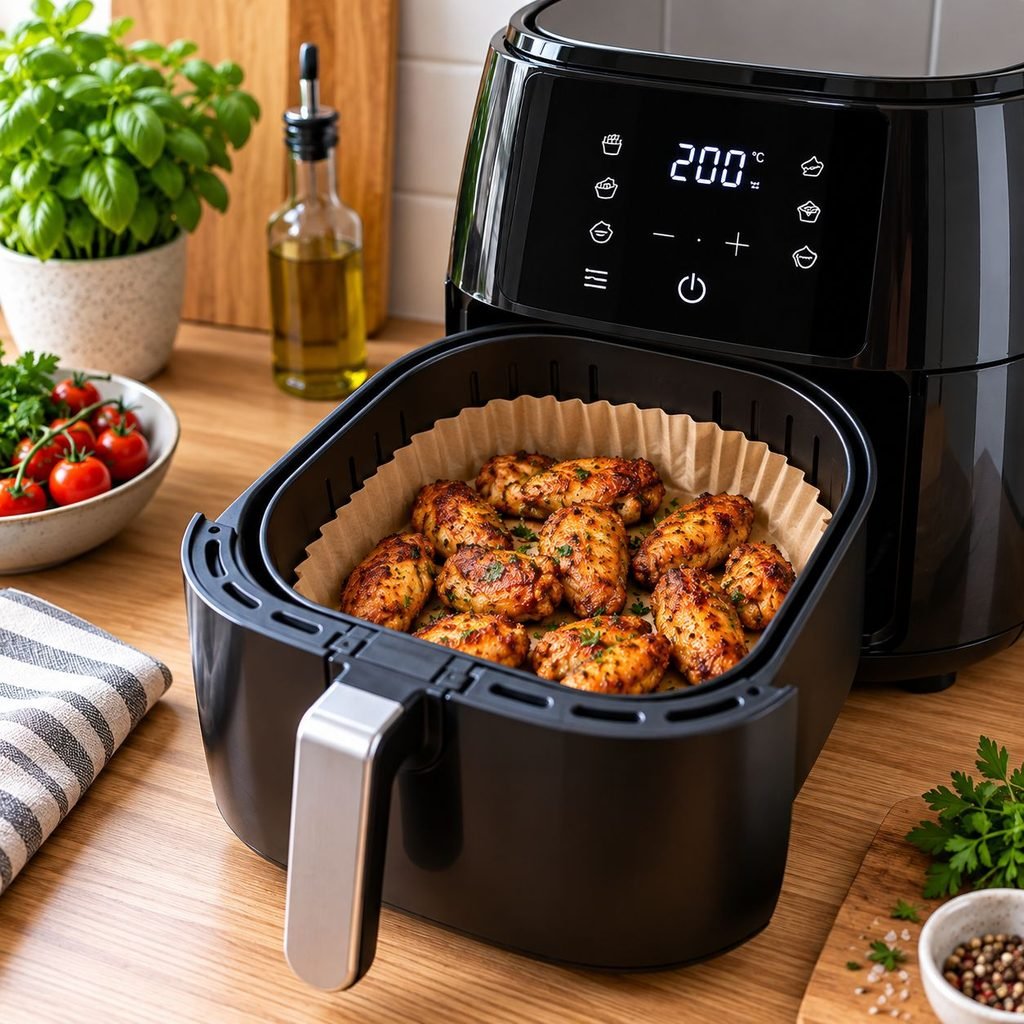
The official advice here is more cautious than many online recipes. Electrical Safety First recommends not using any type of paper in an air fryer, because paper that isn’t weighed down can lift, touch the element and catch fire. Something sold as an “air fryer liner” isn’t automatically suitable for your model either, so go by the manual. If you bake in yours, silicone moulds or tins that fit the basket are a safer bet, and our guide to the best air fryers for baking looks at which models handle that well.
The soapy-water cleaning hack
You may have seen the trick of filling the basket with water and washing-up liquid, then switching the air fryer on. Don’t. Fire services have warned against it, and Dorset and Wiltshire Fire and Rescue Service attended a serious fire in student accommodation after someone tried it.
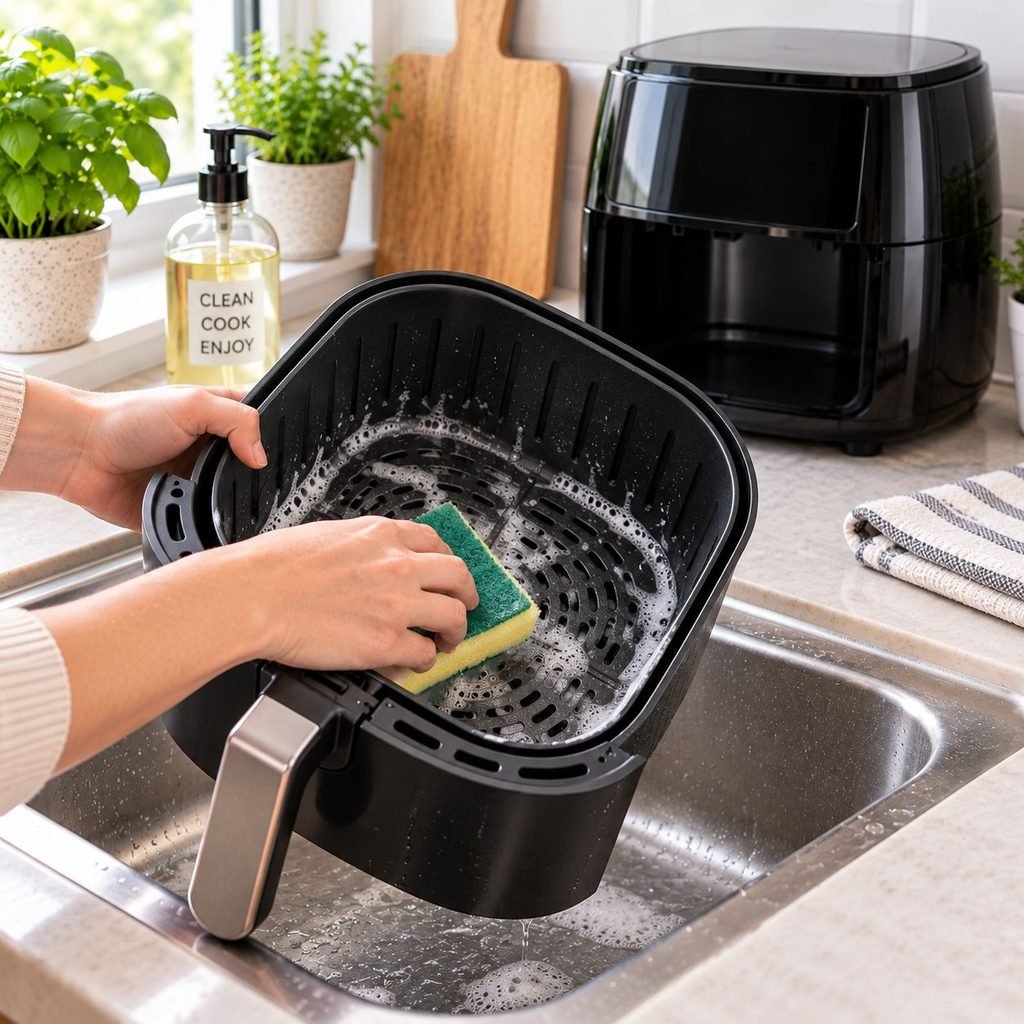
Instead, unplug the air fryer and give it at least 30 minutes to cool, as Electrical Safety First advises. Then wash only the parts the manufacturer says can go in water, and never immerse the main unit. Regular cleaning matters for fire safety too, because built-up grease can ignite.
Burns and everyday handling
Burns are easy to overlook, partly because so many parts of an air fryer get hot. The drawer and basket stay hot for a while after cooking, so hold them by the handle and set the drawer down on a heat-resistant surface. Steam can rush out when you open the drawer, especially with moist foods, so open it slowly and keep your face back.
If your basket has a removable crisper plate, check it’s secure before tipping food out, or use tongs. Outer surfaces and vents can also get warm depending on the model, even where the housing is described as cool-touch. With children around, push the air fryer well back on the worktop and keep the cable out of reach.
Is food cooked in an air fryer safe?
Very hot air doesn’t make food safe by itself. A crisp, browned outside can hide an undercooked middle, especially with thicker pieces of meat.
The Food Standards Agency advises that the centre of food should reach 70°C for two minutes (or an equivalent time and temperature combination). For poultry, pork, burgers and sausages, check that the food is steaming hot all the way through, with no pink meat and juices running clear. A food thermometer is the easiest way to be sure. Our guides to the best air fryers for meat and chicken and the best air fryers for fish cover the models that suit these foods.
The usual kitchen hygiene rules still apply. The FSA advises against washing raw chicken, because splashing water spreads bacteria such as campylobacter, while proper cooking kills them. Wash boards, utensils and surfaces after raw meat, and don’t put cooked food back on a plate that held it raw.
Crowding the basket also leads to uneven cooking. Shake or turn food partway through and cook in batches if you need to. If you’re regularly squeezing a family meal into one basket, a larger air fryer or a dual-drawer model may be a better fit. Cooking times also differ between models, so treat recipe and pack timings as a starting point.
For leftovers, the FSA advises getting cooled food into the fridge within one to two hours and eating it within 48 hours, or freezing it. Reheat it until steaming hot throughout, and only once.
Are non-stick air fryer baskets safe?
This is where online claims get most alarming, so it’s worth separating what’s known from what isn’t.
PFAS (per- and polyfluoroalkyl substances) are a large group of fluorinated chemicals, often called “forever chemicals” because they break down so slowly. The UK government’s PFAS Plan, published in February 2026, lists non-stick cookware among the everyday products where PFAS are used. PTFE, one of the most common non-stick coatings, is a fluorinated polymer and falls within broad definitions of PFAS. Other air fryer baskets use ceramic-type coatings or stainless steel, so materials vary by model.
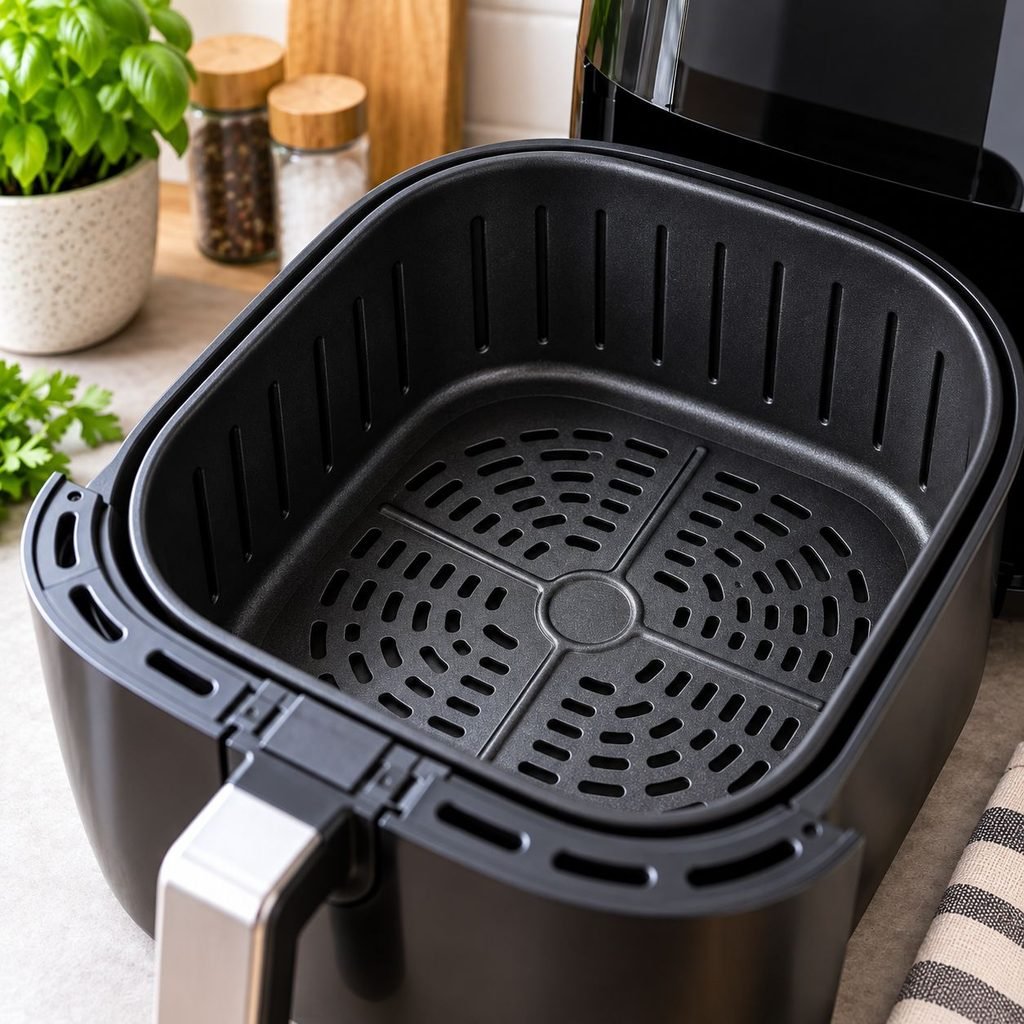
On actual exposure, the UK’s Committee on Toxicity, reviewing work by the European Food Safety Authority (EFSA), notes EFSA’s conclusion that PTFE cookware may contain very low levels of leftover PFOA and likely contributes to PFAS exposure, but that the contribution is small compared with other sources. PFOA is now restricted in Great Britain, although “PFOA-free” isn’t the same as “PFAS-free”. Regulation is still moving too: in 2026, a House of Commons committee called for restrictions on non-essential PFAS uses, including cookware, from 2027. For now, those are recommendations rather than rules.
The clearer practical concern is overheating. Badly overheated PTFE can give off fumes that cause a short-lived, flu-like illness called polymer fume fever, mostly linked to empty pans left on a high heat. Pet birds are particularly sensitive to these fumes. Air fryers run on a thermostat with a set maximum temperature, and we haven’t found UK guidance linking normal air fryer use to this illness. Evidence specific to air fryers is limited, though, so don’t run an empty coated basket for longer than your manual allows.
If the coating concerns you, the sensible steps are simple. Avoid metal utensils and abrasive scourers. Stop using a basket that’s peeling or flaking, and ask the manufacturer about a replacement. If you’d rather avoid PTFE altogether, check the manufacturer’s own specification for a ceramic-coated or stainless steel basket instead of relying on marketing labels.
Do air fryers produce acrylamide?
They can, but it isn’t an air fryer problem as such. According to the Food Standards Agency, acrylamide forms naturally when starchy foods such as potatoes and bread are cooked above 120°C, whether that’s by baking, frying, grilling, toasting or roasting. It turns up in chips, roast potatoes, toast, biscuits and coffee, among other foods.
Laboratory tests show acrylamide causes cancer in animals, and scientists agree it has the potential to do so in humans, so the FSA recommends cutting down as a precaution. Its advice is straightforward: aim for a golden yellow colour or lighter with starchy foods, follow the pack instructions for things like oven chips, and eat a balanced diet. In air fryer terms, that just means taking chips out when they’re golden, not dark brown.
Is air-fried food healthier, or safer than deep frying?
Not automatically healthier. Air frying can mean using less oil than deep frying, but homemade chips, vegetables and processed breaded snacks keep very different nutritional profiles whichever appliance cooks them.
On safety, the two carry different risks. A pan of hot oil is a well-known fire hazard, and air frying avoids that. An air fryer is still a hot electrical appliance, though, so the precautions above still apply.
Cheap, counterfeit and recalled air fryers
A low price doesn’t make an air fryer unsafe. Plenty of affordable models from established brands are properly made, and our guide to the best air fryers under £100 focuses on those. Where you buy matters more. Electrical Safety First advises sticking to reputable retailers rather than unknown third-party sellers online, whose products may not have passed the necessary safety checks.
A 2026 example shows why. In April, the Office for Product Safety and Standards (OPSS) reported on a counterfeit air fryer carrying the Silver Crest name, which was stopped at the UK border and destroyed. Its plug fuse lacked the filler needed to work safely under fault conditions, and the plug didn’t meet the British standard’s dimensions. This was a counterfeit product, not a warning about the genuine brand or budget air fryers in general.
Recalls happen with established brands too. OPSS first issued a recall for certain Tower air fryers in April 2025, extended it in July 2025 and last updated it in March 2026, because the affected units may overheat and ignite. The models listed are:
- T17023 Tower 2.2Ltr Manual Air Fryer
- T17061BLK Tower 4Ltr Manual Air Fryer
- T17067 Tower 4Ltr Digital Air Fryer
- T17087 Tower 2Ltr Compact Manual Air Fryer
- T17129L Tower Vortx 8L Air Fryer (Lidl)
- T17129 Tower Vortx 8L Air Fryer (Argos)
The affected units are black and were made between January 2022 and April 2023. If you have one of these models, stop using it, unplug it and check it on Tower’s recall website, where you can register for a refund or replacement. The recall covers these specific models only.
To check any air fryer, find the model number on its rating label and search the government’s Product Safety Alerts, Reports and Recalls database or Electrical Safety First’s recall checker. Registering a new appliance with the manufacturer means it can contact you if a problem turns up later.
When should you stop using an air fryer?
Switch it off, unplug it if it’s safe to do so, and contact the retailer or manufacturer before using it again if you notice:
- a burning smell that isn’t food, such as burning plastic
- unusual noises while it’s running
- scorch marks, or a plug or socket that feels hot
- buzzing or crackling, blown fuses or a tripping circuit breaker
- a damaged cable, plug, casing or control buttons
- water inside the main unit
- your model in a recall notice
What to do if your air fryer catches fire
If you can reach the socket safely, switch it off at the wall. Don’t throw water on it, and don’t try to fight the fire or carry the appliance outside. Get everyone out, close doors behind you if you can, and call 999.
Working smoke alarms give you the earliest warning. Electrical Safety First recommends at least one smoke or heat alarm on every floor, tested monthly.
Quick safety checklist
- Read the manual, as fill levels, clearances and cleaning vary by model.
- Buy from a reputable retailer, register the appliance and check for recalls.
- Use it on a clear worktop, never on a hob, plugged into a wall socket.
- Don’t overfill it or use loose baking paper, and stay nearby while it cooks.
- Cook meat through, and take starchy foods out at golden.
- Clean it once cool, and unplug it when you’ve finished.
Frequently asked questions
Are air fryers safe to use every day?
Yes, as long as the appliance is in good condition and used as intended. Daily use just means cleaning matters more, because grease builds up faster.
Are air fryers toxic?
That’s too broad a label. PFAS in some coatings and acrylamide in browned starchy foods are separate issues, and neither shows air fryers as a category to be toxic. Acrylamide forms with ovens, toasters and frying pans too.
Do air fryers cause cancer?
UK guidance doesn’t describe air fryers as a cause of cancer. The concern sometimes raised is acrylamide, which forms in starchy foods cooked at high temperatures by any method. Cooking to golden rather than dark brown keeps levels lower.
Should I stop using my air fryer if the coating is scratched?
Light marks aren’t unusual, but if the coating is peeling, flaking or badly damaged, stop using that basket and ask the manufacturer about a replacement.
Can I use foil in an air fryer?
Only if your manual allows it. Fire services have raised concerns about foil and loose paper. Where it’s permitted, keep it weighed down, away from the element, and don’t cover the whole base of the basket, as that blocks airflow.
Is it safe to leave an air fryer plugged in?
It’s better not to. Electrical Safety First advises unplugging it at the socket once you’ve finished cooking.
Bottom line
Air fryers aren’t a uniquely risky appliance, but they’re not risk-free either. Most problems come down to everyday habits: where the air fryer sits, what goes inside it, whether someone’s nearby and how often it’s cleaned. Get those right, cook food through, and check your model against UK recall notices, and there’s little reason for concern.
Non-stick coatings and acrylamide are worth knowing about rather than worrying about. Look after the basket, replace it if it’s damaged, and take chips out when they’re golden.


One Comment