Shark vs Dyson Vacuum Cleaners: Which Is Better in the UK? (2026)
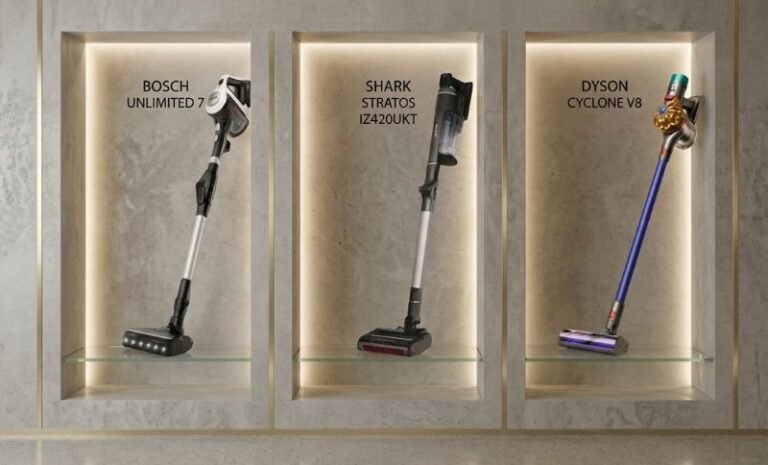
In any Shark vs Dyson vacuum comparison, the first thing to know is that the two brands take noticeably different approaches to cordless cleaning. Dyson puts more emphasis on suction engineering, dust detection, low weight and detailed on-machine feedback. Shark focuses on practical features: flexible wands for reaching under furniture, anti-hair-wrap floorheads, automatic floor and dirt detection and, on some models, self-emptying docks.
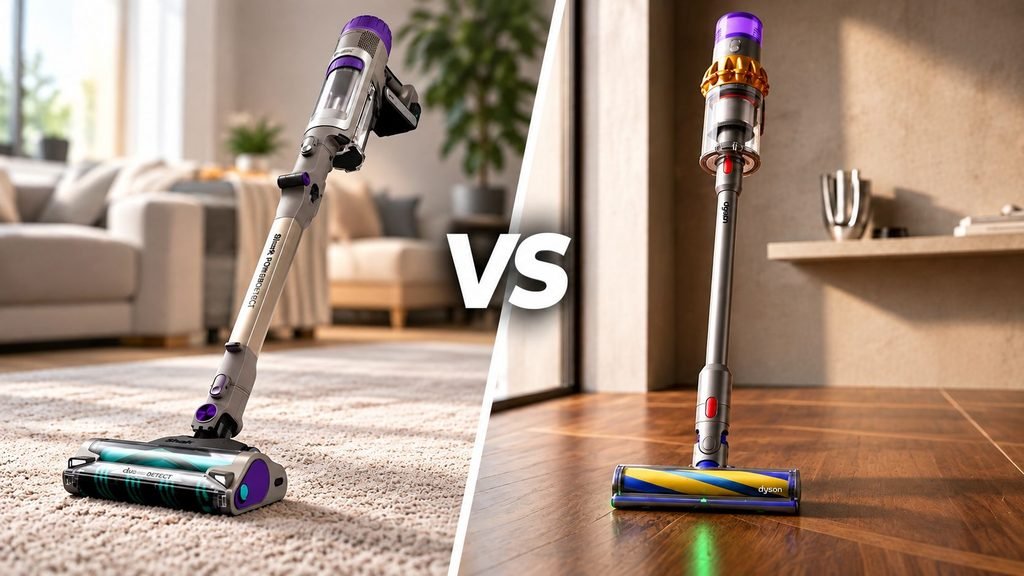
That makes the Shark vs Dyson question less straightforward than it first looks, and 2026 has blurred the lines further. Dyson now sells a self-emptying dock in the UK, and Shark has added a dust-revealing light to its newest PowerDetect. This guide compares the current UK cordless ranges model by model, so you can work out whether a Shark or Dyson vacuum cleaner suits your home. Specifications come from Shark and Dyson UK, with independent testing used where real-world performance matters.
Shark vs Dyson Vacuum Cleaners: the short answer
Dyson gives you information. Shark reduces the need to intervene. That’s the simplest way to sum up the difference.
Dyson makes the stronger case if you want a light machine, high stated suction and live feedback on how much dust you’re picking up. The V12 Detect Slim weighs around 2.4kg, the V15 Detect is still a strong all-rounder, and the V16 Piston Animal tops the range at 315AW. The new V10 Konical can be bought with Dyson’s first Auto-empty Dok.
Shark suits people who want the vacuum to adapt by itself. PowerDetect models adjust to the floor and the dirt as you go, the bendable wand gets under beds and sofas without you crouching, and there are two self-emptying PowerDetect models to choose from. Every Shark in this guide also has a five-year guarantee when registered (two years on the battery), against Dyson’s two years.
Which suits your home?
If you already know what matters most in your home, start here.
| Household / priority | Better fit | Why |
|---|---|---|
| Mostly hard floors | Dyson | V15 and V12 Absolute bundles include the Fluffy Optic soft roller with dust illumination. Shark’s PowerDetect Speed reveals dust too, but has no dedicated soft roller. |
| Mixed hard floors and carpets | Shark | PowerDetect senses floor type and adjusts itself with one main head fitted. |
| Low furniture | Shark | The bendable wand reaches under beds and sofas while you stay upright. |
| Lightweight cleaning and stairs | Dyson | The V12 Detect Slim weighs around 2.4kg and the V10 Konical 2.65kg. |
| Large bin without a separate dock | Dyson | The V16 has a 1.3L bin that compacts debris. |
| Hands-off emptying | Shark, narrowly | Two Clean & Empty models to choose from. Dyson’s Auto-empty Dok holds more, but only works with the V10 Konical and V8 Cyclone. |
| Pet hair and long hair | Either | Compare the main head and the pet tool in the box: Anti Hair Wrap Plus on Shark, conical brush bars on the V16 and V10 Konical. |
| Long cleaning sessions | Shark | The Stratos IZ420UKT comes with two batteries for up to 120 minutes combined. |
| Longer guarantee | Shark | Five years when registered, with two years on the battery. |
| Detailed cleaning feedback | Dyson | Detect models show live particle counts on an LCD screen. |
Shark vs Dyson Vacuum Cleaners at a glance
| Area | Shark | Dyson |
|---|---|---|
| Under-furniture design | Bendable Flexology wand on every Shark here | Rigid wand |
| Hair management | Anti Hair Wrap Plus on PowerDetect and Stratos; Anti Hair Wrap on PowerPro | Conical heads on V16 and V10 Konical; de-tangling Motorbar heads on V15 and V12 |
| Dust illumination | Reveal light on PowerDetect Speed; LED headlights on Stratos | Fluffy Optic head in V15 and V12 Absolute bundles; built-in light on V16 and V10 Konical heads |
| Self-emptying | PowerDetect Clean & Empty and PowerDetect Speed Clean & Empty | V10 Konical with optional Auto-empty Dok |
| Two batteries in the box | Stratos IZ420UKT | None here; V15 and V10 Konical have swappable batteries, spares sold separately |
| Power figure published | Electrical watts (380W on PowerDetect IP1251UKT) | Air Watts (315AW on V16) |
| Guarantee | 5 years when registered; battery 2 years | 2 years, parts and labour |
Don’t read the power row as a contest. Watts measure the electricity going in, while Air Watts relate to suction at the cleaner, so 380W and 315AW can’t be compared. Even within Dyson’s range, more Air Watts doesn’t guarantee better pickup. Floorhead design, brush agitation, the floor itself and the type of debris all play a part.
Shark vs Dyson Vacuum Cleaners compared
These are the current UK models to compare. Many older comparisons still pit the V15 against the Stratos, but the V16, V10 Konical and PowerDetect range now give a truer picture of 2026.
| Model | Listed weight | Bin | Max runtime* | Self-emptying | Best for |
|---|---|---|---|---|---|
| Shark PowerDetect IP1251UKT | 3.71kg | 0.7L | 70 min | No | Mixed floors and low furniture |
| Shark PowerDetect Clean & Empty IP3251UKT | 3.71kg | 0.7L | 70 min | Yes, base holds up to 45 days | Busy homes that want self-emptying |
| Shark PowerDetect Speed Clean & Empty IA3241UKT | Not listed | 0.47L | 60 min | Yes, base holds up to 45 days | Hard floors plus self-emptying |
| Shark Stratos IZ420UKT | Not listed | 0.57L | 120 min (two batteries) | No | Larger homes, long sessions |
| Shark PowerPro Pet IZ380UKT | 3.45kg | 0.38L | 50 min | No | Shark’s essentials for less |
| Dyson V16 Piston Animal | 3.4kg | 1.3L (compacting) | 70 min | No | Top suction, big bin, long hair |
| Dyson V15 Detect | 3.1kg | 0.77L | 60 min | No | Premium all-rounder |
| Dyson V12 Detect Slim | About 2.4kg | 0.35L | 60 min | No | Stairs, flats, quick cleans |
| Dyson V10 Konical | 2.65kg | 0.5L | 60 min | Optional Dok, up to 60 days | Self-emptying Dyson, lighter build |
*Maximum runtimes are manufacturer figures in the lowest power mode, usually with a non-motorised tool. Expect much less on Boost with a powered floorhead.
Which is better on carpets?
Dyson has a strong case on carpets, especially with the V15 Detect. Its Digital Motorbar head combines powered brushing with automatic suction adjustment, and it has a good record in independent carpet tests. The V16 has far more stated suction, but its new dual-cone head means those extra Air Watts don’t automatically translate into better carpet pickup.
Shark’s PowerDetect handles carpets differently, sensing the floor and the dirt level and adjusting as you clean. In independent testing, the PowerDetect Clean & Empty picked up almost all of a fine-dust test on carpet. Results will vary with pile and debris. The bendable wand helps in carpeted bedrooms too, since the head goes under the bed without a tool change.
For deep carpet cleaning, the V15 and PowerDetect are the two to compare.
Which is better on hard floors?
This is where Dyson’s Fluffy Optic head earns its reputation. The soft roller is designed for hard surfaces, and its angled light shows up fine dust you’d otherwise miss in a kitchen or hallway. It comes with V15 and V12 Absolute bundles, but not with the standard V16, which relies on its all-floor cones head with a built-in light.
If your home is mostly hard flooring, look closely at that cones head. At least one independent review found its pointed front awkward to push into edges, and messier than older Dyson heads with larger debris such as oats on tiles.
Shark keeps one head on for everything. PowerDetect adjusts to the floor underneath it, and EdgeDetect boosts suction near skirting boards, which suits homes with a mix of flooring and rugs. The PowerDetect Speed now adds a cyan Reveal light to show dust on hard floors, though it doesn’t have a separate soft roller.
Want to wash hard floors as well? Dyson sells a Submarine wet-and-dry version of the V16 Piston Animal, and our guide to the best wet and dry vacuum cleaners covers the alternatives.
Pet hair and long hair
The old idea that Shark is the anti-tangle brand and Dyson just does suction is out of date. Both now take hair seriously.
Shark’s PowerDetect and Stratos use Anti Hair Wrap Plus, with bristles and combs that pull hair off the brush-roll as you clean. The PowerDetect Clean & Empty cleared pet hair well in independent testing. Dyson’s V16 and V10 Konical use two conical brush bars that spiral long hair off the brush and into the bin, and the Hair screw tool does the same job on sofas, stairs and pet beds.
For pet owners, the small motorised tool often matters as much as the main floorhead. Bundles vary between versions and retailers, so check exactly what’s in the box before you buy.
Weight and manoeuvrability
Dyson offers more choice here. The V16 weighs 3.4kg and the V15 3.1kg, while the V10 Konical comes in at 2.65kg and the V12 Detect Slim at around 2.4kg. If you clean stairs often or find a heavy cordless tiring, the V12 and Konical are the ones to look at.
The Shark PowerDetect IP1251UKT is listed at 3.71kg and the PowerPro Pet at 3.45kg, so on paper both are heavier than every Dyson here. Weights aren’t always measured the same way, but the gap is real. Shark’s newer PowerDetect Speed is a slimmer, more compact design. The flexible wand also offsets some of the weight, because you’re not bending down to reach under furniture. If weight is your main concern, our guide to the best lightweight vacuum cleaners has more options across brands.
Battery life: read the small print
Headline runtimes are easy to misread. Shark rates the PowerDetect IP1251UKT at up to 70 minutes, and Dyson rates the V16 at up to 70 minutes too. Both figures are in Eco mode with a non-motorised tool. The V15, V12 Detect Slim and V10 Konical are rated at up to 60 minutes on Dyson’s lowest setting.
Real cleaning with a powered floorhead uses far more power. Independent tests of models from both brands have recorded Boost-mode runtimes well under 20 minutes.
The Stratos IZ420UKT is the exception. It comes with two removable batteries and a dual charger, for up to 120 minutes combined. The PowerDetect, V15 and V10 Konical also have removable batteries, so a spare is an option later. In the long run, whether you can still buy a replacement battery matters more than a ten-minute difference in stated runtime.
If runtime is a real worry for a large house, a corded vacuum might suit you better. Our corded vs cordless vacuum cleaner guide covers the trade-offs.
Bin size and self-emptying
The V16 changes things for Dyson. Its 1.3L bin is much bigger than the V15’s 0.77L or the V12’s 0.35L, and its CleanCompaktor system squashes debris down. Dyson says it holds up to 30 days’ worth of dust under its test conditions. The PowerDetect IP1251UKT’s 0.7L cup is similar to the V15’s.
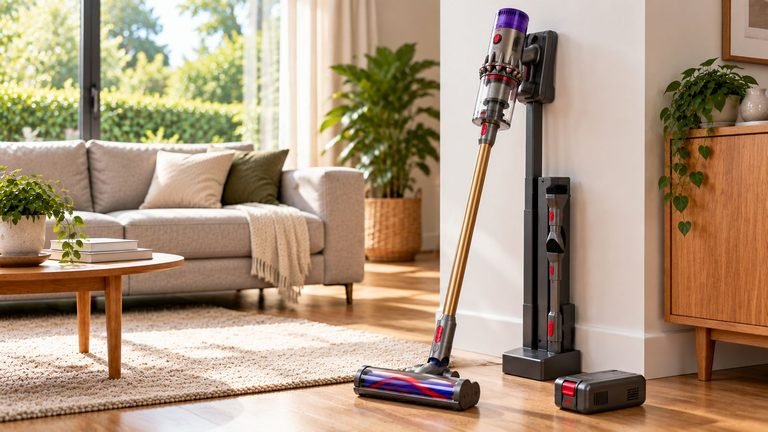
Self-emptying is no longer Shark-only. Both PowerDetect Clean & Empty models tip their dust cup into the base after each clean, and Shark says the base holds up to 45 days of debris. Dyson’s Auto-empty Dok, sold with the V10 Konical, holds 2.5L, which Dyson puts at up to 60 days. It only works with the V10 Konical and V8 Cyclone, though, so you can’t add one to a V15 or V16 later.
Any self-emptying base takes up floor space, and Dyson’s Dok stands around 1.2m tall. A small flat may be better off with a wall dock. The IP3251UKT’s base is bagless, while Dyson’s Dok collects dust in a sealed liner, so check what replacement liners cost.
Filtration and allergies
The two brands describe filtration differently, so the numbers aren’t like-for-like. Dyson quotes particle sizes: the V16 and V10 Konical are rated to capture 99.99% of particles down to 0.1 microns, and the V15’s whole-machine HEPA filtration 99.99% down to 0.3 microns. Shark’s Anti-Allergen Complete Seal is rated to trap 99.9% of dust and allergens on models including the Stratos, PowerPro Pet and PowerDetect Clean & Empty, while the PowerDetect Speed is quoted at up to 99.97% of allergens.
For allergy sufferers, a sealed machine, clean filters and careful emptying matter more than the word ‘HEPA’. A self-emptying base means you handle the dust cup less often, though the base still needs emptying.
Guarantee and long-term costs
This is one of the clearest differences. Shark lists a five-year guarantee on every model in this guide, as long as you register it with Shark. The battery gets two years. Dyson gives two years, parts and labour.
Five years isn’t blanket cover. The battery is one of the parts most likely to wear, and it has the same two years as Dyson. Both brands sell replacement batteries, filters and tools in the UK, but availability thins out as models age. Self-emptying models add their own upkeep, from cleaning the base to buying Dyson’s Dok liners.
Which Shark should you consider?
Shark PowerDetect IP1251UKT
The best starting point for a Shark vs Dyson comparison. Four sensors (DirtDetect, FloorDetect, EdgeDetect and DirectionDetect) let the DuoClean Detect head adjust itself, and it picks up when you pull it backwards as well as pushing forwards. You also get Anti Hair Wrap Plus, the bendable wand, a 0.7L cup and a motorised pet tool in the UK box. Choose it if you want Shark’s full sensing without a self-emptying base.
Shark PowerDetect Clean & Empty IP3251UKT
The same PowerDetect vacuum and 70-minute rating, plus a 2L bagless base that empties the dust cup after each clean. It adds Anti-Allergen Complete Seal. It’s worth the extra if emptying a small cup every day is the job you’d most like to lose, and you have floor space for the base.
Shark PowerDetect Speed Clean & Empty Pet Pro IA3241UKT
Launched in spring 2026, this is a slimmer take on the Clean & Empty idea. It keeps the four Detect sensors, the bendable wand and anti-hair-wrap design, and adds Reveal, a cyan light on the floorhead that shows fine dust on hard floors. The trade-offs are a 60-minute rating instead of 70 and a smaller 0.47L cup. It’s Shark’s most direct rival to the V10 Konical with Dok.
Shark Stratos IZ420UKT
An older design, but still the one to pick for long cleaning sessions. It comes with two removable batteries for up to 120 minutes combined, along with Anti Hair Wrap Plus, Clean Sense IQ dirt detection, anti-odour technology, LED headlights, the bendable wand and a pet tool. Its sensing isn’t as advanced as PowerDetect’s.
Shark PowerPro Pet IZ380UKT
The budget route into Shark’s practical features. You get FloorDetect, Anti Hair Wrap, the bendable wand and a FurFins pet tool, with up to 50 minutes of runtime and a 0.38L cup. It weighs 3.45kg. It lacks PowerDetect’s wider set of sensors, but covers the essentials.
Which Dyson should you consider?
Dyson V16 Piston Animal
Dyson’s current flagship, with 315AW of stated suction, up to 70 minutes of runtime and a 1.3L compacting bin. Its All Floor Cones Sense head moves long hair into the bin and has a built-in light for spotting dust. The standard box doesn’t include a Fluffy Optic head, and older Dysons often cost much less, so buy it for the bin and the hair handling rather than the headline power.
Dyson V15 Detect
Still one of the most balanced cordless vacuums Dyson makes. It weighs 3.1kg, has a 0.77L bin, 240AW and up to 60 minutes, plus dust detection, an LCD screen, whole-machine HEPA filtration and click-in swappable batteries. With the Fluffy Optic head in the box, it’s the Dyson to beat in a home with plenty of hard flooring, especially when it’s discounted well below the V16.
Dyson V12 Detect Slim
The lightest Dyson here at around 2.4kg, and it keeps dust detection, the LCD screen and up to 60 minutes of runtime. The 0.35L bin and 150AW are the price you pay for the smaller build. For flats, stairs and quick daily cleans, that’s often the right trade.
Dyson V10 Konical + Auto-empty Dok
Dyson’s newest mid-range model, and the one it sells with its first self-emptying dock. The vacuum weighs 2.65kg, with a 0.5L bin, 150AW and up to 60 minutes of runtime. The conical brush bars de-tangle long hair, and the head has a dust light. The Dok holds up to 60 days of dust, but it’s tall and only fits the Konical and V8 Cyclone. You can buy the Konical with or without it.
What about the Gen5detect?
It was Dyson’s filtration flagship, but at 3.5kg it’s the heaviest Dyson here, and the V16 now matches its headline filtration claim with more suction and a bigger bin. Only consider it at a big discount.
Price and value
Shark and Dyson both discount so often that list prices say little. Compare what you get at the current price instead: the cleaner heads, the tools, the battery set-up and whether there’s a dock.
A discounted V15 can be better value than a V16 if you don’t need the bigger bin. A Clean & Empty Shark only makes sense if you’ll actually use the base, and the same goes for the V10 Konical’s Dok. If your budget tops out around £300, our guide to the best cordless vacuum cleaners under £300 covers what’s worth buying at that level.
Shark vs Dyson: which should you buy?
Choose Dyson if
- low weight matters most (V12 Detect Slim or V10 Konical)
- your home is mostly hard floors and you want a soft roller with dust illumination (a V15 or V12 bundle with the Fluffy Optic head)
- you want the largest bin without a separate dock (V16)
- you like seeing live dust counts on screen (Detect models)
Choose Shark if
- you regularly clean under low beds and sofas (bendable wand)
- you want the vacuum to adjust itself across mixed floors (PowerDetect)
- you want a choice of self-emptying models (PowerDetect Clean & Empty or PowerDetect Speed)
- you’d like two batteries in the box (Stratos) or a five-year guarantee
Don’t pick a Shark vs Dyson vacuum cleaner on the badge alone. A discounted V15 and a PowerDetect solve different problems, and a lightweight V12 or a self-emptying Shark or Konical is aimed at a different buyer again. Start with your floors, how much hair you deal with, how often you do the stairs, and whether lower weight or less effort matters more to you.
Open to other brands? Our guide to the best cordless vacuum cleaners in the UK compares a wider shortlist.
Frequently asked questions
Is Dyson more powerful than Shark?
You can’t tell from the specs. Dyson publishes Air Watts (up to 315AW on the V16), while Shark’s UK pages list electrical watts instead (380W on the PowerDetect IP1251UKT). The two measures aren’t comparable, and more suction doesn’t guarantee better pickup on every floor.
Does Dyson make a self-emptying cordless vacuum?
Yes. The V10 Konical can be bought with Dyson’s Auto-empty Dok, which Dyson says holds up to 60 days of dust. It only works with the V10 Konical and V8 Cyclone. Shark has two self-emptying PowerDetect models in the UK.
Is Shark better than Dyson for pet hair?
Not across the board. Shark uses Anti Hair Wrap Plus, while Dyson’s V16 and V10 Konical use conical brush bars. Both work, so compare the floorhead and the pet tool included with the exact model.
Which has the better guarantee in the UK?
Shark: five years on the models here when registered, with two years on the battery. Dyson gives two years, parts and labour. Check the terms for the exact model before buying.
Is a Dyson worth the extra money?
It can be if you value lighter machines, the Fluffy Optic hard-floor head and on-screen dust feedback. Shark may be better value if you want the bendable wand, automatic adjustment, a choice of self-emptying models or the longer guarantee. Compare actual models at their current prices rather than assuming the dearer one is better.