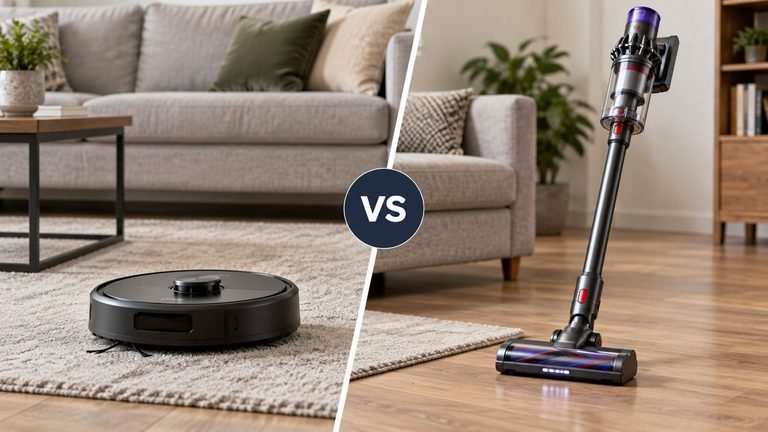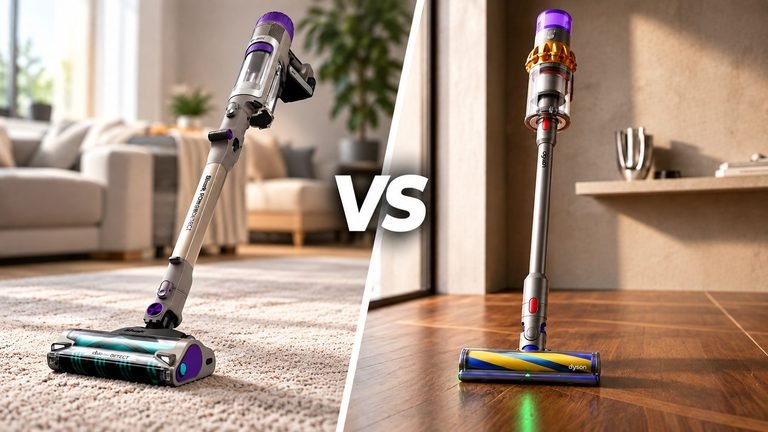
Corded vs Cordless Vacuum Cleaners: Which Should You Buy?
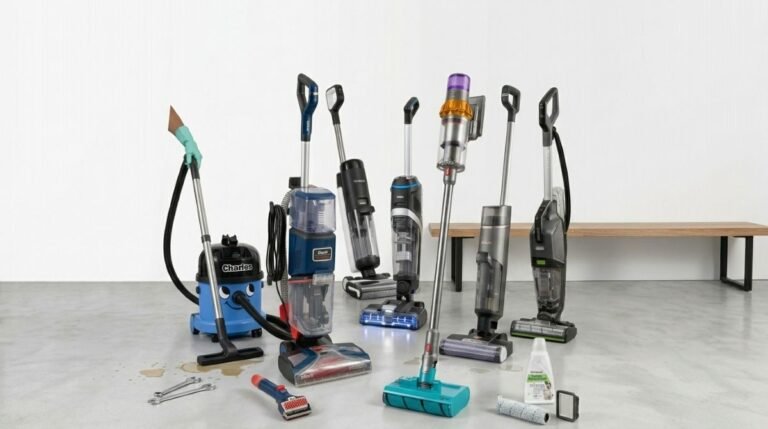
Walk into any UK electrical retailer and the cordless sticks are the ones on the plinths by the door. Corded uprights and cylinders are still there, usually further down the aisle and usually cheaper. That layout tells you where the market has gone. It doesn’t tell you which type suits your home.
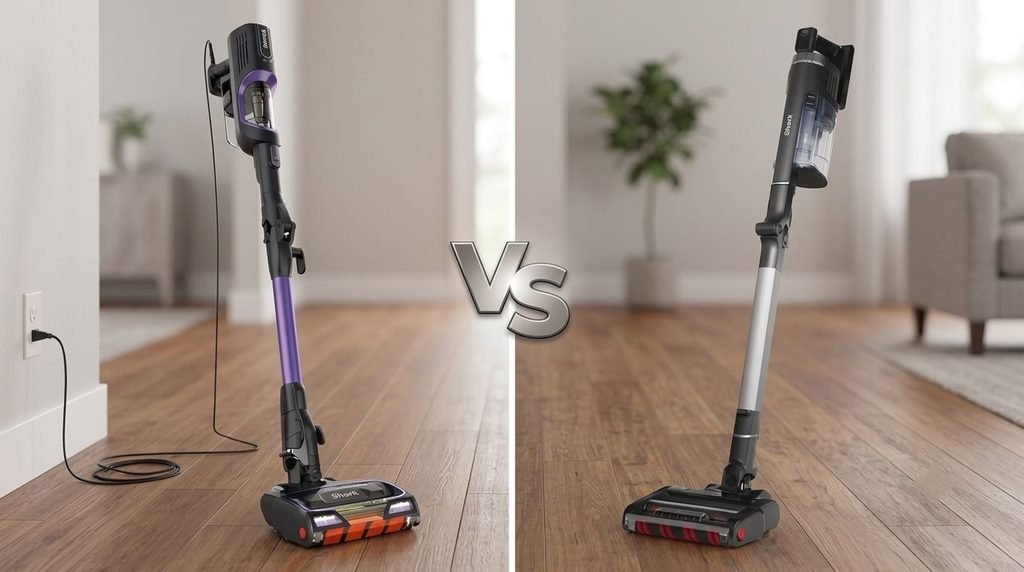
The short version: a good cordless vacuum is the easier machine to live with, and in a flat or an average-sized house it’s now capable enough to be the only vacuum you own. A corded vacuum is the safer bet if you have a lot of carpet, a lot of floor to cover, or the habit of doing the whole house in one go. It’ll also cost you less for the same standard of cleaning.
We’ve taken the comparison job by job below: carpets, hard floors, stairs, cars, pet hair, runtime and what each type costs to keep running. Use the table to jump straight to whichever part matters most to you.
Corded vs cordless vacuum at a glance
Tap any row to jump to that section.
| What you’re comparing | Corded | Cordless | Better bet |
|---|---|---|---|
| Carpet cleaning | Stronger on average | Best models are excellent | Corded |
| Hard floors | Excellent | Excellent | Line ball |
| Cleaning time | Unlimited | Limited by battery | Corded |
| Weight and handling | Heavier, but floor-supported | Lighter, hand-carried | Cordless |
| Dust capacity | Typically 2 litres or more | Typically around 0.7 litres | Corded |
| Stairs | Workable, awkward | Easy, often handheld | Cordless |
| Cars and upholstery | Needs a socket or extension | Converts to handheld | Cordless |
| Pet hair | Long sessions, big bin | Frequent quick passes | Depends on the home |
| Large homes | Built for it | Needs a strong model | Corded |
| Price for performance | Capable from around £100 | Best models cost a lot more | Corded |
| Long-term costs | Bags and filters | Bags, filters and a battery | Corded |
| Long-term reliability | Fewer parts to fail | Battery is the weak point | Corded |
What actually changes when you cut the cable
The power source is the obvious difference. Almost everything else follows from it.
A corded vacuum draws from the mains for as long as you leave it plugged in, so nothing about the way you clean is rationed. Upright and cylinder bodies also have the room for a bigger bin or bag, and the motor never has to justify its power draw against a battery. That’s why the format holds up so well at prices where cordless machines start making visible compromises.
A cordless vacuum carries its energy in a lithium-ion pack. Losing the cable makes the machine far easier to move around: up the stairs, out to the car, from room to room without hunting for a socket. What you give up is a finite runtime, a smaller bin on most models, and one more component that ages.
It’s also why the suction figure on the box tells you so little. Floorhead design, brush agitation, how well the machine is sealed and whether it holds its pickup as the bin fills all matter more than a headline wattage or air-watt number.
Which one actually cleans better?
Corded still has the better record overall, and carpet is where the gap shows. It’s narrower and messier than the old assumption that battery vacuums just lack suction, though.
A mains motor never has to ration power. It can hold full airflow behind the brush bar for as long as you keep cleaning, and that’s what lifts embedded grit out of the pile instead of skimming the surface. Most of the shortfall on the cordless side sits at the cheap end of the market, where small batteries and unpowered floorheads are still the norm.
Which is why the word “cordless” tells you less than the price tag does. A £120 supermarket stick and a £600 flagship both qualify, and they have almost nothing else in common.
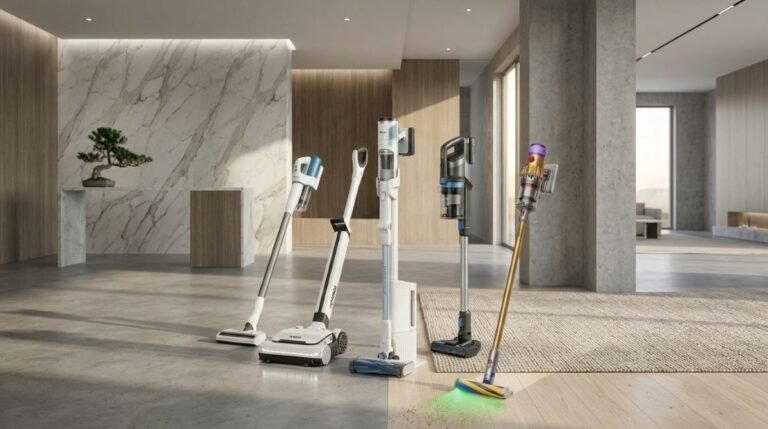
So judge the machine, not the format. On a modest budget with a lot of carpet, corded is the lower-risk purchase. Spend properly on a well-reviewed cordless, the sort of model in our guide to the best cordless vacuum cleaners, and the trade-off largely goes away.
Winner: corded overall, but a good cordless closes most of the gap.
Carpets
Carpet is where corded makes its strongest case. Lifting fine grit out of the pile is a different job from sweeping crumbs off a surface: it needs a properly driven brush bar, real airflow behind it and performance that doesn’t sag halfway through the session.
The advantage compounds in a big carpeted house, too, where you may well want to keep going for longer than a battery will hold its most powerful setting.
Premium cordless machines can do very well here. Powered floorheads, automatic suction adjustment and anti-tangle brush bars have all improved a great deal in the past few years. You just have to choose more carefully. “Cordless” on the box is no promise of carpet performance, in the way it more or less is on hard floors.
One thing no vacuum of either type will fix: if the carpet itself is the problem — traffic lanes, old stains, pet accidents — that’s a job for a carpet cleaner, not better suction.
Winner: corded.
Hard floors
On laminate, tile and engineered wood, the difference all but disappears. A hard floor doesn’t hide dust the way a carpet pile does, so raw airflow counts for much less than the head sweeping across it, and modern cordless floorheads are very good at that job.
What matters here is the head, not the cable. Soft rollers deal well with fine dust and larger debris at the same time, while combination heads let you cross from a kitchen floor onto a rug without stopping to swap anything.
Cordless also picks up a practical edge that never shows in lab results. Hard floors show crumbs immediately and tend to need short, frequent attention, and a vacuum you can grab for ninety seconds after breakfast beats one you have to unwind and plug in first.
Winner: level on cleaning, cordless on convenience.
Battery life: the compromise that matters most
Runtime is the specification that separates the two formats most honestly. Corded machines don’t have one. Cordless machines have several, and the number printed on the box is usually the least useful of them.
Most cordless vacuums quote somewhere around 30 to 45 minutes on their longer-lasting settings, with premium models claiming an hour or more in eco mode. Switch to maximum power, which is exactly the mode you want for ground-in carpet dirt, and that figure can collapse to a small fraction of the headline.
The number worth hunting for is the runtime quoted with the powered floorhead attached, in the mode you’d realistically use. A motorised head draws from the same battery as the motor, so a machine advertised at an hour can leave you with only a few minutes of full-power cleaning.
Removable batteries take some of the sting out of this. A second genuine pack effectively doubles your session and makes eventual replacement painless. It’s rarely cheap, though, so treat it as part of the purchase price and not an upgrade you’ll get round to later.
Winner: corded, and it isn’t close.
Weight and manoeuvrability
Cordless wins here, although the quoted weights need a little interpreting.
Most cordless sticks land somewhere around 3kg. Most uprights and cylinders are nearer 7kg, and some are heavier again. That gap explains a lot about why stick vacuums get used more often. Stairs, quick jobs and carrying a cleaner between floors all stop being an event.
A low figure on the spec sheet doesn’t guarantee an easy machine, though. Stick vacuums put the motor, bin and battery up by your hand, so you carry most of that 3kg rather than push it. A 7kg upright can feel less demanding across a large carpet, because the floor is taking the load. Where cordless is unbeatable is anything above floor level: stairs, skirting boards, high corners, the tops of wardrobes.
Winner: cordless.
Dust capacity and emptying
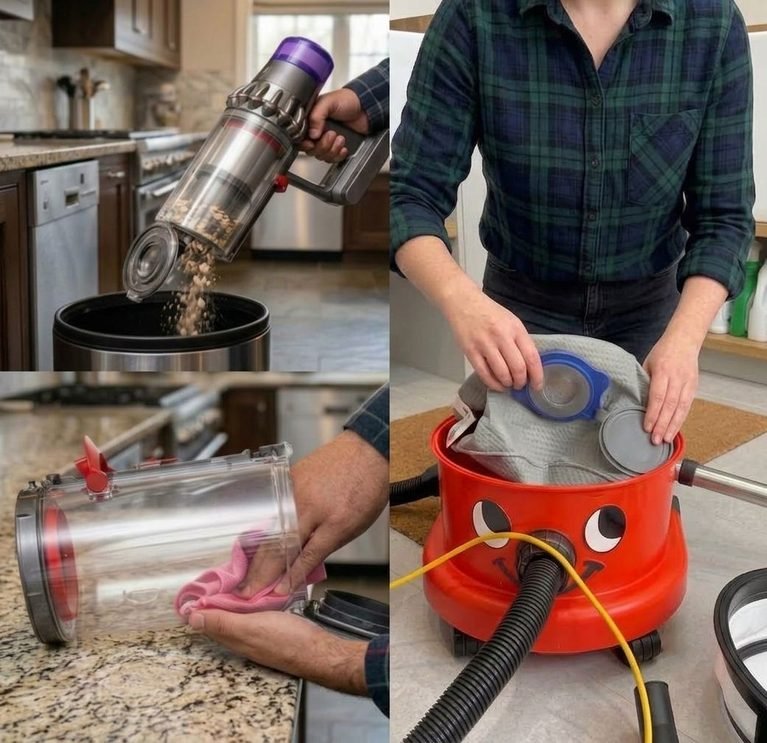
This is the difference nobody weighs up in the shop and everybody notices at home. Cordless bins typically hold somewhere around 0.7 litres. Corded machines usually hold two litres or more, and bagged cylinders often a good deal more than that.
In a flat vacuumed twice a week, 0.7 litres is perfectly fine. In a four-bedroom house with a shedding dog, you’ll be emptying mid-clean, and every emptying is another moment of handling dust you’ve just collected. That’s worth thinking about if anyone in the house has allergies.
Bagged corded cylinders are the strongest option if you’d rather seal the dust in and bin it without ever seeing it. Bagless corded uprights still give you far more room than a slim stick. There are exceptions on the cordless side — auto-empty docks, and bagged designs such as Numatic’s cordless Henry — but they cost more and take up the floor space the format was meant to save you.
Winner: corded.
Stairs
Cordless, comfortably. There’s no cable to drape down the staircase, no socket to find at the right height, and on models that break down to handheld you’re carrying a couple of kilos instead of wrestling a body and hose into position.
Corded machines can clean stairs perfectly well. A cylinder with a long hose, or an upright with a lift-away canister, will do a proper job. The difference is effort, not capability, and effort usually decides whether the stairs get done at all.
If the staircase is the job you keep putting off, that’s not a minor convenience. It’s the whole argument for cordless in a single place.
Winner: cordless.
Cars and upholstery
Cordless again. Most stick vacuums convert to handheld and take crevice, dusting or mini motorised tools, and you can walk out to the driveway without threading an extension lead through the front door.
For upholstery, pet beds and car seats, the tools matter more than the power source. A mini powered brush will pull embedded hair out of fabric that a plain suction nozzle glides straight over. Check what’s in the box, because these are the accessories manufacturers most often hold back for the pricier model in a range.
A corded cylinder with a long hose is excellent indoors and will reach a car parked close to the house. If car cleaning is a real part of your routine, though, cordless is the one that gets used. Worth adding that neither is built for liquid: if you deal with spills, muddy boots or a leaking appliance as often as dust, a wet and dry vacuum is a different tool for a different problem.
Winner: cordless.
Pet hair
There’s no clean answer here, because pet hair isn’t one job. It’s hair worked deep into carpet pile, hair sitting on top of a sofa, and hair drifting across a kitchen floor, and those three reward different machines.
Corded suits carpet-heavy homes with more than one animal: continuous power for long sessions, and a bin or bag big enough to survive them. Cordless suits the other half of pet ownership: the two-minute pass over the sofa and the hallway before it builds into a proper job.
Whichever you choose, look for a powered floorhead, an anti-tangle system if you have a long-haired breed, and a mini motorised tool for furniture. Filtration deserves attention too, along with how cleanly the bin empties. A bin that fires half its contents back at you undoes some of the work.
For a heavily carpeted house with several shedding animals, we’d lean corded. For daily maintenance across mixed flooring and furniture, a strong cordless earns its keep.
Large homes
Corded is the lower-risk choice for a big house, mainly because it removes two things you’d otherwise have to manage: charge level and bin space. You can start upstairs and finish in the hall without either becoming a decision.
Cordless can work, but the conditions are specific: long real-world runtime with the powered head attached, a removable battery, and ideally a second pack in the box. That’s a meaningful extra cost on top of an already expensive machine.
Habits count as much as square footage. A large house cleaned room by room across the week sits comfortably within cordless territory. A large house done top to bottom on a Saturday morning does not.
Winner: corded for whole-house sessions.
Price and value
Corded still offers more cleaning per pound. Genuinely effective corded machines start around the £100 mark, while the cordless models worth recommending sit a long way above that.
That doesn’t make expensive cordless machines poor value. If the portability means you vacuum three times a week instead of once, do the stairs without dreading them and no longer need a separate handheld for the car, the premium is buying you something real.
The mistake is paying for cordless technology when your priorities point the other way. If what you want is long carpet sessions and a big bin, a straightforward corded machine gives you more of both for less money, and the difference goes into a better floorhead instead of a battery.
Winner: corded.
Running costs over five years
Electricity won’t decide this for you. Vacuums run in short bursts compared with anything that heats water or air, and the difference between two machines over a year is small enough to ignore next to the purchase price.
The cordless battery is the real ownership cost. Lithium-ion packs are consumables: capacity fades with age, heat and charge cycles, and a replacement is a realistic expense somewhere in a long ownership period. Prices vary enormously between brands, and so does how easy the pack is to get at in the first place.
Corded machines swap that for consumables of their own. A bagged cylinder used weekly gets through bags steadily, and both formats need filters washing or replacing. A bagless machine with washable filters can go years with almost no routine spending at all.
A fair five-year comparison covers filters, bags, replacement batteries where relevant and wear items like brush rolls, not pence per hour of electricity. And a cheap-to-run vacuum that’s annoying enough to stay in the cupboard isn’t cheap at all.
Where longevity matters, we give extra credit to cordless models with user-replaceable batteries and spare parts you can still buy in three years’ time.
Reliability and long-term ownership
Corded machines are simpler in one respect that counts: there is no battery or charging circuit to degrade. Owners tend to bear that out. The fault that retires a cordless vacuum early is overwhelmingly a battery that no longer holds charge, rather than a motor that has given up.
It’s not a guarantee. Motors, switches, hoses, cables and brush heads all fail, and how a manufacturer handles spares and repairs matters more than the format does. Some corded machines are effectively disposable; some cordless ones are supported for a decade.
For cordless, the question to answer before you pay is whether the battery is user-replaceable. A vacuum with a healthy motor and a dead sealed battery is a difficult object to do anything useful with. A replaceable pack turns the same problem into a spare-part order.
Whichever you buy, Electrical Safety First’s advice is worth following: buy from a reputable retailer, register the appliance so you hear about any recall, and use only batteries and chargers the manufacturer has verified for that product. Cut-price third-party packs are a common false economy.
The case for a corded vacuum
Corded vacuums are the unglamorous option and they know it. What they offer is consistency: the same performance in the first minute and the fortieth, a bin you empty when it’s full, not when it interrupts you, and a price that leaves room in the budget for a better machine.
Pros and cons
- Cleaning time is unlimited
- Stronger average carpet performance
- Much larger dust capacity, typically 2 litres or more
- Capable machines start around £100
- No battery to degrade or replace
- Fewer parts that wear out or fail
- The cable restricts where you can go
- Heavier to carry between floors
- Awkward on stairs
- Too much effort for a two-minute tidy-up
- Car cleaning usually needs an extension lead
- Bulkier to store
Buy it if your home is large or heavily carpeted, you clean it in one long session, you want a big bin or a sealed bag, and you’d rather put your money into cleaning performance than battery technology.
Skip it if the reason your vacuum stays in the cupboard is that getting it out feels like a chore. A corded machine you avoid using cleans nothing.
The case for a cordless vacuum
Cordless machines win on the thing that’s hardest to measure and easiest to feel: how likely you are to pick the vacuum up. The best of them now clean well enough that the convenience costs you very little, provided you buy at the right end of the market.
Pros and cons
- No cable to unwind, trip over or re-plug
- Around 3kg on average, so far easier to carry
- Much better on stairs, cars and upholstery
- Quick enough to use for a two-minute job
- Most models convert to handheld
- Slim designs store in a cupboard or on a wall bracket
- Top models clean as well as good mains-powered machines
- Runtime is finite, and shortest in the mode you want most
- Small bins need emptying mid-clean in bigger homes
- Weaker average carpet performance across the category
- The ones worth owning are expensive
- The battery is a consumable that may need replacing
- Charging becomes part of the routine
Buy it if convenience is what will get you cleaning more often, you have stairs, mixed flooring, a car or pets to keep on top of, and you’re willing to spend properly instead of buying the cheapest stick on the shelf.
Skip it if you have a large, heavily carpeted home, you clean it top to bottom in one go, or the budget will only stretch to an entry-level model. In those cases corded gives you more for the money.
What to check before you buy
Once you know which format suits you, the decision stops being corded versus cordless and starts being one machine against another. These are the specifications that change how a vacuum performs in a real house.
- The floorhead. A driven brush bar for carpet, a soft roller for hard floors, or a combination head if you have both. This matters more than any motor figure.
- Usable runtime. For cordless, the figure with the powered head fitted, in the mode you’ll actually use. Not the eco-mode maximum.
- Battery access. Removable and replaceable beats sealed, every time, if you plan to keep the machine for years.
- Bin or bag size. Small bins are fine for frequent cleaning and tiresome in a large or pet-heavy home.
- Filtration and sealing. Look at how the whole system is sealed, not just the HEPA badge on the box.
- Where the weight sits. The total figure tells you nothing about how heavy a stick vacuum feels in your hand after ten minutes.
- Tools. One good mini powered brush is worth more than five accessories you’ll never take out of the drawer.
- Guarantee and spares. Check the cover length and whether filters, batteries and brush rolls can still be bought for the model.
Corded vs cordless: your questions answered
Are cordless vacuums as powerful as corded ones?
The best ones are. Across the category, though, corded machines still hold a clear average advantage on carpet dust pickup, and the weaker cordless models drag that average down a long way. Power is a property of the individual machine here, not of the format.
How long does a cordless vacuum last on one charge?
Roughly 30 to 45 minutes on the longer-lasting settings for most models, with premium machines quoting an hour or more in eco mode. High-power modes cut that sharply, so compare figures for the mode and floorhead you’ll really use.
How long before the battery needs replacing?
There’s no reliable figure, because it depends on cell chemistry, charging habits, heat and how hard the machine is worked. What you can control is buying a model with a user-replaceable pack, so that the day it happens is an inconvenience rather than the end of the vacuum.
Can a cordless vacuum be my only vacuum?
In most homes, yes, as long as you buy a capable model with enough runtime and bin capacity for the way you clean. In a large, heavily carpeted house, a corded machine is still the more straightforward main cleaner.
Is corded cheaper to run?
Electricity is a rounding error for both. The costs that count are bags, filters and, for cordless, an eventual replacement battery. That last one is usually the single largest running expense either type will hand you.
Should I replace a corded vacuum that still works?
Not just because cordless is newer. If your current machine cleans well and the cable doesn’t bother you, you’ll gain very little. Cordless is worth the money when its portability solves a problem you actually have, like stairs you keep skipping.
Which is better for pet owners?
It depends on the home rather than the pet. Corded suits long sessions on heavily shedded carpet; cordless suits frequent quick passes over floors, stairs and furniture. In both cases the brush head and the pet tools decide the result.
Final verdict
Cordless is the better format for the way most people clean now. A good model is lighter, moves between rooms without ceremony, and makes stairs, cars and quick daily tidying easy. In a flat or a medium-sized house, a carefully chosen cordless vacuum will serve perfectly well as the only cleaner you own.
Corded isn’t the outdated option it’s often taken for. It gives you unlimited cleaning time, a much bigger bin, stronger carpet cleaning and fewer parts that can wear out, and it does all of that at prices the best cordless machines can’t approach.
So the honest answer depends on your house and your habits. Large, carpeted and cleaned in one long push: corded. Little and often, with stairs, a car and mixed flooring: cordless. Somewhere in between, and it comes down to whether you’d rather spend the money on cleaning performance or on never dealing with a cable again.
The best vacuum is the one that matches how you actually clean. A brilliant specification counts for nothing if the machine is too much trouble to use, and cordless convenience counts for nothing if the battery gives out before the job does.
How we put this guide together
This comparison is built from manufacturer specifications across the current UK range, the patterns that come up repeatedly in owner feedback, and published safety guidance. Where a figure is given as a typical or average value, it reflects the spread of models on sale in the UK rather than a single tested machine.
- Electrical Safety First — vacuum cleaner and battery safety guidance. Used for advice on buying from reputable retailers, registering appliances, and using manufacturer-verified chargers and replacement batteries.
- Energy Saving Trust — home appliances and energy efficiency. Used for general context; the running-cost conclusions here are deliberately qualitative.