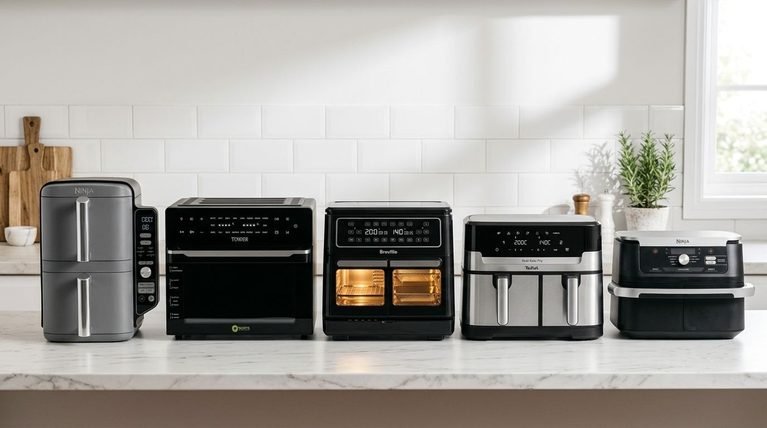
Air Fryer vs Oven: Which Is Better & Cheaper to Run in the UK?
Cook for one or two people and the air fryer wins most weeknights. It heats a small chamber fast, usually skips the preheat entirely, and gets chips, chicken, vegetables or anything from the freezer onto a plate quicker and for less money than firing up a full-sized oven.
Cook for four or more and the picture flips. An oven’s whole advantage is volume: several shelves, several trays, everything ready at the same time. The moment an air fryer pushes you into a second or third batch, most of its speed and energy advantage disappears.
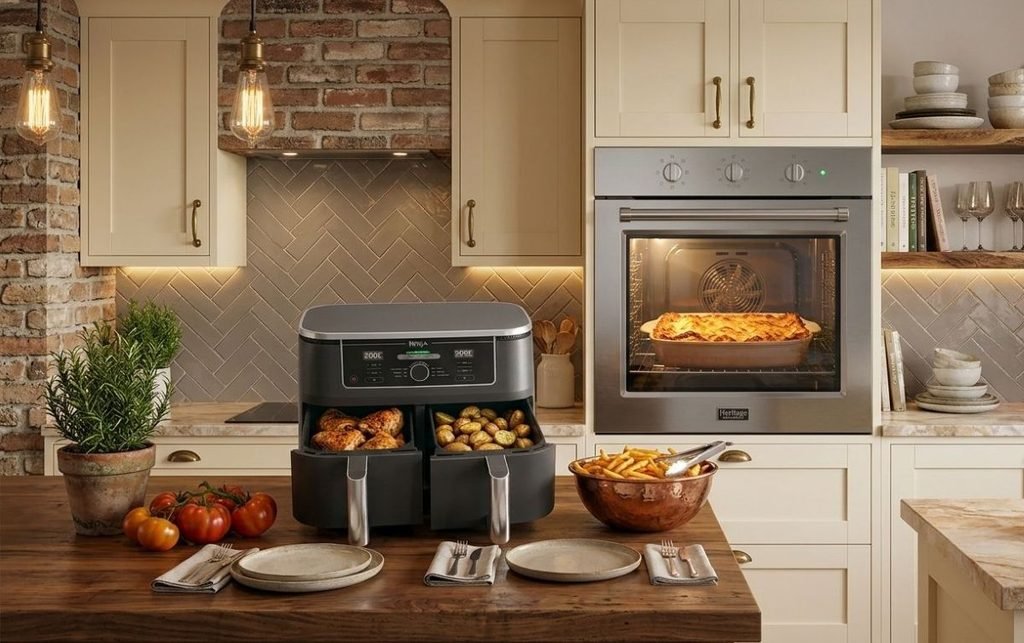
So the honest answer isn’t that one appliance beats the other. They’re good at different jobs. If you already own both, the savings come from matching the appliance to the meal rather than trying to retire one of them.
Here’s how the two compare category by category, with running costs worked out at current Ofgem rates.
Air fryer vs oven at a glance
Tap any row to jump straight to that section.
| What you’re comparing | Air fryer | Electric oven | Better choice |
|---|---|---|---|
| Running cost, small meal | Usually cheaper | Usually dearer | Air fryer |
| Running cost, full family meal | Advantage narrows or vanishes | Uses its capacity properly | Oven |
| Cooking speed | Faster for small loads | Slower off the mark | Air fryer |
| Preheating | Little, often none | 10-15 minutes is normal | Air fryer |
| Crisping and browning | Excellent | Good on a spread-out tray | Air fryer |
| Capacity | Restrictive above 3-4 people | Several shelves | Oven |
| Batch cooking | Sequential batches | Everything at once | Oven |
| Baking | Small items only | Full-size tins and trays | Oven |
| Cleaning | One drawer, often dishwasher-safe | Racks, trays, cavity, door | Air fryer |
| Worktop space | Needs a permanent home | Already built in | Oven |
| Everyday convenience | Excellent | Fine, but slower | Air fryer |
| Overall versatility | Very good | Still unbeaten | Oven |
How an air fryer actually differs from an oven
An air fryer isn’t a new cooking technology. It’s a fan oven that’s been shrunk.
Both use an electric element and a fan to push hot air around food. What changes is the size of the box.
An air fryer moves that air around a chamber roughly the size of a shoebox. There’s very little empty space to bring up to temperature, so it gets hot quickly, and the airflow hitting your food is far more concentrated. That’s the whole reason it browns and crisps so well.
A built-in oven has a cavity of 60 litres or more. Enormously more capacity, but also a lot more air, metal and glass to heat before anything starts cooking.
This is also why comparing the wattage on the box is close to useless. A 2,400W air fryer can comfortably use less electricity over a meal than a 2,000W oven, because it reaches temperature sooner, cycles its element off more often and finishes earlier. Rated power tells you how fast an appliance can draw electricity. It says nothing about how much it will actually use.
Which is cheaper to run, an air fryer or an oven?
For the same small quantity of food, the air fryer is cheaper. The interesting question is by how much, and at what point the gap closes.
From 1 October to 31 December 2026, Ofgem’s average electricity unit rate for a standard variable tariff paid by Direct Debit is 26.32p per kWh. (It was 26.11p for July to September.) Electricity barely moved this quarter because VAT was removed from domestic electricity bills for the winter, which offset a rise in wholesale costs. Your own tariff will differ, but this is the fairest national benchmark to work from.
The sum is straightforward:
Power in kW × time in hours × price per kWh = cost.
Here’s what half an hour costs at 26.32p/kWh, if the appliance drew its full rated power for the entire time:
| Appliance | Rated power | 30 minutes at full power |
|---|---|---|
| Compact air fryer | 1,400W | 18p |
| Mid-size single-drawer air fryer | 1,700W | 22p |
| Large single-drawer air fryer | 2,100W | 28p |
| Dual-drawer air fryer | 2,400W | 32p |
| Built-in electric oven | 2,500W | 33p |
| Larger electric oven | 3,000W | 39p |
Treat those as a ceiling, not a bill. No appliance draws full power for a whole cooking cycle. Once the element reaches the target temperature it starts switching itself on and off, and the real figure usually lands well below the number in that table. The point of the arithmetic is to show that a big air fryer and a modest oven are much closer on paper than most people assume.
Measured energy use tells a clearer story. In Which?’s testing, roasting a chicken took 0.54kWh in an air fryer against 1.16kWh in a built-in oven. At 26.32p/kWh that’s roughly 14p versus 30p for the same bird.
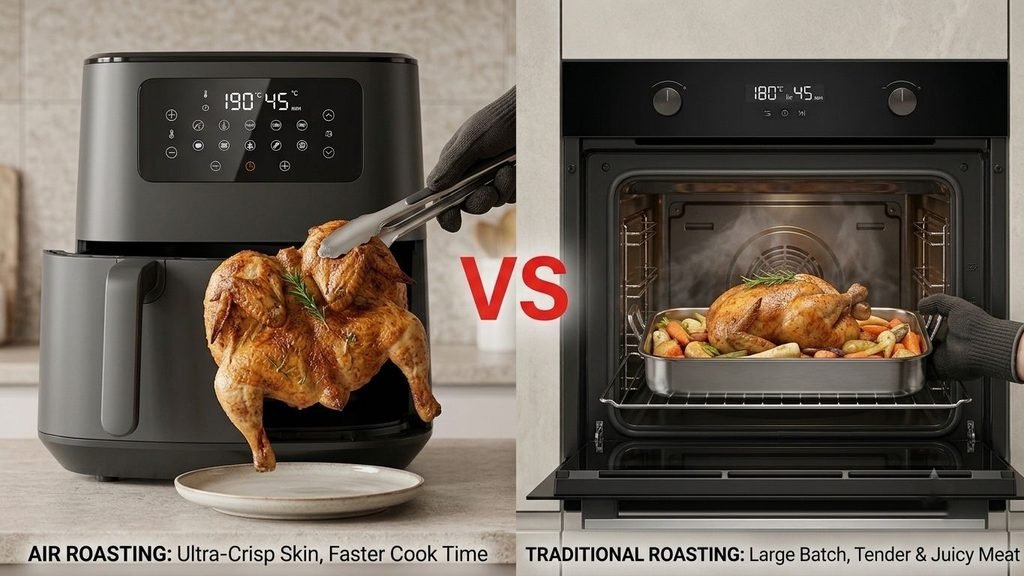
Sixteen pence. Worth having, but worth keeping in proportion too, which we come back to below.
And the qualification matters: if you need three consecutive air fryer batches to produce what the oven does in one go, you’re paying for three warm-ups and three cooking cycles. The comparison stops flattering the air fryer very quickly.
What if you have a gas oven?
Almost every air fryer comparison quietly assumes an electric oven. Plenty of UK kitchens have a gas one, and that changes the maths more than you’d expect.
Gas costs 7.97p per kWh under the October cap, against 26.32p for electricity. That’s roughly a third of the price per unit of energy.
Gas ovens are less efficient than electric ones. Heat escapes through the flue, and they generally burn more energy to do the same job. But even if a gas oven used twice the energy of the electric oven in that roast chicken test, say 2.3kWh against 1.16kWh, it would cost about 18p to run. The air fryer’s 14p still wins, by four pence rather than sixteen.
If you cook on gas, the energy-saving argument for an air fryer is much weaker than the headlines suggest. Buy one for the speed and the crisping instead.
Cheaper to run: the air fryer, provided the meal fits in one load and your oven is electric.
Which cooks food faster?
The air fryer, and it isn’t a close-run thing for small portions.
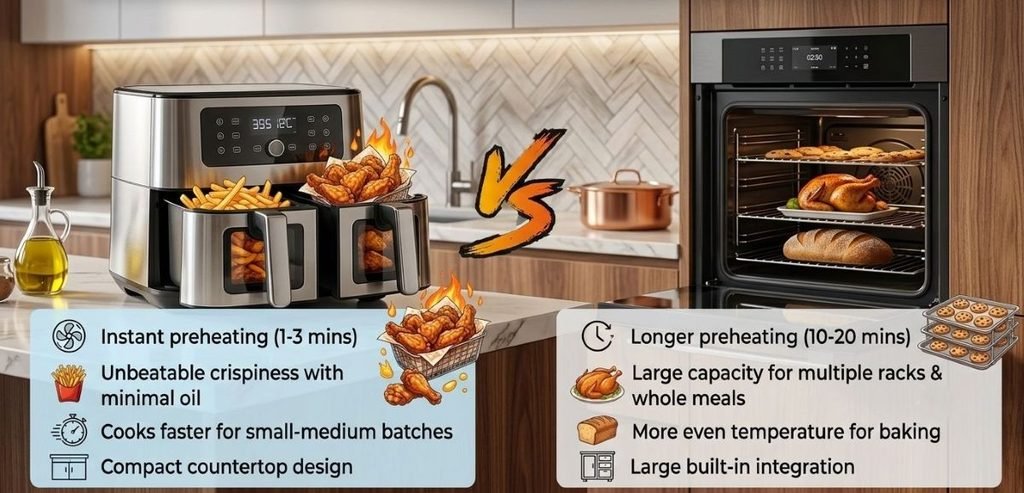
A compact chamber comes up to temperature in a couple of minutes rather than ten or fifteen, and the concentrated airflow moves heat into food efficiently. For chips, wings, sausages, fish fillets, halloumi, a tray of veg or anything from the freezer, you’re eating noticeably sooner.
The oven claws it back as the meal grows. Two twenty-minute air fryer batches, with a reload in between, is not faster than thirty minutes in an oven that fits the lot.
Dual-basket models soften the problem, since two foods can cook at once at different temperatures and finish together. Even so, a 9.5-litre dual drawer doesn’t come close to the usable tray area of a full-sized oven.
Faster: the air fryer, comfortably, until you need a second batch.
Which is better for crispy food?
The air fryer. Its small chamber and fast air circulation strip surface moisture quickly, which is exactly what browning needs. Chips, roast potatoes, breaded chicken and wings come out crisp on a fraction of the oil a deep fryer would need.
A good fan oven can match it, mind. Spread food across a large tray with space between each piece and you’ll get excellent results. The air fryer’s edge is that it achieves the same thing faster, and without you having to think about it.
There’s one way to lose that advantage completely: overfill the basket. Food needs air moving around it, and a crowded drawer steams rather than crisps. You’ll end up shaking, turning and adding minutes, at which point you may as well have used the oven. Cook in a single layer where you can.
Crispier: the air fryer, as long as you don’t overload it.
Which is better for a family?
It depends almost entirely on how many people you’re feeding.
For one or two, a single-basket air fryer handles a surprising share of everyday oven jobs. For three or four, you want a large single basket or a dual-zone model, and it still works well for midweek meals.
Beyond that, an oven’s capacity gets very hard to replace. A Sunday roast makes the problem obvious. A large air fryer will take a whole chicken, but then you still need somewhere for the potatoes, the parsnips, the stuffing and the Yorkshires, and everything needs to be ready at once.
A 9 or 10-litre dual model narrows the gap. Just don’t read the litre figure as though it’s comparable to oven capacity, because the usable flat area is what actually limits you. It’s the mistake most buyers make: chase the biggest litre figure, then find that 10L split across two fixed drawers still won’t take a whole chicken. Our guide to the best dual air fryers in the UK goes through which drawer configurations actually work for a family of four.
Better for families: the oven for full meals, the air fryer for everything in between.
Air fryer vs oven for one or two people
This is the air fryer’s clearest win.
Heating a 60-litre cavity for two chicken breasts, one portion of chips or a small tray of vegetables means paying to warm a lot of empty space. The Energy Saving Trust makes the same point: for smaller quantities, an air fryer’s compact size can make it cheaper to run than the oven for the identical meal.
There’s a behavioural argument too. Small meals are exactly the ones where nobody wants to stand around waiting fifteen minutes for an oven to preheat, which is how people end up ordering a takeaway instead.
If you live alone, cook as a couple, or everyone in the house eats at different times, an air fryer is easy to justify.
Better for one or two: the air fryer, without much argument.
Which is better for batch cooking?
Here the result reverses, and reverses hard.
Batch cooking is the one job where an oven’s size becomes the efficient option rather than the wasteful one. Three trays of roasted vegetables, a tray of chicken thighs and a couple of baked dishes all go in together, running on one heating cycle instead of five.
The Energy Saving Trust points to exactly this when it recommends ovens for larger groups and batch cooking. It’s a useful reminder that efficiency isn’t about which appliance is smaller. It’s about how fully you use the space you’re heating.
Running a large oven for one portion of chips is wasteful. Running a small air fryer five times in a row when one oven load would have done it is wasteful too.
Better for batch cooking: the oven, easily.
Which is better for baking?
Air fryers bake better than most first-time owners expect. Small cakes, muffins, cookies, pastries and even a modest loaf all work, particularly on models with a dedicated bake setting that dials the fan back.
The limitation isn’t temperature control. It’s geometry. You need tins that physically fit the drawer, and the aggressive airflow can catch the tops of delicate mixtures before the middle has set. There’s also only room for one thing at a time.
For a full-size cake, a tray of two dozen biscuits, bread proved in a normal tin, or anything where you want two shelves going at once, the oven is the tool for the job.
Better for baking: the oven.
Which is easier to clean?
The air fryer, on any ordinary weeknight.
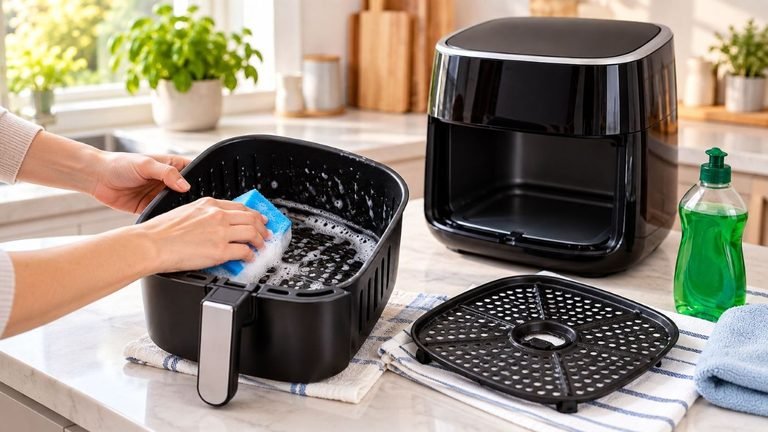
Most models have a removable basket and crisper plate, and manufacturers usually list at least one of them as dishwasher-safe. Cleaning an oven means racks, trays, baked-on grease up the cavity walls and a glass door that never quite comes clean. Pyrolytic and catalytic systems help, but they’re still a job you schedule rather than one you just do.
Air fryers aren’t maintenance-free, though, and this is the bit owners tend to discover late. Grease builds up around the heating element and on the underside of the lid, where you can’t see it and the dishwasher can’t reach it. Non-stick baskets also need a soft sponge rather than anything abrasive, or the coating goes patchy within a year.
Even allowing for that, washing one drawer beats scrubbing a roasting tin.
Easier to clean: the air fryer, if you wipe the element occasionally.
What about kitchen space?
This one catches people out. An air fryer has a small cooking chamber, but it’s still an appliance that needs somewhere to live, and a large dual-drawer model can swallow a serious chunk of worktop.
An oven takes up far more total space, but that space was designed into the kitchen. It isn’t competing with your chopping board.
If your kitchen is tight, check the external width, depth and height rather than the advertised litres. Then add clearance: most manufacturers want a gap behind and above for hot air to escape, and you need room to pull the drawer fully out without hitting a wall or a tap. Stacked dual models save width but get tall, so measure the gap under your wall units before you order one.
Better on space: the oven, since it’s already accounted for.
Can an air fryer replace an oven completely?
For some households, nearly. For most, no.
Someone living alone who cooks mainly single portions could run an air fryer as their primary appliance and switch the oven on a handful of times a year. A family that regularly does roasts, pizzas, lasagne, several baking trays or multiple dishes at once will find the oven very difficult to work around.
We wouldn’t buy an air fryer expecting the oven to become redundant. The stronger case is that it reduces how often you need the oven at all, which is a different and much more achievable claim.
That distinction is worth holding on to. You’re adding a correctly sized appliance for small jobs, not buying a miniature oven that somehow does everything a big one can.
Is buying an air fryer just to save electricity worth it?
Only if you buy the right one. Here’s the arithmetic nobody puts in the marketing.
Take that 16p saving on the roast chicken as a working figure. Use the air fryer instead of the oven five times a week and you save roughly £42 a year.
Against that:
- A £70 budget model pays for itself in about 20 months.
- A £130 mid-range dual drawer takes a little over three years.
- A £200 premium model needs nearly five years before the electricity saving covers the purchase.
Most air fryers won’t be in daily service five years from now, so the expensive ones rarely pay for themselves on energy alone. If running cost is your main reason for buying, spend less rather than more. Several of the best air fryers under £100 do the same job on small meals as models costing twice as much.
None of which makes them a bad buy. Speed, crisping, and not having to clean an oven every Sunday are perfectly good reasons to spend £200. Just don’t let “it’ll cut my electricity bill” be the reason, because on the numbers above it won’t, at least not quickly.
If you already wanted one for the convenience, the lower running costs on small meals are a genuine bonus rather than the business case.
Air fryer vs oven: pros and cons
Air fryer
- Cheaper to run for small and medium portions
- Heats up in minutes, often with no separate preheat
- Excellent crisping and browning on very little oil
- Ideal for one and two-person households
- Removable baskets are quick to wash, often dishwasher-safe
- Dual-zone models cook two foods at different temperatures and finish them together
- Reheats leftovers without turning them soggy
- Far less usable cooking area than an oven
- Larger families end up cooking in batches
- Occupies worktop space permanently
- Big dual models are bulkier than the litre figure suggests
- Baking is limited by drawer size and tin shape
- Grease collects around the heating element where it’s awkward to clean
- Bought purely for energy savings, a premium model can take years to pay back
Electric oven
- Far greater capacity, with several shelves in use at once
- The efficient choice for batch cooking and big gatherings
- Handles full-size cakes, bread tins, roasting dishes and large trays
- Cooks a complete meal in a single heating cycle
- Already installed and paid for in most UK kitchens
- Still the most versatile cooking appliance in the house
- Wasteful when you’re heating 60 litres for one portion
- Preheating adds 10 to 15 minutes before cooking starts
- Inconvenient for quick individual meals
- Considerably more work to clean properly
- Overkill for a side dish or a handful of chips
Our verdict
Buy an air fryer if you cook for one, two or three people, make a lot of roasted and crispy food, regularly fire up a full oven for small portions, want weeknight meals on the table faster, or simply want less cleaning. Dual-zone models earn their money when a main and a side need different temperatures.
Skip it and stick with your oven if you cook for a large household, batch-cook several meals at a time, routinely use more than one shelf, bake full-size cakes or bread, do roasts with several accompaniments, or would need three air fryer batches to get a normal family dinner out. If your oven runs on gas, the running-cost argument is weaker still.
There’s no prize for forcing every recipe into an air fryer because the appliance is fashionable.
Air fryer vs oven FAQs
Is an air fryer cheaper to run than an oven in the UK?
For smaller quantities, yes. It heats a much smaller chamber and usually finishes sooner. The advantage shrinks once you need several batches to cook what an oven would handle in one load, and it shrinks again if your oven runs on gas.
How much does an air fryer cost to run for 30 minutes?
At 26.32p/kWh, a 1.7kW air fryer drawing full power for the whole half hour would cost about 22p. In practice the element cycles on and off once it reaches temperature, so the real figure is normally lower.
Does a 2,400W air fryer use more electricity than a 2,000W oven?
Not necessarily. Wattage is the maximum rate an appliance can draw power, not how much energy a whole cooking cycle consumes. Preheating time, total cooking time and how often the element cycles all matter more.
Is an air fryer basically a small fan oven?
Essentially, yes. Same electric element, same circulating hot air. The smaller chamber and more concentrated airflow are what let it heat quickly and brown small quantities so effectively.
Is an air fryer good enough for a family of four?
A large or dual-zone model works well for four on everyday meals. The oven wins back on anything that needs several dishes or trays finishing at the same time.
Can I cook a Sunday roast in an air fryer?
Parts of it, comfortably. Large models take a whole chicken or a decent quantity of roast potatoes. Fitting the meat and all the trimmings at once is the sticking point, so for a full family roast the oven is still the easier route.
Does an air fryer need preheating?
Usually not, though it depends on the model and the recipe. Some manufacturers recommend two or three minutes for meat and baking. Most everyday cooking can start from cold. Check your manual.
Is air-fried food healthier than oven-cooked food?
Neither appliance makes food healthy or unhealthy on its own. Both cook with little or no added oil. What you put in matters far more than whether the hot air came from a drawer or a cavity.
Can an air fryer replace a microwave?
Not really. Air fryers are far better at reheating anything that should stay crisp, like pizza or chips. Microwaves are much faster for soups, sauces, liquids and anything where texture doesn’t matter. They solve different problems.
Is a dual air fryer cheaper to run than an oven?
Often, particularly when both drawers let you cook the whole meal in one cycle. But large dual models carry high power ratings, so the meaningful comparison is the energy needed to cook the complete meal rather than the wattage printed on the box.
Final verdict: air fryer or oven?
For most UK households, “air fryer or oven” is the wrong question. The two are good at genuinely different things.
The air fryer owns the small everyday meal. It heats a compact chamber, gets food on the table faster, and on an electric tariff it will use noticeably less power than warming a full oven for two portions. For single people, couples, quick lunches, side dishes, frozen food and anything that needs to come out crisp, it’s the obvious choice.
The oven owns capacity. A big family dinner, a batch-cooking session, two trays of biscuits, anything with several components landing at once: that’s what all that space is for, and using it properly is efficient rather than wasteful. If the air fryer would need three goes, the oven has already won.
Own both and you don’t have to pick a side. Use the air fryer when the meal fits in one load and the oven when it genuinely doesn’t. That’s a better outcome on cost, speed and results than committing to either one.
And if you’re buying purely to cut the electricity bill, keep the purchase price in view. A £70 model might pay for itself inside two years. A £200 one probably won’t. Capacity, how you actually cook and how often you’d reach for it matter more than the running cost on its own.
Where these numbers come from
- Ofgem – energy price cap unit rates and standing charges. Electricity is 26.32p/kWh and gas 7.97p/kWh on the average Direct Debit standard variable tariff for 1 October to 31 December 2026. The preceding rate, for 1 July to 30 September 2026, was 26.11p/kWh.
- Which? – air fryer versus oven energy testing, used for the measured roast chicken figures and the effect of batch cooking on the comparison.
- Energy Saving Trust – guidance on small portions versus batch cooking, and when each appliance is the efficient option.
A note on the costs. All figures use Ofgem’s average electricity rate of 26.32p/kWh for 1 October to 31 December 2026. VAT was removed from domestic electricity for this period, which is reflected in that rate. What you actually pay depends on your tariff, region, appliance wattage, cooking temperature, cooking time and how frequently the heating element cycles. Payback calculations assume five oven-replacing uses per week.