
How to Clean an Air Fryer Properly: A UK Guide (2026)
Air fryers are fairly easy to look after, but they do need regular cleaning. Grease, crumbs and bits of food collect in the drawer, basket and crisper plate, and some of it ends up on the walls of the cooking chamber and around the heating element. Leave it there and it bakes on. It gets harder to shift each time you cook, and it can cause smoke or unpleasant smells.
The removable parts do most of the dirty work, so they need the most attention. The inside of the main unit and the heating element need a lighter, more careful clean, because that’s where the electrics are. That part never goes near the sink.
Keep your manual handy, too. Coatings, removable parts and dishwasher advice vary between brands, and sometimes between models from the same brand, so what works for one air fryer won’t always suit another. Below, we cover the routine clean step by step, baked-on grease, the dishwasher question, the heating element, smoke and smells, and the cleaning shortcuts you’re better off skipping.
How to Clean an Air Fryer: The Quick Answer
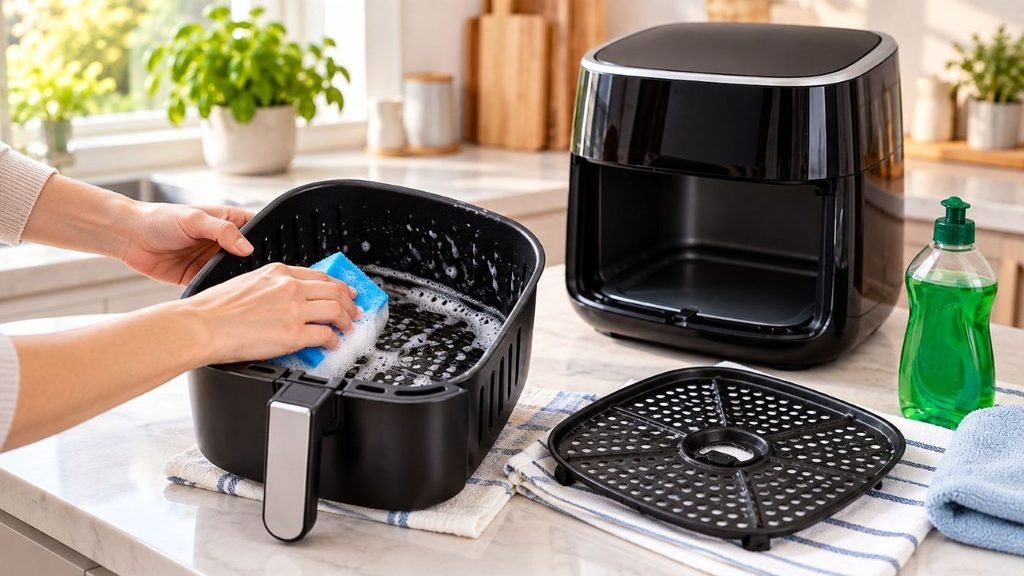
Switch off and unplug your air fryer and let it cool for at least 30 minutes. Wash the drawer, basket and crisper plate in warm water with washing-up liquid and a soft sponge, or put them in the dishwasher if your manual says they’re dishwasher-safe. Wipe the inside with a damp cloth, gently clear any residue from the heating element if your model allows it, wipe the outside, and let everything dry fully before you put it back together. And never put the main unit in water.
Air Fryer Cleaning at a Glance
| Part | How to clean it | Avoid |
|---|---|---|
| Drawer, basket and crisper plate | Warm water, washing-up liquid and a soft sponge. Soak if food is stuck on. Dishwasher only if your manual allows it. | Scourers, wire wool, metal utensils |
| Inside the cooking chamber | A soft cloth or sponge that’s damp, not dripping | Pouring or rinsing water into the unit |
| Heating element | Unplugged and fully cool, with a soft brush or damp cloth | Wire brushes, hard bristles, excess water |
| Exterior | A lightly damp soft cloth, then dry | Spraying cleaner directly onto the appliance |
| Display and controls | A damp microfibre cloth, then dry | Cleaning sprays, harsh chemicals |
Before You Start: Switch Off, Unplug and Let It Cool
Switch the air fryer off, unplug it at the socket and let it cool before you clean anything. Electrical Safety First, the UK electrical-safety charity, recommends waiting at least 30 minutes after use so it can cool down fully. Fat can also pool underneath the basket or crisper plate and stay hot for a while, so take care when you lift them out.
Never put the main body of the air fryer in water or hold it under a running tap. It contains the electrical components, and Electrical Safety First warns that immersing an air fryer in water can increase the risk of a short circuit or an electric shock when it’s next used. Only the parts your manufacturer says are washable should go in water. That’s usually the drawer, basket and accessories.
What You Need
You don’t need specialist products for routine cleaning. A basic kit is enough:
- Warm water and washing-up liquid
- A soft, non-abrasive sponge
- A soft or microfibre cloth
- A soft brush, such as a clean washing-up brush, for the heating element if your model allows it
- A clean tea towel or kitchen roll for drying
Leave the scouring pads, wire wool, wire brushes and abrasive creams in the cupboard unless your manufacturer specifically says otherwise. Many air-fryer drawers and baskets have a non-stick coating, and Philips, Bosch, Tefal and Ninja all warn against abrasive cleaning materials or scouring pads.
How to Clean an Air Fryer Step by Step
1. Empty Crumbs and Loose Food
Once the air fryer is cool and unplugged, pull out the drawer and take out the basket, crisper plate and any racks or other accessories. Tip loose crumbs into the bin, along with any fat sitting in the bottom of the drawer. Bin the fat rather than pouring it down the sink, where it can harden and block pipes.
Don’t scrape stuck food off with a knife, fork or metal spatula, especially on non-stick surfaces. If something won’t come away easily, leave it for the soak in the next step.
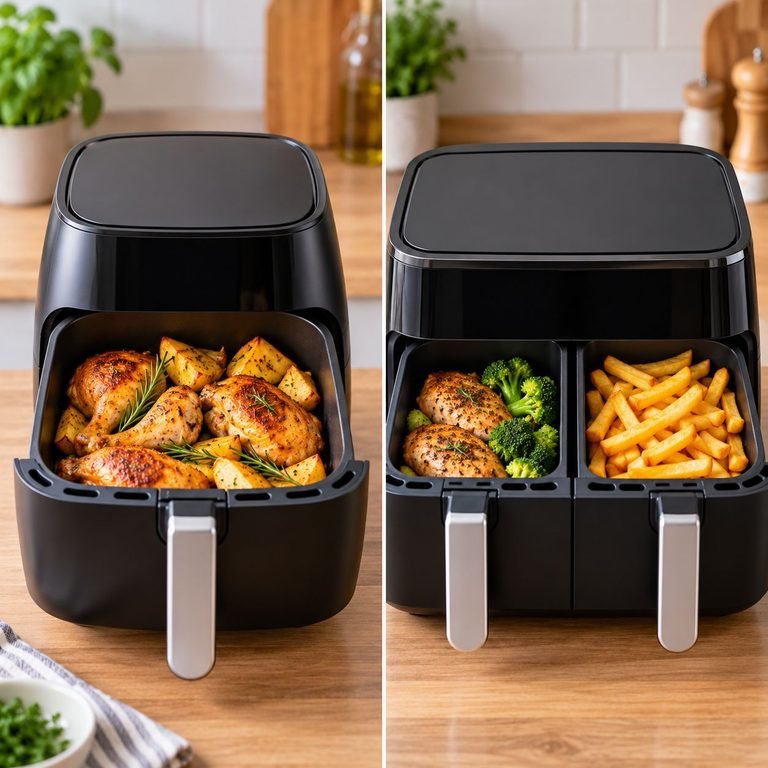
If you have a dual-drawer air fryer, check both drawers. Fat and crumbs collect in whichever ones you’ve cooked in.
2. Wash the Drawer, Basket and Removable Parts
Wash the removable parts in warm, soapy water with a soft sponge. Pay attention to the corners of the drawer, the holes or ridges in the crisper plate and the underside of any removable plate. That’s where grease likes to hide.
If food is stuck on, soak the parts in hot water with washing-up liquid first. Philips puts the soak at 10 to 15 minutes for its Airfryer pan and basket, while Ninja’s advice is around 15 minutes for its drawers and crisper plates. After that, a soft sponge should do the rest. Rinse and leave to dry.
Removable parts can usually be soaked, but don’t take it for granted. Instant’s manual for its compact Vortex Mini says that model’s basket shouldn’t be immersed in water, so check if you’re not sure about a particular part. If your parts are dishwasher-safe, you can use the dishwasher instead, although some brands still prefer hand washing (more on that below).
3. Wipe the Inside of the Air Fryer
With the drawer out, wipe the inside of the cooking chamber with a soft cloth or sponge that’s damp but not dripping. A drop of washing-up liquid helps with greasy splashes. Wring the cloth out well so water doesn’t run into vents or electrical parts.
Look up as well as around. Splashes and crumbs often end up near the top of the chamber, close to the fan and heating element. Just don’t pour water into the main unit or try to rinse it out.
4. Clean the Heating Element Carefully
Grease and light bits of food, like loose breadcrumbs or seasoning, can get blown up towards the heating element and burn on. It’s worth having a look every so often and cleaning it whenever you can see residue.
Only do this when the air fryer is unplugged and completely cool. Brands differ slightly on what to use:
- Philips: a soft-to-medium bristle brush. It specifically warns against steel wire brushes and hard-bristle brushes.
- Bosch: a soft brush, used gently to lift stuck-on food.
- Instant: a damp cloth wiped over the heating coil.
Whatever you use, keep it gentle and keep water to a minimum. Cosori and Instant both say the heating coil must be completely dry before the air fryer is used again. Don’t force a brush into gaps you can’t see into, and don’t remove covers or panels unless your manual explains how.
5. Wipe the Outside and the Controls
Wipe the outside with a lightly dampened soft cloth, then dry it. Touch controls and displays need a bit more care. Bosch’s advice is a damp microfibre cloth only, with no cleaning sprays or harsh chemicals, and Philips tells owners to dry the control panel afterwards so no moisture is left on it.
Don’t spray cleaning products straight onto the display, buttons or vents. If you want to use a cleaner on the outside, put it on the cloth instead, and steer clear of anything containing alcohol, which Bosch specifically advises against.
6. Dry Everything Before Reassembling
Let the drawer, basket, crisper plate and any accessories dry completely, or dry them with a clean tea towel, before putting everything back together. Check the inside of the main unit is dry too, particularly around the heating element, before you plug it back in.
How to Clean Baked-On Grease from an Air Fryer
Baked-on grease is usually residue that has been cooked over several times. It takes more effort to shift. But scrubbing harder with something abrasive is the quickest way to ruin a non-stick coating, so be patient with it.
Start with a longer soak. Bosch suggests filling the basket with hot water and a few drops of washing-up liquid and leaving it to soak. Once the residue softens, clean it off with a soft sponge. Still not budging? Soak it again rather than reaching for a scourer or a knife.
For really stubborn residue, a couple of brands suggest something stronger, but only for their own products:
- Cosori recommends a paste of bicarbonate of soda and water (around two tablespoons of bicarb to one of water) for its baskets and crisper plates. Spread it on, scrub gently, leave it for 15 minutes, then rinse and wash with soapy water before you cook in it again.
- Philips mentions a liquid degreaser for stubborn grease in the manual for its Airfryer XXL.
If your own manual doesn’t mention either, stick with soaking and a soft sponge.
For grease inside the main unit, use a damp soft cloth with a little washing-up liquid, go over it again with a clean damp cloth, then dry it. The main body never gets rinsed or soaked.
Can an Air Fryer Basket Go in the Dishwasher?
Sometimes. It depends on the model, and occasionally on the individual part.
Plenty of air fryers have dishwasher-safe drawers, baskets and plates. Philips lists the pan and basket of its 3000 Series Essential Airfryer as dishwasher-safe, and Cosori’s cleaning guidance says the same for its baskets and crisper plates. It isn’t universal, though. The Instant Vortex Mini manual says that model’s basket shouldn’t go in the dishwasher at all.
Even when a part is dishwasher-safe, some manufacturers would rather you washed it by hand. Tefal lists the drawers and grill plate of its Dual Easy Fry & Grill as dishwasher-safe, but recommends hand washing to prolong the life of the product. If you do use the dishwasher, Tefal suggests a low-temperature programme and a non-aggressive detergent. Ninja also recommends hand washing its drawers to make them last longer.
So it’s worth checking the advice for your exact model. Don’t assume a basket is dishwasher-safe just because another air fryer from the same brand is.
Can You Put Water in an Air Fryer to Clean It?
There’s an important difference between soaking a removable basket and putting water into the air fryer itself.
A removable drawer, basket or pan can usually be soaked in soapy water if your manufacturer allows it. The main electrical body should never be immersed.
You may also have seen the shortcut where you pour water and washing-up liquid into the drawer and run the air fryer for a few minutes to loosen the grease. Don’t do this unless your manual specifically tells you to. Air fryers generally aren’t designed to heat water in the drawer, water or steam could reach parts that are meant to stay dry, and Philips, for one, tells owners not to fill the pan with oil, frying fat or any other liquid.
A few models do have a built-in cleaning function. Philips’ steam air fryers have a Steam Clean setting designed to loosen fat from the basket and around the heating element. If yours has something similar, use it exactly as described in the instructions. It’s not a reason to try the same trick in an air fryer that doesn’t have one.
How Often Should You Clean an Air Fryer?
Ideally, after every use. Philips, Bosch, Cosori and Instant all recommend cleaning after each use or straight after cooking, and Bosch makes the point that doing it promptly stops food residue drying and sticking. Philips also lists greasy residue left in the pan from previous use as one of the causes of white smoke.
A sensible routine looks like this:
- After every use: empty fat and crumbs, then wash the drawer, basket and crisper plate.
- Regularly: wipe the inside of the cooking chamber and check the heating element, cleaning it whenever you can see residue.
- As needed: wipe the outside and the controls.
It matters most after greasy or strong-smelling food, such as sausages, chicken thighs or fish. A quick wash while the residue is still fresh is far easier than tackling layers of baked-on grease a week later.
Air Fryer Cleaning Mistakes to Avoid
- Putting the main unit in water. Only wash or soak the parts your manufacturer says are washable.
- Cleaning it while it’s still hot. Unplug it and give it at least 30 minutes to cool.
- Using metal utensils, scourers or wire brushes. Soak stubborn residue instead and use a soft sponge.
- Assuming every part is dishwasher-safe. Check the advice for your exact model.
- Spraying cleaner onto the display or controls. A damp microfibre cloth is all they need.
- Running the air fryer with soapy water inside. Only use a built-in cleaning function if your model has one.
- Reaching for oven cleaner or dishwasher tablets. Both are harsher than an air fryer needs (see the FAQs below).
- Putting it back together while wet. Let everything dry fully first, including around the heating element.
Why Does My Air Fryer Smell or Smoke?
A brand-new air fryer may give off a little smoke the first time you use it. Philips notes in its manuals that this is normal.
After that, grease is the usual suspect. Philips lists several causes of white smoke from its Airfryers: greasy residue left in the pan from previous use, high-fat food, breading that isn’t stuck to the food properly, and light ingredients being drawn up into the heating element. Its fixes are simple enough. Clean the pan and basket after every use, carefully pour off excess fat during cooking, press breading on firmly and pat food dry before it goes in.
Lingering food smells often come from grease left in the drawer or residue on the heating element. A thorough clean of the removable parts, a wipe of the cooking chamber and a check of the element are the first things to try.
Not every smell is a cleaning problem, though. If you notice a burning or electrical smell that isn’t coming from the food, or any unusual noises, Electrical Safety First advises switching the air fryer off immediately and contacting the retailer or manufacturer. Unplug it once it’s safe to do so, and don’t use it again until it’s been checked. It’s also worth registering your air fryer with the manufacturer, which Electrical Safety First recommends, so you hear about any safety recalls.
For wider safety advice, see our guide to whether air fryers are safe.
Frequently Asked Questions
Can I use washing-up liquid to clean an air fryer?
Yes. Washing-up liquid, warm water and a soft sponge is the standard way to clean the drawer, basket and crisper plate, and it’s what most manufacturers recommend. A drop on a damp cloth is fine for wiping the inside too. Just don’t pour soapy water into the main unit.
Can I use bicarbonate of soda to clean an air fryer?
Only if your manufacturer says it’s suitable. Cosori recommends a bicarb-and-water paste for stubborn grease on its baskets and crisper plates, and Instant suggests a mix of bicarbonate of soda and vinegar for stubborn residue in the cooking chamber of its Vortex Mini. If your manual doesn’t mention it, stick with washing-up liquid and a soak. Bicarb is mildly abrasive, so use it with a soft sponge, not a scourer.
Can I use oven cleaner on an air fryer?
No. None of the manufacturer guidance we checked recommends oven cleaner, and several brands, including Bosch, Tefal and Instant, warn against harsh or aggressive cleaning agents. Oven cleaners are strong, caustic products made for a different job, and they can damage non-stick coatings, plastics and painted finishes. Mild washing-up liquid is the safer choice unless your manual names something else.
Can I use a dishwasher tablet to clean an air fryer basket?
Best avoided unless your manufacturer says otherwise. Ninja warns that dishwasher tablets may contain highly concentrated, abrasive cleaning agents that could affect the non-stick coating over time, and recommends sticking to washing-up liquid and warm water.
Can I use paper liners to keep my air fryer clean?
Check your manual first. Electrical Safety First recommends not using any type of paper in an air fryer, because paper that isn’t weighed down could be blown into the heating element and catch fire, and it advises following the manufacturer’s instructions before using paper products. The same goes for foil: check what your manual says before using it.
Final Takeaway
Cleaning an air fryer properly is mostly about routine. Let it cool, unplug it, wash the removable parts with washing-up liquid and a soft sponge after each use, and soak stubborn food rather than scraping it. Give the inside and the heating element a careful wipe whenever you can see residue, and keep the main unit out of water. Where your manual says something different from general advice, go with the manual.
If you’re shopping for a replacement and easy cleaning is high on your list, check which parts are dishwasher-safe before you buy. Our guides to the best Ninja air fryers and the best air fryers under £100 are a good place to start.
Sources
We checked the advice in this guide against UK electrical-safety guidance and manufacturer cleaning instructions, including:
- Electrical Safety First: Air fryer safety advice
- Bosch UK: Cleaning your air fryer
- Ninja UK: How to clean an air fryer
- Cosori: Cleaning your air fryer
- Philips user manuals and UK support guidance: 3000 Series Essential Airfryer (HD9252) and Airfryer XXL
- Tefal UK: Dual Easy Fry & Grill product information

One Comment