Sage Barista Express vs Barista Express Impress: Which Should You Buy?
The Sage Barista Express has been the default answer to “which espresso machine with a built-in grinder should I buy?” for years. The Barista Express Impress keeps almost all of it: the same 54mm portafilter, the same 93°C PID-controlled heating, the same 15-bar pump with pre-infusion and the same manual steam wand.
What changes is everything that happens before the shot. The Impress works out how much coffee to grind, tells you whether it got it right, and tamps it for you with a lever. So the real question is a simple one. Is that worth paying extra for, or is the original Express still the smarter buy?
Quick Comparison
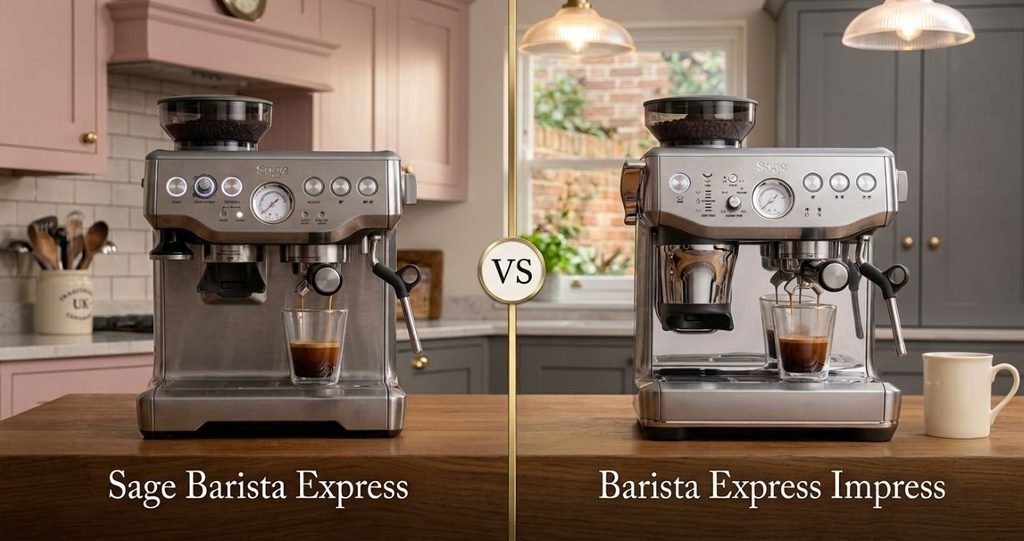
If dosing and tamping sound like the part you’ll get wrong, or you want fewer decisions and less mess on a weekday morning, the Impress earns its premium, particularly when the price gap is around £100. If you’re happy to learn a couple of hand skills, or the gap has stretched well beyond that, the Express is capable of exactly the same espresso for less money and is the better value.
Sage Barista Express vs Barista Express Impress: at a glance
| Barista Express (SES875) | Barista Express Impress (SES876) | |
|---|---|---|
| Best for | Hands-on learners and value buyers | Beginners who want a guided, tidier routine |
| List price | £629.95 | £729.95 |
| Typical street price | Often discounted to around £480 to £500 | Usually close to list price, occasionally around £600 to £630 |
| Grinder | Conical burr, 16 settings | Conical burr, 25 settings |
| Dosing | Timed grind, set with a Grind Amount dial | Intelligent dosing that corrects the next dose |
| Dose feedback | Check tamper height, trim with the Razor | Dose level indicator after tamping |
| Tamping | Removable hand tamper | Assisted lever, 10kg with a 7° twist |
| Brewing | 15-bar pump, pre-infusion, 9-bar extraction, PID at 93°C | Same |
| Milk | Manual 360° steam wand | Same |
| Maintenance prompts | Cleaning cycle only | Cleaning cycle and descaling |
| Water tank / hopper | 2 litres / 250g | 2 litres / 250g |
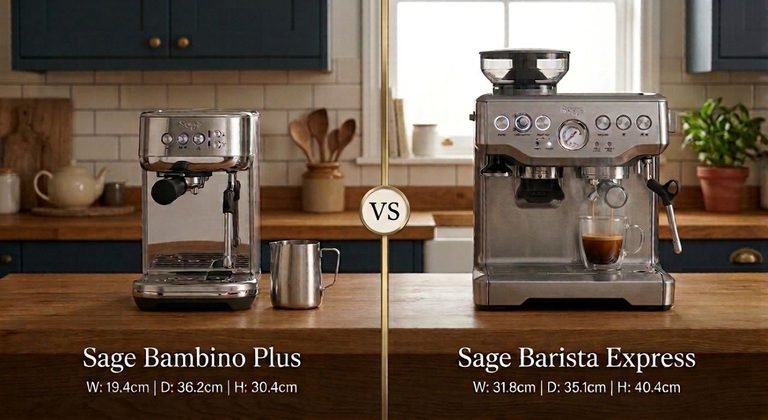
| Size (H × W × D) | 40.4 × 31.8 × 35.1cm | 41 × 33 × 38cm |
| Weight | 10.6kg | 10.98kg |
Prices change regularly, so treat the figures above as a guide rather than today’s shelf price.
Sage Barista Express vs Barista Express Impress: what’s the difference?
From the group head down, these are the same espresso machine. Heating, pump, pre-infusion, portafilter, pressure gauge, steam wand, water tank and hopper all match. If you judged them on brewing hardware alone, you would struggle to justify paying more for either.
The difference sits in the steps between whole beans and a locked-in portafilter, which happens to be exactly where most beginners go wrong.
- Dosing. On the Express, you set how long the grinder runs and judge afterwards whether it was right. The Impress times the dose itself, shows you where it landed and adjusts the next one.
- Tamping. The Express gives you a hand tamper. The Impress has a lever that presses at a fixed 10kg.
- Workflow and mess. On the Impress, the portafilter stays in one cradle while the machine grinds and tamps. On the Express, you grind through a dosing funnel and tamp by hand on the worktop.
- Grinder steps. 16 on the Express, 25 on the Impress.
- Maintenance. The Impress tells you when to descale. The Express doesn’t.
What stays the same matters just as much. On both machines, you still choose the grind size, watch the shot and steam the milk entirely by hand.
Grinder and dosing
Both machines use an integrated conical burr grinder with a 250g hopper, and both grind straight into the portafilter. Where they part ways is in how much coffee ends up in the basket, and how you find out.
How the Barista Express does it
You pick your basket size, set the Grind Amount dial (Sage suggests starting around the 3 o’clock position), fit the dosing funnel and push the portafilter against the switch. The grinder runs for a set time and stops. You can also hold the portafilter in to grind manually.
Then you tamp and check. Sage’s rule of thumb is that the top of the tamper’s metal cap should sit level with the rim of the basket after tamping. Too much coffee, and you trim it with the supplied Razor tool. Too little, and you nudge the dial towards More next time.
None of this is difficult, but it is trial and error, and it starts again whenever you change beans or grind size, because a finer grind changes how much coffee the same grind time produces.
How the Barista Express Impress does it
Choose your basket, press Dose, and the machine grinds a calculated amount into the centre of the basket. After you tamp, a dose level indicator shows whether you’re under, over or on target. Short? Press Dose again for “A Bit More”. Over? Trim with the Razor. Either way, the machine remembers the correction and adjusts the grind time for next time.
Does intelligent dosing actually help?
For most beginners, yes. The Impress doesn’t weigh your coffee, but it does the thing that matters day to day: it tells you straight away whether the dose was right, and fixes the next one without you working out by how much. That makes settling in with a new bag of beans noticeably quicker.
It won’t do everything, though. Sage’s own manual says a change of beans or grind size can still throw the dose out, so you’ll reach for “A Bit More” or the Razor now and then. And if you already own scales and like weighing each dose, the Express gives you the same control for a bit more effort.
On the grind dial, 25 steps against 16 gives the Impress more positions to fine-tune between. Both machines also let you move the upper burr to shift the grind range if your beans need it. Neither is a replacement for a dedicated espresso grinder if you get very particular about light roasts.
Winner: Barista Express Impress, for making dosing quicker to get right.
Tamping
What the Impress’s assisted tamp does
Once the coffee is in, you pull a lever on the side of the machine. It presses the grounds with a consistent 10kg and finishes with a 7° twist to polish the surface of the puck. The machine beeps when the tamp is complete, and Sage suggests tamping twice for a neater finish.
The appeal is repeatability. Same force, level every time, whoever is making the coffee.
Why beginners appreciate it
Tamping looks trivial and isn’t. Press too lightly or at a slight angle, and water finds the weak spot and rushes through one side of the puck. The shot runs fast and tastes thin, and a beginner has no idea whether to blame the grind, the dose or their wrist. The lever takes one of those suspects off the list, so when a shot goes wrong on the Impress, there’s less to troubleshoot.
Is manual tamping on the Express hard to learn?
Not really. Sage recommends 10 to 15kg of pressure, and pressing the tamper onto a set of bathroom scales for a few minutes will teach you what that feels like. Keeping it level is the real skill, and that comes with practice. Most people are comfortable within a couple of weeks. If you ever want a better feel in the hand, a separate 54mm tamper is an easy, inexpensive upgrade.
Will experienced users miss doing it by hand?
Some will. The lever applies a fixed pressure, and in automatic mode the Impress is built around one ideal puck height, so there’s less room to experiment with puck preparation. For most home baristas that’s no real loss, because once a tamp is firm and level, grind and dose matter far more than extra pressure. But if you enjoy distributing and tamping by hand, the Express simply lets you get on with it.
Winner: Impress for beginners and consistency. Express for anyone who enjoys the ritual.
Espresso quality
This is the part that surprises people: the Impress doesn’t have better espresso hardware. Both use a Thermocoil heater with PID control set to 93°C (adjustable by up to 2°C either way), a 15-bar pump delivering 9-bar extraction, low-pressure pre-infusion and the same 54mm portafilter with single and dual-wall baskets. Use the same beans, grind, dose and tamp on both, and you should expect very similar coffee.
So it helps to separate two things. Potential coffee quality is effectively the same on both machines. How easily and consistently you reach it is where the Impress has the edge.
What actually decides how your espresso tastes:
- Freshness. Beans with a roasted-on date, used within a few weeks, make more difference than either machine. Stale supermarket beans taste flat on both.
- Grind size. Too coarse and the shot gushes and tastes sour. Too fine and it drips and tastes bitter. Sage’s guide points to a double shot running for roughly 25 to 30 seconds.
- Dose. The double basket is designed for 16 to 19g. An inconsistent dose is one of the most common reasons shots vary from one day to the next.
- Tamping. Firm and level. This is where the Impress helps most.
- Extraction and technique. Watching the pressure gauge and the flow, and changing one thing at a time.
The Impress tidies up dose and tamp, the two variables beginners find hardest to keep steady. It won’t choose your grind or taste the coffee for you. An Express owner who has settled into a routine will pull shots every bit as good as an Impress owner. The Impress owner will simply get there sooner, with fewer shots poured down the sink along the way.
Winner: A draw on what’s possible in the cup. Impress on getting there consistently.
Milk steaming
There’s no hardware difference here. Both machines have the same manual 360° swivel steam wand, and neither offers automatic frothing.
That means the learning curve is identical. You need to find the depth that gets the milk spinning, let in a little air early on, and stop at around 60 to 65°C. The first few jugs tend to come out either flat or full of big bubbles. With practice, the wand can produce the glossy microfoam a flat white needs, and cappuccinos and lattes are just as achievable. The limit is your technique, not the model.
Two practical notes. First, both machines use one heating system for brewing and steaming, so you pull the shot and then steam the milk rather than doing both at once. That’s fine for a couple of drinks and a bit slow for a round of four. Second, the current UK Barista Express is listed with Sage’s Temp Control milk jug, which has a colour-changing strip to show milk temperature. That’s a handy aid while you learn, though bundles can vary between retailers, so check the listing. The Impress comes with a standard 480ml stainless steel jug.
Winner: A draw. If anything, the Express’s jug gives beginners a small head start.
Ease of use
Here’s how a weekday flat white looks on each machine.
Barista Express: fit the dosing funnel, grind into the portafilter, tamp by hand, remove the funnel, check the dose and trim if needed, lock in, brew, steam, pour, purge the wand.
Barista Express Impress: press Dose, pull the tamp lever, glance at the dose indicator and top up or trim if prompted, lock in, brew, steam, pour, purge the wand.
The Impress has fewer steps and, more importantly, fewer judgement calls. There’s no funnel, no tamping on the worktop and no guessing whether the dose was right. It’s tidier too, because the portafilter stays put while the machine grinds and tamps.
The Express isn’t hard to use, but it asks more of you for the first few weeks. Once the routine becomes second nature, the time difference on a single drink is small.
Winner: Barista Express Impress, clearly, for anyone new to espresso.
Cleaning and maintenance
The daily routine is the same on both: knock out the puck, rinse the basket and portafilter, wipe and purge the steam wand straight after use, and empty the drip tray regularly. Sage recommends washing parts by hand rather than in the dishwasher for both machines. Beyond that, a few differences are worth knowing.
- Descaling reminders. The Impress’s maintenance light flashes when a cleaning cycle is due and stays on when it’s time to descale. The Express has a Clean Me light for the cleaning cycle but no descaling reminder. Sage suggests descaling roughly every 60 to 90 days depending on water hardness, so put a reminder in your phone.
- Tamp mechanism. The Impress adds a job the Express doesn’t have: removing the tamp cover now and then and brushing grounds off the tamp face and chute. Leave it too long and the puck surface suffers.
- Mess. The Express’s dosing funnel is one more small part to rinse. The Impress tends to leave less coffee on the worktop in the first place.
- Water filters. Both include a water tank filter, which Sage suggests replacing every three months, or sooner in hard water areas. Much of London and the South East falls into that group.
Winner: Close. The Impress’s descaling prompt is genuinely useful, but it also has an extra mechanism to keep clean.
Which is better for beginners?
The Barista Express Impress.
It turns the two most frustrating steps for a first-time espresso maker into a button and a lever, and it tells you when something is off. That means fewer wasted shots, less mess and a shorter path from unboxing to coffee you actually enjoy. If more than one person in your house will use the machine, that consistency counts for even more.
The Express is still a sensible first machine if you’re patient and watching your budget. Plenty of people have learned on one. Just expect a couple of weeks of adjusting before everything clicks.
Which is better for experienced home baristas?
The Barista Express, in most cases.
If you already understand dose, grind and extraction, the Impress mostly automates things you can do yourself. Since the brewing side is identical, you’d be paying for convenience rather than capability. The Express leaves puck preparation in your hands, works happily with your own tamper and distribution tools, and costs less.
The exception is the experienced drinker who just wants a quicker, cleaner routine before work. If you know good espresso and don’t enjoy the tamping part, the Impress’s consistency can still be worth having. That’s a lifestyle choice rather than a coffee-quality one.
And if you’re pushing hard for better shots, the integrated grinder is the bigger limit on both machines. At that stage, a separate espresso machine and grinder setup may suit you better than either, and our guide to the best espresso machines in the UK is a good place to compare options.
Is the Barista Express Impress worth the extra money?
At list price, the Impress costs £100 more: £729.95 against £629.95. In practice, the gap moves around. The Express is discounted often, while the Impress tends to sit at or near full price. At the time of writing, the Express is £499.95 at Sage and Argos and £479.99 at Currys, while the Impress is around £730 at all three, a gap of £230 to £250. When both have been on offer, the gap has been closer to £100 to £130.
It helps to put that in everyday terms. Spread a £130 premium over two years of two coffees a day, and it works out at about 9p a cup. At £250, it’s about 17p. Neither figure is huge if the Impress is the reason you actually use the machine every morning rather than giving up on it after a month.
The Impress is worth paying for if
- This is your first espresso machine, and dialling in dose and tamp sounds off-putting.
- You want a quick, predictable routine on busy mornings.
- Several people will use it, and you want similar results whoever makes the coffee.
- Coffee grounds scattered across the worktop drive you mad.
- You can find it for around £100 more than the Express.
The Express is the smarter buy if
- Value matters most, especially when the gap heads towards £200.
- You enjoy the hands-on process and want to learn it properly.
- You already own, or plan to buy, your own tamper and scales.
- You’re happy to follow a guide and practise for a week or two.
- You care more about what’s in the cup than how you get there, since the brewing hardware is the same.
Put simply, the Impress doesn’t buy you better coffee. It buys you an easier route to good coffee, and how much that’s worth depends on how much you’d struggle without it.
Pros and cons
Sage Barista Express
- Same brewing and steaming hardware as the Impress for less money
- Frequently discounted below its list price
- Hand tamping leaves puck preparation fully in your control
- Works well with your own tamper, scales and distribution tools
- Current UK listing includes a dosing funnel and a Temp Control milk jug
- Getting the dose right takes trial and error, especially after a change of beans
- Consistent hand tamping takes practice
- Messier workflow, with the funnel and tamping on the worktop
- No descaling reminder
- 16 grind settings give you fewer steps to fine-tune between
Buy it if you want the most espresso machine for your money, you like the idea of learning the process properly, or you already know your way around a tamper.
Skip it if the thought of dialling in dose and tamp is likely to put you off using the machine at all.
Sage Barista Express Impress
- Intelligent dosing shows whether the dose is right and corrects the next one
- Assisted 10kg tamp gives consistent, level pucks
- Tidier workflow, with the portafilter staying in the cradle
- 25 grind settings for finer adjustment
- Prompts you for both cleaning and descaling
- Easier for everyone in a household to get similar results
- Costs more for identical brewing and steaming hardware
- Less freedom for anyone who likes preparing the puck by hand
- Tamp mechanism needs occasional cleaning
- About 3cm deeper than the Express, so measure your worktop and the space under wall cupboards
- Tends to be discounted less often than the Express
- Milk steaming is still fully manual, with the same learning curve
Buy it if you’re new to espresso, you want a quicker and cleaner morning routine, or more than one person will be making the coffee.
Skip it if you enjoy tamping by hand, or the price gap over the Express has grown well beyond £100.
Which Sage should you buy?
- Best for most buyers: Barista Express Impress, as long as the price gap is around £100. Assisted dosing and tamping remove the steps people most often struggle with, and that is what turns an espresso machine into something you use every day.
- Best for beginners: Barista Express Impress.
- Best for manual control: Barista Express.
- Best value: Barista Express, especially when it’s discounted and the gap widens.
If neither feels quite right, our guide to the best coffee machines in the UK covers a wider range of styles and budgets. If you’d rather skip the manual steps altogether, the best bean-to-cup coffee machines handle grinding, brewing and often milk at the press of a button. And if automatic milk frothing appeals, our Ninja Luxe Café Pro vs Sage Barista Express Impress comparison is worth a read.
Final verdict
The Barista Express Impress isn’t a better espresso machine than the Barista Express. It’s the same machine with a smarter front end. What you’re paying for is fewer ruined shots while you learn, a cleaner worktop and a routine that asks less of you at seven in the morning.
For a first-time buyer who’s nervous about dosing and tamping, that’s money well spent at around a £100 premium. For anyone who enjoys the craft, already knows the basics, or spots the Express on a good discount, the original remains the better value, with exactly the same coffee potential.
Frequently asked questions
Does the Barista Express Impress make better coffee than the Barista Express?
Not in terms of what’s possible. Both share the same heating, pump, pre-infusion, portafilter and steam wand. The Impress makes it easier to get a consistent dose and tamp, so beginners are likely to reach good results sooner, but a practised Express owner can make espresso that’s just as good.
What is the Impress Puck System?
It’s Sage’s name for the Impress’s assisted preparation. The machine calculates the dose based on your last grind, you tamp with a lever that applies 10kg and a 7° twist, and a dose level indicator shows whether you need a little more coffee or should trim some off. The machine then adjusts the next dose automatically.
Can you control the dose yourself on the Impress?
Yes. There’s a manual dose mode, selected with the dial on the front, which lets you set the grind time yourself. The tamp is still carried out by the lever.
Can either machine froth milk automatically?
No. Both have the same manual steam wand, so you texture the milk yourself. It takes some practice, but it’s capable of proper microfoam for flat whites, lattes and cappuccinos.
Can you use pre-ground coffee in either machine?
Yes. Both come with dual-wall filter baskets, and Sage recommends using them with pre-ground coffee or beans that are more than a month past their roast date. The dual wall evens out the pressure, which covers for a grind that isn’t quite right. You’ll get a drinkable coffee, but both machines are built around grinding fresh beans, and that’s where they’re at their best.
Can you make an Americano on these machines?
Yes. Both have a dedicated hot water outlet, so you can pull a shot and top it up with hot water from the same machine. Sage’s guide for the Impress says each go gives you up to 240ml of hot water, which is plenty for a mug. The outlet is also handy for warming cups before you brew.
How long do they take to heat up?
Not long. Sage’s guide for the Impress says the power light flashes for up to 55 seconds while it heats. The Express guide doesn’t give a figure, but it uses the same Thermocoil heating, so you shouldn’t expect a meaningful difference. Steam needs a little longer to build, so give the wand a few extra seconds before texturing milk.
Can you change the brew temperature?
Yes, on both. The default is 93°C, and you can move it up or down by 1°C or 2°C through a button combination described in each manual. It’s a small adjustment, but it can help. Darker roasts often taste better slightly cooler, and lighter roasts slightly hotter.
How often do you need to descale?
It depends on your water. Sage’s Express guide suggests roughly every 90 days in moderately hard water and every 60 days in very hard water. The Impress tells you when it’s due with its maintenance light. The Express doesn’t, so it’s worth setting a reminder. Changing the water filter every three months also cuts down how often you need to descale.
What comes in the box, and is there any difference?
Most of it is the same: a 54mm portafilter, single and dual-wall baskets in one and two-cup sizes, the Razor trimming tool, a water filter and holder, a cleaning disc, tablets, a brush and an Allen key. The current UK Express also includes a dosing funnel, a hand tamper and a Temp Control milk jug with a temperature strip. The Impress has its tamp built in, so it comes with a 480ml stainless steel jug, a steam wand cleaning tool and descaling powder. Bundles can vary between retailers, so check the listing before you buy.
Is either machine worth it if you only drink one coffee a day?
It can be, but the maths is slower. A £480 to £500 Express works out at well under £1.50 a cup over its first year at one coffee a day, and less each year after that. That compares well with a café flat white, but it’s still a large outlay for a light habit. If you only drink one coffee a day, the extra £230 or so for the Impress is harder to justify unless the easier routine is what gets you using the machine at all.