
5 Best Dehumidifiers for Drying Clothes in the UK (2026)
If you dry washing indoors through a UK winter, you’ll know the problem: clothes that stay damp for a day or more, and condensation running down the windows. A dehumidifier deals with both, but a good laundry dehumidifier needs more than a big litres-per-day figure. Room temperature, airflow, tank size and how the laundry mode actually works can matter just as much.
These five cover the most common UK situations, from a cold utility room to a heated bedroom. If you mainly need a dehumidifier for damp or condensation rather than washing, our best dehumidifiers guide is the better place to start.
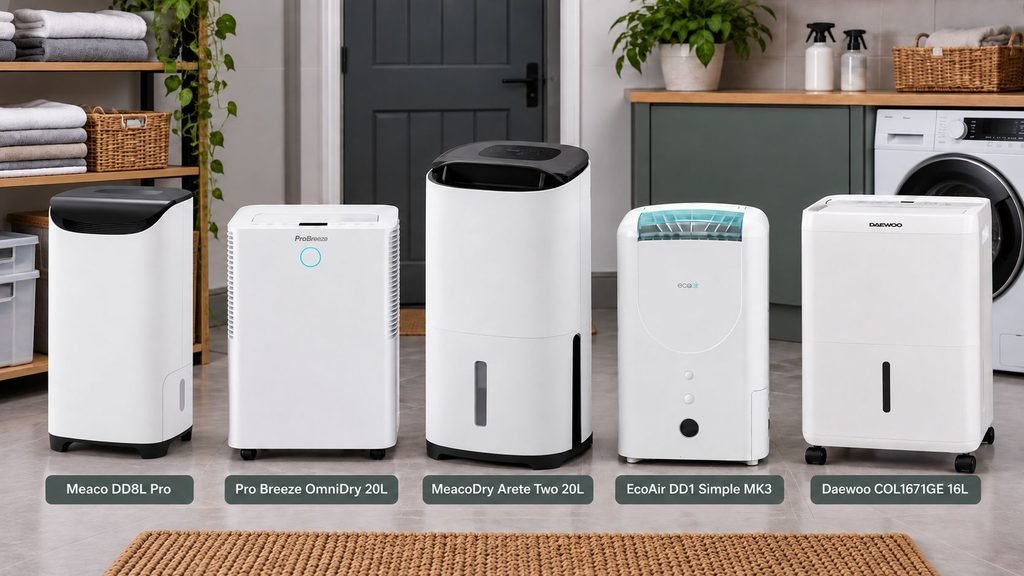
Quick verdict
The Meaco DD8L Pro is our best dehumidifier for drying clothes overall. It’s a desiccant model, so it keeps working well as the room gets colder, and its Laundry mode combines warm air with an automatic louvre that spreads it across the washing. It costs more to run than the compressor models here, and that’s the main thing to weigh up.
If your washing dries in a normally heated home, the MeacoDry Arete Two 20L is the stronger compressor choice, with the highest published airflow here, a 4.8L tank, low published power consumption and a five-year warranty. The Pro Breeze OmniDry 20L is the value alternative: cheaper to buy, quiet, with a proper Laundry mode and app control, but only a one-year standard warranty.
For a cold room on a tighter budget, the EcoAir DD1 Simple MK3 is the simpler desiccant option. The Daewoo COL1671GE 16L suits buyers keeping the purchase price down, as long as it is actually cheaper than the OmniDry on the day you buy.
The best dehumidifiers for drying clothes at a glance
| Model | Best for | Type | Tank | Laundry advantage | Score |
|---|---|---|---|---|---|
| Meaco DD8L Pro | Best overall for drying clothes | Desiccant | 2L | Warm air + automatic louvre; works from 1°C | 9.2/10 |
| MeacoDry Arete Two 20L | Best for heated homes | Compressor | 4.8L | Up to 255m³/h airflow + Smart Laundry timer | 9.0/10 |
| Pro Breeze OmniDry 20L | Best value | Compressor | 4L | Laundry mode + app control; quiet 36dB | 8.8/10 |
| EcoAir DD1 Simple MK3 | Best simple choice for cold rooms | Desiccant | 2L | Works from 1°C + adjustable 3D louvre | 8.6/10 |
| Daewoo COL1671GE 16L | Best budget compressor | Compressor | 2L | Laundry mode at a lower price | 8.3/10 |
A note on extraction figures: they aren’t directly comparable between the two types. Compressor models are usually rated in warm, very humid conditions (the Arete Two’s 20.45L/day is measured at 30°C and 80% RH), while desiccant models are normally rated at 20°C and 60% RH, which is much closer to a typical UK room. We’ve shown the test conditions in each product’s specifications where the manufacturer publishes them.
Scores are editorial assessments for laundry use, not laboratory grades. Every model is judged on the same factors: laundry-specific features, independent laundry evidence where available, extraction and airflow, suitability for typical UK room temperatures, running costs, tank and drainage practicality, warranty, owner feedback and value for money.
How we chose
Laundry changes the buying criteria. Headline extraction rates are useful, but they are measured under controlled temperature and humidity. A 20L compressor will not remove 20 litres of water a day in an ordinary winter bedroom. For this guide, we gave more weight to the things that matter around an airer: sustained moisture removal at realistic room temperatures, useful airflow, a dedicated laundry mode and, where available, a louvre that can direct dry air towards the washing.
Independent evidence involving actual laundry carried more weight than general performance claims, but we’ve kept it separate from manufacturer specifications and owner feedback, and flagged any results that involved extra equipment such as a fan or heated airer. We also looked at the practical details that shape day-to-day use: tank capacity, noise, drainage, portability, warranty and power consumption.
As a rule, compressor models make more sense in normally heated rooms, while desiccant models become more attractive as the drying space gets colder.
1. Meaco DD8L Pro: Best Overall Dehumidifier for Drying Clothes
Score: 9.2/10
Best for: cool utility rooms and spare rooms
Watch out for: about 16p an hour to run on Laundry mode (623W), and a 2L tank
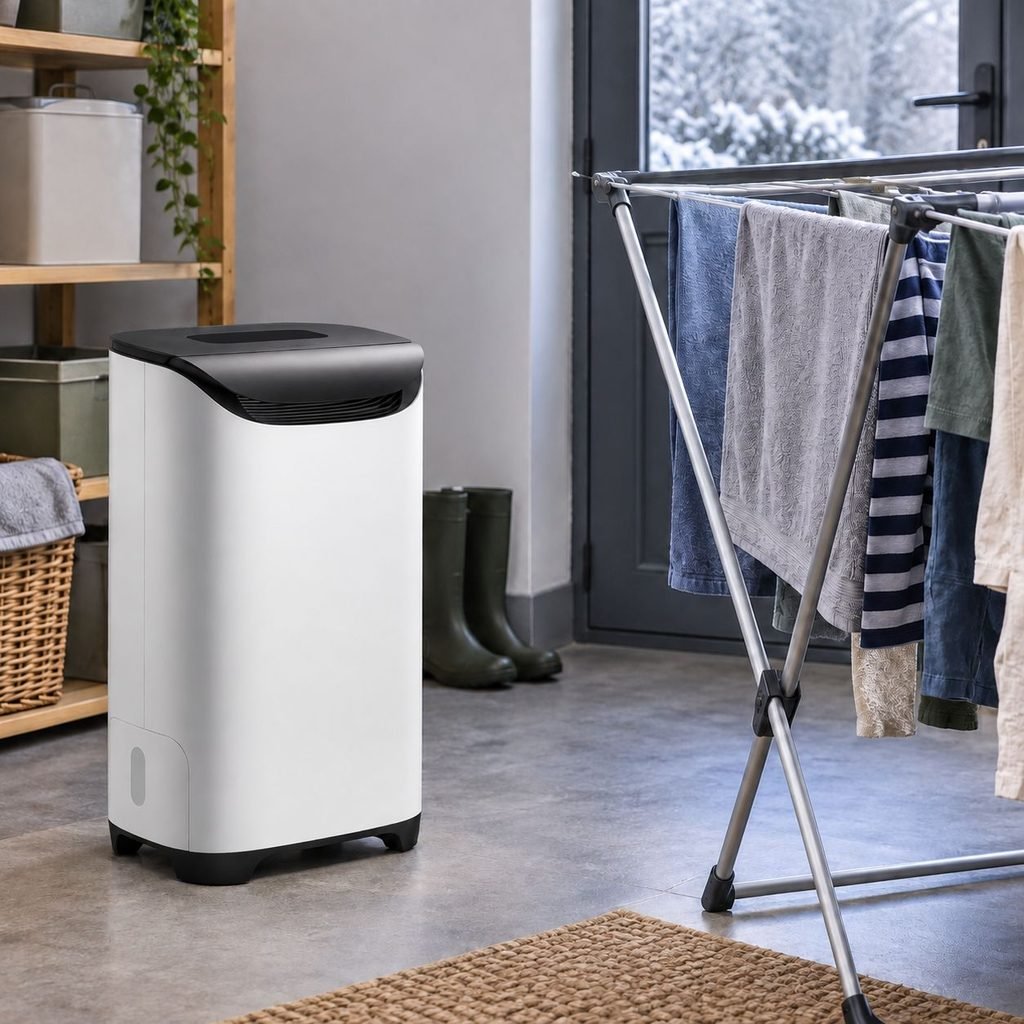
Meaco’s DD8L Pro is the most convincing laundry specialist in this group. Its 7.97L/day rating looks small next to a 20L compressor, but on Meaco’s standard test of 20°C and 60% RH, its own Arete Two 20L compressor manages 8.5L/day, so the gap is far smaller than the boxes suggest. At 10°C, the DD8L Pro is still rated at 6.89L/day, while the Arete Two drops to 3.35L/day.
Laundry mode uses the desiccant’s warm exhaust air along with an automatic louvre that spreads it across the airer. It runs on a timer, six hours by default, then switches itself off. Wi-Fi and app control come as standard, and it’s rated to work from 1°C.
Key specifications
| Specification | Meaco DD8L Pro |
|---|---|
| Type | Desiccant |
| Extraction | 7.97L/day at 20°C/60% RH; 6.89L/day at 10°C/60% RH |
| Operating temperature | 1–35°C |
| Power consumption | 231 / 437 / 623W |
| Airflow | 110 / 150 / 175m³/h |
| Tank | 2L |
| Noise (published) | 40 / 47 / 50dB |
| Weight | 8.7kg |
| Laundry mode | Yes, with automatic louvre and timer |
| Warranty | 3 years |
Why we picked it
Washing tends to end up in the coldest room in the house, and that’s where the DD8L Pro earns its place. If your drying room regularly falls into single figures in winter, it makes more sense than a compressor model. The independent evidence is encouraging too. Overnight testing on the six-hour laundry cycle left a mixed load, including thick jumpers, dry by morning. An owner-reviewer who used it through three winter months also timed full loads on Laundry mode, although the quickest result had a pedestal fan running alongside it, so treat that one as a combined setup.
Laundry mode runs at the top 623W setting, which works out at about 16.4p an hour at the current price cap rate, so it costs noticeably more to run than the compressor models here. It’s also loud at that speed, which makes a utility room or closed spare room a better fit than a lounge or bedroom. One reviewer had to empty the 2L tank halfway through a load, so continuous drainage is worth setting up if you can. The hose is sold separately.
Pros and cons
- Holds its extraction rate well in cold rooms (6.89L/day at 10°C)
- Encouraging independent laundry evidence
- Laundry mode combines warm air with an automatic louvre
- Works from 1°C
- Lighter than the 20L compressor models at 8.7kg
- Wi-Fi and app control
- Three-year warranty
- Highest running cost here: about 16.4p an hour on Laundry mode (623W)
- Small 2L tank can fill during a single load
- Noticeably loud at the top fan speed
- Costs more to buy than budget compressor models
Verdict: The strongest laundry specialist in this group. Running costs are the main compromise, but it makes a convincing case when clothes are regularly dried in cooler rooms.
Buy it if: you regularly dry washing in a cool utility room, spare room, conservatory or any space that falls well below living-room temperature in winter.
Skip it if: you dry almost exclusively in a warm, heated room and care more about low running costs and quiet operation than cold-room performance.
2. MeacoDry Arete Two 20L: Best Dehumidifier for Heated Homes
Score: 9.0/10
Best for: frequent laundry in a normally heated home
Watch out for: the highest price here and a 15.1kg weight
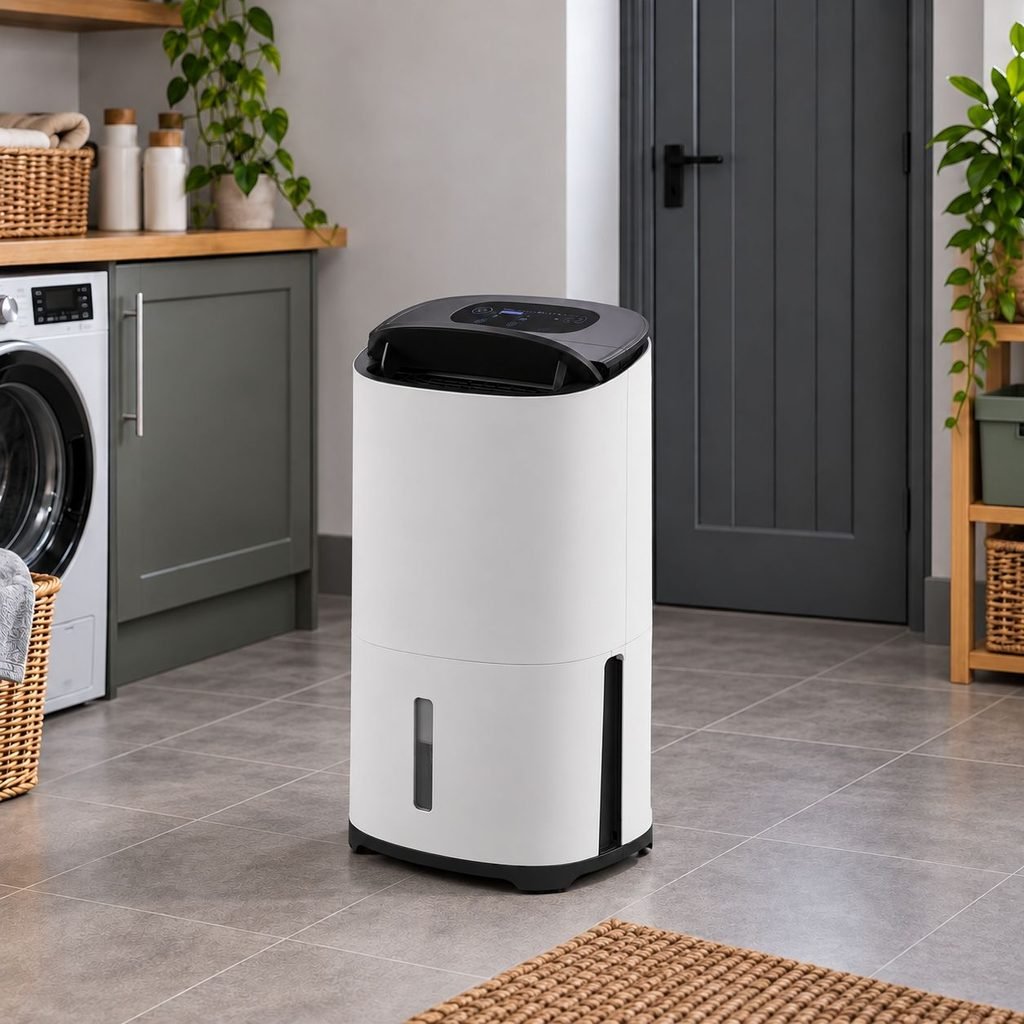
For washing that dries in a normally heated room, the Arete Two 20L is the compressor to beat. Meaco publishes its figures at several test conditions, which makes it easier to judge than most. The headline 20.45L/day is measured at 30°C and 80% RH. At 20°C and 60% RH it’s rated at 8.5L/day using 207W, and that’s the figure to set against the DD8L Pro.
For laundry, its biggest strength is airflow. The top setting of 255m³/h is the highest published figure in this group, a manual louvre lets you aim it at the airer, and Smart Laundry mode has its own 1–12 hour timer. Meaco says it can also switch itself off once the washing is dry.
Key specifications
| Specification | MeacoDry Arete Two 20L |
|---|---|
| Type | Compressor |
| Extraction | 20.45L/day at 30°C/80% RH; 8.5L/day at 20°C/60% RH; 3.35L/day at 10°C/60% RH |
| Operating temperature | 5–35°C |
| Power consumption | 271W at 30°C/80% RH; 207W at 20°C/60% RH |
| Airflow | 150 / 175 / 255m³/h |
| Tank | 4.8L |
| Noise (published) | 38 / 40 / 50dB |
| Weight | 15.1kg |
| Laundry mode | Smart Laundry with 1–12 hour timer |
| Warranty | 5 years |
Why we picked it
It beats the OmniDry on airflow, tank size, warranty and how clearly its performance is documented. The 4.8L tank is the largest here, the warranty runs for five years, and its 207W draw at 20°C/60% RH is the lowest consumption figure published for any model in this group (Pro Breeze and Daewoo don’t say what conditions their wattage figures relate to). There’s app control, continuous drainage and a HEPA H13 filter too, so it can work as an air purifier on non-laundry days.
At 15.1kg it’s heavy, although castors help, and like any compressor model it slows down in the cold. Extraction falls to 3.35L/day at 10°C and the operating range starts at 5°C, so it’s the wrong choice for an unheated garage. The OmniDry costs less, but if you dry washing most days, the Arete Two’s extras are the ones you’ll notice.
Pros and cons
- Up to 255m³/h airflow, the highest published here
- Low published consumption of 207W at 20°C/60% RH
- Largest tank in this group at 4.8L
- Smart Laundry mode with its own timer
- Performance published at several test conditions
- Five-year warranty
- Highest purchase price in this group
- Heavy at 15.1kg
- Noise rises to 50dB at the top fan setting
- Extraction drops sharply in cold rooms (3.35L/day at 10°C)
Verdict: The best compressor option for frequent laundry in a normally heated home, where its airflow, large tank and long warranty have the most chance to justify the higher price.
Buy it if: you dry washing several times a week in a heated home and want strong airflow, fewer trips to empty the tank and a long warranty.
Skip it if: your drying room is unheated in winter, or you’ll only use a dehumidifier occasionally and don’t need to pay for the extras.
3. Pro Breeze OmniDry 20L: Best Value Dehumidifier
Score: 8.8/10
Best for: regular laundry in a heated home on a smaller budget
Watch out for: a one-year standard warranty
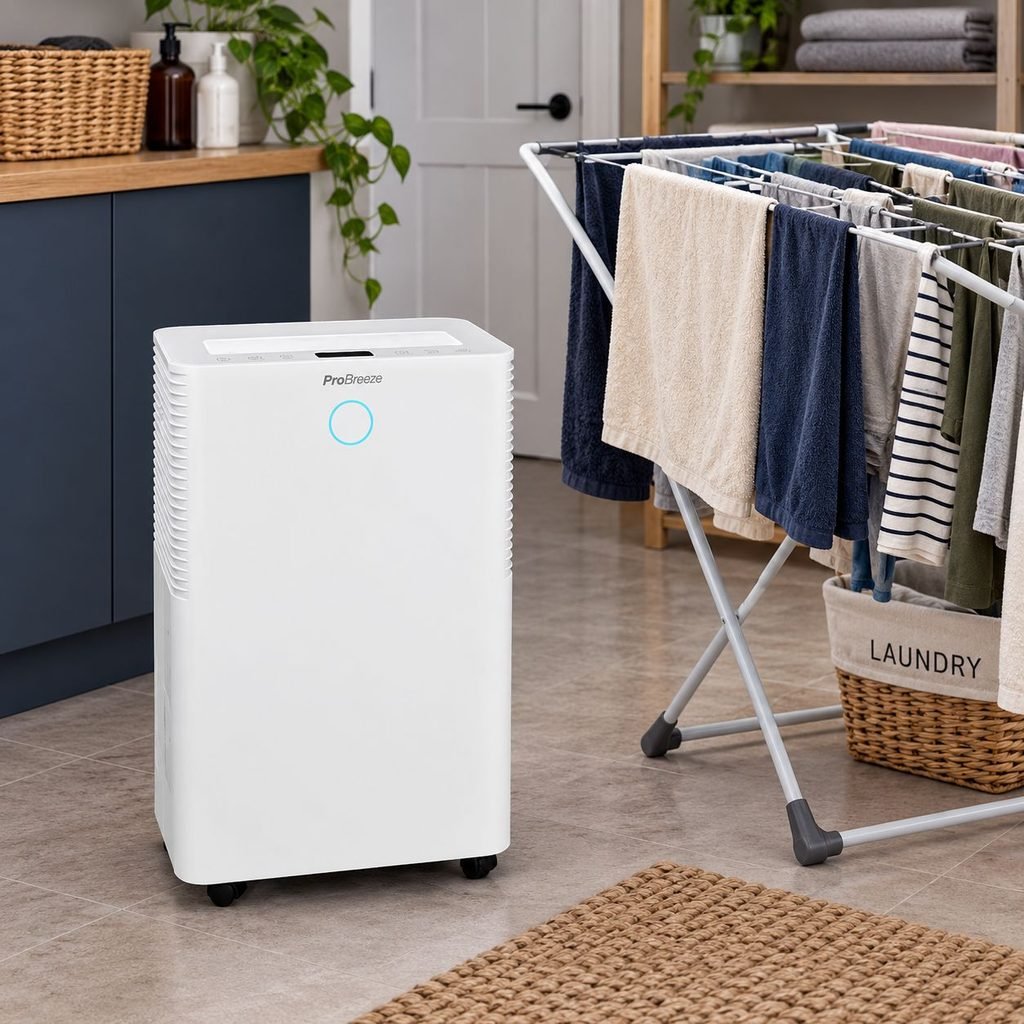
The OmniDry 20L gives you most of what matters for laundry in a heated room without Arete Two pricing. There’s a dedicated Laundry mode, which Pro Breeze says uses a higher fan speed and maximum dehumidification, along with app control, 150m³/h airflow and a quiet 36dB noise rating.
The 4L tank is reasonable for regular loads, and a continuous drainage hose comes in the box, which is handy when both Meaco models leave you to buy your own. Pro Breeze lists power as 270W, or about 7p an hour, but doesn’t say what conditions that figure or the 20L/day rating are measured at.
Key specifications
| Specification | Pro Breeze OmniDry 20L |
|---|---|
| Type | Compressor |
| Extraction | Up to 20L/day (test conditions not stated) |
| Operating temperature | 5–32°C |
| Power consumption | 270W (test conditions not stated) |
| Airflow | 150m³/h |
| Tank | 4L |
| Noise (published) | 36dB |
| Weight | 12.5kg |
| Laundry mode | Yes |
| Warranty | 1 year (optional paid extension to 3 years) |
Why we picked it
On paper it’s close to the Arete Two for a lot less money, and owner feedback includes positive comments about clothes drying. Without published test conditions, though, it’s hard to line up directly against Meaco’s figures, so we’d treat it as a well-specified mid-price compressor rather than assume it matches the Arete Two litre for litre.
Pro Breeze’s standard UK warranty is only one year, with an optional paid protection plan taking it to three, and that’s one of the main reasons it sits below the Arete Two. If you’re happy with that, or with paying for the extension, it’s the best value in this group for laundry in a heated room.
Pros and cons
- Cheaper to buy than the Arete Two
- Quiet 36dB published noise level
- Dedicated Laundry mode
- Wi-Fi and app control
- Useful 4L tank
- Drainage hose included
- Standard warranty is only one year
- Test conditions for extraction and power aren’t published
- Less suited to cold rooms than a desiccant model
- Smaller tank and lower airflow than the Arete Two
Verdict: A well-balanced, lower-cost choice for regular family laundry in a heated home. Check the warranty terms before you buy, especially if it’ll be running most days.
Buy it if: you dry washing several times a week in a heated room and want a quiet, app-controlled machine without paying premium prices.
Skip it if: your main drying area is an unheated garage or cold conservatory, or a long manufacturer warranty matters to you.
4. EcoAir DD1 Simple MK3: Best Simple Choice Dehumidifier for Cold Rooms
Score: 8.6/10
Best for: cold rooms, if you want something simple and light
Watch out for: about 15p an hour on the high setting (580W), and a 2L tank
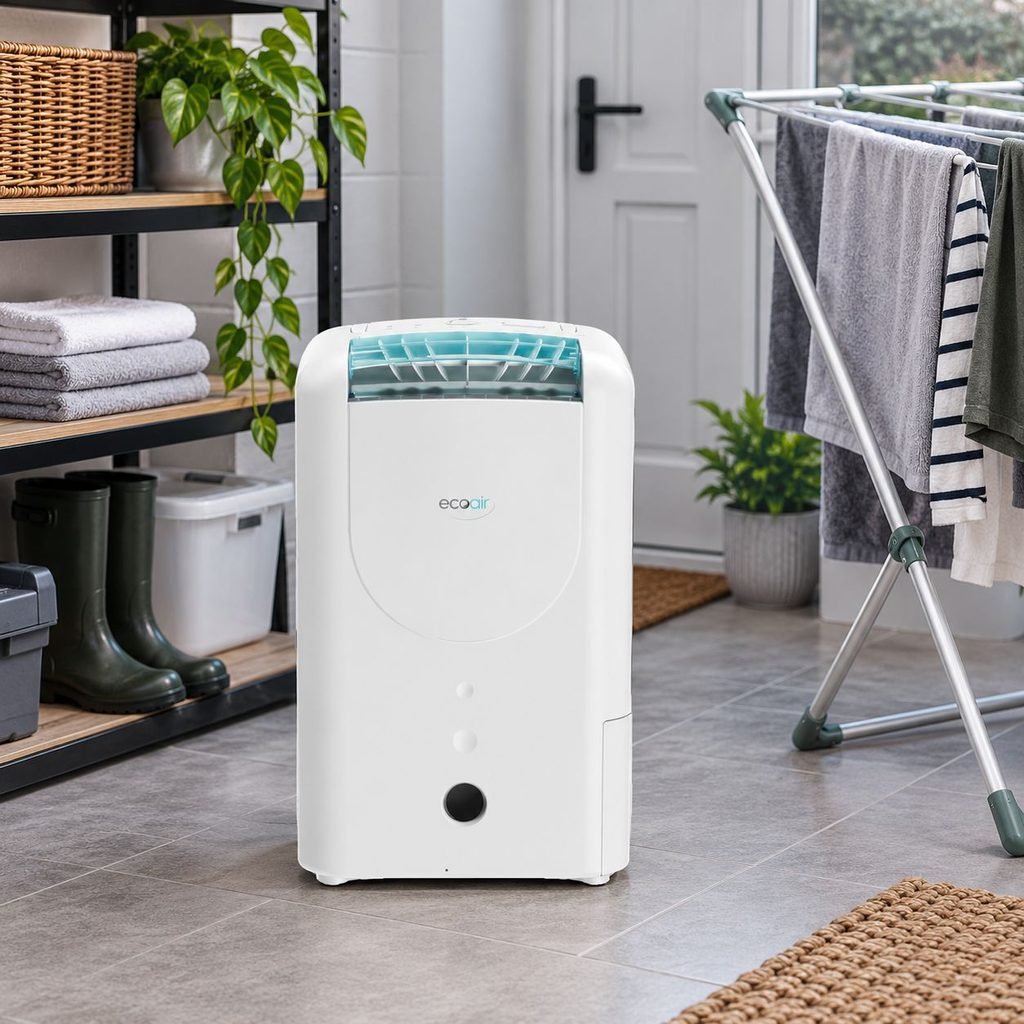
The DD1 Simple MK3 is deliberately uncomplicated. Set it to Laundry, angle the adjustable 3D louvre towards the washing and leave it to get on with it. In a cold utility room, that can be more useful than smart controls you’ll rarely touch.
It’s rated at 7.5L/day at 20°C and 60% RH and works from 1°C. Power consumption is 300W on low and 580W on high, and at 6kg it’s the lightest machine here, so it’s easy to carry between rooms.
Key specifications
| Specification | EcoAir DD1 Simple MK3 |
|---|---|
| Type | Desiccant |
| Extraction | 7.5L/day at 20°C/60% RH |
| Operating temperature | 1–35°C |
| Power consumption | 300W low / 580W high |
| Tank | 2L |
| Noise (published) | 34 / 47dB |
| Weight | 6kg |
| Laundry mode | Yes, with adjustable 3D louvre |
| Warranty | 3 years |
Why we picked it
It fills a specific gap. The DD8L Pro is the more sophisticated desiccant, but the EcoAir gives buyers with cold drying spaces a lighter, simpler and typically cheaper alternative. Its louvre adjusts from wide to narrow, so you can aim the air at different levels of the airer. You do give up Wi-Fi, the automatic louvre and a third fan speed, and EcoAir doesn’t publish a low-temperature extraction figure, so we can’t say how it compares with the DD8L Pro at 10°C.
Running the high setting for several hours uses considerably more electricity than any of the compressor models, which is easier to justify in a cold room than a warm one. The 2L tank is small for regular laundry, though continuous drainage is an option.
Pros and cons
- Works from 1°C
- Warm, dry desiccant airflow
- Adjustable 3D louvre
- Dedicated Laundry mode
- Lightest here at 6kg
- Three-year warranty
- Small 2L tank
- About 15.3p an hour on high (580W)
- Basic controls with no app
- No published low-temperature extraction figure
Verdict: A focused cold-room pick: simple, portable and well suited to laundry drying when temperatures fall.
Buy it if: you regularly dry washing in a cold utility room, basement, conservatory or similar space and want something simple and easy to move.
Skip it if: your drying room is consistently heated and you’d rather keep electricity use down.
5. Daewoo COL1671GE 16L: Best Budget Compressor
Score: 8.3/10
Best for: keeping the purchase price down
Watch out for: about 12p an hour to run (450W listed power), and a 2L tank
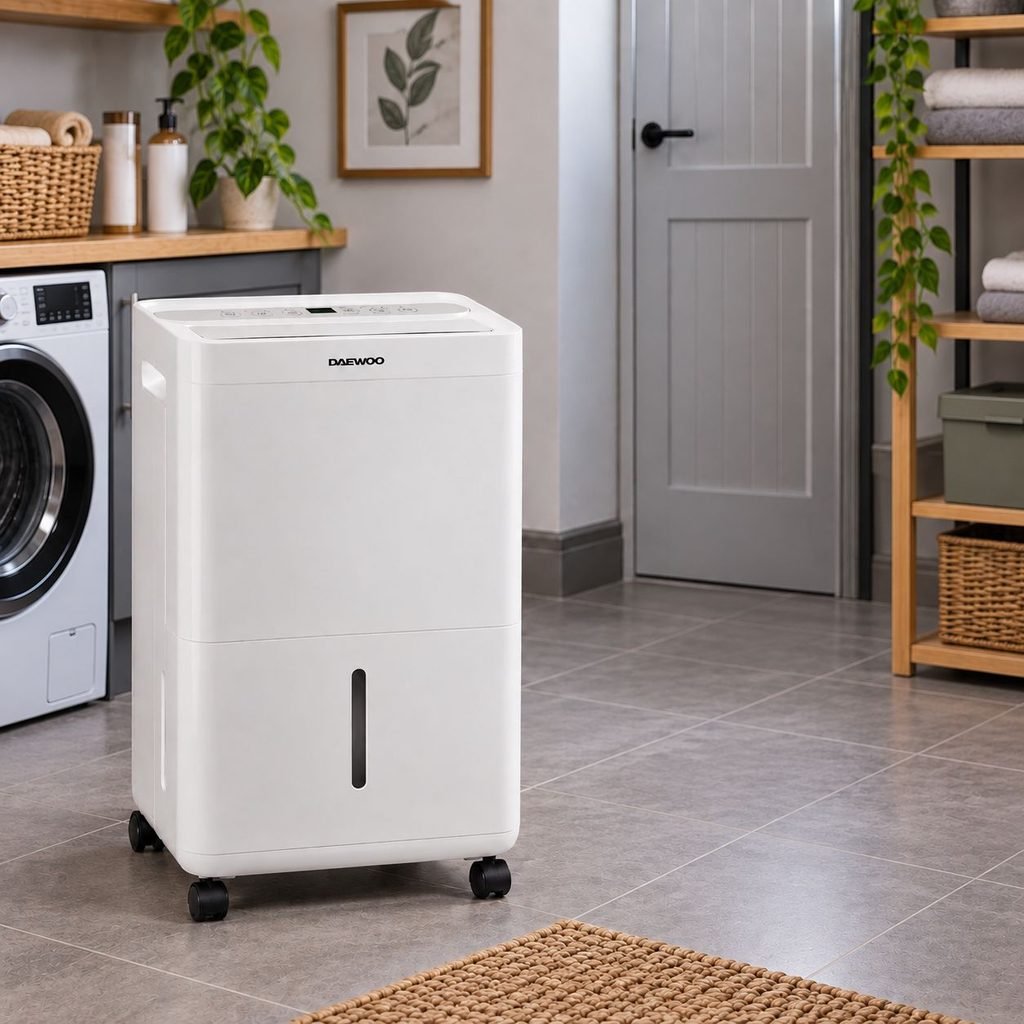
Daewoo’s 16L model is the lower-cost compressor option in this group. It has a dedicated Laundry mode alongside Dehumidify, Silent and Fan Only, and Daewoo recommends it for rooms of 20–30m². Its 16L/day rating sits between compact 10–12L machines and the 20L models above.
Retailer listings put noise at 39dB, which is fine for a machine that may run for hours in a bedroom or utility room. A drainage hose is included, and there’s a washable filter for basic air purification.
Key specifications
| Specification | Daewoo COL1671GE 16L |
|---|---|
| Type | Compressor |
| Extraction | Up to 16L/day (test conditions not stated) |
| Recommended room size | 20–30m² |
| Power consumption | 450W |
| Tank | 2L |
| Noise | 39dB (retailer-listed) |
| Weight | 11kg |
| Laundry mode | Yes |
| Warranty | Up to 3 years with online registration |
Why we picked it
It earns its place with a Laundry mode and more capacity than the compact machines usually found at this price. There’s some encouraging independent evidence for laundry drying, but one particularly quick result was achieved with a heated airer running alongside it, so that shouldn’t be read as the Daewoo’s own drying time.
Its listed 450W is the highest power figure of the compressor models here (Daewoo doesn’t give the test conditions), so a cheaper machine won’t necessarily mean cheaper drying. The 2L tank is also small for a 16L model. Prices move around, too. The OmniDry is sometimes discounted to a similar level, and if the two are close, the OmniDry is the better buy.
Pros and cons
- Dedicated Laundry mode
- Up to 16L/day extraction
- 39dB listed noise level
- Drainage hose included
- Up to three-year warranty with registration
- Small 2L tank
- About 11.8p an hour (450W), the highest of the compressor models here
- No published airflow figure
- Fewer laundry-specific features than the premium models
Verdict: A credible budget option with a Laundry mode and useful 16L capacity. The small tank, higher listed power and more basic laundry features keep it behind the others.
Buy it if: you’re on a budget, dry laundry in a normally heated room and want more capacity than a compact 10–12L model.
Skip it if: you dry several loads back to back and don’t want to keep emptying a 2L tank, or the OmniDry is on offer at a similar price.
Which one suits your laundry room?
| Model | Best room conditions | Approx. cost per hour when drying | Warranty |
|---|---|---|---|
| Meaco DD8L Pro | Cool to heated rooms (from 1°C) | 16.4p (623W; Laundry mode runs at top speed) | 3 years |
| MeacoDry Arete Two 20L | Normally heated rooms (from 5°C) | 5.4–7.1p (207–271W) | 5 years |
| Pro Breeze OmniDry 20L | Normally heated rooms (from 5°C) | 7.1p (270W) | 1 year |
| EcoAir DD1 Simple MK3 | Cold or unheated rooms (from 1°C) | 7.9p low / 15.3p high (300 / 580W) | 3 years |
| Daewoo COL1671GE 16L | Normally heated rooms | 11.8p (450W) | Up to 3 years (with registration) |
Running costs: what will a laundry session cost?
For a like-for-like illustration, the table below uses 26.32p/kWh, Ofgem’s average electricity unit rate for a Direct Debit customer on a default tariff in England, Scotland and Wales from 1 October to 31 December 2026. VAT isn’t charged on household electricity from 1 October 2026 to 31 March 2027, so that’s close to what a typical capped customer pays per unit. Your own tariff may be higher or lower, and the cap is reviewed every three months.
| Model / setting | Published power | Approx. per hour | Approx. 6 hours |
|---|---|---|---|
| Meaco DD8L Pro, fan 1 / 2 / 3* | 231 / 437 / 623W | 6.1 / 11.5 / 16.4p | 36p / 69p / 98p |
| MeacoDry Arete Two 20L** | 207–271W | 5.4–7.1p | 33p–43p |
| Pro Breeze OmniDry 20L | 270W | 7.1p | 43p |
| EcoAir DD1 Simple MK3, low / high | 300 / 580W | 7.9 / 15.3p | 47p / 92p |
| Daewoo COL1671GE 16L | 450W | 11.8p | 71p |
* Laundry mode runs at the top fan setting, so 16.4p an hour is the realistic figure when drying clothes.
** 207W at 20°C/60% RH and 271W at 30°C/80% RH. Pro Breeze and Daewoo don’t state the conditions behind their wattage figures, so those rows aren’t strictly like-for-like.
Some manufacturers quote their own hourly running costs (Daewoo advertises around 11p an hour, for example). Those are based on different unit rates, so we’ve recalculated every model from its published wattage at the same 26.32p/kWh.
These are wattage-based illustrations, not measured full-load drying costs. A compressor cycles on and off depending on temperature, humidity and its control settings, while a laundry mode may keep it working harder for longer. Desiccant models generally draw more power because they use a heater to regenerate the desiccant material.
Cheaper per hour doesn’t always mean cheaper per load
What really counts is how much water a machine removes for the electricity it uses. Meaco publishes extraction and power at the same test conditions for both of its models here, so we can compare them fairly (all figures at 60% RH):
| Model and room temperature | Extraction | Power | Cost per litre removed |
|---|---|---|---|
| Meaco DD8L Pro (fan 3), 20°C | 7.97L/day | 623W | About 49p |
| MeacoDry Arete Two 20L, 20°C | 8.5L/day | 207W | About 15p |
| Meaco DD8L Pro (fan 3), 10°C | 6.89L/day | 623W* | About 57p |
| MeacoDry Arete Two 20L, 10°C | 3.35L/day | 176W | About 33p |
* Meaco only publishes the DD8L Pro’s power draw at 20°C, so we’ve assumed a similar draw at 10°C.
Even at 10°C, the compressor removes water more cheaply per litre. What the desiccant gives you in a cold room is speed. It’s rated to remove roughly twice as much water a day at 10°C, and its warmer air helps the washing dry. In a heated room, a compressor is the cheaper way to dry clothes.
Bear in mind these are laboratory figures for moisture removed from room air, not measured costs per load of washing. The real cost will depend on the size and dampness of the load, room temperature, starting humidity, airflow and how long the machine needs to run.
How to get clothes dry faster without wasting electricity
Room setup makes a big difference. Put the airer in the smallest practical room, close the windows and door, and leave enough space between garments for air to circulate. A dehumidifier has an easier job dealing with one contained pocket of damp air than with moisture spreading through the whole house.
- Use the highest suitable spin speed on the washing machine before hanging the load. The more water removed during the spin, the less the dehumidifier has to deal with afterwards.
- Leave gaps between clothes and expose thicker areas such as waistbands, pockets and cuffs to moving air. Crowding garments together slows drying.
- Use Laundry mode for the wettest part of the session, then switch off once the clothes are dry rather than leaving it running out of habit. Timers and auto-off laundry programmes help here.
- Point an adjustable louvre towards the airer where the manufacturer’s instructions allow, while keeping the air inlet and outlet clear.
- A small fan can help by moving more air across the clothes, but it adds its own running cost.
- Consider continuous drainage for repeated loads if the machine can sit near a suitable drain. A 2L tank may otherwise need emptying partway through a session.
- Keep dripping clothes away from the appliance and follow the manufacturer’s guidance on positioning, clearances and electrical safety.
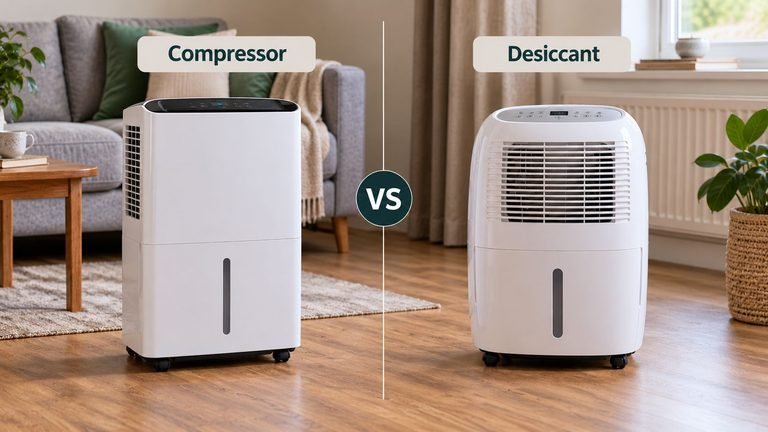
Compressor vs desiccant for drying clothes
For a heated UK home, a compressor dehumidifier is normally the more economical choice. The Arete Two 20L and OmniDry 20L both have much lower published power consumption than a desiccant model on its higher setting, while still offering plenty of capacity for regular family laundry.
Desiccant dehumidifiers become more compelling as the room gets colder. The DD8L Pro and EcoAir DD1 Simple MK3 are both rated to work from 1°C, and their warmer exhaust air helps create better drying conditions around the clothes. Meaco’s own figures show how big the gap can get: at 10°C, the DD8L Pro is rated at 6.89L/day against 3.35L/day for the Arete Two.
There’s no single cut-off temperature, but as your drying room heads towards 10°C and below, a desiccant model becomes increasingly worth considering. Room size, humidity, airflow and how often you dry washing indoors matter too. For a fuller explanation of how the two technologies work, see our compressor vs desiccant guide.
Frequently asked questions
Is a dehumidifier good for drying clothes indoors?
Yes. A dehumidifier lowers the room’s relative humidity, so moisture keeps evaporating from wet clothes rather than building up in the air around them. It also cuts down on condensation. Good airflow around the airer helps as well, so leave some space between garments rather than packing them together.
How long does it take to dry clothes with a dehumidifier?
It varies too much to give a single figure. Load size, fabric, spin speed, room size and temperature all make a difference. Independent testing of the DD8L Pro saw a mixed load dry overnight on its six-hour laundry cycle, and quicker results have been reported when a fan or heated airer was used alongside a dehumidifier. Be wary of any drying time quoted without the conditions behind it.
Should I open a window while using a dehumidifier to dry clothes?
Usually not during the drying session. An open window lets in outside air, which makes it harder for the dehumidifier to control humidity in the room. Keeping windows and doors closed generally gives you a more efficient drying space, as long as the appliance is positioned and used according to the manufacturer’s instructions.
What size dehumidifier is best for drying clothes?
For occasional loads in a small, heated room, a 12–16L compressor dehumidifier can be enough. A 20L-class compressor model gives you more headroom for frequent family laundry or larger rooms.
Don’t compare the headline litres-per-day rating of a desiccant dehumidifier directly with a compressor model’s, though. They’re usually measured under different conditions and respond differently to temperature, which is why a lower-rated desiccant machine can still be the better choice for a cold utility room or garage.
Can I dry clothes with a dehumidifier in a cold garage or conservatory?
Yes, but a desiccant model is the better fit. The two compressor models here with a published operating range are rated from 5°C, and compressor extraction drops sharply as the temperature falls. The DD8L Pro and EcoAir DD1 Simple MK3 are both rated to work from 1°C.
Is a dehumidifier cheaper to run than a tumble dryer?
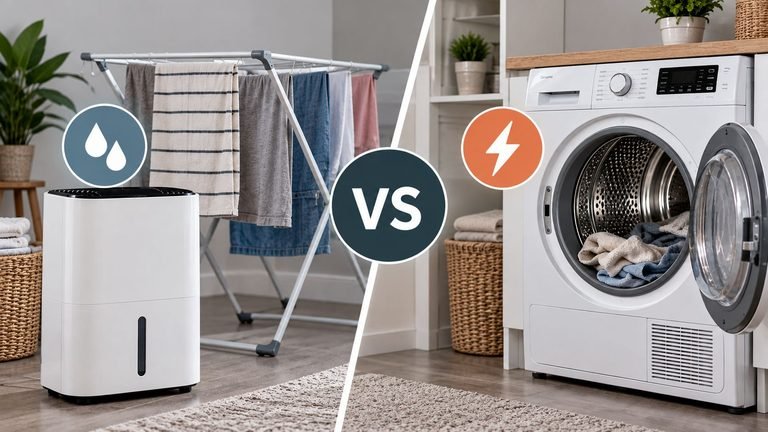
A dehumidifier usually draws far less power while it’s running, but it normally takes much longer to dry a load. The final cost depends on the dehumidifier, drying time, room conditions, the amount of washing and the tumble dryer you’re comparing it with. For a fair comparison, look at the electricity used for a complete drying session rather than the hourly running cost alone.
Do I need a heated airer as well?
No. A dehumidifier can dry laundry effectively with an ordinary clothes airer. A heated airer or separate fan may shorten the drying time, but it also adds to the total electricity used, so results from a combined setup shouldn’t be read as the dehumidifier’s performance or running cost on its own.
Final verdict
The Meaco DD8L Pro is our first choice for drying clothes, particularly if your laundry room is cool. Its desiccant system costs more to run than an efficient compressor model, but its cold-room extraction and encouraging independent laundry evidence give that extra energy use a clear purpose.
For a normally heated home, the MeacoDry Arete Two 20L is the stronger compressor, with the highest published airflow here, a 4.8L tank, low published consumption and a five-year warranty. The Pro Breeze OmniDry 20L is the value pick if you’d rather spend less, as long as you’re comfortable with its one-year standard warranty.
The EcoAir DD1 Simple MK3 is the straightforward alternative for a genuinely cold laundry room, while the Daewoo COL1671GE 16L makes sense when keeping the purchase price down matters more than premium features.
Whichever you choose, start with the temperature of the room where you actually dry your clothes, then look at airflow, tank size, running cost and how often you dry washing indoors. Those tell you far more about day-to-day suitability than the biggest litres-per-day number on the box.
Specifications, prices, stock and warranty terms can change, so check the exact model and the retailer’s terms before you buy.
One Comment