
5 Best Dehumidifiers in the UK (2026)
Most people start shopping for a dehumidifier after a bad winter morning: streaming windows, a musty spare room, or washing that still isn’t dry two days later. The awkward part is that the number on the box, 12L, 20L, 30L, tells you less than you’d expect. It describes extraction under specific test conditions, not what you’ll pour out of the tank each morning.
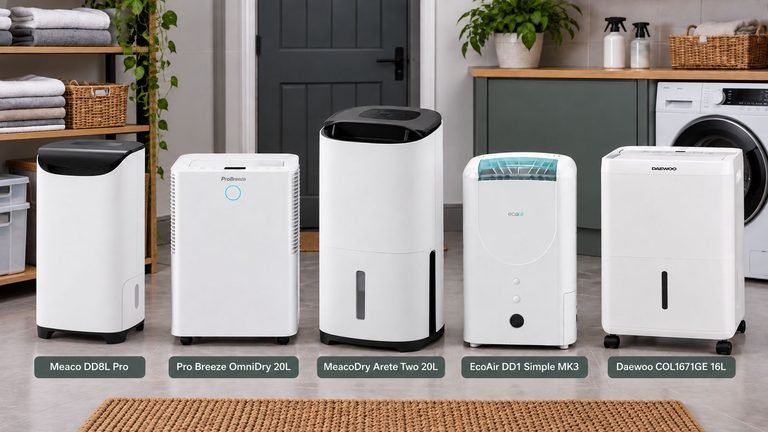
These five cover the situations UK homes actually run into: a flat with condensation, a family home with constant indoor laundry, a cold garage, and a large open-plan space. Every specification here comes from the manufacturer’s own published data, with the test conditions shown wherever they’re stated.
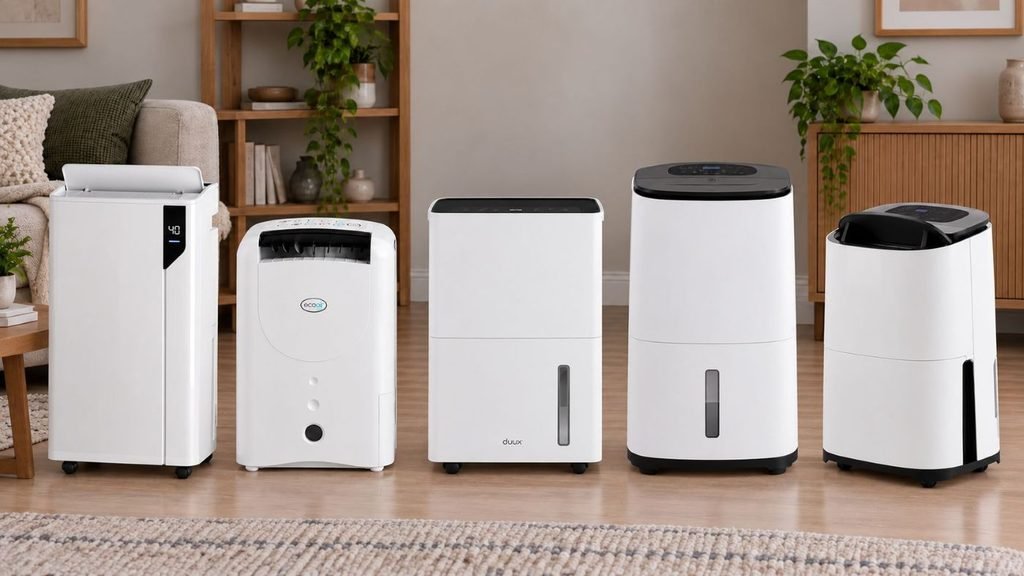
Best Dehumidifiers: Quick verdict
For most households, the MeacoDry Arete Two 20L is the strongest all-rounder. It pairs useful whole-home capacity with a large 4.8-litre tank, automatic humidity control, a laundry mode, app and voice control, HEPA air purification and a five-year warranty. Meaco publishes 207W at 20°C and 60% relative humidity, which is low for this capacity class and matters on a machine that may run for hours a day through autumn and winter.
The Pro Breeze 20L Premium is the value alternative at roughly half the price, with the biggest tank here at 5.5 litres. Smaller properties are better served by the MeacoDry Arete Two 12L, which keeps almost every useful feature of its bigger sibling in a quieter, lower-powered body.
The last two solve narrower problems. The EcoAir DD1 Classic MK6 is a desiccant machine specified to work from 1°C, which is the right answer for garages, conservatories and unheated utility rooms where a compressor struggles. The Duux Bora Smart 30L is the high-capacity option for large heated rooms, though its stated 15°C minimum rules it out of cold spaces entirely.
Best Dehumidifiers in the UK: Comparison
| Model | Best for | Type | Extraction | Tank | Noise | Operating temp. | Editorial score |
|---|---|---|---|---|---|---|---|
| MeacoDry Arete Two 20L | Best overall | Compressor | 8.5L/day at 20°C/60% RH | 4.8L | 38 / 40 / 50dB | 5–35°C | 9.4/10 |
| Pro Breeze 20L Premium | Best value | Compressor | Up to 20L/day* | 5.5L | 39dB stated | 5–35°C | 9.0/10 |
| MeacoDry Arete Two 12L | Best for flats and smaller homes | Compressor | 5.4L/day at 20°C/60% RH | 2.5L | 35 / 38 / 44dB | 5–35°C | 8.9/10 |
| EcoAir DD1 Classic MK6 | Best for cold rooms and garages | Desiccant | 7.5L/day at 20°C/60% RH | 2L | 34 / 46dB | 1–40°C | 8.8/10 |
| Duux Bora Smart 30L | Best for large rooms | Compressor | Up to 30L/day* | 4L | 36–42dB | From 15°C | 8.7/10 |
Tap a model name to jump to its full review. *Manufacturer publishes no test conditions for this figure.
One column in that table needs explaining, because it’s where most dehumidifier comparisons quietly mislead people. The Arete Two 20L looks like it extracts less than half as much as the Pro Breeze. It doesn’t.
Meaco publishes what its machine collects in a room at 20°C and 60% humidity, which is roughly what a lived-in British house feels like. Most brands publish the figure from a warm, humid test chamber instead, and that number is always much bigger. Run the Arete Two 20L in those same warm conditions and Meaco’s own data has it reaching 20.45 litres a day. Same class of machine, more honest number.
So when you see a bare “20L” or “30L” on a box, read it as a size category rather than a daily promise. The realistic figure for a normal heated room is usually somewhere between a third and a half of it.
How I chose these five best dehumidifiers
A useful shortlist can’t be built on litres per day alone. Compressor and desiccant machines behave differently as rooms get colder, tank size changes how annoying a machine is to live with, and a unit that suits a heated family home can be close to useless in an unheated garage.
So the picks weigh extraction capacity against the things you notice in daily use: tank size, humidity control, noise at the lowest fan speed, operating temperature range, laundry functionality, continuous drainage, published power consumption and warranty length. I’ve deliberately included two capacities of the same machine and one desiccant model, because the right answer genuinely depends on the room.
On the scores: these are editorial judgements of how well each machine suits the job it’s here to do, based on published manufacturer specifications, feature set, warranty and price. They are not test results, and I haven’t run these machines in a lab. A model isn’t marked down for having a lower headline extraction figure than another, only for falling short of what its own buyer needs.
1. MeacoDry Arete Two 20L: best overall
Score: 9.4/10
The Arete Two 20L is where I’d start for a typical family home. Its appeal isn’t one headline specification, it’s that the everyday details are right: a 4.8-litre tank, three fan speeds, automatic humidity control, a dedicated laundry mode with an adjustable 1 to 12 hour timer, and a five-year warranty that no other brand here matches as standard.
Meaco publishes extraction of 8.5 litres per day at 20°C and 60% relative humidity, drawing 207W under those same conditions. That combination is the reason it takes first place. Plenty of machines will pull moisture out of warm, damp air; doing it at around 200W in ordinary room conditions is what keeps the running cost sensible when the machine is on for six or eight hours a day.
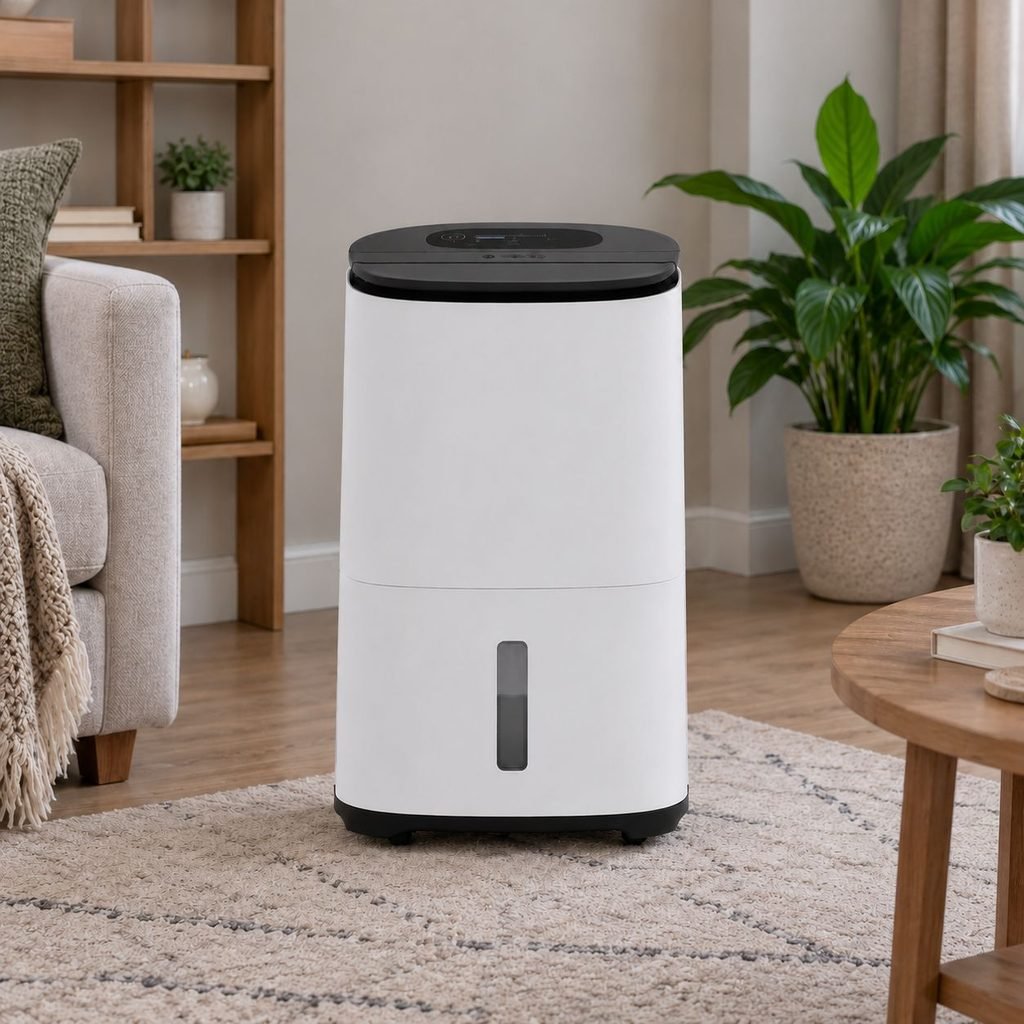
Meaco also publishes figures further down the temperature range, which is unusual and genuinely useful. At 10°C and 60% RH the same unit manages 3.35 litres per day. That’s a real drop, and it’s the clearest illustration you’ll find of why a compressor model isn’t the right tool for a cold garage, even a good one like this.
The air-purification mode and included H13 HEPA filter are worthwhile extras rather than the main event, and there’s a separate purification-only mode for when you don’t need dehumidification. Worth knowing before you buy: no drainage hose is supplied. Meaco includes an adapter so you can use a standard garden hose instead, which is fine if you have one and mildly irritating if you don’t.
Specifications
| Type | Compressor dehumidifier and air purifier |
| Extraction, typical room (20°C / 60% RH) | 8.5 litres/day |
| Extraction, warm and humid (30°C / 80% RH) | 20.45 litres/day |
| Extraction, cold room (10°C / 60% RH) | 3.35 litres/day |
| Tank | 4.8 litres |
| Power | 207W at 20°C/60% RH |
| Noise | 38 / 40 / 50dB(A) by fan speed |
| Operating temperature | 5–35°C |
| Airflow | 150 / 175 / 255m³/h |
| Humidistat range | 40–70% RH |
| Features | Smart humidity mode, Smart Laundry mode, app and voice control (Alexa, Google), HEPA and dust filtration, night mode, child lock, 1–24 hour timer, castors, continuous drainage |
| Dimensions | 61.8 × 36.6 × 27.2cm (H × W × D) |
| Weight | 15.1kg |
| Warranty | 5 years |
Pros and cons
- Low published power consumption for the capacity, at 207W in typical room conditions
- Large 4.8-litre tank reduces emptying during damp spells
- Smart Laundry mode with an adjustable 1–12 hour timer
- Five-year warranty as standard
- Meaco publishes extraction data across six temperature and humidity combinations
- HEPA filtration with a standalone air-purification mode
- Roughly twice the price of the Pro Breeze
- At 15.1kg it’s the sort of thing you position once rather than carry about
- 50dB on the highest fan speed is noticeable in a quiet room
- More capacity than a one-bedroom flat needs
- No drainage hose in the box, only an adapter
Who should buy it: Anyone with a medium-to-large heated home who wants one machine to handle condensation, damp-prone rooms and regular indoor washing. It makes most sense if it’ll be running most days through the colder months.
Who should avoid it: Anyone dealing with occasional bathroom condensation in a small flat. The 12L model is the more sensible buy there. If the problem room is genuinely cold, the EcoAir is the better fit.
2. Pro Breeze 20L Premium: best value
Score: 9.0/10
This is the pick for anyone who wants 20L-class capacity without premium pricing. Its most practical advantage is the 5.5-litre tank, the largest in this shortlist, which meaningfully cuts how often you’re carrying water to the sink during a wet fortnight or a run of indoor laundry.
The rest of the specification is sensibly judged: five operating modes, a one-click laundry mode, an oscillating louvre, an activated carbon filter, a humidity indicator and continuous drainage with a hose included. Pro Breeze states a room-size guide of 20 to 30m² and airflow of 180m³/h.
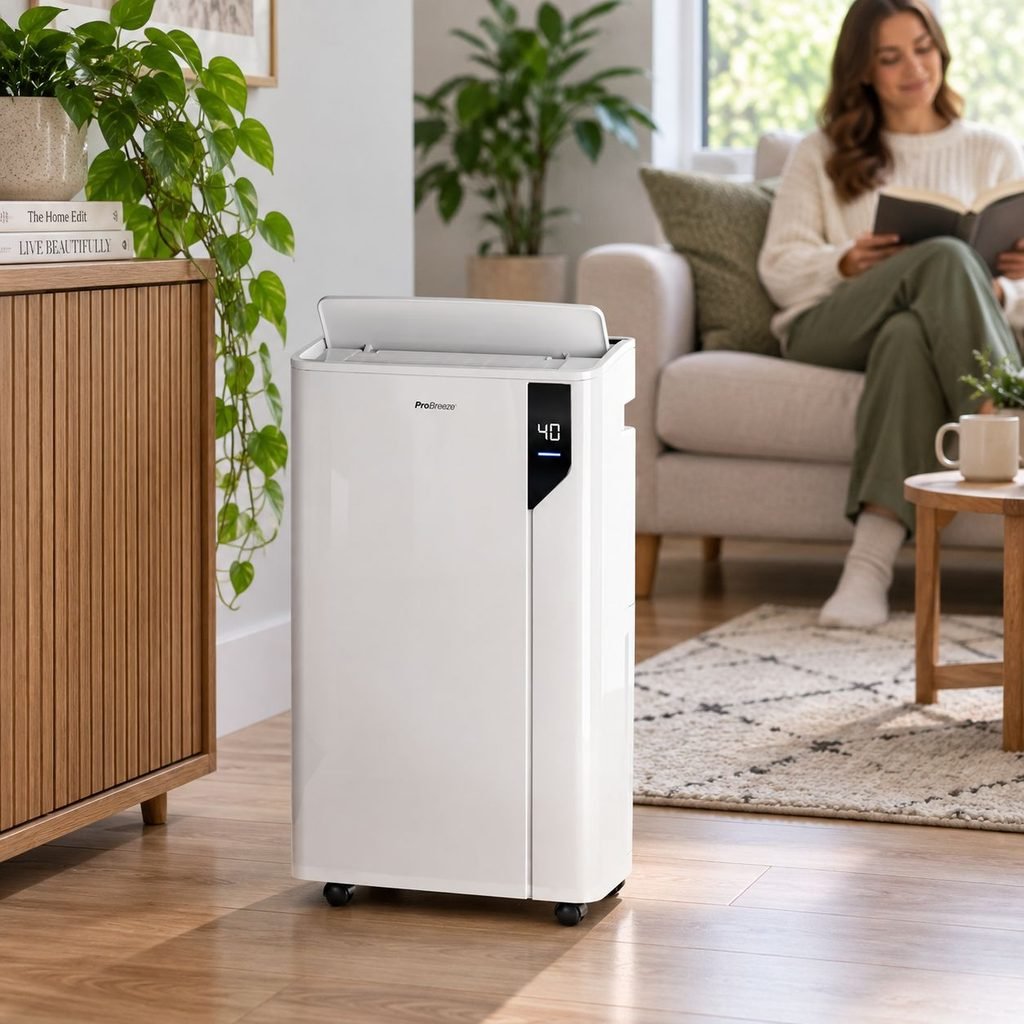
Two things are worth being clear about. First, the 20L/day headline is published without test conditions, so treat it as a capacity class rather than a daily expectation. Second, the power figures need care: Argos lists the unit at 500W, while Pro Breeze quotes 0.27kWh per hour of operation, which works out at around 270W in normal use. Those aren’t contradictory. The higher number is a rated maximum and the lower one reflects typical running. It does mean you can’t line 500W up against Meaco’s 207W and draw a conclusion, because they’re measuring different things.
The warranty is where the price gap shows. Pro Breeze products bought from an official distributor come with a one-year limited warranty, extendable to three years only by buying an optional protection plan separately. Against five years as standard on the Meacos, that’s a genuine difference on an appliance you expect to run hard every winter.
Specifications
| Type | Compressor |
| Extraction | Up to 20L/day (test conditions not published) |
| Tank | 5.5 litres |
| Power | 500W rated; around 270W in typical operation per manufacturer figures |
| Noise | 39dB stated at retail; Pro Breeze quotes up to 42dB(A) elsewhere |
| Airflow | 180m³/h |
| Operating temperature | 5–35°C per the instruction manual |
| Suggested room size | 20–30m² |
| Features | Five operating modes, one-click laundry mode, oscillating louvre, humidity indicator, activated carbon filter, timer, continuous drainage with hose included |
| Dimensions | 60.8 × 35.5 × 20cm (H × W × D), manufacturer-stated |
| Weight | 13kg |
| Warranty | 1 year standard; optional paid 3-year protection plan |
Pros and cons
- Around half the price of the Arete Two 20L
- Largest tank here at 5.5 litres
- One-click laundry mode and an oscillating louvre to spread airflow
- Drainage hose supplied in the box
- Quiet enough at a stated 39dB for most living spaces
- One-year standard warranty, with longer cover charged as an extra
- Extraction figure published without test conditions
- No app or voice control on this model
- 13kg is still awkward to move regularly
- Stated 30m² room guidance limits it in larger open-plan spaces
Who should buy it: Anyone who wants capable moisture removal and indoor laundry drying for a sensible price, and who cares more about tank size and getting the basics right than about app control or a long warranty.
Who should avoid it: Anyone putting the machine in a bedroom or small flat, where the quieter 12L Meaco fits better. Also worth skipping if warranty length sits high on your list.
3. MeacoDry Arete Two 12L: best dehumidifier for flats and smaller homes
Score: 8.9/10
The 12L isn’t here just as a smaller version of the winner. It solves a different problem. In a flat or a small house, a 20L or 30L machine takes up more floor space, costs more to run and gives you capacity you’ll rarely use. Meaco pitches this one at flats and 1 to 3 bedroom homes, which is about right.
At 20°C and 60% RH it’s quoted at 5.4 litres per day drawing 136W. The lowest fan setting is 35dB, quiet enough that it won’t dominate a bedroom, and the whole unit is 10.9kg against 15.1kg for the 20L. The 2.5-litre tank is the main compromise, though it’s proportionate to the smaller body and less of an issue if you run a drainage hose.
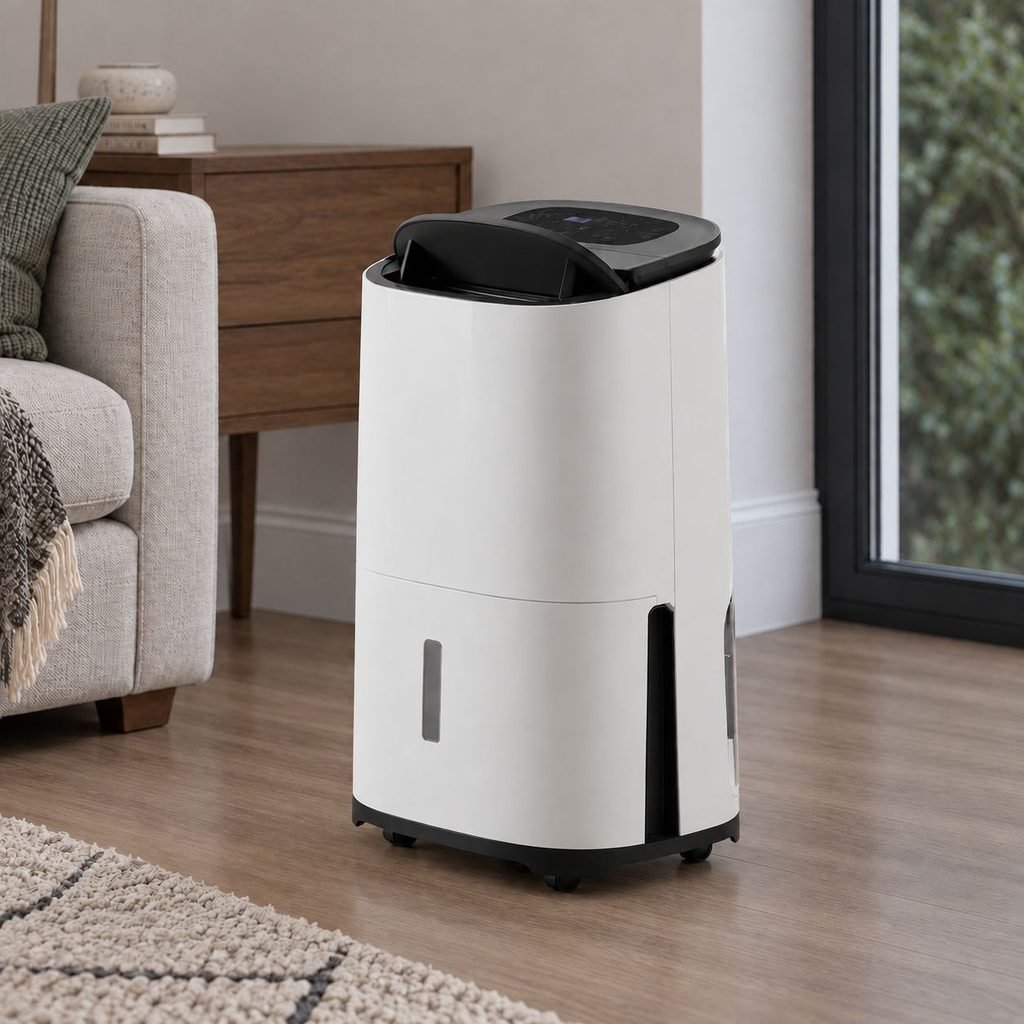
What makes it an easy recommendation is that downsizing costs you almost nothing in features. Three fan speeds, Smart Laundry mode, automatic humidity control, app and voice control, HEPA filtration, continuous drainage and the same five-year warranty are all still here. It’s also wall-mountable with optional brackets, which is handy in a utility room or a small office where floor space is the actual constraint.
Specifications
| Type | Compressor dehumidifier and air purifier |
| Extraction, typical room (20°C / 60% RH) | 5.4 litres/day |
| Extraction, warm and humid (30°C / 80% RH) | 11.99 litres/day |
| Extraction, cold room (10°C / 60% RH) | 1.97 litres/day |
| Tank | 2.5 litres |
| Power | 136W at 20°C/60% RH |
| Noise | 35 / 38 / 44dB(A) by fan speed |
| Operating temperature | 5–35°C |
| Airflow | 80 / 100 / 140m³/h |
| Humidistat range | 40–70% RH |
| Features | Smart humidity mode, Smart Laundry mode, app and voice control, HEPA and dust filtration, night mode, child lock, timer, wall-mountable with optional brackets, continuous drainage |
| Dimensions | 47.2 × 31.9 × 23.7cm (H × W × D) |
| Weight | 10.9kg |
| Warranty | 5 years |
Pros and cons
- 35dB on the lowest fan setting suits bedrooms and home offices
- 136W at 20°C/60% RH, the lowest draw of the compressor models here
- Noticeably smaller and lighter than the 20L
- Keeps Smart Laundry, app control and HEPA filtration
- Wall-mountable with optional brackets
- Same five-year warranty as the larger model
- 2.5-litre tank needs emptying more often
- Not enough capacity for heavy whole-home moisture problems
- Costs more than basic 10–12L machines
- 10.9kg isn’t what most people would call portable
Who should buy it: Anyone in a flat or a 1 to 3 bedroom house where condensation and indoor laundry are regular problems but a 20L machine would be overkill. It’s also the pick if the unit will spend its time in a bedroom, where noise matters more than capacity.
Who should avoid it: Anyone dealing with damp across several rooms of a larger house, or anyone whose problem space regularly drops close to freezing.
4. EcoAir DD1 Classic MK6: best dehumidifier for cold rooms and garages
Score: 8.8/10
The DD1 Classic is the specialist here, and the only desiccant machine on the list. Rather than condensing moisture on cold coils, it passes air over a moisture-absorbing material, which is why it keeps working when a compressor starts to fade. EcoAir specifies an operating range of 1°C to 40°C and a coverage area of up to 60m².
Quoted extraction is 7.5 litres per day at 20°C and 60% RH, with power consumption of 300W in low mode and 580W in high mode, plus a 25W humidity-sampling mode when it’s idling. Set against 207W for the Arete Two 20L at the same reference point, that’s a lot more electricity for less water, and it’s exactly why I wouldn’t buy this for a heated living room.
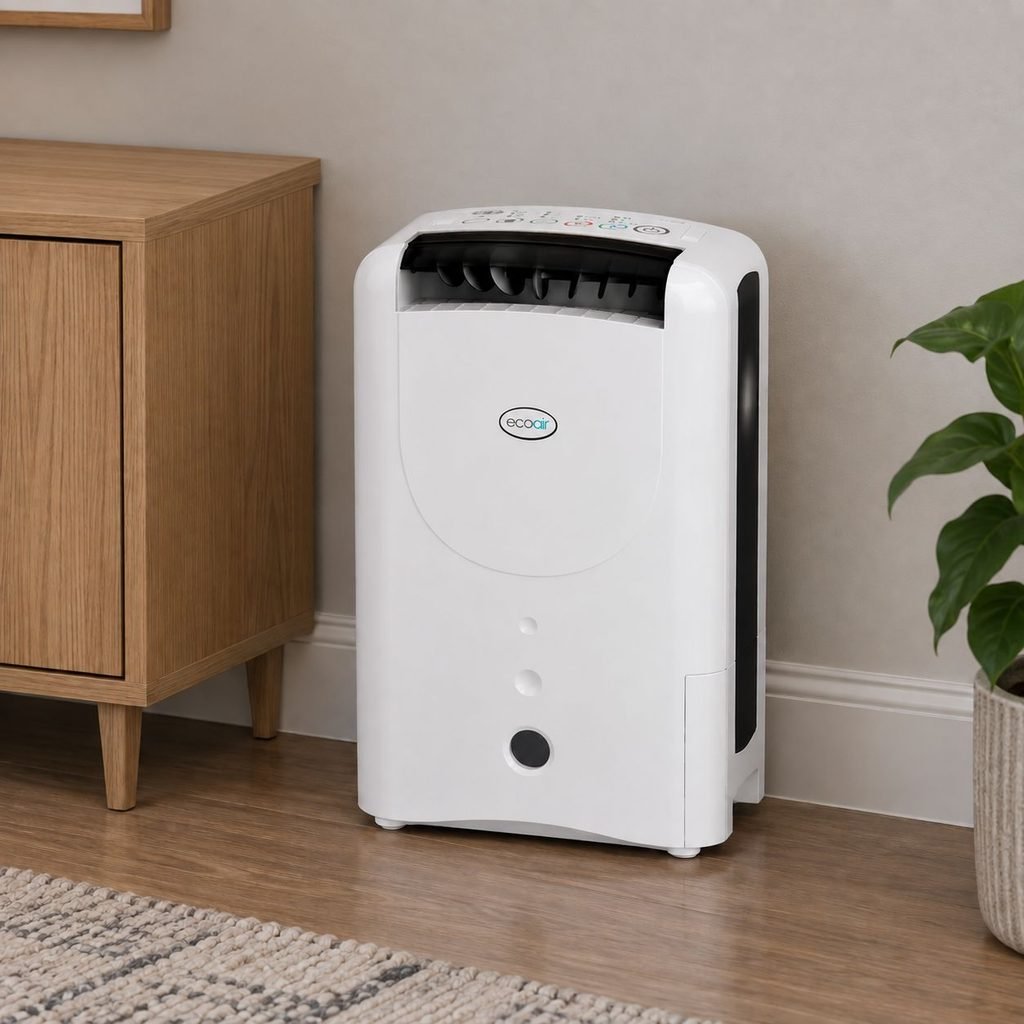
The picture changes in a cold space. Look at Meaco’s published figures again: the Arete Two 20L drops to 3.35 litres per day at 10°C. The DD1’s advantage isn’t efficiency, it’s that it still does the job when the temperature falls. There’s a side benefit too, and it’s a real one in a garage or conservatory: desiccant machines discharge slightly warm air, which nudges the room temperature up and helps clothes dry.
At 6kg with a carry handle, it’s easily the most portable machine here, which suits people who want to move it to whichever room needs it. The feature list is fuller than the price suggests: laundry mode with a turbo function, economy mode, E7 humidity sensing, a manually adjustable 3D louvre, an ioniser, a silver nano antibacterial filter, over-dry and tilt protection, and a one-metre drainage hose in the box. The warranty is three years.
Specifications
| Type | Desiccant |
| Extraction, typical room (20°C / 60% RH) | 7.5 litres/day |
| Tank | 2 litres, with carry handle |
| Power | 25W sampling / 300W low / 580W high |
| Noise | 34 / 46dB(A) |
| Operating temperature | 1–40°C |
| Coverage | Up to 60m² |
| Features | Laundry mode with turbo, economy mode, E7 humidity sensing, 3D louvre, ioniser, silver nano filter, 2/4/8 hour off timer, auto restart, over-dry and tilt protection, 1m drainage hose included |
| Dimensions | 47.5 × 29 × 17.5cm (H × W × D) |
| Weight | 6kg |
| Warranty | 3 years |
Pros and cons
- Specified to work from 1°C, where compressor models fall away
- Discharges slightly warm air, which helps in an unheated room
- 6kg with a carry handle, genuinely easy to move between rooms
- 34dB low setting is the quietest figure on this list
- Drainage hose and ioniser included as standard
- Three-year warranty
- 300W low and 580W high is far more than the compressor models draw
- Small 2-litre tank for a machine rated at 7.5L/day
- Poor value as an everyday machine for heated living spaces
- The warm air it produces is unwelcome in summer
Who should buy it: Anyone whose problem is a garage, cellar, conservatory, boat or unheated utility room. It also suits anyone who wants one light machine they can carry to whichever room has gone damp this week.
Who should avoid it: Anyone running it in a normally heated bedroom or lounge for hours at a time. A compressor model does that job for a fraction of the electricity.
5. Duux Bora Smart 30L: best dehumidifier for large rooms
Score: 8.7/10
The Bora Smart is the high-capacity option, rated at up to 30 litres a day with 230m³/h airflow and an effective space of 50m². That suits large heated rooms, open-plan areas and homes where indoor laundry adds a lot of moisture at once.
Its power consumption is better than the capacity implies. Duux publishes a range of 20 to 315W, with 0.9W on standby, and Currys lists the unit at 314W. For a machine of this size that’s reasonable, and it undercuts the desiccant EcoAir’s high mode by a wide margin.
You also get app control through the Duux Smart app, an adjustable hygrostat with an unusually wide 30 to 80% range, night mode, a carbon filter, automatic defrost, a self-cleaning function and a dedicated laundry programme on a four-hour timer. Noise is quoted at 36 to 42dB.
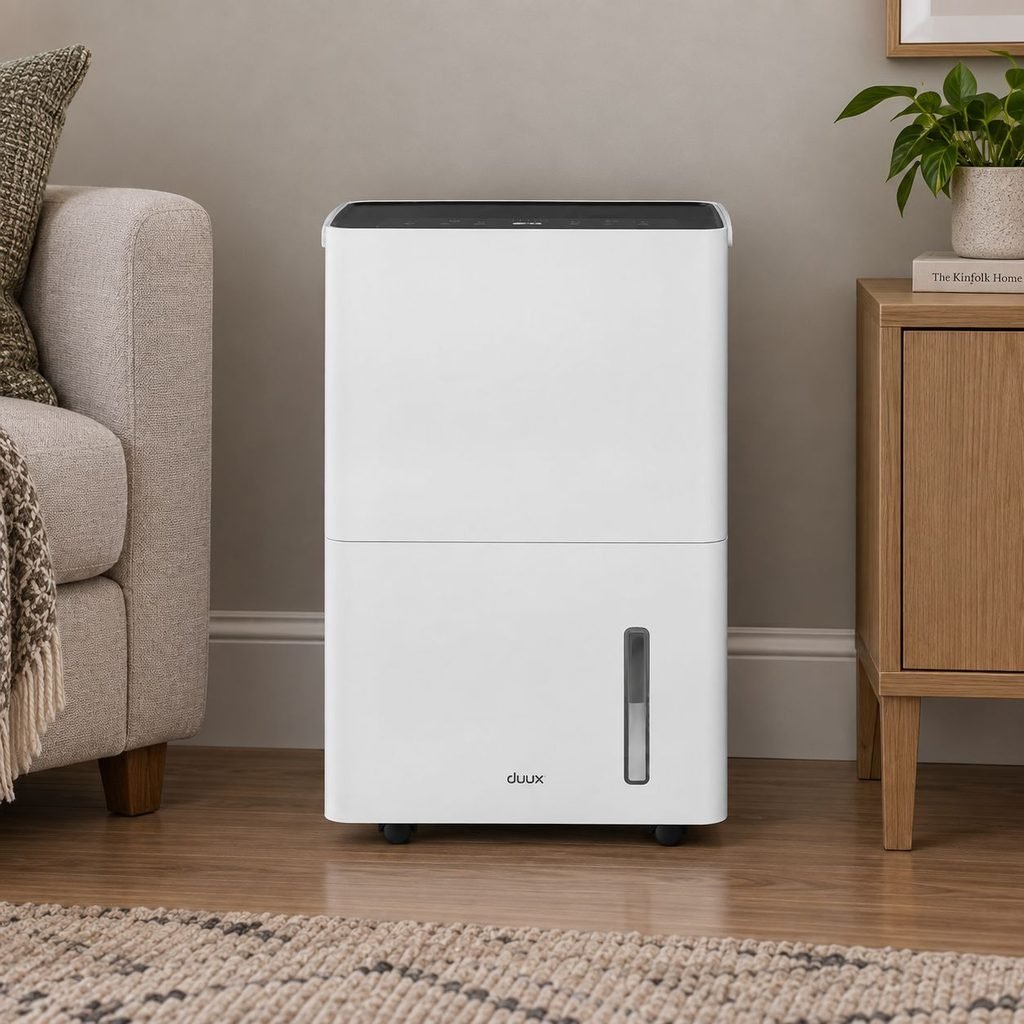
The caveat is temperature, and it’s a firm one. Duux specifies a minimum operating temperature of 15°C, higher than every other machine here. This is a dehumidifier for heated living space, not for the garage. The 4-litre tank is also on the modest side for something rated at 30L/day, so if you’re going to work it hard, plan on using the drain hose connection rather than emptying it by hand.
Specifications
| Type | Compressor |
| Extraction | Up to 30L/day (test conditions not published) |
| Tank | 4 litres |
| Power | 20–315W; 0.9W standby |
| Noise | 36–42dB |
| Airflow | 230m³/h |
| Effective space | Up to 50m² |
| Minimum operating temperature | 15°C |
| Hygrostat range | 30–80% RH |
| Features | App control, hygrostat, night mode, carbon filter, automatic defrost, self-cleaning function, 1–24 hour timer, four-hour laundry programme, wheels and carry handle, continuous drainage |
| Dimensions | 51 × 32 × 23.5cm (H × W × D) |
| Weight | 14.5kg |
| Guarantee | 24 months |
Pros and cons
- Highest headline extraction here at up to 30L/day
- 230m³/h airflow suits large and open-plan rooms
- Peak draw of around 315W is modest for the capacity
- App control and a wide 30–80% hygrostat range
- Quiet 36dB night mode
- 15°C minimum operating temperature rules out cold spaces
- 4-litre tank is small relative to the extraction rating
- 24-month guarantee against five years on the Meacos
- Heavy at 14.5kg, and the priciest machine on the list
- Extraction figure published without test conditions
Who should buy it: Anyone with a genuinely large heated room or open-plan space, a heavy moisture load, and somewhere sensible to run a drain hose.
Who should avoid it: Anyone whose target room is a garage or anywhere that drops below 15°C. Also anyone drawn to 30L capacity mainly because the number sounds reassuring.
Best Dehumidifiers running costs: what the numbers actually mean
Running cost is where dehumidifier marketing gets slippery, because every manufacturer quotes pence per hour at a different electricity rate. To make these comparable, the table below applies a single assumed unit rate of 27p per kWh to each machine’s published power figure. Substitute your own rate from a recent bill for a figure that means something for your home.
| Model | Published power | Cost per hour at full draw (27p/kWh) |
|---|---|---|
| MeacoDry Arete Two 12L | 136W at 20°C/60% RH | 3.7p |
| MeacoDry Arete Two 20L | 207W at 20°C/60% RH | 5.6p |
| Pro Breeze 20L Premium | Around 270W typical | 7.3p |
| Duux Bora Smart 30L | Up to 315W | 8.5p |
| EcoAir DD1 Classic MK6 | 300W low / 580W high | 8.1p / 15.7p |
Worked example only, calculated from published power figures at an assumed 27p/kWh. Not a measured running cost.
Those numbers come with caveats, and they change the picture more than you’d think.
A humidistat-controlled machine set to a target of, say, 55% RH doesn’t draw its quoted wattage all day. It pulls the room down to target, switches the compressor off, and idles until humidity creeps back up. In a moderately damp room that can mean it’s actively dehumidifying for a fraction of the hours it’s switched on, so your real daily cost is usually well below eight hours at full draw. The EcoAir makes this explicit with a 25W sampling mode.
The figures also aren’t measured the same way. Meaco’s are power draw at a stated 20°C and 60% RH. Pro Breeze’s 500W is a rated maximum, with roughly 270W the figure that reflects normal operation. Duux publishes a range. Comparing them precisely isn’t possible, which is why the table above is a rough guide rather than a league table.
And the cheapest machine to run isn’t always the right one. The EcoAir looks expensive on this table, but in a 5°C garage the compressor models would be collecting very little water for their electricity, which is a worse outcome than paying more per hour for a machine that works.
Which dehumidifier should you choose?
| If this sounds like your home | Choose | Why | Main compromise |
|---|---|---|---|
| 3–5 bedroom home, condensation and regular indoor laundry | MeacoDry Arete Two 20L | Best balance of capacity, controls and low power draw, with five-year cover | Higher purchase price |
| Want 20L-class capacity on a budget | Pro Breeze 20L Premium | Biggest tank here and the essentials done well for around half the price | One-year standard warranty, no app |
| Flat or 1–3 bedroom home, bedroom use | MeacoDry Arete Two 12L | Quieter at 35dB, lower powered and more compact, same features | Smaller 2.5L tank |
| Cold garage, cellar, conservatory or utility room | EcoAir DD1 Classic MK6 | Desiccant design works from 1°C and puts out slightly warm air | Much higher power consumption |
| Large heated or open-plan room, heavy moisture load | Duux Bora Smart 30L | Up to 30L/day with 230m³/h airflow and app control | 15°C minimum operating temperature |
What to look for when buying a dehumidifier
What size dehumidifier do I need?
Start with the space and the problem rather than the number on the box. As a rough guide, a 10 to 12L machine suits a flat or small house with mild condensation. A 20L machine suits a typical 3 to 4 bedroom home, or any home where washing is dried indoors most weeks. A 25 to 30L machine only makes sense when you have a genuinely large or open-plan area, or a persistent damp problem that a smaller unit can’t keep ahead of.
One point that catches people out: litres per day is an extraction rating, not a description of the machine’s physical size or its tank. A 30L machine doesn’t hold 30 litres of water. The Duux here is rated at 30L/day and has a 4-litre tank.
Don’t compare litres per day without the test conditions
A 20L or 30L headline figure places a machine in a broad capacity class. It isn’t a promise about what you’ll find in the tank tomorrow morning. Extraction changes considerably with temperature and relative humidity, and the headline number is usually measured in warm, humid conditions that don’t resemble a British house in February.
Where a manufacturer publishes figures at 20°C and 60% RH, take those seriously. They’re a much better guide to what you’ll see day to day, and a brand willing to publish them is telling you something about its confidence.
Compressor or desiccant?
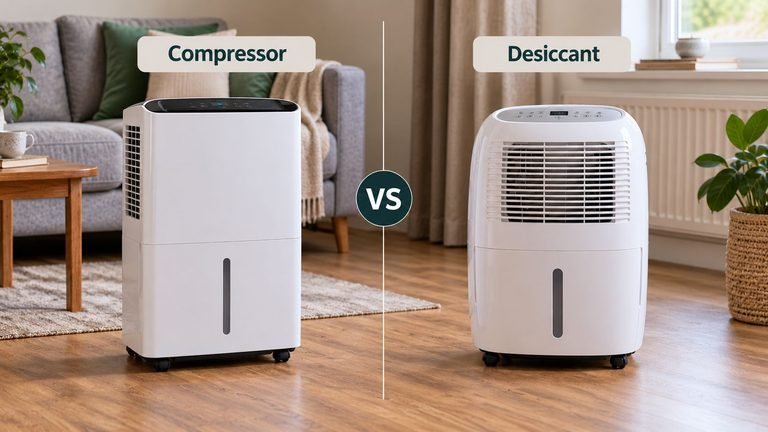
A compressor dehumidifier draws air across cold coils so moisture condenses out. That works well in a heated room, and these machines are the more efficient choice for ordinary indoor use. As the room gets colder, though, there’s less of a temperature difference to work with and output falls away. Meaco’s published data shows this plainly: the Arete Two 20L goes from 8.5 litres a day at 20°C to 3.35 litres at 10°C.
A desiccant machine passes air over a moisture-absorbing material instead, so it doesn’t depend on that temperature difference. It keeps working in the cold, and it discharges slightly warm air as a by-product. The trade-off is electricity: desiccant models typically draw considerably more power than a compressor of similar capacity.
The practical rule is to let the room decide. Heated living space, compressor. Garage, cellar, conservatory, boat or anywhere that regularly drops below about 15°C, desiccant.
Tank size and continuous drainage
A small tank isn’t a problem if you use continuous drainage, but it gets tedious during a wet spell. If you plan to empty it by hand, a 4 to 5.5 litre tank makes daily ownership noticeably easier than a 2-litre one, especially when the machine is also drying laundry.
Check what’s in the box, too. The EcoAir and Pro Breeze both include a drainage hose; Meaco supplies an adapter for a standard garden hose rather than a hose itself. And gravity drainage only works if there’s somewhere lower to drain to. Running water upwards to a sink needs a pump, which is a separate purchase.
Noise figures need context
Dehumidifiers change fan speed and cycle their compressors, so a single dB figure rarely tells the whole story. Look for the lowest and highest published settings where a brand provides both. The Arete Two 20L is quoted at 38, 40 and 50dB across its three speeds, and that top figure is a very different proposition from the bottom one. A bedroom has a different noise requirement from a hallway or utility room.
Humidity control
A humidistat is the feature that makes a dehumidifier something you can leave alone. Set a target, usually somewhere around 50 to 55% relative humidity for a normally occupied home, and the machine manages itself rather than extracting flat out. It’s worth checking the adjustable range: the Meacos run between 40 and 70% RH, while the Duux allows 30 to 80%.
Laundry mode is useful, but airflow matters more
A laundry mode typically overrides the humidity target and runs the machine harder for a set period. For better results, space the garments out, keep the room closed, and position the dehumidifier so air can circulate around the washing. You don’t need it pressed against the airer; airflow around the room matters more than proximity. Always follow the manufacturer’s guidance on positioning and clearances, which is usually around 20cm on all sides.
Warranty deserves real weight here
A dehumidifier can run for hours a day across the dampest half of the year, which is harder use than most household appliances get. The spread on this list is wide: five years as standard on both Meacos, three on the EcoAir, two on the Duux, and one on the Pro Breeze unless you pay for the extended plan. Registration requirements and exclusions matter as well as the headline number, so it’s worth reading the terms before you buy rather than after something fails.
Frequently asked questions
What is the best dehumidifier in the UK for most homes?
For the broadest range of households, the MeacoDry Arete Two 20L. It combines useful capacity, automatic humidity control, a proper laundry mode, low published power consumption for its class and a five-year warranty. Smaller flats, very large spaces and cold rooms are all better served by one of the more specialised options above.
Is a 20L dehumidifier better than a 12L model?
Not automatically. A 20L machine has more extraction capacity, but a 12L unit can be quieter, smaller and cheaper to run in a modest property. Buying more capacity than you need mostly means paying more and giving up more floor space.
Which type is best for a cold garage?
A desiccant model. The EcoAir DD1 Classic MK6 in this guide is specified to operate from 1°C, whereas the Duux Bora Smart 30L has a stated minimum of 15°C and the compressor models here are rated from 5°C with output falling as the temperature drops.
Can a dehumidifier help dry clothes indoors?
Yes. Pulling moisture out of the room air lets clothes give up their own moisture faster, and it stops that moisture settling on cold windows and walls instead. It works best in an enclosed room with good air circulation. Drying time still depends on fabric, load size, room temperature, humidity and how closely the clothes are spaced.
Should I run a dehumidifier all day?
You don’t need to run it flat out. A machine with a humidistat responds to the room rather than extracting continuously, so set an appropriate target and let it cycle. There’s little benefit in trying to make a normally occupied home excessively dry, and following the manufacturer’s instructions on target humidity is the sensible starting point.
Is a bigger water tank always better?
A larger tank reduces how often you empty it. It doesn’t make the machine extract moisture any faster. If you use a continuous drain hose, tank capacity stops mattering almost entirely.
Are dehumidifiers expensive to run?
Less than most people expect. Cost depends on the machine’s actual power draw, how long it operates and your electricity tariff. A unit drawing 200W uses 0.2kWh for each hour at that level, so at an assumed 27p per kWh that’s about 5.4p an hour. Multiply by your own unit rate for a figure that fits your tariff. In practice humidistat-controlled machines cycle rather than drawing their quoted power continuously, so daily cost is usually lower than the arithmetic suggests. Desiccant models draw more, but that’s a fair trade in a cold space where a compressor would achieve little.
Final verdict
For most medium-to-large UK homes, the MeacoDry Arete Two 20L is the one to start with. The 4.8-litre tank, 38dB low setting, published 207W draw at typical room conditions and five-year warranty add up to a machine that’s easy to live with over a long damp winter.
Choose the Pro Breeze 20L Premium if the price gap matters more than the warranty and the smart controls. The Arete Two 12L is the better fit for a flat or smaller house, particularly if it’ll be running in a bedroom. For cold or intermittently heated spaces, the EcoAir DD1 Classic MK6 is the only one here that will actually do the job. The Duux Bora Smart 30L earns its place when there’s a genuinely large heated room to manage.
Buy for the space and the conditions you’re actually dealing with, not the biggest number on the box. Room temperature decides the technology, the size of the problem decides the capacity, and tank size and noise decide whether you’ll be happy with the thing in six months.
One Comment