3 Best Dehumidifiers for Mould and Damp in the UK (2026)
Condensation on the windows every morning, a musty smell that won’t shift, black spots creeping along a cold corner: all signs that your home may have a moisture problem. Excess humidity and condensation are often to blame, but poor ventilation, cold surfaces, leaks and other types of damp can look much the same. A dehumidifier helps when there’s too much moisture in the air. Which one you need depends on the size of the space, how damp it is and how long you’ll be running it.
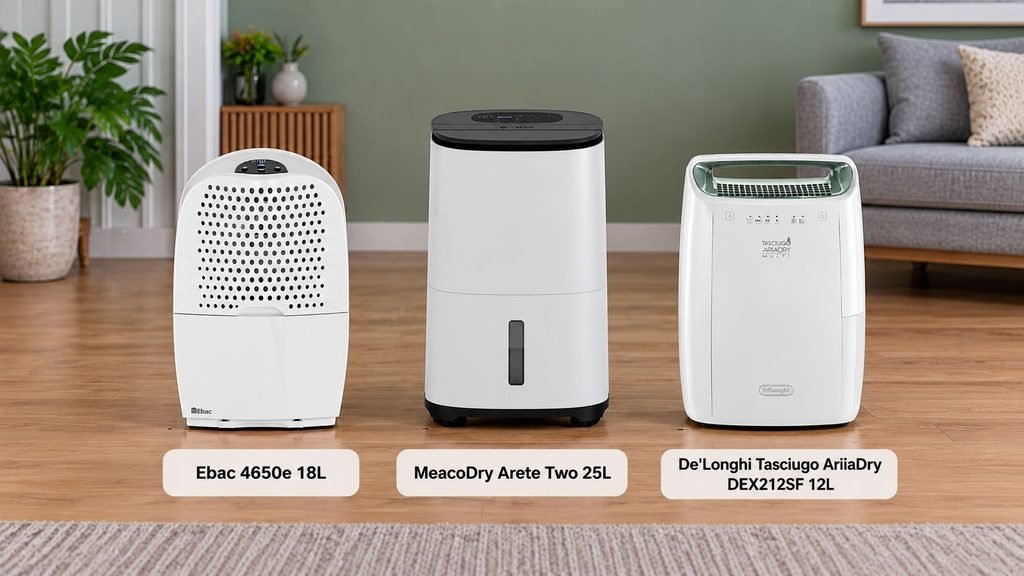
We’ve narrowed the best dehumidifiers for mould and damp down to three, one for each type of home. Our top pick is the Ebac 4650e 18L, mainly for its Smart Control system, which switches the machine on and off as humidity rises and falls through the day. For bigger homes or heavier damp, go for the MeacoDry Arete Two 25L. And if the problem is one smaller room where size and noise matter, the De’Longhi Tasciugo AriaDry Multi DEX212SF 12L is the better fit.
One thing to be clear on before you buy. A dehumidifier reduces excess humidity and condensation, which makes conditions less favourable for mould. It can’t fix a leaking roof, faulty plumbing, penetrating damp, rising damp or any other way water is getting into the building. Existing mould needs cleaning or treating separately. Think of a dehumidifier as a way to control moisture in the air. It won’t fix the cause of persistent damp.
Best Dehumidifiers for Mould and Damp: Comparison
| Model | Best for | Rated extraction | Tank | Key strength | Our rating |
|---|---|---|---|---|---|
| 1. Ebac 4650e 18L | Best overall | 18L/day (test conditions not published) | 3.5L | Smart Control switches on and off as humidity changes | 9.3/10 |
| 2. MeacoDry Arete Two 25L | Large homes and heavy moisture loads | 25.25L/day at 30°C/80% RH; 10.85L/day at 20°C/60% RH | 4.8L | Most capacity, 40–70% humidistat, biggest tank | 9.1/10 |
| 3. De’Longhi Tasciugo AriaDry Multi DEX212SF 12L | Small rooms and everyday humidity | 12L/day at 30°C/80% RH | 2.1L | Compact, with the lowest headline noise figure (36dB(A)) | 8.7/10 |
Our ratings are an editorial judgement for this use case, based on manufacturer specs, features and practicality. They aren’t lab test scores. The extraction figures also come from different test conditions, so don’t compare them like for like.
Our pick: The Ebac 4650e is the most rounded choice for ongoing damp and condensation. Go bigger with the Meaco if you have a larger home or more moisture to shift, or smaller with the De’Longhi if it’s just one room.
How we chose the best dehumidifiers for mould and damp
Litres per day is the number everyone looks at, but it’s only part of the picture. Manufacturers usually measure maximum extraction at 30°C and 80% relative humidity. That’s far warmer and more humid than a heated UK living room in January. In a real home, how much water you collect depends on the temperature, the humidity and how much moisture is actually there. So for damp control we gave more weight to automatic humidity control, the right capacity for the space, power use, tank size, continuous drainage, noise and how easy the machine is to live with.
We also picked three machines for three different homes. The Ebac is the self-managing all-rounder, the 25L Meaco has the capacity for larger homes and heavier moisture loads, and the 12L De’Longhi is sized for a single room. Three similar 18L machines would have been less use to most readers.
This guide is based on current manufacturer specifications, product manuals and UK retailer listings. We treat rated extraction figures as reference points, not a promise of how much water you’ll collect each day. A bigger capacity or higher wattage doesn’t automatically make one machine better. If you want a wider shortlist for general use, see our best dehumidifiers UK guide.
1. Ebac 4650e 18L: Best Overall Dehumidifier for Mould and Damp
Score: 9.3/10
The Ebac 4650e is the one we’d choose for a home where condensation keeps coming back. The 18-litre figure is fine, but Smart Control is the reason it’s here. Ebac says the system measures and remembers the humidity levels in your home, then switches the dehumidifier on as they start to rise and off again as they fall. When you first set it up, the manual says it runs non-stop for six hours before it starts cycling on its own.
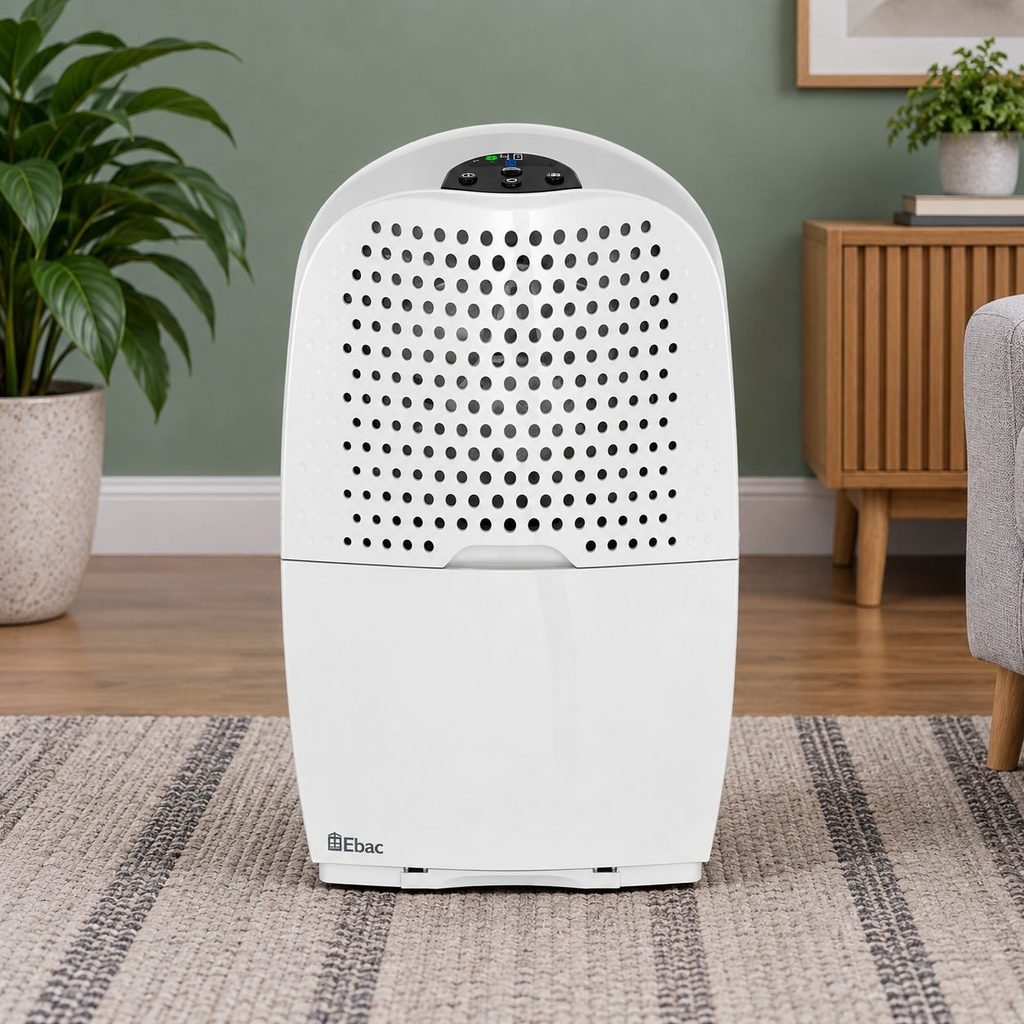
That suits damp control well. Humidity goes up and down all day as people cook, shower and dry washing, and you don’t need bone-dry air. You just need to stop it sitting high for hours at a time. Ebac rates the 4650e for 3–4 bedroom homes (up to 180m²/360m³). Its quoted maximum power draw is 190W, which is low on paper for a machine this size. You also get Wi-Fi app control, a laundry mode and a boost mode.
The downsides are mostly about information and noise. Ebac doesn’t publish the test conditions behind its 18L figure or a numerical humidity range, which makes a direct comparison with the Meaco harder. Continuous drainage needs a kit bought separately. And at a quoted 44dB(A), it’s louder than the De’Longhi’s headline figure and the Meaco on its low setting. For a bedroom where it’ll run overnight, we’d pick something quieter.
| Specification | Ebac 4650e 18L |
|---|---|
| Type | Compressor dehumidifier |
| Rated extraction | 18L/day (test conditions not published) |
| Recommended for | 3–4 bedroom homes, up to 180m²/360m³ |
| Water tank | 3.5L |
| Power consumption | 190W maximum |
| Noise level | 44dB(A) |
| Fan speeds | 2 |
| Humidity control | Smart Control (automatic) |
| Modes | Smart, Laundry and Boost |
| Connectivity | Wi-Fi app control (Smart Life app, 2.4GHz Wi-Fi) |
| Continuous drainage | Yes, with drainage kit bought separately |
| Full-tank shut-off | Yes |
| Filter | Carbon filter included |
| Operating temperature | 3–35°C |
| Dimensions (H × W × D) | 54 × 34 × 26.5cm |
| Weight | 13kg |
| Warranty | 5 years when bought direct from Ebac (retailer terms may differ) |
| Made in | UK |
Pros and cons
- Smart Control turns the machine on and off by itself as humidity rises and falls
- 190W maximum power draw is low for an 18L-class dehumidifier
- Wi-Fi app control, plus laundry and boost modes
- Five-year warranty when bought direct from Ebac
- 44dB(A) may be noticeable in a quiet bedroom
- Drainage kit costs extra
- No published test conditions for the 18L figure, and no humidity % range
- 3.5L tank is smaller than the Meaco’s 4.8L
Verdict: Smart Control is what puts the Ebac 4650e at the top. For a typical home with recurring condensation, it’s the most rounded machine here.
Buy it if: condensation keeps coming back on your windows, humidity stays high in more than one room, or you want a dehumidifier that gets on with it without constant adjustment.
Skip it if: you need more capacity for a large, very damp home, it’ll run close to a bed, or you want to set an exact humidity percentage.
2. MeacoDry Arete Two 25L: Best for Large Homes and Heavy Damp
Score: 9.1/10
The MeacoDry Arete Two 25L is for when there’s simply more moisture to deal with. Meaco recommends it for homes with four or more bedrooms. It has a 4.8-litre tank, three fan speeds and airflow of up to 255m³/h, so it can keep up when humidity is high in several rooms at once, where a smaller machine would be running for hours on end.
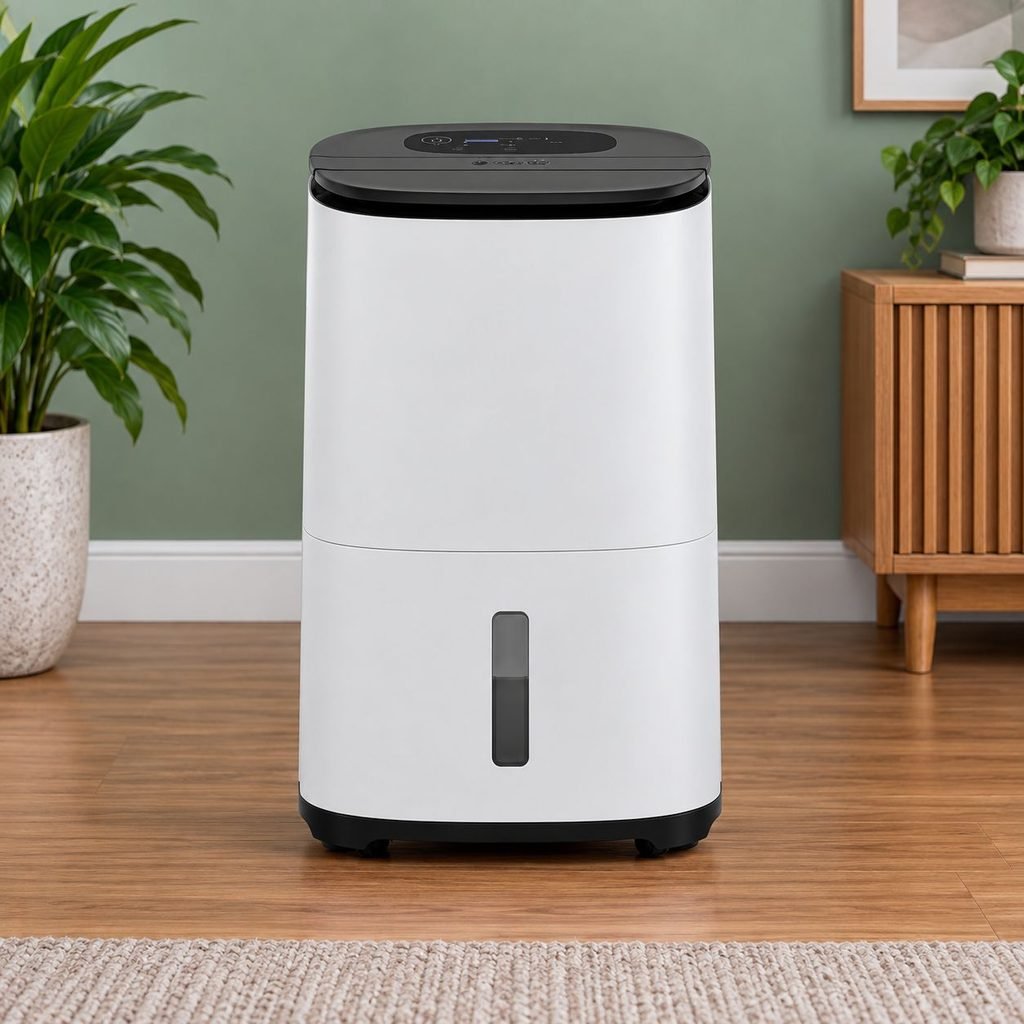
Meaco is also more upfront about real-world extraction than the other two makers here. The 25.25L/day headline is measured at 30°C and 80% relative humidity. At 20°C and 60% RH, which is closer to a heated UK home, Meaco quotes 10.85L/day at 250W (355W at the higher test point). So a 25L machine won’t pull 25 litres a day out of your living room. It’s still the most capable of the three.
The display is a big help if you’re trying to get on top of damp. It shows current and target humidity, and a ‘WET’ indicator tells you when humidity has climbed high enough that the machine should be back on. Smart Humidity mode defaults to 55% RH, and you can set anything from 40% to 70% in 5% steps, on the machine or in Meaco’s app. It won’t fix structural damp. It will show you whether the humidity side of the problem is under control.
| Specification | MeacoDry Arete Two 25L |
|---|---|
| Type | Compressor dehumidifier with separate air-purification mode |
| Extraction at 30°C/80% RH | 25.25L/day (355W) |
| Extraction at 20°C/60% RH | 10.85L/day (250W) |
| Recommended for | 4+ bedroom homes |
| Water tank | 4.8L |
| Airflow | 150 / 175 / 255m³/h across three fan speeds |
| Noise level | 40 / 42 / 50dB(A), depending on fan speed |
| Humidistat range | 40–70% RH |
| Modes | Smart Humidity, Smart Laundry, Night mode and air purification |
| Other features | Timer, child lock, auto restart, ‘WET’ high-humidity indicator |
| Connectivity | Wi-Fi app control; works with Amazon Alexa and Google Home |
| Filtration | H13 HEPA filter and dust filter |
| Continuous drainage | Yes (hose adapter included; garden hose not supplied) |
| Operating temperature | 5–35°C |
| Refrigerant | R290 |
| Castors | Yes |
| Dimensions (H × W × D) | 61.8 × 36.6 × 27.2cm |
| Weight | 16.1kg |
| Warranty | 5 years |
Pros and cons
- Most extraction capacity here, for larger homes and heavier moisture loads
- Publishes a 20°C/60% RH figure as well as the maximum, so you know what to expect
- Clear humidity display, ‘WET’ indicator and adjustable 40–70% humidistat
- Big 4.8L tank, and castors to move it
- Wi-Fi app, HEPA filter and five-year warranty
- Biggest and heaviest of the three at 16.1kg
- 50dB(A) on the top fan speed
- Uses more power than the Ebac’s quoted maximum (250W at 20°C/60% RH)
- You’ll need your own garden hose for continuous drainage
Verdict: The Meaco is the high-capacity choice, and the published 20°C figure makes it easier to judge than the other two. Pick it when damp is spread across a bigger part of the house.
Buy it if: you have a larger home with condensation in several rooms, or a smaller machine would be running for hours to keep up.
Skip it if: the problem is one bedroom, box room or home office, you’ll be carrying it up and down stairs a lot, or the space is cold and unheated (a desiccant model may suit better).
3. De’Longhi Tasciugo AriaDry Multi DEX212SF 12L: Best for Small Rooms and Everyday Damp
Score: 8.7/10
If the damp is in one room, you don’t need an 18L or 25L machine. The De’Longhi DEX212SF is rated at 12L/day at 30°C/80% RH, less than the other two, but it’s compact (about 22cm deep) and has a headline noise figure of 36dB(A). That makes it the one to look at for a bedroom, home office or small living room where it’ll be running while you’re in there.
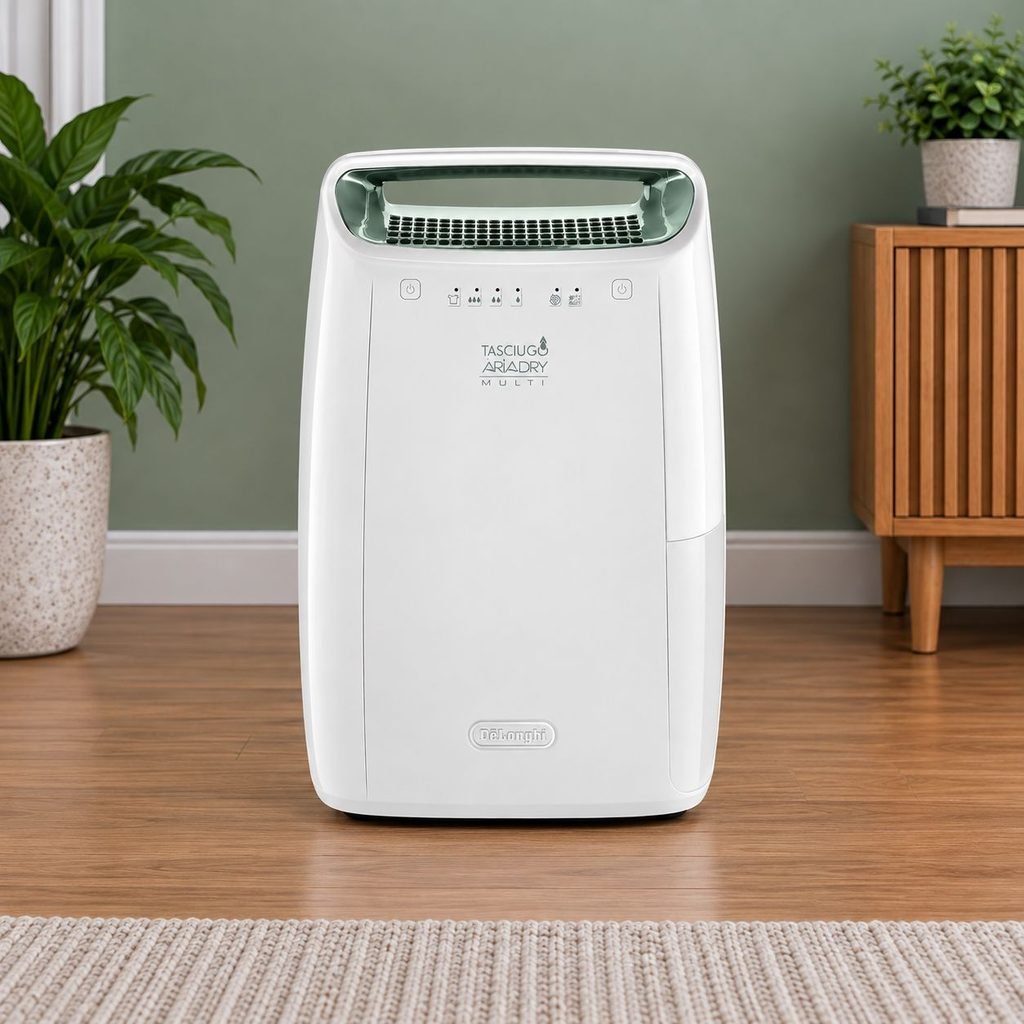
De’Longhi recommends it for rooms up to 55m³. That’s roughly a 4.5m × 5m room with a standard 2.4m ceiling. A drainage hose comes in the box, there’s a laundry function, and the three-stage filter covers dust, allergens and odours (the last one with active carbon). Just don’t confuse filtration with mould treatment. It won’t remove mould that’s already on your walls or deal with where the damp is coming from.
Watch the tank. At 2.1 litres, it’ll fill several times a day in a really damp room, so the hose is worth setting up. Power is the other surprise: current UK listings quote 285W (some say 300W), which is more than the bigger Ebac’s quoted maximum. And 36dB(A) is a headline figure. At least one retailer lists a 33–48dB range, so expect more noise on higher settings. No castors either, just a carry handle.
| Specification | De’Longhi Tasciugo AriaDry Multi DEX212SF |
|---|---|
| Type | Compressor dehumidifier with anti-frost protection |
| Rated extraction | 12L/day at 30°C/80% RH |
| Recommended room size | Up to 55m³ |
| Water tank | 2.1L |
| Power consumption | 285W (some listings quote 300W) |
| Noise level | 36dB(A) headline figure |
| Airflow | 125m³/h |
| Filtration | 3-stage: dust, anti-allergen and active carbon |
| Continuous drainage | Yes, hose included |
| Laundry function | Yes |
| Full-tank shut-off | Yes |
| Operating temperature | 2–30°C |
| Refrigerant | R290 |
| Castors | No (carry handle) |
| Dimensions (H × W × D) | 50.8 × 33.4 × 22cm |
| Weight | 10.3kg |
| Warranty | 2 years (check the retailer’s terms) |
Pros and cons
- Compact, 22cm-deep body fits smaller rooms
- Lowest headline noise figure in this guide at 36dB(A)
- Drainage hose included, plus a laundry function
- Three-stage filtration
- 2.1L tank fills quickly in a damp room
- 285W is a lot of power for a 12L-class machine
- Not built for a large home with heavy damp
- No castors
- Shorter warranty than the Ebac and Meaco
Verdict: Smaller rooms deserve a properly sized recommendation, and this is it. It can’t match the Meaco for capacity or the Ebac for hands-off control, but it’s compact, relatively quiet and right for one problem room.
Buy it if: the damp is concentrated in one smaller room, like a bedroom with streaming windows or a humid home office, and low noise matters more than capacity.
Skip it if: condensation affects several rooms, you’d rather not empty a small tank often and can’t run a hose, or you’ll be moving it round the house a lot.
Running costs: how much do these dehumidifiers cost to run?
If you’re controlling damp, you’ll be running a dehumidifier for months, so electricity cost matters. We’ve used Ofgem’s average electricity unit rate of 26.32p/kWh for Direct Debit customers in England, Scotland and Wales under the price cap from 1 October to 31 December 2026. Your rate will depend on your supplier, tariff, region and how you pay.
| Model | Power figure used | Approx. cost per hour | Approx. cost for 6 hours |
|---|---|---|---|
| Ebac 4650e 18L | 190W (Ebac’s stated maximum) | 5.0p | 30.0p |
| MeacoDry Arete Two 25L | 250W (at 20°C/60% RH) | 6.6p | 39.5p |
| De’Longhi DEX212SF 12L | 285W (listed power) | 7.5p | 45.0p |
The sum is watts ÷ 1,000 × hours × unit rate. So 190W for an hour is 0.19kWh, or about 5p. At Meaco’s 30°C/80% RH rating of 355W, the Arete Two would cost about 9.3p an hour, but you’re unlikely to see those conditions in a heated UK home.
Treat these as rough estimates. They aren’t measured running costs, and the three power figures aren’t measured the same way. Ebac quotes a maximum without saying under what conditions. Meaco gives 250W at 20°C/60% RH. De’Longhi’s is a listed power rating. Compressor dehumidifiers also switch off once they hit the target humidity, so they won’t draw that power all day. Room temperature, starting humidity, fan speed, target setting and how often doors and windows are opened all change what you’ll actually pay.
On paper, the Ebac is cheapest to run per hour and the De’Longhi the most expensive, even though it’s the smallest. Hourly cost isn’t the whole story, though. A bigger machine may bring humidity down faster and then switch off, while a small one might run much longer to do the same job. Over a winter, a machine that holds humidity steady efficiently can end up cheaper to run than one that just has the lowest wattage.
What humidity level helps prevent mould?
You’re aiming for controlled humidity, not bone-dry air. When relative humidity stays high for long periods, condensation forms more easily on cold surfaces and mould gets the conditions it likes. That’s why automatic humidity control is so useful. Leaving a machine running flat out all day is rarely necessary.
As a rule of thumb, around 50–60% RH is a sensible range for a damp-prone home. Meaco’s Smart Humidity mode, for example, defaults to 55%. It’s a practical guideline. What really decides whether condensation forms is how cold the surface is. In a room at 20°C and 60% RH, moisture will condense on anything colder than about 12°C: single glazing, a poorly insulated external wall, the corner behind a wardrobe. Bring the room down to 50% and that point drops to around 9°C.
So the number on your dehumidifier is a guide. Insulation, heating, ventilation and how much moisture the household produces all play a part. If one wall or window stays wet even when room humidity looks fine, find out why. Turning the humidity setting lower and lower won’t solve it.
How to use a dehumidifier for damp and mould control
Where you put it matters. Leave space around the air intake and outlet, keep external windows shut while it’s running, and don’t hide it behind furniture or heavy curtains. If one room is the obvious problem, start there with the door closed. If the whole house feels damp, try a central spot like a hallway, with internal doors open or ajar.
Windows shut doesn’t mean no ventilation. Keep using kitchen and bathroom extractor fans and trickle vents, and open a window for a while after a shower or cooking. Just don’t run the dehumidifier with a window wide open, or it’ll spend its time drying the air outside.
Give it time, especially in a room that’s been damp for a while. Furniture, carpets and walls hold moisture, so you may collect more water in the first few days and less as things dry out. A falling collection rate doesn’t mean the machine is failing. There’s probably just less moisture left to remove.
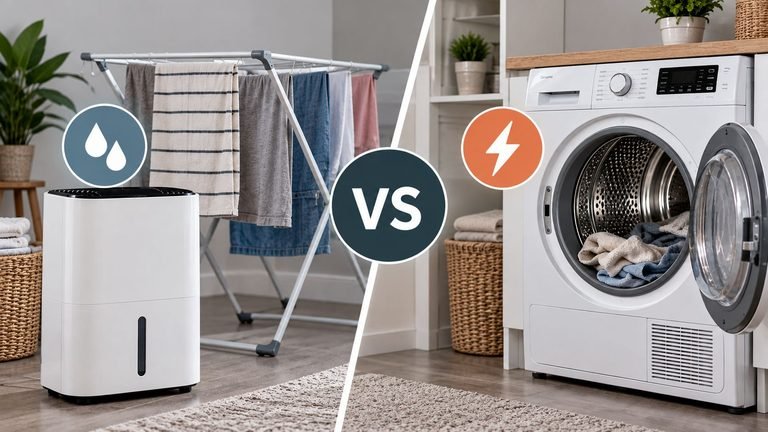
Drying washing indoors puts a lot of moisture into the air in winter. If you use an airer, put the dehumidifier in the same room, close the door and switch on laundry mode. There’s more on this in our guide to the best dehumidifiers for drying clothes, and if you’re weighing up the options, see dehumidifier vs tumble dryer.
If the machine will sit in one place for weeks, set up continuous drainage so it doesn’t stop when the tank fills. The hose needs a downhill route to a drain or sink unless you add a suitable pump. The De’Longhi comes with a hose, the Meaco takes a standard garden hose, and the Ebac needs a drainage kit bought separately.
When a dehumidifier won’t solve the problem
A dehumidifier works best on condensation and general dampness in the air. It helps to know the main types of damp, because only the first responds well to a dehumidifier on its own:
- Condensation: moisture from cooking, showering, drying washing and breathing settles on colder surfaces such as windows, external walls and corners. Cold spots around window reveals and lintels (cold bridging) and poor ventilation make it worse. This is where a dehumidifier helps most, alongside heating and ventilation.
- Penetrating damp: water getting in from outside through defects in walls, roofs, windows or guttering. It’s often worse after heavy rain.
- Rising damp: ground moisture rising through walls or floors, usually in older properties. It’s often misdiagnosed, so get a proper survey before paying for treatment.
- Leaks: water from burst or leaking pipes, overflowing baths or sinks, or faulty plumbing.
A dehumidifier can help dry the air while penetrating damp, rising damp or a leak is being fixed. It can’t cure any of them. Running one to hide a leaking roof, failed guttering or bad plumbing just treats the symptom.
It won’t make existing mould disappear either. Visible mould needs cleaning or professional treatment, depending on how much there is and what’s causing it. UK government guidance says damp and mould can affect anyone’s health, and people with underlying health conditions or weakened immune systems are at greater risk. If mould keeps coming back once humidity is under control, or damp patches get worse after rain, the moisture is coming from somewhere else. Find the source before buying a bigger dehumidifier. If you rent and the damp comes from a building defect, report it to your landlord in writing.
Compressor or desiccant for a damp UK home?
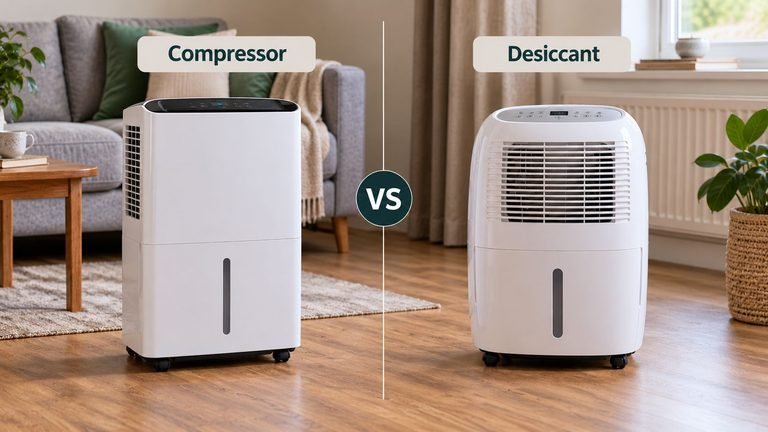
All three picks are compressor models, because this guide is about heated homes. Compressor dehumidifiers are generally economical at normal room temperatures and come in the larger capacities you need when damp affects more than one room.
They work by passing air over a cold coil so moisture condenses on it, and that gets less effective as the room gets colder. All three will still run in a cool room (De’Longhi rates the DEX212SF down to 2°C, Ebac down to 3°C and Meaco down to 5°C), but extraction drops and they spend more time defrosting. For a cold garage, cellar, unheated conservatory in winter or similar space, a desiccant model is often the better choice, and more so as temperatures fall towards 10°C and below. There’s no hard cut-off. Room size, starting humidity and how you use the space matter too. Our compressor vs desiccant dehumidifier guide covers the trade-offs in more detail.
Which is the best dehumidifier for mould and damp for your home?
- Condensation in several rooms of a typical 3–4 bedroom home: the Ebac 4650e 18L. It manages humidity by itself and has the lowest quoted power draw here.
- A larger home, or damp that’s hard to keep on top of: the MeacoDry Arete Two 25L. Most headroom, biggest tank, clearest humidity display.
- One bedroom, box room or home office: the De’Longhi DEX212SF 12L. It’s compact, has the lowest headline noise figure and is sized for a single room.
- A cold, unheated space such as a garage: look at a desiccant dehumidifier instead.
Final verdict
For most homes with recurring condensation, the best dehumidifier for mould and damp is the Ebac 4650e 18L. Its extraction figure isn’t the biggest here. Smart Control is what matters, because keeping humidity in check day after day does more for damp than a big headline number. The MeacoDry Arete Two 25L is the better buy for a larger home or heavier damp, and the De’Longhi DEX212SF 12L suits a single smaller room.
Whichever you choose, a dehumidifier deals with excess moisture in the air. It won’t fix every kind of damp. Leaks, water getting in from outside and mould that keeps coming back still need the cause found and fixed.
FAQs
Can a dehumidifier stop mould from coming back?
It helps. Lower humidity and less condensation make conditions worse for mould. But it can’t guarantee mould won’t return if there’s a leak, cold bridging, penetrating damp or another source of moisture, and it won’t remove mould that’s already there.
What size dehumidifier do I need for damp?
Match the capacity to the space and the amount of moisture. As a guide, De’Longhi recommends the 12L DEX212SF for rooms up to 55m³, Ebac rates the 18L 4650e for 3–4 bedroom homes, and Meaco recommends the 25L Arete Two for homes with four or more bedrooms. Bigger isn’t automatically better, especially when the problem is one small room.
Should I run a dehumidifier all day?
Not once humidity is under control. Set a target or use the automatic mode and let it switch itself on and off. Expect longer running times at first in a room that’s been damp for a while.
Where should I put a dehumidifier for mould?
Start in the room with the highest humidity or the worst condensation, and leave clearance around the air intake and outlet. If several rooms are affected, a central spot can work as long as air can move between them. Keep it away from furniture, curtains or anything else that blocks airflow.
Should I keep windows closed when using a dehumidifier?
Yes, in the room it’s working in. Otherwise it’ll be drying outside air. Keep using extractor fans and trickle vents, though, and air rooms briefly after a shower or cooking.
Is a dehumidifier OK to run in a bedroom overnight?
It can be, if the noise suits you. The De’Longhi has the lowest headline figure here at 36dB(A). The Meaco has a Night mode that drops to its low fan speed (40dB(A)) and turns off the display lights. The Ebac is quoted at 44dB(A), which light sleepers may notice.
Will a dehumidifier dry a damp wall?
It can help moisture evaporate from a damp wall and pull it out of the air. It can’t fix why the wall got damp. Leaks, rising damp, penetrating damp and other building defects need to be identified and repaired.
A note on specifications and running costs
Specifications in this guide were checked against manufacturer product pages, user manuals and UK retailer listings in September 2026. Where sources disagreed, we’ve used the manufacturer’s figure or shown the range. Extraction figures are quoted with their test conditions where those conditions are published. Electricity examples use 26.32p/kWh, Ofgem’s average Direct Debit electricity unit rate for England, Scotland and Wales from 1 October to 31 December 2026.