
Compressor vs Desiccant Dehumidifier: Which Should You Buy?
Two dehumidifiers can sit next to each other on the same shelf at a similar price and behave completely differently once you get them home. The reason is usually the technology inside: compressor or desiccant.
Both pull moisture out of the air. They do it by different methods, and those methods respond very differently to temperature. That’s why the room you’re buying for matters far more than the litres-per-day figure printed on the box.
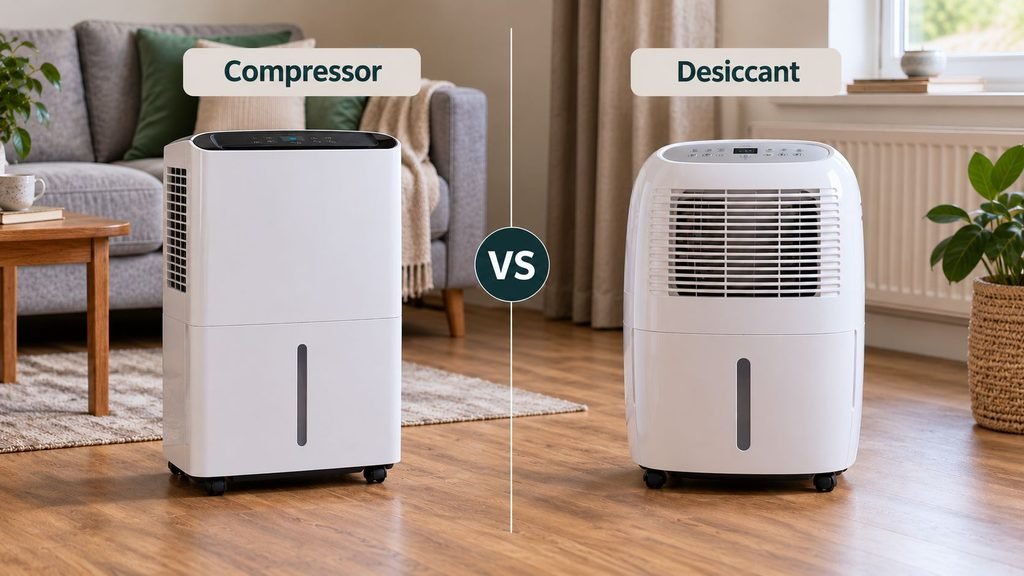
Quick answer: which type should you buy?
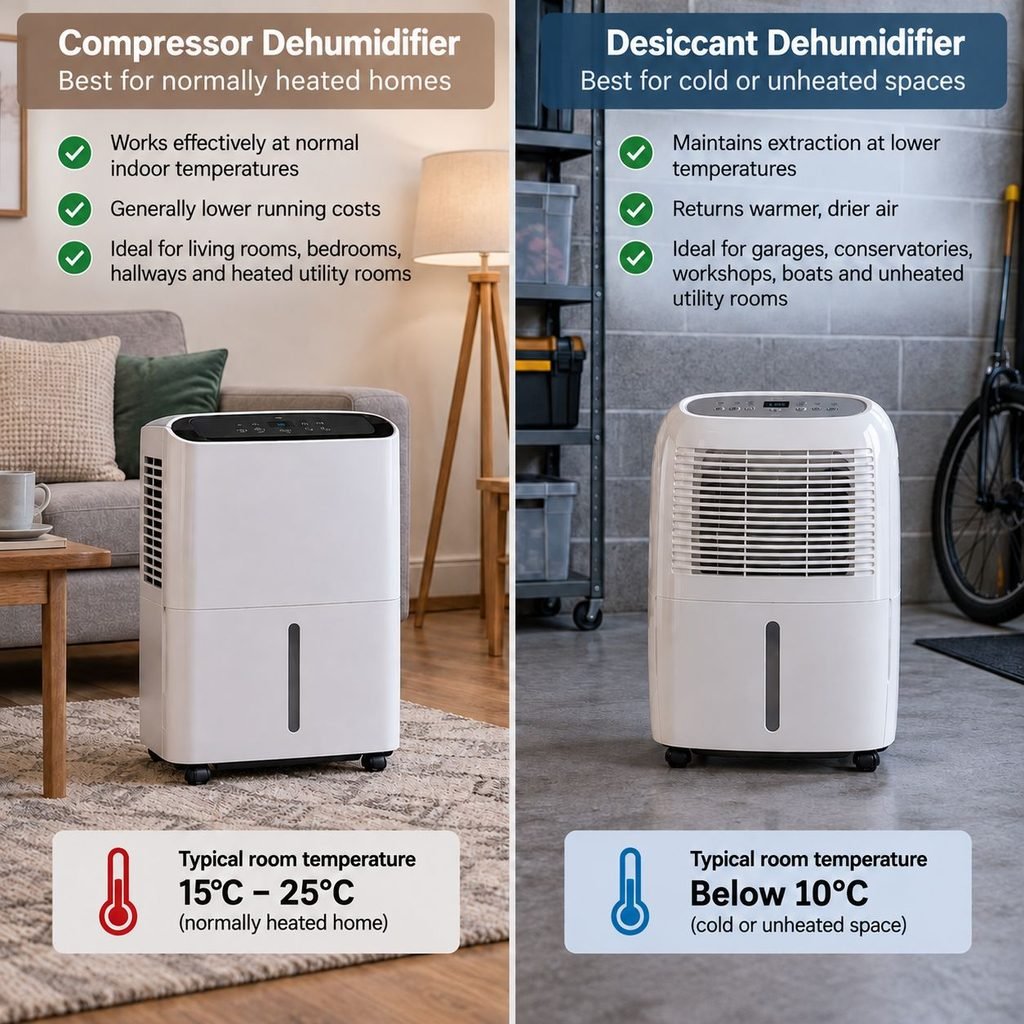
If the room is normally heated, start with a compressor dehumidifier. If the space sits cold for long stretches of winter, a desiccant model deserves serious consideration.
The reason comes down to how each one takes water out of the air. A compressor model has to chill air below its dew point so moisture condenses on a cold coil. Cold air holds less moisture to begin with, so as the room temperature drops there’s less water available to condense and the machine collects less from every hour it runs. A desiccant doesn’t work that way. It absorbs moisture onto a drying material, then heats that material to drive the water back off, so its output holds up much better as the room cools.
The rest of this guide is about where that line sits for your room, and what you give up either way. Neither technology is better in the abstract, and individual models within each type vary a great deal.
Compressor vs desiccant dehumidifier at a glance
| Factor | Compressor (refrigerant) | Desiccant |
|---|---|---|
| How it removes moisture | Condenses water on a chilled coil | Absorbs moisture onto a desiccant wheel, then heats it to release the water |
| Output as the room cools | Falls, sometimes by more than half | Holds up much better |
| Typical minimum operating temperature | Often around 5°C, model dependent | Often as low as 1°C, model dependent |
| Electricity use | Lower in a heated room | Higher, because regeneration needs heat |
| Air returned to the room | Slightly warmer than the room | Noticeably warmer |
| Weight | Heavier, because of the compressor | Lighter |
| Tank size | Usually larger | Usually smaller |
| Best suited to | Heated rooms and whole-house use | Cold or intermittently heated spaces |
Treat those as tendencies rather than rules. Operating range, noise, airflow and power draw all vary between individual machines, and the specification sheet for the model you’re looking at beats any general comparison.
How a compressor dehumidifier works
A compressor dehumidifier, also sold as a refrigerant dehumidifier, works on the same principle as condensation forming on a cold glass.
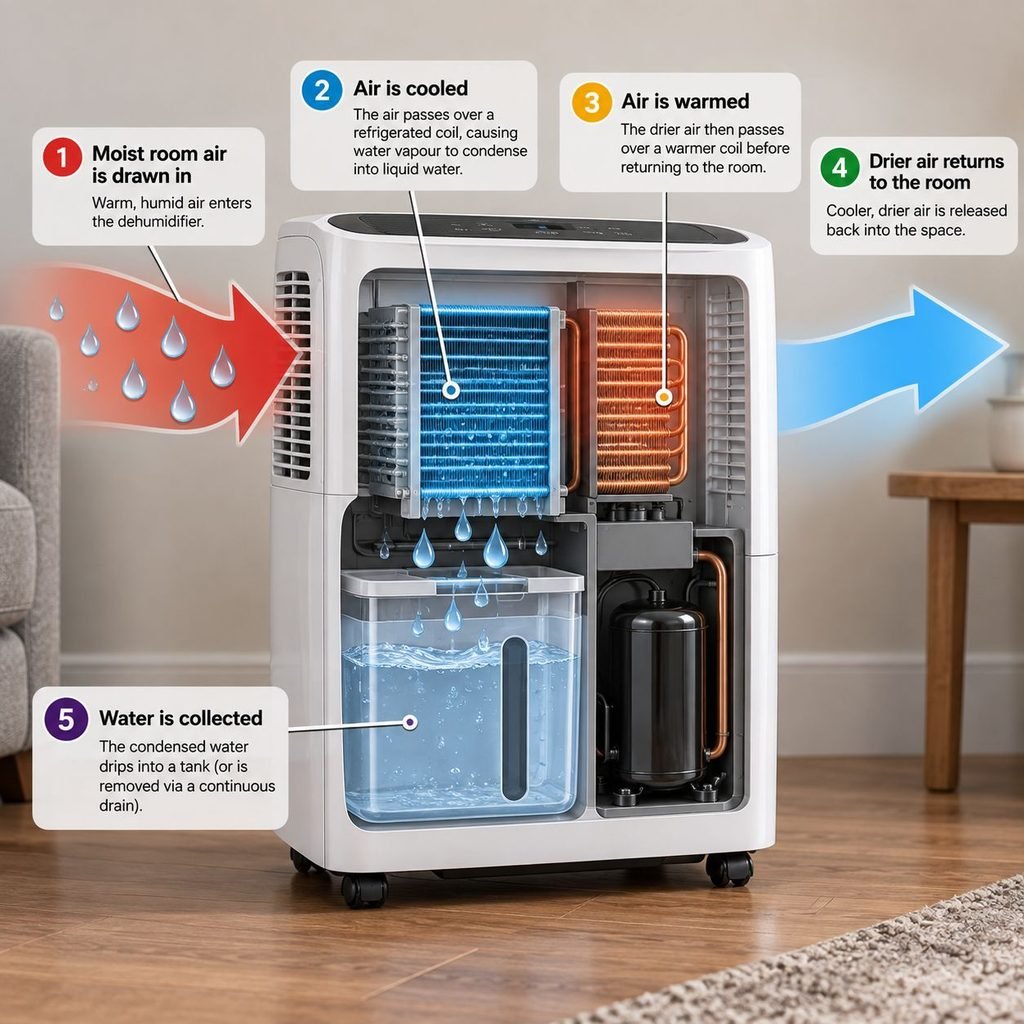
A fan draws room air across a coil chilled by a refrigeration circuit. The air cools below its dew point, water condenses on the coil and drips into the tank or out through a drain hose. The air then passes over the warm side of the circuit and returns to the room drier and slightly warmer than it started.
Everything about that process depends on there being enough moisture in the air to condense. In a room at 20°C it works well. As the temperature falls, output drops away, and in genuinely cold conditions the coil can fall below freezing and frost starts to build on it. Many compressor models handle this with an automatic defrost cycle, which pauses dehumidification while the coil clears. The machine is still drawing power during that pause. It just isn’t collecting any water.
Manufacturers also set a minimum operating temperature. Meaco specifies the Arete Two 20L, one of the more popular compressor models in the UK, for use between 5°C and 35°C. A garage sitting at 3°C in January is outside that range entirely, which is a more fundamental problem than reduced efficiency.
How a desiccant dehumidifier works
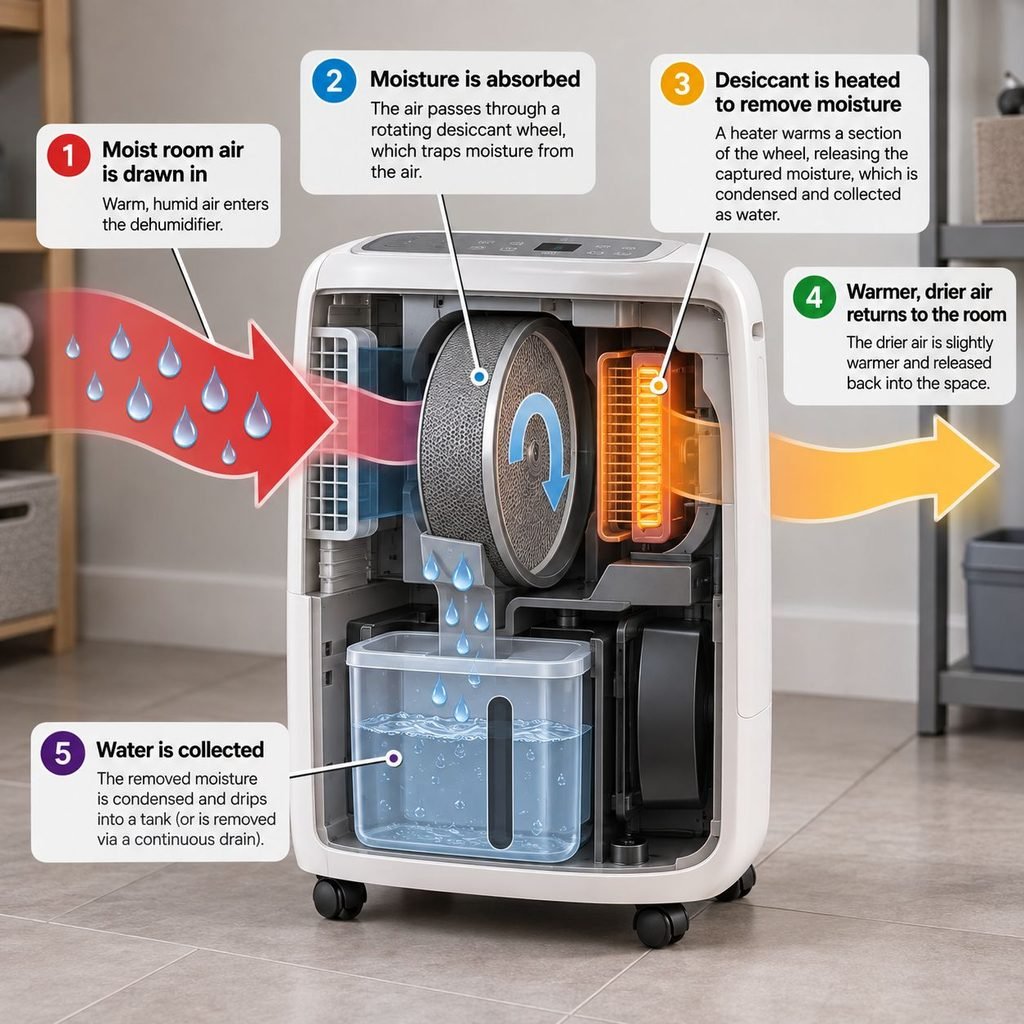
A desiccant dehumidifier has no refrigeration circuit at all. Room air passes through a slowly rotating wheel coated in a moisture-absorbing material, and the moisture sticks to it. A second, smaller airstream is heated by an internal element and pushed through another segment of the wheel, driving the captured moisture back off. That hot, very humid air is then cooled inside the machine so the water condenses into the tank. The wheel keeps turning, so the cycle runs continuously.
Because nothing relies on chilling air below its dew point, there’s no cold coil to frost up and no defrost pause. That’s why output holds up as the room gets colder, and why desiccant models are usually specified to much lower temperatures. EcoAir gives an operating range of 1°C to 40°C for the DD1 Classic MK6.
The trade-off is that heating element. Regeneration heat is where most of the electricity goes, and it’s also why the air coming out is noticeably warmer than the room. In a cold garage that’s a small bonus. In a warm bedroom in September, not so much.
Which removes more moisture?
Litres per day is a test result, not a promise. Manufacturers measure it at a set temperature and humidity, and the headline number is usually taken at the most flattering combination.
Meaco publishes the full grid for the Arete Two 20L, which makes the point better than any general explanation.
| Room conditions | Published extraction | Published power draw |
|---|---|---|
| 30°C / 80% RH | 20.45 litres per day | 271 W |
| 20°C / 80% RH | 13.85 litres per day | 217 W |
| 20°C / 60% RH | 8.50 litres per day | 207 W |
| 10°C / 60% RH | 3.35 litres per day | 176 W |
Manufacturer figures. The “20L” on the box is the 30°C and 80% RH result, which is nothing like a British house at any point in the year. At 20°C and 60% RH, much closer to a heated living room, the same machine is rated at 8.5 litres a day.
Now put a desiccant next to it at the same conditions. EcoAir rates the DD1 Classic MK6 at 7.5 litres per day at 20°C and 60% RH. A machine sold as “20L” and a machine sold as “7.5L” are quoted within a litre of each other once you compare them at the same temperature and humidity. The headline figures make them look three times apart.
One practical difficulty: compressor manufacturers increasingly publish a full grid like the one above, while desiccant makers tend to quote a single figure plus an operating range. That makes a like-for-like cold-room comparison difficult from specification sheets alone, so the cold-weather case for desiccant rests on how the technology behaves rather than on published head-to-head numbers.
Which works better in cold rooms?
Desiccant, and this is the clearest difference between the two technologies.
Meaco’s own figures show what happens to a good compressor model as the room cools: 8.5 litres a day at 20°C and 60% RH, down to 3.35 litres at 10°C and the same humidity. Every compressor model loses output this way to some degree, so this isn’t a knock on the Meaco in particular.
Operating range matters just as much as efficiency. The Arete Two 20L is specified from 5°C; the DD1 Classic MK6 is specified from 1°C. In an unheated garage that drops close to freezing, that difference decides whether the machine is usable at all.
There is no exact temperature at which one technology takes over from the other, and any guide that gives you a single number is oversimplifying. As a working rule: a room that stays in the high teens is compressor territory, a room that regularly sits in single figures points towards desiccant, and between roughly 10°C and 15°C it depends on the specific model, how damp the space is and how long you’re willing to leave the machine running.
Which is cheaper to run?
In a normally heated room, a compressor model, usually by a wide margin. But wattage on its own is the wrong test, and this is where a lot of buyers get caught out.
Wattage tells you cost per hour. What actually matters is cost per litre of water removed, because a machine that’s barely extracting isn’t cheap at any wattage. The figures below use the published specifications above and the Ofgem price cap rate of 26.32p per kWh, the average for direct debit customers in England, Scotland and Wales between 1 October and 31 December 2026. Your own rate will depend on your region, tariff and supplier, and Ofgem publishes the current price cap unit rates for each region, updated every quarter.
| Example | Power | Extraction | Cost per hour | Cost per litre removed |
|---|---|---|---|---|
| Arete Two 20L at 20°C / 60% RH | 207 W | 8.5 L/day | about 5.5p | about 15p |
| Arete Two 20L at 10°C / 60% RH | 176 W | 3.35 L/day | about 4.6p | about 33p |
| DD1 Classic MK6 at 20°C / 60% RH, full power | 580 W | 7.5 L/day | about 15p | about 49p |
Our calculation from manufacturer specifications, assuming continuous running at the stated conditions. Real machines cycle on a humidistat, so actual bills will be lower than a flat 24-hour figure.
Look at the first two rows. As the room gets colder the compressor draws less power, so it looks cheaper by the hour. Cost per litre of water removed more than doubles. Anyone choosing a dehumidifier for a cold room on wattage alone is reading the number backwards.
The third row is why desiccant is hard to justify in a heated house. Three times the cost per litre at normal indoor conditions is a real difference over a winter of regular use. Most desiccant models do have a lower-power economy mode, and EcoAir quotes roughly 8p an hour on low against 15p on full power for the DD1 Classic, but the gap in a warm room is still substantial.
In a 4°C garage the comparison inverts, because the compressor may be outside its operating range or extracting very little, and a desiccant that’s actually collecting water is the cheaper machine per litre despite the higher wattage.
Which is quieter?
Neither technology wins this one, and the common assumption that compressors are the noisy option doesn’t hold up against published figures. Meaco quotes the Arete Two 20L at 38, 40 and 50 dB(A) across its three fan speeds. EcoAir quotes the DD1 Classic MK6 at 34 dB(A). On those numbers the desiccant is the quieter machine.
Two things are worth knowing about dB figures. They are almost always measured at the lowest fan speed, and the spread across speeds can be large: 12 dB between the Arete Two’s quietest and loudest settings is the difference between background noise and something you notice. Compare the range, not the single number.
The character of the noise matters too. A compressor switches on and off as the humidistat calls for it, and that change is often what wakes people rather than the volume itself. A desiccant tends to run as steadier fan noise. For a light sleeper, steady noise at a slightly higher level can be easier to live with than intermittent noise at a lower one.
Which is better for drying clothes?
Both work, and the mechanism is the same either way. Wet clothes release moisture into the air around them, and evaporation slows down as that air becomes saturated. The dehumidifier keeps the surrounding air dry enough for evaporation to continue.
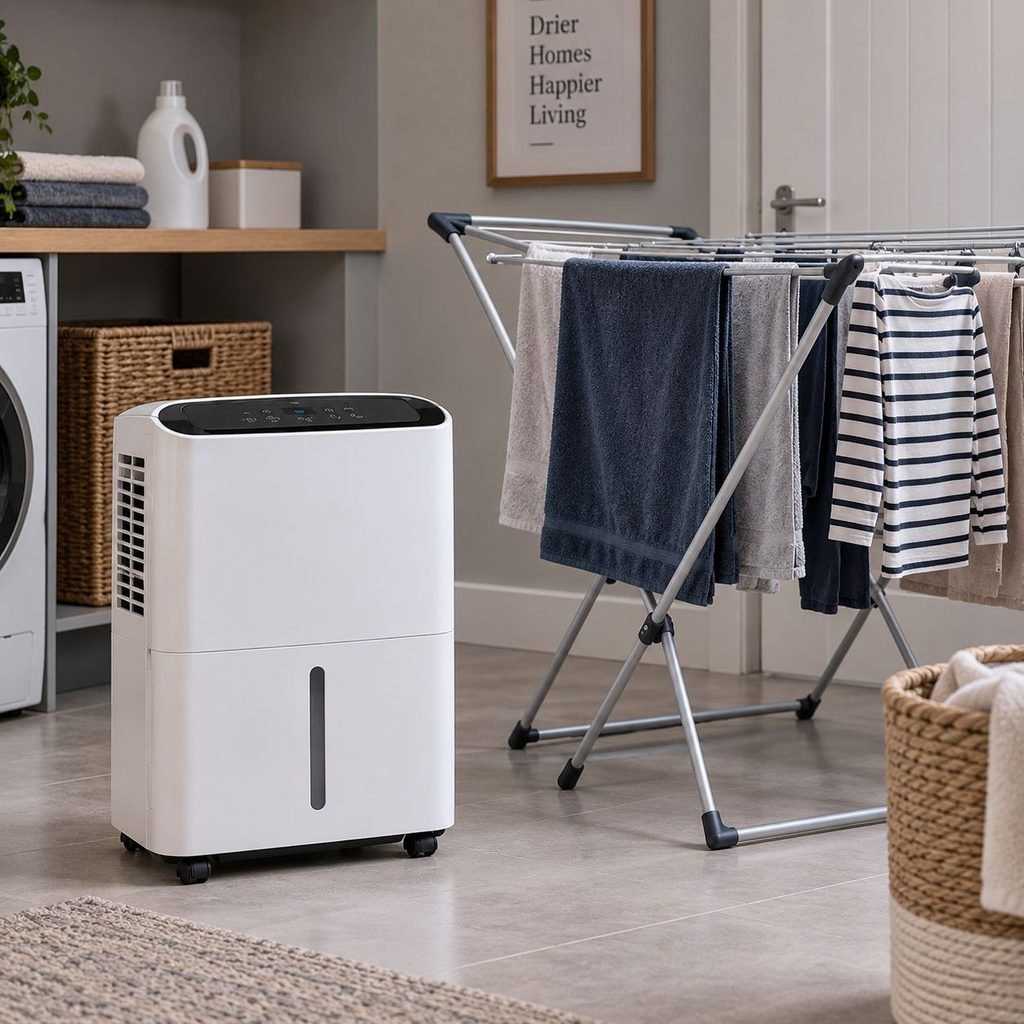
In a heated utility room, kitchen or bedroom, a compressor model is the sensible choice. It will dry a load at a fraction of the cost per litre, and most now include a laundry mode that runs the fan harder and targets a lower humidity.
In a cold utility room, garage or unheated conservatory, a desiccant makes more sense for two separate reasons. Its output holds up at the lower temperature, and the warmed air it returns lifts the room temperature slightly, which helps evaporation along. In a small cold room that warming effect is noticeable.
Whichever type you buy, airflow around the washing matters as much as the machine itself. Leave gaps between garments, keep the door shut so you’re drying one room rather than the whole house, and position the unit so air moves across the airer rather than straight into a wall. Follow the manufacturer’s clearance guidance rather than pushing it up against the washing.
Which is better for a bedroom?
For a normally heated bedroom, a compressor model. Bedroom dehumidifiers tend to run for long overnight stretches, which is exactly where a lower cost per litre adds up, and there are plenty of quiet compressor models to choose from.
What separates a good bedroom machine from a poor one is rarely the technology. It’s whether the display can be dimmed or turned off, what noise it makes when the tank fills, how abruptly the fan changes speed, and whether it will sit far enough from the bed to be out of the way.
A cold spare room or a poorly heated bedroom is the exception. If the room genuinely sits in single figures through winter, low-temperature performance matters more than the compressor’s running-cost advantage, and the warm air a desiccant returns is a benefit rather than a nuisance.
Which is better for a garage or conservatory?
Desiccant has its clearest advantage here, but it comes down to temperature rather than the type of room. What matters is how cold the space gets when you actually need the machine running.
Garages, workshops, boats, caravans and unheated conservatories track outdoor temperature fairly closely in winter. Check the compressor model’s operating range before anything else, because a minimum of 5°C rules out a lot of British garages in January. A heated conservatory used as a proper room stays in normal indoor territory and suits a compressor perfectly well.
One practical point that gets overlooked in these spaces: you’re much less likely to be out there emptying a tank every day, and desiccant tanks tend to be smaller. The DD1 Classic MK6 holds 2 litres against 4.8 litres on the Arete Two 20L. If the machine is going to live in a garage, plan for continuous drainage to a drain or a hose out through a vent rather than relying on the tank.
Compressor dehumidifiers: pros and cons
Pros
- Much lower cost per litre of water removed in a normally heated room
- Widest choice of capacities, from one-bed flats to large family houses
- Larger tanks on most models, so fewer trips to the sink
- Laundry modes, humidistats and filtration are common at mainstream prices
Cons
- Extraction falls as the room cools, in some cases by more than half
- Many models aren’t specified to operate below around 5°C
- Defrost cycles pause moisture removal in cold conditions while still drawing power
- Heavier to carry between floors
- Headline litres-per-day figures are measured in conditions no UK home sees in winter
Desiccant dehumidifiers: pros and cons
Pros
- Output holds up in cold rooms, with many models specified down to around 1°C
- No refrigeration circuit, so no defrost pause in cold conditions
- Warmed outgoing air is useful in an unheated space and when drying laundry
- Lighter and easier to move around
Cons
- Higher electricity use, because regenerating the desiccant needs heat
- Cost per litre is substantially higher in a normally heated room
- Smaller tanks on most models, so continuous drainage matters more
- Fewer high-capacity options for larger houses
- The added warmth is unwanted in a room that’s already comfortable
Which dehumidifier should you choose?
| Your situation | Start with | Check on the specification sheet |
|---|---|---|
| Heated living room, hallway or flat | Compressor | Extraction quoted at 20°C / 60% RH, not just the headline figure |
| Normally heated bedroom | Compressor | Noise at lowest fan speed, dimmable display, tank-full alert |
| Heated utility room for laundry | Compressor | Laundry mode, airflow rate, adjustable louvre |
| Cold or unheated utility room | Desiccant | Stated minimum operating temperature |
| Unheated garage or workshop | Desiccant | Operating range and continuous drainage option |
| Conservatory | Depends on whether it’s heated | The temperature it actually sits at when you need it |
| Boat or caravan | Desiccant | Weight, operating range, drainage |
| Cold spare bedroom | Desiccant | How low the room really drops overnight |
Three things to check before you buy either type
Operating temperature range
This is the one specification most buyers never look at, and it’s the one that decides whether the machine works in the room you bought it for. It’s usually listed in the technical specification rather than the marketing copy.
Humidistat and target humidity
A humidistat lets the machine respond to room humidity instead of running flat out, which is where most of the real-world running-cost saving comes from. Check the range it can be set to as well as whether it has one. Around 50 to 55% RH is a sensible everyday target for a UK home.
Tank size and continuous drainage
Tank capacity affects convenience, not performance. A bigger tank means fewer interruptions, and continuous drainage makes tank size almost irrelevant if the machine can sit near a drain. Most models take a standard hose, though some need a separate pump to drain upwards into a sink.
Frequently asked questions
Is a compressor or desiccant dehumidifier better?
Neither, in the abstract. A compressor is the better default for a normally heated UK home because it removes far more water per unit of electricity. A desiccant is better for cold or unheated spaces, where compressor extraction drops away and some models stop working altogether.
At what temperature should I choose a desiccant dehumidifier?
There is no single cut-off, because machines differ. As a practical guide, a room that regularly sits in single figures points towards desiccant, and a room in the high teens doesn’t. Between roughly 10°C and 15°C, check the individual model’s published extraction and its minimum operating temperature.
Do desiccant dehumidifiers use more electricity?
Generally yes, and by a noticeable margin. A desiccant has to heat the drying material to release the moisture it has absorbed, and that heat is the main power draw. Published figures for popular models run into several hundred watts against roughly 200W for an efficient compressor at normal indoor conditions.
Which type is cheaper to run?
It depends which cost you measure. By the hour, a compressor is cheaper in almost any room. By the litre of water actually removed, a compressor is much cheaper in a heated room, but its advantage shrinks as the room cools and disappears in a space cold enough to stop it extracting properly.
Are desiccant dehumidifiers better for drying clothes?
In a cold utility room, garage or conservatory, yes, because output holds up at low temperatures and the warmed air helps evaporation. In a heated room, an efficient compressor with a laundry mode will dry the same load for considerably less.
Do desiccant dehumidifiers heat the room?
They return air that’s noticeably warmer than the room, as a by-product of the regeneration process. In a small cold space that’s a genuine benefit. It won’t replace a heater, and you won’t want it in a room that’s already comfortable.
Are compressor dehumidifiers useless in cold rooms?
No, but they are working against themselves. They keep removing moisture at lower temperatures, just less of it per hour, and defrost cycles eat into that further. The bigger issue is the stated operating range: if a model is specified from 5°C and your garage drops to 2°C, that’s a limit rather than an inefficiency.
Which type is better for condensation on windows?
In a heated home, a compressor model handles everyday condensation well. Persistent condensation usually has a cause behind it, such as limited ventilation, cold spots or a lack of extraction in the kitchen and bathroom, and a dehumidifier manages the symptom rather than fixing the source.
Final verdict
Choose the room first, then the machine. That sounds obvious, but most people do it the other way round and end up comparing litres-per-day figures that were measured in tropical conditions.
Before you compare a single model, it’s worth answering a few questions honestly. What temperature does the space actually sit at when you need the dehumidifier running, not what it feels like on a mild afternoon? Does the model you’re looking at list an operating range that covers it? And what extraction does that model quote at 20°C and 60% RH, rather than at its headline conditions?
Answer those and the technology choice usually makes itself. A heated house points to a compressor, and the running-cost gap over a winter of regular use is large enough to be worth caring about. A garage, workshop, boat or unheated conservatory points to a desiccant, where a higher wattage buys you a machine that’s genuinely collecting water rather than one that’s nominally switched on. Laundry sits between the two and follows the same rule, decided by the temperature of the room you dry in rather than by the laundry mode on the control panel.
Once the technology suits the room, compare individual machines on operating range, extraction at realistic conditions, noise across all fan speeds, tank size, drainage and warranty. Our guide to the best dehumidifiers in the UK does that model by model.
One Comment