
Dehumidifier vs Tumble Dryer: Which is Better?
Wet washing has to go somewhere when the weather rules out the washing line. In most UK homes, that means one of two things: put the load straight into a tumble dryer, or hang it on an airer and run a dehumidifier to pull moisture out of the air.
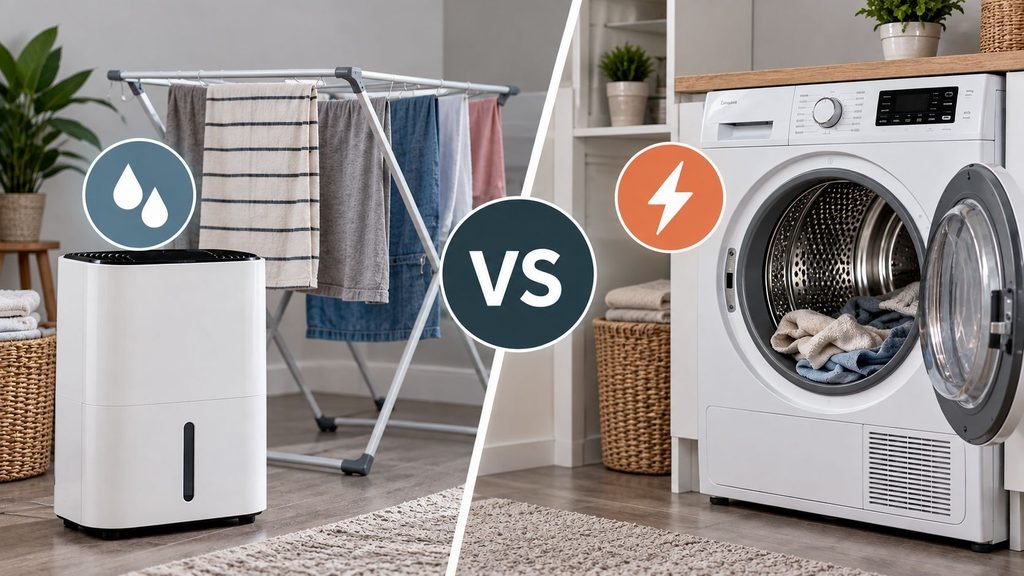
At first glance, a dehumidifier looks like the cheaper option. A typical compressor model draws a couple of hundred watts, while a tumble dryer uses a lot more power when it’s running. The catch is time. A dehumidifier may need to run for several hours while the clothes dry, and the type of tumble dryer you’re comparing it with makes a big difference to the sums.
Cost is only part of the dehumidifier vs tumble dryer decision, too. Drying time, load size, convenience, fabric care, space and what all that moisture does to your home matter just as much. Below, we go through each one using current UK electricity prices and manufacturer figures, so you can see which suits the way you actually do your laundry.
Quick answer
- Cheapest to run: usually a dehumidifier, especially compared with a condenser or vented dryer. Against a heat-pump dryer it’s much closer, and comes down to how long your washing takes to dry.
- Cheapest to buy: usually a dehumidifier, depending on the model.
- Fastest: a tumble dryer. Condenser and vented dryers are quicker than heat-pump models.
- Large and frequent loads: a tumble dryer.
- Delicates and air-dry-only clothes: a dehumidifier and airer.
- Damp and condensation: a dehumidifier, as it also takes moisture out of the room.
- Small homes: a dehumidifier. It’s portable and doesn’t need a permanent spot.
- Convenience and busy families: a tumble dryer, ideally a heat-pump model if you’ll use it several times a week.
- Winter: a tumble dryer is the most predictable. A dehumidifier works well in a heated room, and a desiccant model copes better with a cold one.
How each method dries clothes
A tumble dryer does the drying itself. It tumbles the clothes in warm air inside the drum and gets rid of the moisture in one of three ways. Vented dryers blow warm, damp air outside through a hose. Condenser dryers heat the air with an element, then cool it so the water condenses into a tank or drains away. Heat-pump dryers are a type of condenser dryer, but they use a heat pump instead of a heating element to warm the air, and reuse that air in a closed loop.
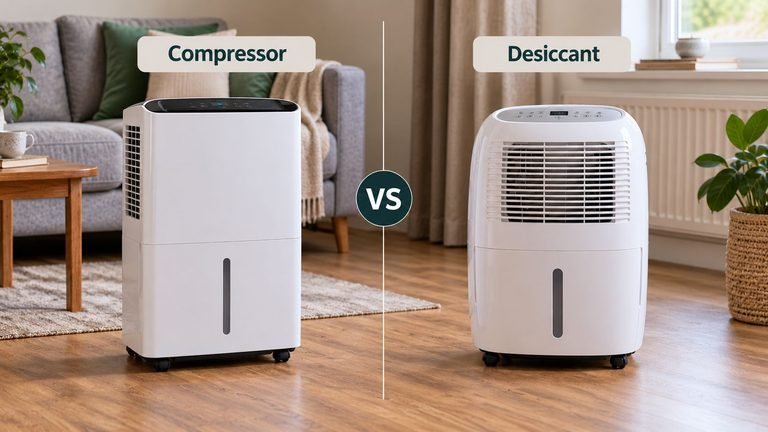
A dehumidifier works differently. It doesn’t heat or tumble the clothes at all. It draws in room air, takes water out of it and blows drier air back into the room. Compressor models do this with a cold coil, a bit like a small fridge, while desiccant models use an absorbent material that’s then warmed to release the water. Drier air lets moisture evaporate from the clothes faster, and the water ends up in the dehumidifier’s tank instead of hanging around in the room.
So a dehumidifier speeds up air drying. It doesn’t replace it, and that explains most of what follows.
Dehumidifier vs tumble dryer: quick comparison
| Factor | Dehumidifier + airer | Heat-pump tumble dryer | Condenser/vented tumble dryer |
|---|---|---|---|
| Electricity cost* | Roughly 4–7p per hour for many compressor models; more for desiccant models | Around 42–49p per full load in our examples | Around £1.03–£1.22 per full load in our examples |
| Drying time | Usually several hours; varies a lot with the room and load | Around 3½ hours for a full cotton load on the standard programme | Around 2–2¼ hours for a full cotton load on the standard programme |
| Upfront cost | Often less than a new tumble dryer, depending on model | Usually the most expensive type | Usually cheaper than a heat-pump model |
| Capacity | Limited by airer size and hanging space | Set by drum size; suits larger loads | Set by drum size; suits larger loads |
| Fabric care | No heat or tumbling | Lower drying temperatures than conventional dryers | More heat exposure |
| Room moisture | Removes moisture released by the drying clothes | Collects water in a tank or drains it away | Condenser: tank or drain. Vented: must vent outside |
| Convenience | Hang up, wait, collect; empty the tank | Load the drum and pick a programme | Load the drum and pick a programme |
| Space | Portable, but the airer takes up floor space while drying | Needs a permanent home | Needs a permanent home; vented models need a window or wall vent |
*Costs are worked out at the Ofgem price cap rate of 26.32p/kWh (1 October to 31 December 2026). Dehumidifier costs are per hour and tumble-dryer costs are per completed load, so they can’t be compared directly. The next section shows how to compare them fairly. Tumble-dryer costs and drying times come from manufacturer energy-label figures for example models, so treat them as benchmarks, not guaranteed costs.
Which is cheaper to run?
Running cost matters, but you can’t settle it by looking at the wattage on each appliance.
For all the calculations in this guide, we’re using the Ofgem price cap average electricity rate of 26.32p/kWh for Direct Debit customers in England, Scotland and Wales, which applies from 1 October to 31 December 2026. The cap changes every three months, and your own rate may be higher or lower, especially if you’re on a fixed or time-of-use tariff.
The sum itself is simple:
Electricity cost = power (kW) × running time (hours) × electricity price (£/kWh)
How much does a dehumidifier cost to run?
Plenty of compressor dehumidifiers used for laundry cost around 4–7p an hour at the current rate. To give two examples from one manufacturer’s published figures, a 10-litre compressor model draws about 151W (roughly 4p an hour) and a 20-litre model draws about 216W (roughly 5.7p an hour).
Desiccant dehumidifiers use more electricity. One popular 8-litre desiccant model draws around 350W on its low setting and around 650W on high. That’s about 9p and 17p an hour.
Take a 250W compressor dehumidifier as a simple example. Running flat out for eight hours, it would use:
0.25kW × 8 hours = 2kWh
2kWh × 26.32p = about 53p
Here’s how that scales across different running times and power levels:
| Running time | 150W compressor | 250W compressor | 350W desiccant (low setting) |
|---|---|---|---|
| 4 hours | 16p | 26p | 37p |
| 6 hours | 24p | 39p | 55p |
| 8 hours | 32p | 53p | 74p |
| 10 hours | 39p | 66p | 92p |
| 12 hours | 47p | 79p | £1.11 |
These figures assume the dehumidifier draws full power the whole time. It often won’t. A compressor model can cycle on and off as the room dries out, and many desiccant models have lower or laundry-specific settings. The real unknown is the number of hours, which depends on how much washing there is, the room temperature, airflow, the fabrics and how much water is left after the final spin.
That’s why cost per hour isn’t the same as cost per load. A dehumidifier is cheap while it runs, but it takes much longer to finish the job.
How much does a tumble dryer cost per load?
This depends a lot on the type of dryer. Treat them all as if they use the same electricity and you’ll get a misleading answer.
The best starting point is the energy label and product information sheet, which list the electricity used on the standard cotton programme at full load and at partial load (half the rated capacity). Here are the published figures for example Bosch models of each type:
| Dryer type (example model) | Full load | Cost per full load | Half load | Cost per half load |
|---|---|---|---|---|
| Heat pump, A+++, 9kg | 1.61kWh | 42p | 0.90kWh | 24p |
| Heat pump, A++, 8kg | 1.87kWh | 49p | 1.14kWh | 30p |
| Condenser, B, 8kg | 4.63kWh | £1.22 | 2.61kWh | 69p |
| Vented, C, 7kg | 3.90kWh | £1.03 | 2.29kWh | 60p |
Label figures come from a standard test, so they’re benchmarks. A smaller load, a faster spin or a different programme will change the cost, and models of the same type vary too.
Still, the pattern is hard to miss. Heat-pump dryers are the most energy-efficient mainstream type, and in these examples they use less than half the electricity of the condenser and vented models for a full load. So a modern heat-pump machine and an older vented dryer give you very different answers in any dehumidifier vs tumble dryer cost comparison.
Comparing like with like
Dehumidifier costs are per hour and tumble-dryer costs are per load, so a fairer question is: how long could a dehumidifier run for the price of one dryer load? Using a 250W compressor dehumidifier at about 6.6p an hour:
| Dryer load | Cost per load | Equivalent 250W dehumidifier running time |
|---|---|---|
| Heat pump, full load | 42–49p | About 6½–7½ hours |
| Heat pump, half load | 24–30p | About 3½–4½ hours |
| Vented, full load | £1.03 | About 15½ hours |
| Condenser, full load | £1.22 | About 18½ hours |
This isn’t a universal break-even point. A full 8–9kg dryer load is a lot of washing to spread over one airer, so in the same time a dehumidifier might be drying less, or need longer. Room conditions, spin speed and the dehumidifier itself all move the numbers. What the table does show is that a lower hourly cost doesn’t automatically mean a cheaper load.
Dehumidifier vs heat-pump tumble dryer
This is the closest contest if you care about both running cost and everyday practicality.
A compressor dehumidifier uses far less electricity per hour, but the clothes still need time on the airer. If a full load takes more than six or seven hours to dry with a 250W dehumidifier, an efficient heat-pump dryer can match it or beat it on electricity. A smaller, lower-wattage dehumidifier or a quicker-drying load swings it back the other way.
If you dry large or frequent loads, a heat-pump dryer gives you capacity, convenience and good efficiency in one box. A dehumidifier makes more sense if you’re happy to air-dry, have smaller or less frequent loads, or want to deal with the moisture your washing puts into the room.
Dehumidifier vs condenser or vented tumble dryer
Against a conventional dryer, the sums look very different.
At around £1.03–£1.22 for a full load in the examples above, a 250W dehumidifier could run for more than 15 hours before it cost the same. On running costs alone, an efficient compressor dehumidifier is likely to come out cheaper, as long as the washing dries in a reasonable time. A desiccant model on a high setting closes a lot of that gap.
The conventional dryer is still much quicker and easier, and that might matter more if you’re getting through several loads a week.
Which dries clothes faster?
The tumble dryer wins on speed, but not every type is equally quick.
Heat-pump dryers work at lower temperatures, which usually means longer cycles than conventional dryers. In the label examples above, the standard cotton programme for a full load takes about 3½ hours (205–215 minutes) on the heat-pump models, compared with just over 2 hours (128–137 minutes) on the vented and condenser models. Other programmes can be quicker or slower, and smaller loads finish sooner.
A dehumidifier is slower and less predictable. How quickly the washing dries depends on room temperature, humidity, airflow, load size, how far apart the garments are, fabric thickness, your washing machine’s final spin speed, room size and the dehumidifier’s own capacity and type. A few lightweight shirts in a small, warm room with dry air blowing across them can be ready in a few hours. Thick towels crammed onto an airer in a cool room can take most of the day.
That gap matters most for families getting through several loads, anyone who needs uniforms or work clothes ready quickly, and people who regularly dry bulky towels and bedding.
To be fair to the dehumidifier, it isn’t trying to compete on speed. What it offers instead is gentle air drying, low hourly running costs and humidity control thrown in.
Energy use: why wattage doesn’t tell the whole story
On paper, a dehumidifier looks like the easy winner on energy because its rated power is so much lower than a tumble dryer’s. But wattage doesn’t tell you how much electricity it takes to get a load dry. What counts is the total energy used, in kWh, from wet to dry.
A 250W dehumidifier running for eight hours uses 2kWh. That’s slightly more than the 1.61–1.87kWh our example heat-pump dryers use for a full load, but well under half what the condenser and vented examples use. A low-wattage appliance can end up using a similar amount of energy if it runs for long enough.
Air drying has a hidden cost too. Evaporating water takes energy, and on an airer a lot of it comes from the warmth of the room, which in winter means your heating. That never shows up in a dehumidifier’s hourly figure. Dehumidifiers do give off a bit of warmth as they work, which partly makes up for it, but it’s one more reason to look at total energy, not wattage.
Which is cheaper to buy?
The dehumidifier usually wins on upfront cost.
A decent laundry dehumidifier often costs less than a new tumble dryer, and typically less than a heat-pump model, though prices vary a lot with capacity, type and features. You also don’t need to find a permanent spot for a full-sized appliance, which can matter just as much in a smaller home.
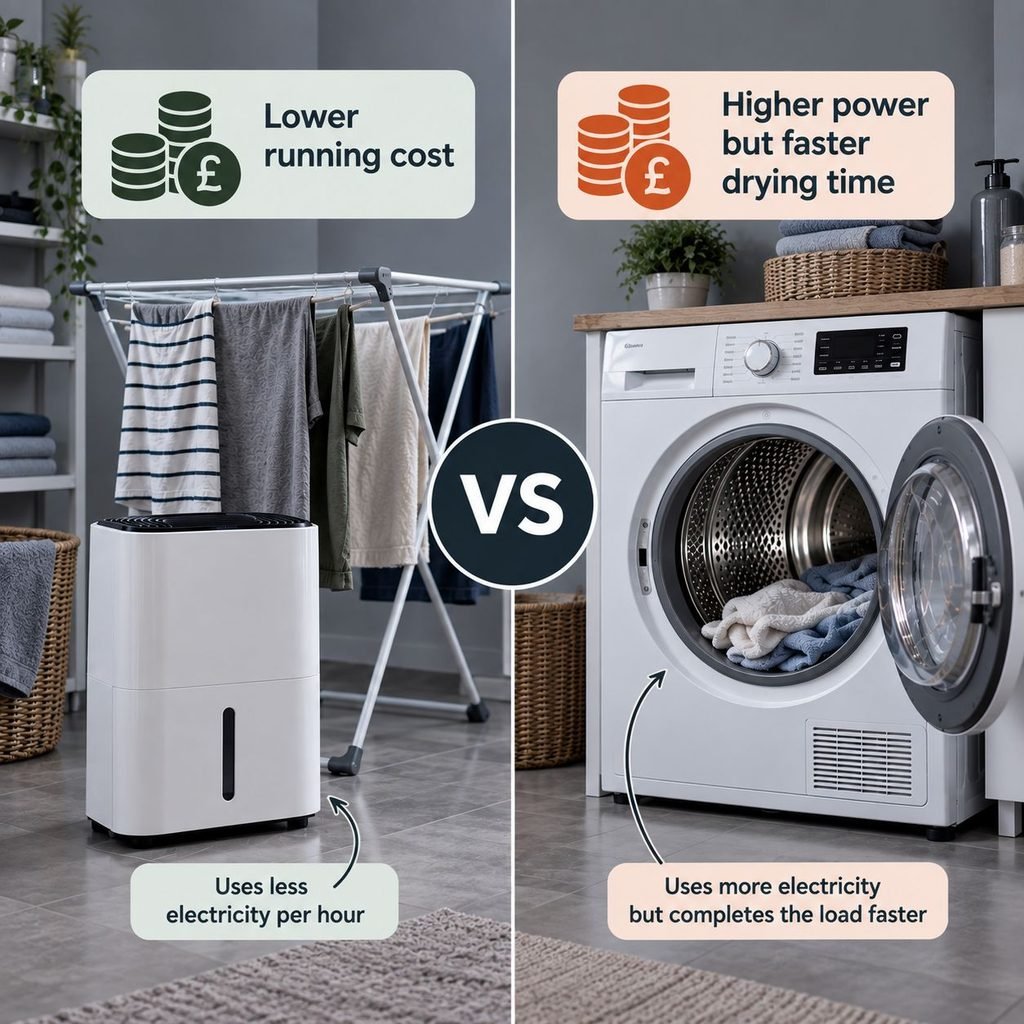
Heat-pump dryers cost more to buy than condenser or vented models because the technology is more complex, but they’re much cheaper to run.
Conventional dryers can be cheaper upfront, but you’ll pay for it in electricity. In the label examples above, the difference is roughly 50–80p per full load.
For occasional indoor drying, a dehumidifier is the easier purchase to justify. If you’re dealing with several large loads every week, the speed and convenience of a tumble dryer may be worth the extra outlay.
Capacity: which is better for large loads?
For large and frequent loads, the tumble dryer has the practical advantage.
Tumble dryers are rated by the weight of dry laundry they can take, and the examples in this guide range from 7kg to 9kg. Bigger models can handle a proper family load, although the maximum is often lower on programmes for synthetics and delicates.
A dehumidifier doesn’t work like that. Its extraction rate, in litres per day, tells you how much water it can pull from the air over 24 hours in set test conditions. It says nothing about how much washing you can dry at once. In practice, you’re limited by the size of the airer, the space in the room and how well air can move around the clothes.
A full washing-machine load needs room to hang without being packed together. Crowd the airer or fold thick items over several rails and there’s less surface for water to evaporate from, so everything takes longer.
Bedding shows the difference best. Sheets and duvet covers need a lot of hanging space, while a decent-sized tumble dryer takes them in its stride.
For smaller or occasional loads, an airer and dehumidifier work perfectly well. If you’re regularly drying family loads, towels or bedding, a tumble dryer is much easier to live with.
Which is better for clothes?
For anything that’s better air-dried, the airer and dehumidifier have the edge.
Since the dehumidifier doesn’t heat or tumble the clothes, it’s ideal for items that can be air-dried but shouldn’t go in a tumble dryer.
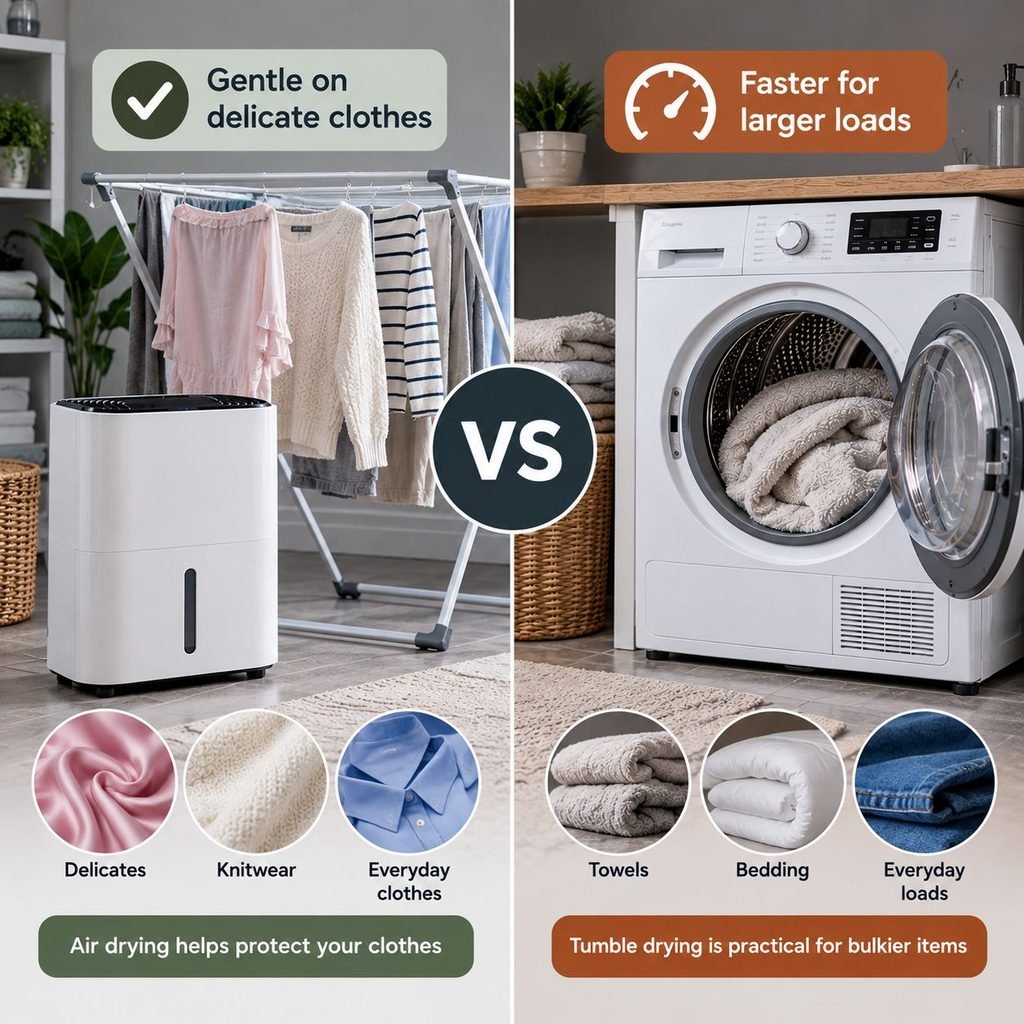
A heat-pump dryer is gentler than conventional high-temperature drying because it works at lower temperatures. Even so, the care label should decide whether something goes in the dryer.
Delicates, stretchy fabrics and anything marked as unsuitable for tumble drying are better kept out of the drum altogether. Don’t rely on a low-temperature programme to make them safe.
What happens to all the moisture?
This is where using a dehumidifier for drying clothes indoors really earns its place.
Wet laundry releases moisture as it dries. Without decent ventilation or something to deal with it, a lot of that water vapour stays in the room and pushes the humidity up. When humid air hits a cold surface, like a window or an outside wall, it can condense into droplets.
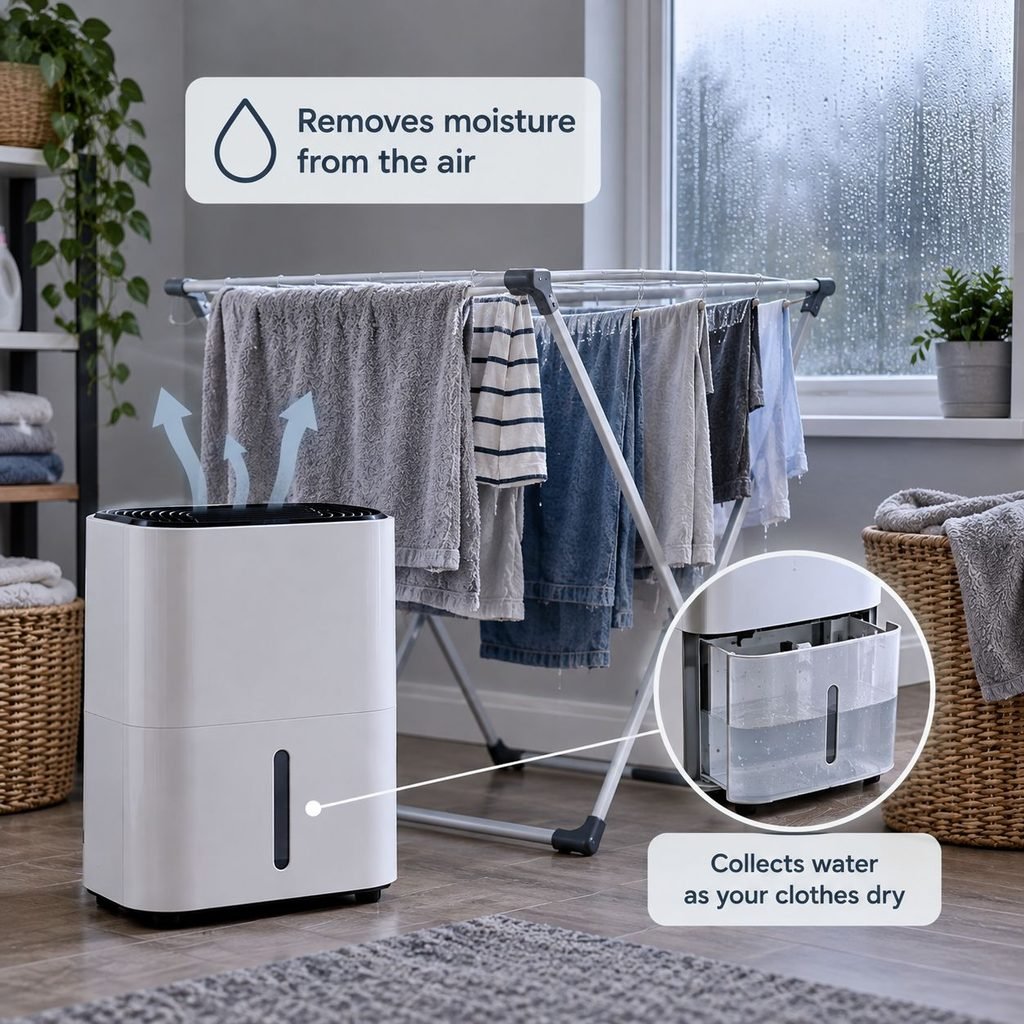
A dehumidifier deals with this directly. It draws moisture out of the air and collects it in its tank, or sends it down a continuous-drainage hose. That brings the humidity down, which makes condensation less likely. It can’t guarantee you’ll never get any, because room temperature, cold surfaces and ventilation all play a part, but it deals with much of the extra moisture your washing adds.
A tumble dryer handles the moisture inside the appliance. A vented dryer pushes warm, damp air out through its hose, so the hose needs to go outside through a window or wall, not just into the room. Condenser and heat-pump dryers condense the moisture and collect it in a tank or drain it away.
If drying washing indoors regularly leaves you with steamed-up windows or damp patches, the dehumidifier is doing two jobs at once. And if damp is a wider problem in your home, our guide to the best dehumidifiers in the UK covers models for whole-home use.
Which is better in winter?
That mostly comes down to where you dry your clothes.
A tumble dryer is the more predictable option when you need things dry quickly in winter. Everything happens inside the machine, so the conditions in the room matter much less. If your dryer lives in an unheated garage or outbuilding, check the operating temperature range in the manual.
A dehumidifier is much more affected by room temperature. Compressor models work best in a normally heated home and lose effectiveness as the room gets colder. One manufacturer’s published figures for a 20-litre compressor model show it removing less than half as much water per day at 10°C as at 20°C, at the same humidity. Desiccant dehumidifiers cope much better in cold spaces such as an unheated utility room, but as the running-cost figures above show, they use more electricity. Our compressor vs desiccant dehumidifier guide goes into the trade-off in more detail.
So for fast, predictable winter drying, go for the tumble dryer. For air drying in a heated room, especially if you’re also fighting condensation, a dehumidifier can make more sense.
Which is more convenient?
For everyday convenience, the tumble dryer is the easier option.
Move the clothes from the washing machine to the drum, pick a programme and take them out when it’s done. Models with moisture sensors can end the cycle once the load reaches the dryness you’ve chosen. Condenser and heat-pump dryers do need their water tank emptying regularly, unless they’re plumbed into a drain.
A dehumidifier asks more of you. The clothes need hanging on an airer with room for air to circulate, the dehumidifier needs to be in the right spot, the washing needs collecting once it’s dry, and the tank needs emptying unless you’re using a drainage hose.
The airer also takes up floor space for hours, which gets annoying in a busy house.
That changes if you simply don’t have room for a tumble dryer. A portable dehumidifier is much easier to store or move from room to room, and it can keep humidity in check around the house when it isn’t drying laundry.
Dehumidifier vs tumble dryer: which suits your household?
There’s no single winner for every home. It depends on how big your loads are, how often you dry, how much space you have, what fabrics you’re dealing with, your room conditions and how quickly you need things dry.
Choose a dehumidifier if…
A dehumidifier makes most sense if you haven’t got space for a tumble dryer, mostly dry small or medium loads, don’t mind waiting several hours, or already need help with damp and condensation.
It’s also a good fit if you air-dry a lot of your clothes anyway. Instead of buying an appliance just for laundry, you can use the same dehumidifier elsewhere in the house when humidity becomes a problem.
Our guide to the best dehumidifiers for drying clothes covers models that are particularly good for laundry.
Choose a heat-pump tumble dryer if…
A heat-pump dryer is the better bet if you regularly dry large loads and want the capacity and convenience of a tumble dryer without the high electricity use of a conventional one.
It costs more to buy, and its cycles are longer than a condenser or vented dryer’s. But lower-temperature drying and much better efficiency make it a strong choice if you’ll be using it several times a week.
For a busy family working through towels, bedding, uniforms and everyday washing, being able to load the drum and walk away can matter as much as the running cost.
What if you already have a condenser or vented dryer?
Don’t assume that replacing a working dryer straight away will save you money.
Condenser and vented dryers use a lot more electricity than modern heat-pump models. In the label examples above, the difference is roughly 50–80p per full load, which would add up to around £80–£125 a year at three full loads a week. Smaller loads mean a smaller saving.
Weigh that against the cost of a replacement and how much life your current dryer has left. If you only use it now and then, it could take many years for the electricity savings to pay for a new machine.
Can using both make sense?
Yes, and in a lot of homes it’s more practical than picking one method for every load.
Towels, bedding and tough everyday clothes that are fine to tumble dry can go in the dryer. Delicates and anything marked as unsuitable for tumble drying can stay on the airer.
If you already have a dehumidifier, running it in the room where those clothes are drying will deal with the moisture they give off. That way you get speed and capacity from the tumble dryer, and gentle air drying with humidity control from the dehumidifier.
How to make dehumidifier drying more efficient
Efficiency starts before you switch the dehumidifier on.
Use the fastest final spin the fabrics can take, so the washing goes onto the airer holding less water. Leave gaps between garments so air can circulate, instead of packing the rails tightly.
If you can, dry the washing in a smallish room with the doors and windows closed. That keeps the moisture from the laundry in the space the dehumidifier is treating, so it isn’t working against a much bigger volume of air. Some dehumidifier manufacturers specifically recommend this for laundry, but check the guidance for your own model.
Where possible, point the dehumidifier so its dry air blows across the washing, following the placement advice in the manual. Keep the air inlet and outlet clear, never drape washing over the dehumidifier, and make sure clothes can’t drip onto it.
Finally, don’t run it longer than you need to. Many models have a laundry mode or a timer. Once the washing’s dry, leaving the dehumidifier on just adds to your bill.
Final verdict: dehumidifier or tumble dryer?
There’s no universal winner, because the two appliances tackle the same problem in completely different ways.
A tumble dryer is better for speed, large loads and convenience. If you’re buying one to use several times a week, a heat-pump model is the sensible choice. In our examples it used less than half the electricity of a conventional dryer, at roughly 42–49p for a full load at the current price cap, though its cycles are longer.
A dehumidifier suits households that prefer air drying, are short on space or need to deal with the moisture from wet washing. At around 4–7p an hour for many compressor models, it’s cheap to run by the hour, but what it costs per load depends on how long your washing takes to dry. Against a condenser or vented dryer it’ll normally win on running cost. Against a heat-pump dryer, it’s close enough that drying time decides it.
So start with how much laundry you dry and how quickly you need it. If fast, frequent drying of big loads is the priority, get a heat-pump tumble dryer. If you’re happy to air-dry and like the flexibility, the gentler treatment of your clothes and the damp control, get a dehumidifier. And if you’ve got room for both, you don’t have to choose.
FAQs
Is a dehumidifier cheaper to run than a tumble dryer?
Usually, but not always. A compressor dehumidifier costs around 4–7p an hour at the current price cap, but your clothes may need several hours on the airer. Against a condenser or vented dryer, which can cost over £1 for a full load, a dehumidifier will normally work out cheaper. Against a heat-pump dryer at around 42–49p a load, it comes down to how long your washing takes to dry.
How long does a dehumidifier take to dry clothes?
There’s no fixed drying time. Load size, fabric type, spin speed, room temperature, humidity, airflow and the dehumidifier itself all make a difference.
A small, well-spaced load in a warm room will dry much faster than heavy towels or tightly packed washing. For the best results, use a high final spin that suits the fabrics, leave gaps between garments and run the dehumidifier in a smallish room with the door shut.
Is a heat-pump tumble dryer cheaper than a dehumidifier?
It can be, if the dehumidifier has to run for a long time. At 26.32p/kWh, a heat-pump dryer using 1.6–1.9kWh for a full load costs roughly 42–49p. That’s about the same as running a 250W dehumidifier for 6½–7½ hours.
The fairest comparison is the total electricity it takes to get the clothes dry, not the hourly cost of each appliance.
Why does a heat-pump tumble dryer take longer than a conventional dryer?
Heat-pump dryers dry at lower temperatures and reuse warm air in a closed loop. That saves a lot of electricity, but each cycle tends to take longer. In the manufacturer label examples in this guide, a full cotton load took around 3½ hours on the heat-pump models and just over 2 hours on the condenser and vented models.
Does a dehumidifier stop wet clothes causing condensation?
It helps. By taking moisture out of the air, a dehumidifier cuts the extra humidity that comes from drying clothes indoors, which makes condensation less likely. It can’t guarantee you won’t get any, though.
Room temperature, ventilation, how cold your walls and windows are and the overall moisture level in your home all affect whether condensation forms.
What’s the cheapest way to dry clothes indoors?
An airer on its own costs nothing to run, but drying can be slow in winter and the moisture from the washing stays in your home. Adding a compressor dehumidifier costs a few pence an hour at the current price cap and deals with much of that moisture. That makes it one of the cheapest ways to dry clothes indoors without adding to damp problems.
Which is better for a large family?
If you’re drying several large loads a week, a tumble dryer is the more practical choice. It handles big loads without needing lots of hanging space, and a heat-pump model keeps the electricity cost down.
A dehumidifier is still handy for clothes that are better air-dried, and for dealing with the extra humidity from indoor drying.
Can I use a dehumidifier and a tumble dryer together?
Yes, although they don’t usually need to dry the same clothes at the same time. Use the tumble dryer for towels, bedding and everyday washing that’s fine to tumble dry, and the dehumidifier for delicates and non-tumble-dry clothes on the airer.
One Comment