Robot Vacuum vs Cordless Vacuum Cleaner: Which Is Better in the UK? (2026)
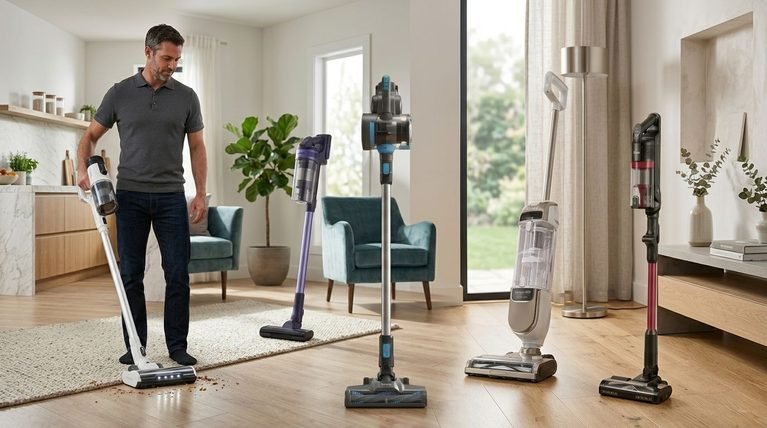
Robot vacuums have become far more capable, but they still solve a different problem from a cordless vacuum. A good robot can keep accessible floors under control with very little day-to-day effort. A cordless gives you direct control and can go where a robot can’t: up the stairs, onto the sofa and into the car.
That’s why headline suction figures don’t settle this one. Stairs, upholstery, skirting boards and awkward corners still favour a cordless. Open floors, daily crumbs and pet hair that keeps coming back are where a robot is genuinely useful.
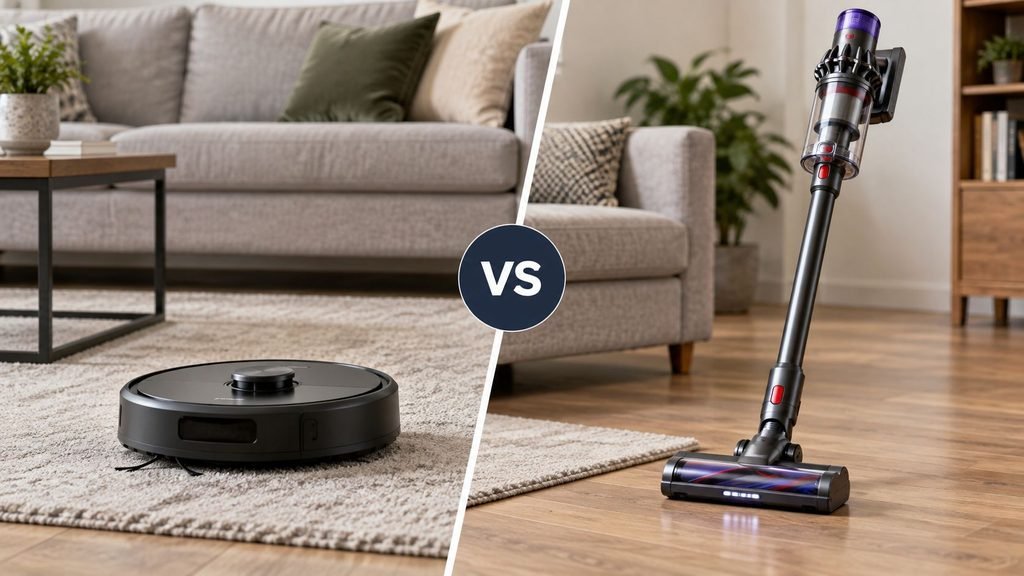
So rather than asking which is “better”, it helps to ask which one suits your home and the way you clean. If you’re buying only one vacuum, a cordless is usually the safer choice. A robot makes a stronger case when you want to cut down routine floor cleaning, and the two can work very well together.
Quick answer: Choose a cordless if you need one vacuum for the whole home, especially if you have stairs, pets that sit on the furniture or a car to clean. Choose a robot if you already have a way to handle stairs and detail cleaning and want your floors kept tidy without doing it yourself. In a single-level, fairly uncluttered home with mostly hard floors, a robot can handle most of the everyday work, but it still won’t clean anything above floor level.
Robot Vacuum vs Cordless Vacuum: Quick Comparison
| Category | Robot vacuum | Cordless vacuum | Edge |
|---|---|---|---|
| Routine floor cleaning | Runs on a schedule, even when you’re out | You clean when you choose to | Robot |
| Deeper carpet cleaning | Varies a lot by model, with limited control | You control speed and number of passes | Cordless, on a good model |
| Hard floors (dry debris) | Good on capable models | Good on capable models | Depends on model |
| Mopping | Many models mop; best for light, regular cleaning | Not a standard feature | Robot, if mopping matters |
| Pet hair on floors | Frequent runs stop it building up | Effective with the right floor head | Depends on model |
| Pet hair on sofas and pet beds | Can’t reach | Good with a mini motorised tool | Cordless |
| Stairs | Can’t clean them | Well suited | Cordless |
| Under beds and sofas | Good if it fits the gap | Possible with a low head or flexible wand | Robot, if clearance allows |
| Corners and edges | Improved, but can still miss dirt | Direct access with a crevice tool | Cordless |
| Car and above-floor jobs | No | Good in handheld mode | Cordless |
| Hands-on effort | Low, but not zero | You do the cleaning | Robot |
| Maintenance | More parts, plus the dock | Simpler | Cordless |
| Storage | Needs floor space for the dock | Wall bracket or stand | Depends on your home |
| Best as your only vacuum | Only in simple single-level homes | More versatile | Cordless |
How Robot and Cordless Vacuums Differ
With a cordless vacuum, you decide where to clean, how slowly to go over a dirty patch and which attachment to use. Most stick models also convert for above-floor jobs such as stairs, upholstery and the car.
A robot vacuum works differently. Once it has mapped your home and you’ve set your preferences, it can leave its dock, clean selected rooms and return on its own. Depending on the model, a more advanced dock may also empty the dust bin, wash and dry the mop pads, and manage clean and dirty water.
It also changes when the cleaning happens. A cordless cleans when you pick it up. A robot cleans on a schedule, including while you’re at work, so its real strength is little and often rather than one big weekly clean.
Automation is the reason to buy a robot. A cordless takes the power cable out of vacuuming; a robot takes much of the routine floor cleaning off your hands. If you’re still weighing up whether to go cordless at all, our corded vs cordless vacuum cleaner comparison covers that decision.
Cleaning Performance Compared
Which cleans carpets better?
For a thorough carpet clean, a good cordless is generally the more practical choice. You can slow down over high-traffic areas such as the hallway or the patch in front of the sofa, make extra passes and spend more time where dirt tends to build up.
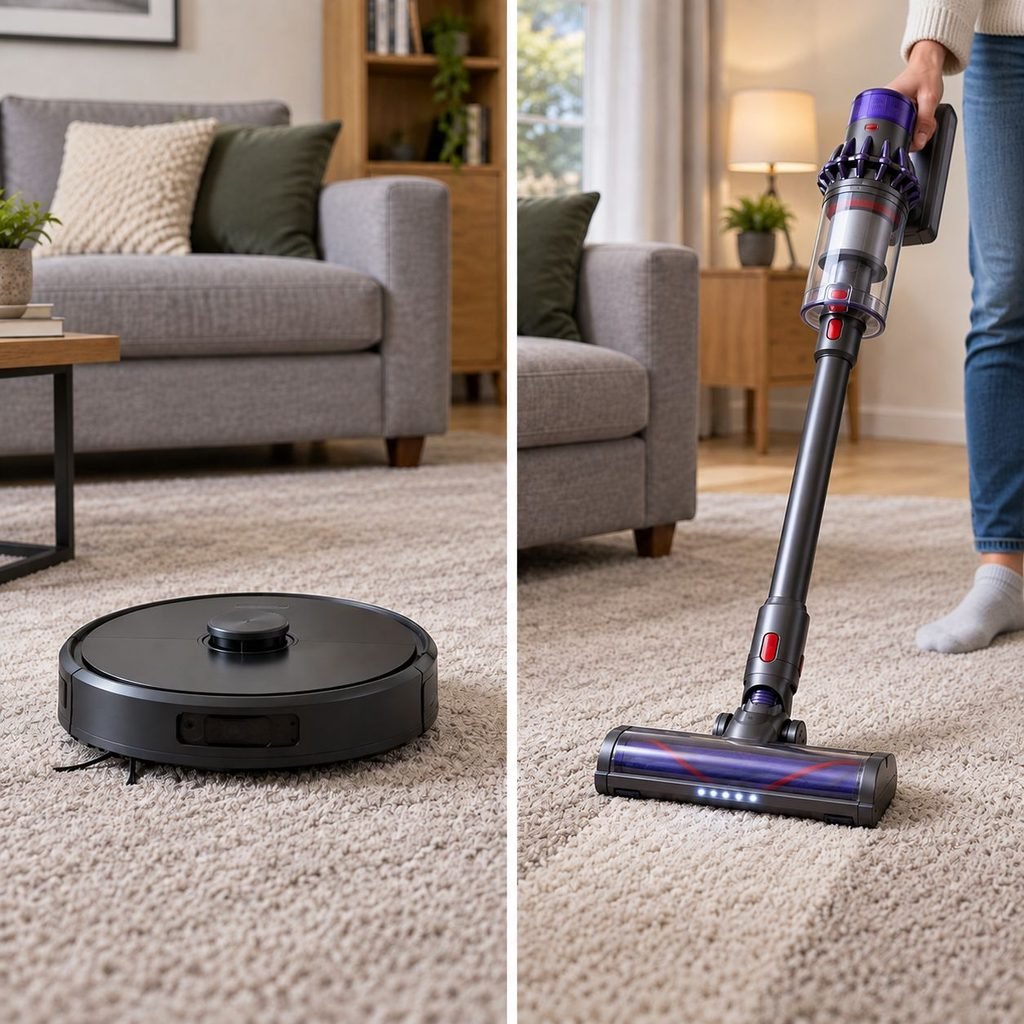
That doesn’t mean every cordless cleans carpet well. Pickup from carpet varies widely between models, and a lot of it comes down to the floor head. A motorised brush bar that properly agitates the pile matters as much as the motor, so judge the individual vacuum rather than the category.
A capable robot can still be useful on carpet, particularly for picking up surface debris and hair before they get trodden in. Many models boost suction automatically when they detect carpet, and some newer ones can raise their body slightly to cope with deeper pile. Shaggy rugs, rug tassels and very deep pile are still difficult for many robots, so check what the manufacturer says about carpet height before buying.
Neither type washes a carpet. For stains, ground-in dirt or pet accidents, a carpet cleaner does a different job altogether.
Which is better on hard floors?
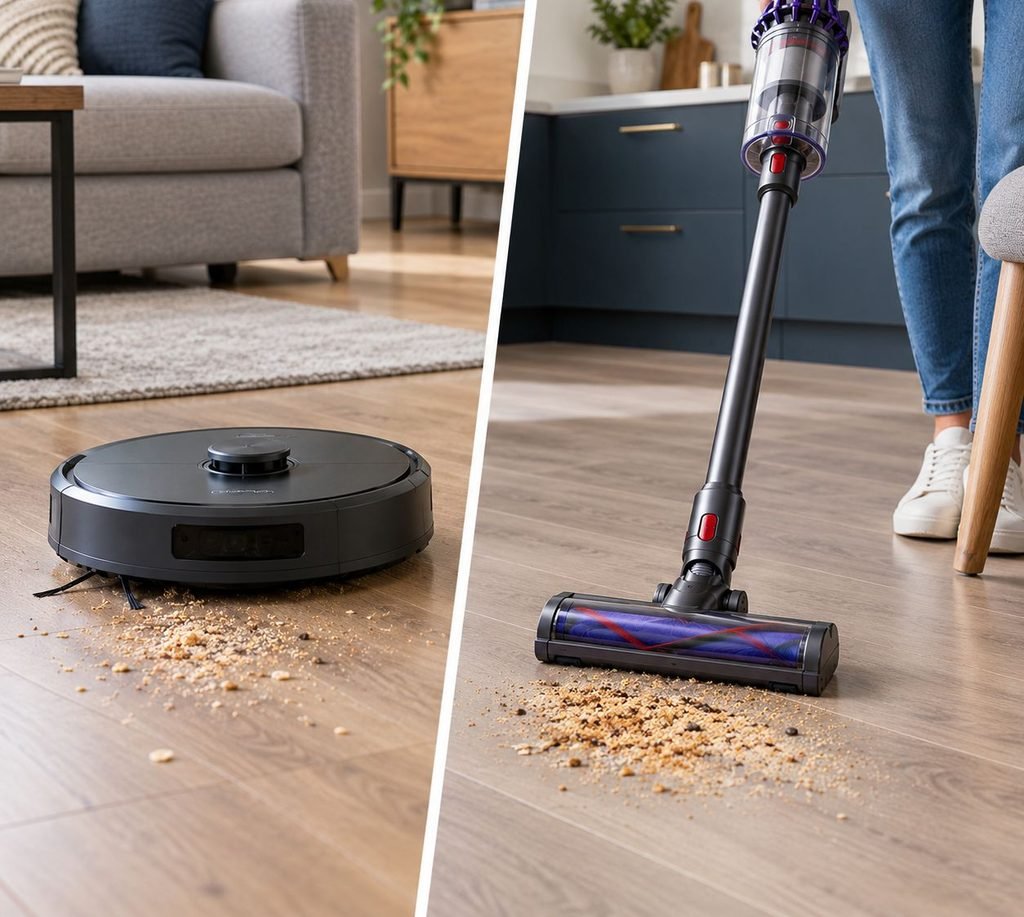
On hard floors, the gap is much smaller. Both types handle everyday dust, crumbs and hair well, provided the individual machine is a good one.
The robot’s advantage is frequency. Scheduling the kitchen or hallway every day stops loose debris building up and getting walked through the house. Many robots also mop. Basic models drag a damp pad behind them, while more advanced systems use spinning pads or rollers, lift them when they reach carpet and wash them at the dock, sometimes with heated water.
Robot mopping is best treated as routine maintenance rather than a replacement for tackling dried-on marks. If you want a proper wash, a wet and dry vacuum cleaner or, on sealed hard floors, a steam mop will do a more thorough job.
A cordless has a different advantage. When cereal goes across the kitchen floor, you can grab it and deal with the mess in seconds rather than wait for the next scheduled run.
Which is better for pet hair?
Pet hair is one of the better reasons to consider a robot. It can run daily, so loose fur has less time to gather in corners and along skirting boards. Anti-tangle designs, such as rubber rollers and brushes built to clear wrapped hair, help in homes with long-haired pets, although you’ll still need to check the brush now and then.
But pets shed on more than floors. Sofas, pet beds, stairs and car seats are all outside a robot’s reach. A cordless with a mini motorised tool is far more useful for those jobs.
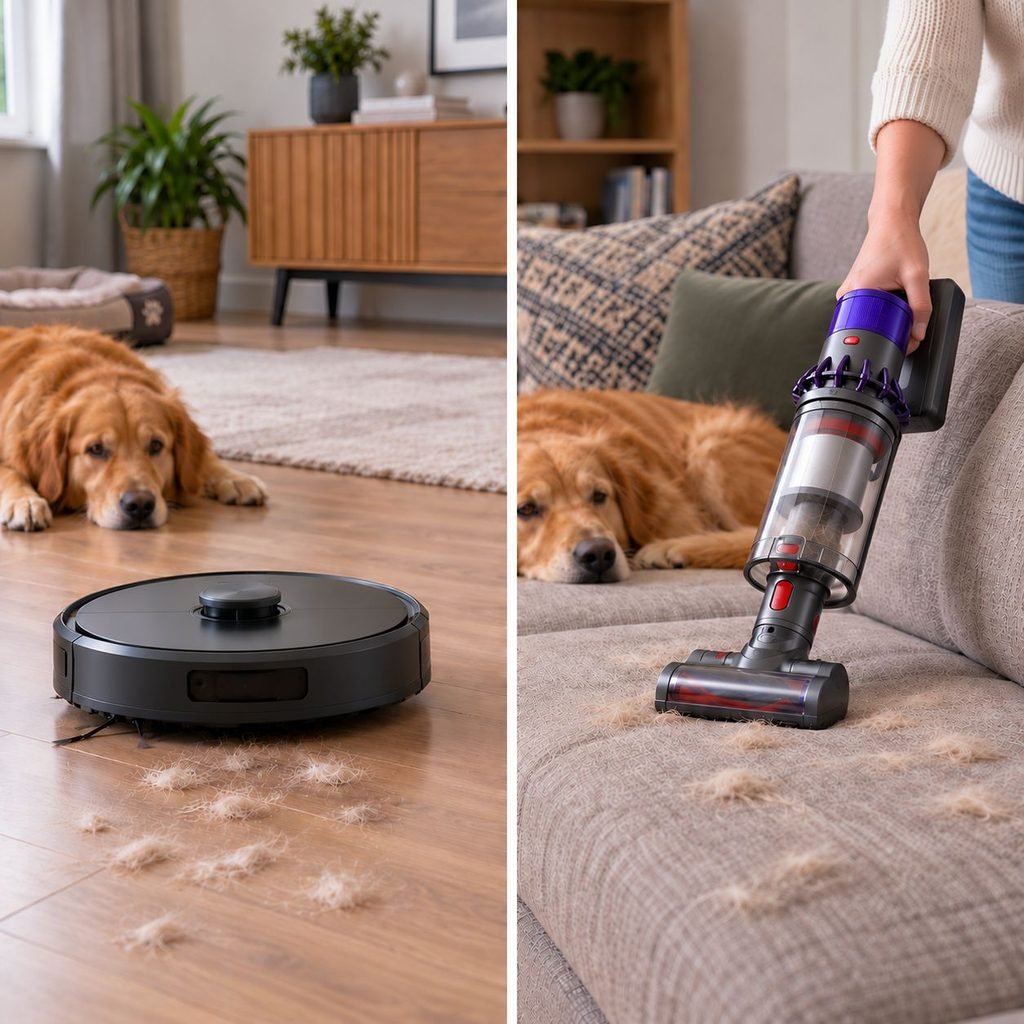
If loose hair on the floor is the recurring problem, a good robot can make a noticeable difference. If you want one machine to tackle pet hair around the whole home, a cordless is the more versatile option. Plenty of pet owners end up with both for exactly this reason.
Robot vacuum vs cordless vacuum for stairs
For stairs, a cordless is the clear choice. Robot vacuums use cliff sensors to stop them falling down steps, but mainstream robots on sale in the UK can’t clean the staircase itself.
Stair-climbing robots are starting to appear. Several manufacturers have shown robots or carrier platforms that can move between floors, but at the time of writing these are prototypes or very limited launches tied to specific high-end models. Most of the carrier designs also move the robot between floors without cleaning the steps. For now, it’s sensible to assume a robot stays on one floor.
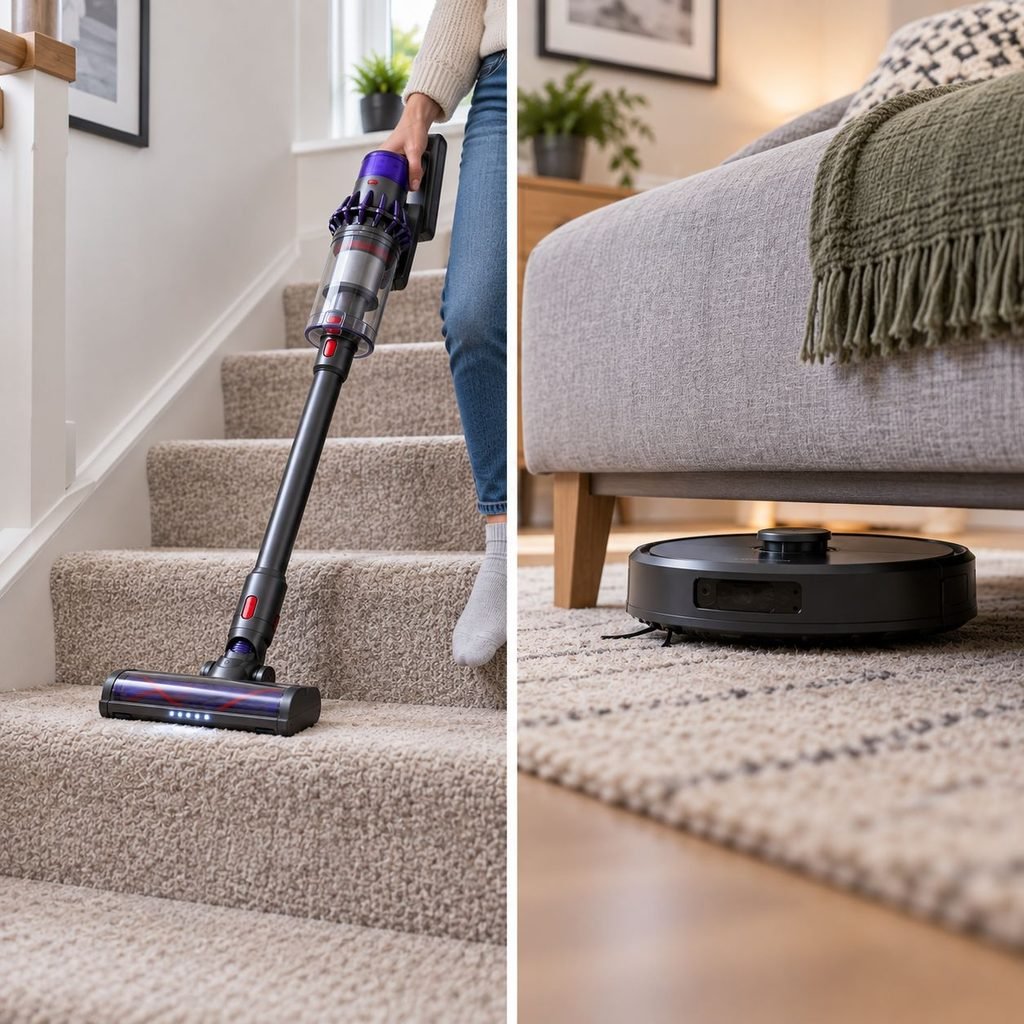
A lightweight vacuum cleaner can be carried between floors and, with a mini motorised tool or crevice tool, used on stair treads, edges and carpeted risers. That matters in a lot of UK houses, where the staircase is often carpeted and gets heavy daily use.
Which is better under beds and furniture?
A robot has a useful advantage here. If there’s enough clearance, it can regularly clean beneath beds, sofas and cabinets that tend to get skipped during a manual clean.
A cordless can reach beneath furniture too, especially with a low-profile head or a flexible wand, but you still have to get down and manoeuvre it yourself.
Robot heights vary by a few centimetres between models, and some newer ones retract their laser sensor to fit under lower furniture. Measure the gap under your bed and sofa and compare it with the robot’s listed height before buying, as even a small difference decides whether it fits. Beds with drawers or solid bases block access completely.
What about corners and edges?
Corners and narrow gaps still favour a cordless. Side brushes that extend and mop pads that swing outwards have improved what robots can reach, but some dirt can still be left along edges and in awkward corners.
A crevice tool gives you direct access to skirting boards, furniture gaps and tight corners. It’s another reason to think of a robot as a floor-maintenance cleaner rather than a complete replacement for a cordless.
Living With Each One
Which needs less effort day to day?
A robot, comfortably. It can clean while you work, cook or go out, and cleaning that happens without you is the whole point of buying one. A self-emptying dock stretches that further, so you deal with collected dust every few weeks rather than after every run, depending on the dock and how much dirt your home produces.
A cordless still needs you to pick it up, walk it round the house and empty it afterwards. That’s quick work in a flat and a proper chore in a four-bedroom house with stairs.
Which is easier to maintain?
Here it goes the other way. A basic cordless is the simpler appliance: empty the bin, clear hair from the brush bar, wash or replace the filter and keep the floor head clear.
A robot has more to look after. Hair collects around the main brush and side brushes, filters need cleaning or replacing, and sensors and wheels want a wipe now and then. Self-emptying docks use bags that run out, and mopping docks add clean- and dirty-water tanks, pads and a wash tray. The dirty-water tank needs emptying and rinsing regularly or it starts to smell, which is the job most new owners underestimate.
Does a robot vacuum need you to tidy first?
Sometimes. Obstacle recognition has improved a lot, especially on camera-equipped models, but cables, phone chargers, shoelaces, socks, small toys and rug tassels can still catch some robots out. Some models are designed to recognise pet mess, but don’t assume obstacle avoidance will spot everything every time.
Keeping the floor reasonably clear makes automated cleaning far more reliable. In practice, a robot suits homes where a quick tidy before it runs is realistic. With a cordless, you simply move the object or clean around it.
Doors, thresholds and room layout
A robot can only clean the rooms it can reach, so a few things about your home matter more than the spec sheet suggests.
Internal doors need to be open, or the robot will clean only one side of them. Scheduling a run while you’re out works well, but only if you remember to leave the doors open.
Door thresholds are worth checking too. Many UK homes have raised door bars or small steps between rooms, often where the flooring changes between a hallway and a kitchen or bathroom, and older properties can have taller thresholds still. Some 2026 flagship robots claim to cross single thresholds of around 4.5cm in manufacturer testing, but cheaper models typically manage much less. Check the listed maximum and measure your highest threshold before buying.
Most app-connected robots let you set no-go zones, choose individual rooms and adjust suction room by room, which helps in awkward layouts. The robot will still need rescuing now and then if it gets stuck under a chair or beached on a rug, so you’ll still be called in from time to time.
Which is better for small homes and flats?
A robot can work very well in an uncluttered, single-level flat, particularly where hard flooring dominates. Scheduled cleaning can keep most of the floor tidy with little day-to-day effort.
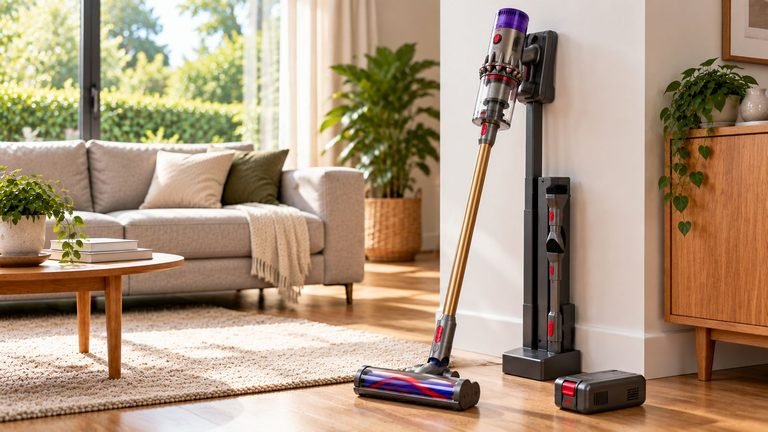
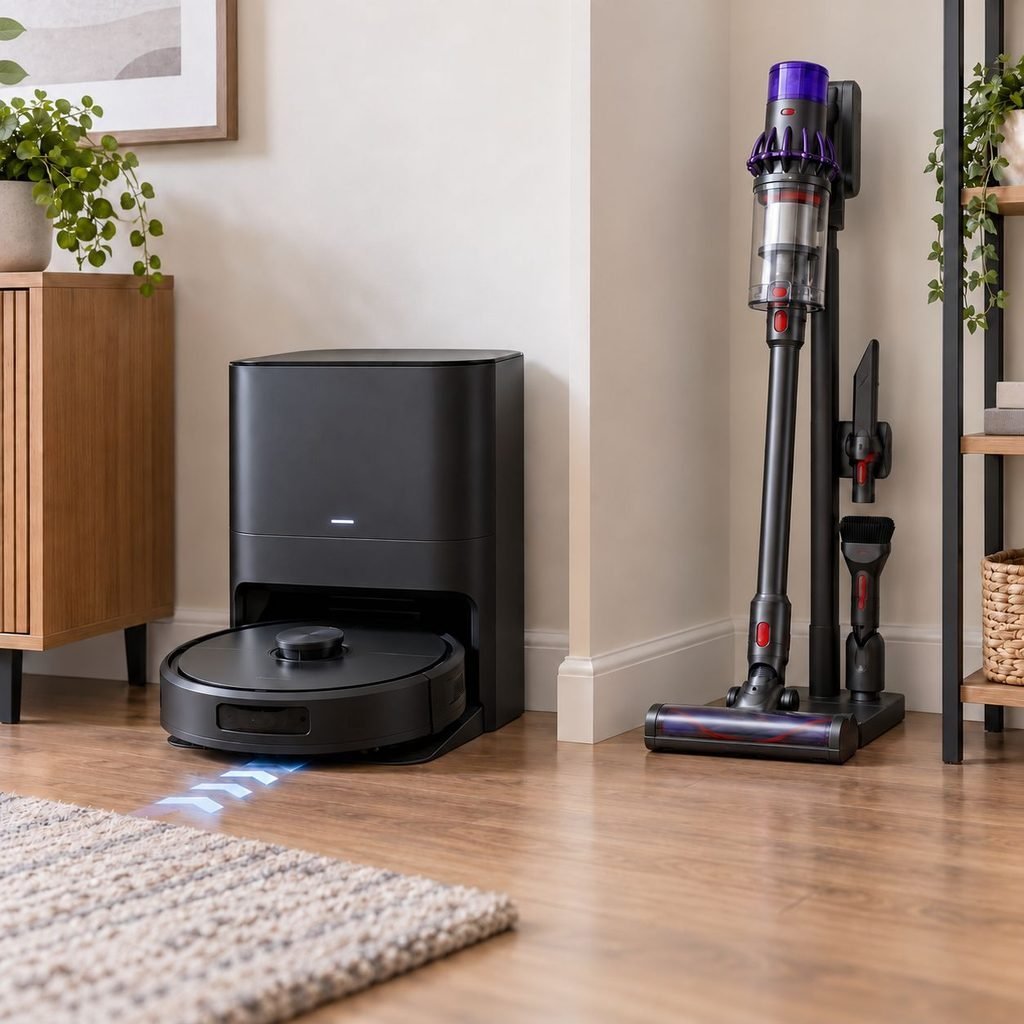
Storage is worth thinking about. A basic charging dock takes up little room, but a self-emptying or mop-washing station needs considerably more floor space, plus clear space around it for the robot to dock and a nearby plug socket. In a compact flat, a cordless that hangs on a wall bracket or stands in a cupboard may be easier to live with. If you rent and can’t drill for a wall mount, check whether a floor stand is included or available.
Layout matters as much as size. Tight furniture gaps, raised thresholds and floor clutter can all reduce the benefit of automated cleaning.
Which is better for larger and multi-storey homes?
A robot becomes more useful as the amount of accessible floor space increases. Mapping, room selection, schedules and recharge-and-resume features help it cover larger areas without you vacuuming every room yourself.
In a multi-storey home, the robot can’t move itself between floors. Many app-connected robots can store maps for more than one floor, so you can carry it upstairs and it will recognise where it is, but its dock stays where you put it. Some households buy a second robot for the upper floor; others keep a cordless for the stairs and bedrooms.
With a cordless, battery runtime matters more as the home gets larger. Treat advertised maximum runtimes cautiously, because higher power settings and motorised floor heads can cut how long the battery lasts.
Battery life: robot vs cordless
Battery life matters in different ways for the two types. With a cordless, it decides how long you can clean before recharging or swapping the battery. A robot can usually return to its dock when charge runs low and, if the model supports recharge-and-resume and it’s switched on, carry on where it left off. That makes large jobs slower rather than impossible.
So uninterrupted runtime is more important with a cordless. Check whether the quoted maximum applies to the lowest power setting or a non-motorised tool, and whether the battery clicks out for swapping or replacement. Batteries in both types lose capacity over the years, so it’s worth checking that replacements are sold in the UK before you buy.
Dust capacity and emptying
Cordless bins are fairly compact, so they may need emptying often in larger homes or homes with pets.
Robots also have small onboard bins, but a self-emptying station transfers the debris into a larger bag or container in the dock. Robots without self-emptying need their onboard bin emptied regularly, often after every run or two.
Most self-emptying docks use disposable bags, which many people find less messy to empty but which add an ongoing cost. It’s the same trade-off we cover in our guide to bagged vs bagless vacuum cleaners.
Budget
Price ranges overlap more than you might expect. A basic robot without a self-emptying dock can cost less than a mid-range cordless, while flagship robot-and-dock systems that vacuum, mop, wash their own pads and empty themselves can cost well over £1,000.
What you get for the money differs, though. At the lower end, a robot usually means simpler navigation, a smaller bin you empty by hand and less capable obstacle avoidance, so it needs more supervision. A cordless at a similar price is often the more complete cleaning tool, because none of its budget goes on sensors and a dock. If you need one machine on a tight budget, our guides to the best cordless vacuum cleaners under £200 and under £300 are good places to start.
What about running costs?
Running costs are harder to compare than they look. Manufacturers don’t publish energy figures for a complete cleaning cycle, and battery capacity doesn’t tell you what a machine draws from the wall, so any figure covering either category as a whole would be guesswork.
What you can check is the dock. Stations that wash mop pads with heated water or dry them with warm air use electricity for heating on top of charging the battery, and the rated power is usually on the dock label or in the specifications. Multiply that by the hours it runs and then by your unit rate for a rough idea. Ofgem’s average price cap unit rate for electricity on a standard variable tariff paid by Direct Debit is 26.32p per kWh from 1 October to 31 December 2026 across England, Scotland and Wales, though your own rate depends on region, tariff and meter type.
Parts and consumables are the costs you can actually predict, and the two types spend money in different shapes.
A robot’s costs arrive steadily. Filters, main and side brushes and mop pads wear out, self-emptying docks get through bags, and mopping models may want cleaning solution. None of it is expensive on its own, but it’s a small annual top-up you’ll keep paying, and the more the dock does, the more items there are on the list.
A cordless costs very little year to year, usually just filters and the occasional brush bar or floor head. The catch is the battery. It loses capacity over the years, and a manufacturer replacement for a premium model can run to over £100, so one lump payment can wipe out several years of savings.
So over a typical ownership period, a cordless is usually cheaper to keep running, especially a mid-range one that isn’t doing heavy daily work. That flips if the battery fails outside the guarantee, or if the battery isn’t user-replaceable and the whole vacuum has to be replaced instead. Before buying either, check what the wear parts cost in the UK, and for a cordless check whether the battery clicks out and how long the guarantee runs.
Robot vacuum privacy and app support
A connected robot vacuum is a smart device, and it’s worth treating it like one. Mapping, scheduling, room selection and remote control usually depend on an app, a Wi-Fi connection and an account with the manufacturer. Robots build a map of your home, and some use a camera at floor level for obstacle recognition. Read how the manufacturer handles map and image data, and check what still works without the app.
UK law helps a little here. Since 29 April 2024, manufacturers of consumer connectable products sold in the UK have had to avoid universal default passwords and publish the minimum period for which a product will receive security updates. That support period is worth looking up before you buy, particularly for a robot you expect to keep for several years.
The UK’s National Cyber Security Centre advises using smart devices safely by switching on automatic updates where available, using a strong password and doing a factory reset before you sell or give a device away. Turning on two-step verification for the app account, where offered, adds another layer of protection.
None of this should put you off a robot, but software support and account security deserve a place alongside suction, navigation and dock features. Most cordless vacuums don’t need an app at all, although some newer models do connect to one.
Can a Robot Vacuum Replace a Cordless Vacuum?
In some single-level homes, a robot can handle most routine floor cleaning. For most households, though, it can’t cover every job a cordless can.
It can’t clean stairs, sofas, mattresses, shelves or the car. Tight corners and concentrated messes are also quicker to deal with by hand.
Its more natural role is floor maintenance. If you already own a capable cordless, a robot can take over the repetitive cleaning while the cordless comes out for stairs, furniture, edges and deeper work.
Robot Vacuum or Cordless Vacuum: Which Should You Buy?
The right answer depends on your home as much as the machines: how many floors you have, what’s on them, how cluttered they tend to be, whether you have pets, how much storage you can spare, your budget and whether you already own another vacuum.
A robot vacuum makes sense if you:
- Want the floors kept tidy several times a week without doing it yourself
- Have mostly open hard flooring or short-pile carpet, without high thresholds between rooms
- Already own a vacuum for stairs, furniture and detail cleaning
- Can live with a quick tidy before it runs, and with rescuing it occasionally
- Have floor space for the dock
A cordless vacuum makes sense if you:
- Are buying your only vacuum
- Have stairs, especially carpeted ones
- Clean sofas, mattresses, pet beds or the car with any regularity
- Live somewhere cluttered, tightly furnished or full of awkward thresholds, where a robot would spend half its time stuck
- Would rather decide exactly where the machine goes and how thoroughly you clean
If a cordless looks like the better fit, our roundup of the best cordless vacuum cleaners in the UK compares the models worth shortlisting.
Is it worth owning both?
If budget and storage allow, robot and cordless vacuums complement each other well.
The robot handles routine floor maintenance, while the cordless covers anything that needs reach or a more concentrated clean. This works particularly well with pets: regular robot runs collect loose hair from the floors while the cordless tackles sofas, stairs and pet beds.
You don’t need to buy both at once. If you already have a good cordless, adding a robot later just takes the repetitive part off your hands.
Final Verdict
There’s no universal winner, because robot and cordless vacuums are good at different jobs.
A cordless is the better all-rounder. It moves from floors to stairs, furniture and the car, while a robot is at its best keeping accessible floors clean with minimal day-to-day effort.
If you’re buying only one vacuum, a capable cordless is the more practical choice for most UK homes, particularly anything with stairs. A robot can stand alone only in a fairly simple, single-level home where you’re happy to deal with above-floor cleaning some other way. If you already have a vacuum for stairs and detailed cleaning, a robot can take much of the repetitive floor cleaning off your hands.
For many households, the two work better together than as alternatives: let the robot keep on top of the floors and use the cordless when you need more reach or a deeper clean.
FAQs
Are robot vacuums better than cordless vacuums?
Not overall. Robot vacuums are better at automated, regular floor cleaning, while cordless vacuums are more versatile because they can also clean stairs, furniture, corners and cars.
Is a stick vacuum the same as a cordless vacuum?
Mostly, yes. Most cordless vacuums sold in the UK are battery-powered stick models, and many convert into a handheld for above-floor jobs. So a robot vacuum vs stick vacuum comparison is essentially the same decision covered in this guide.
Can a robot vacuum replace a normal vacuum cleaner?
Not completely. It can handle much of the routine floor cleaning in a suitable home, but stairs, upholstery, above-floor areas and tight spaces still need another vacuum.
Do robot vacuums work well on carpet?
Good models can keep carpets tidy, particularly when used frequently. For a deeper clean of heavily used areas, a capable cordless or upright gives you more control over where you clean and how many passes you make. Very deep pile and shaggy rugs can still cause problems for many robots.
Are robot vacuums worth buying if I already have a cordless?
Often, yes. The robot takes over the repetitive floor cleaning and the cordless stays on hand for stairs, furniture, edges and anything that needs a proper going over.
Which is better for pet owners?
A robot keeps shed hair off the floors between cleans, while a cordless deals with it on stairs, sofas, pet beds and car seats too. Brush design matters more than the category here, so check how each model handles wrapped hair.
Do robot vacuums use a lot of electricity?
Manufacturers don’t publish energy figures for a full cleaning cycle, so there’s no reliable figure for the category. Docks that heat water or dry mop pads with warm air are the part that uses most, and the rated power on the dock is the number to look for.
Is a robot vacuum suitable for a two-storey house?
Yes, but it can’t move between floors by itself or clean the stairs. You’ll need to carry it between levels, buy a second robot for upstairs or use another vacuum for the stairs and upper floor.
Which is better for a small flat?
A robot can work well in an uncluttered single-level flat, especially with mostly hard floors and few thresholds. A cordless suits you better if storage is tight, furniture is packed closely together or a large dock would be in the way.
Should I buy a robot vacuum or cordless vacuum first?
If you don’t already own a capable vacuum, a cordless is usually the more practical first purchase because it can handle more cleaning jobs. A robot makes more sense once you have another way to clean stairs, furniture and detailed areas.