
Best Coffee Machines for Cappuccino and Latte UK 2026
Most of a cappuccino or latte is milk. So if milky coffee is what you drink, your machine has to do two things well: pull a decent shot of espresso, and turn cold milk into something silky and sweet instead of a jug of big bubbles. Lots of machines are fine at the first bit and pretty average at the second.
The right one for you depends on how you like to make it. Some people love steaming milk by hand and having a go at pouring a heart on top. Others just want to press a button at 7am and get on with their day. There’s nothing wrong with either, but they’ll point you towards very different machines.
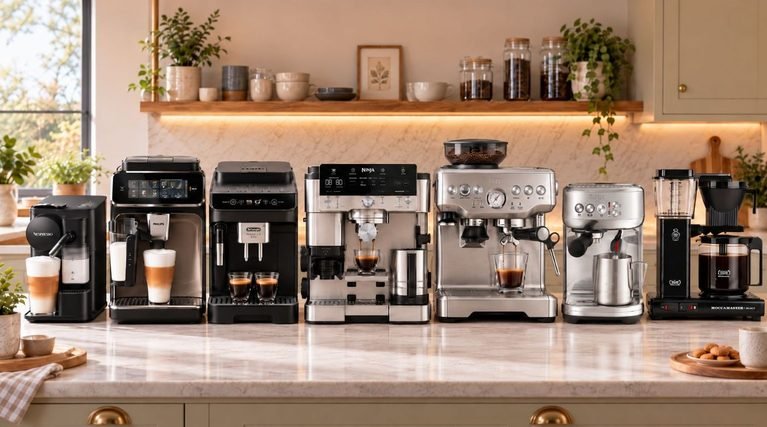
We’ve narrowed it down to five machines that are good at milk drinks specifically, from hands-on espresso machines to a capsule machine. For each one, we’ve looked at how it froths milk, what the espresso underneath is like, how much work goes into each cup, and how much cleaning the milk side needs. People tend to forget about that last one until the machine’s already on the worktop.
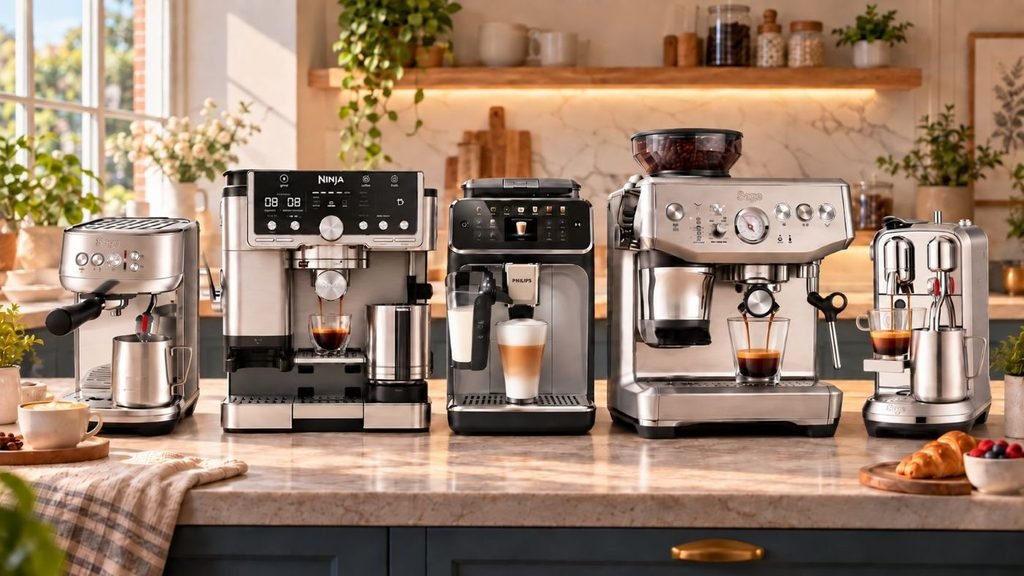
Quick answer: the best coffee machines for cappuccino and latte
- Best for cafe-style milk without a learning curve: Sage Bambino Plus
- Best all-rounder with a grinder and hands-free milk: Ninja Luxe Cafe Pro Series
- Best for one-touch cappuccinos and lattes: Philips 5500 Series LatteGo
- Best for learning to steam milk like a barista: Sage Barista Express Impress
- Best capsule machine for milk drinks: Nespresso Creatista Plus by Sage
Cappuccino and latte machines compared
| Coffee machine | Milk system | Built-in grinder | Hands-free milk | Best for | Typical UK price |
|---|---|---|---|---|---|
| Sage Bambino Plus Manual espresso | Automatic steam wand, 3 temps and 3 foam levels | ✗ | ✓ | Beginners and small kitchens | £330 to £400 |
| Ninja Luxe Cafe Pro Series Assisted espresso, 3-in-1 | Steam-and-whisk jug, 5 froth presets | ✓ | ✓ | Fresh-bean drinks with less effort | £550 to £730 |
| Philips 5500 LatteGo Bean-to-cup | Integrated LatteGo milk carafe | ✓ | ✓ | Push-button milk drinks | £500 to £670 |
| Sage Barista Express Impress Manual espresso with grinder | Manual steam wand | ✓ | ✗ | Learning latte art | £600 to £730 |
| Nespresso Creatista Plus Capsule | Automatic steam wand, 8 textures and 11 temps | ✗ | ✓ | Convenience with milk control | £470 to £500 |
Prices were checked in early October 2026 across the manufacturers and major UK retailers. Coffee machine prices move a lot, so treat these as a guide rather than a promise.
How we chose: we’ve gone through manufacturer specs and UK manuals, checked current UK prices, and looked closely at how each milk system works in everyday use. We haven’t lab-tested these machines ourselves, so we won’t pretend to have test scores. What you’ll get instead is a clear idea of what each one is like to live with if you mostly drink milky coffee.
1. Sage Bambino Plus: best for cafe-style milk without the learning curve
The Bambino Plus does the hardest part of a latte for you. Its steam wand is automatic. You fill the 480ml jug that comes in the box, sit it on the drip tray under the wand, pick one of three temperatures (Warm, Ideal or Hot) and one of three foam levels, and press Steam. A sensor under the jug switches it off once the milk reaches the temperature you chose. Go low on foam for a latte or flat white, and high for a cappuccino. And if you fancy learning to steam by hand later on, you can do that too.
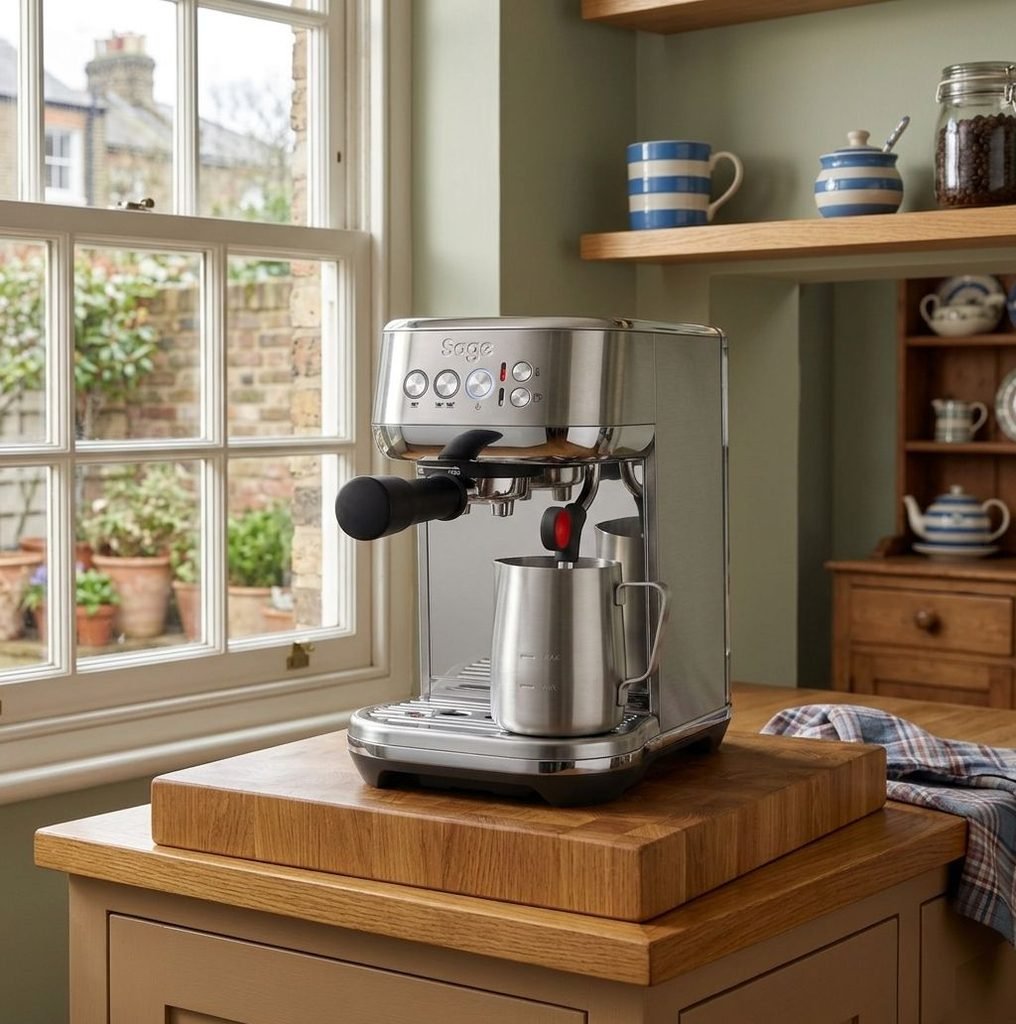
Underneath, it’s a real espresso machine with a 54mm portafilter, PID temperature control and low-pressure pre-infusion. The ThermoJet heater is ready in about three seconds, so there’s hardly any waiting between pulling a shot and steaming milk. The big downside is that there’s no grinder. You’ll need either a separate burr grinder or pre-ground coffee in the dual-wall baskets included, and your espresso will only ever be as good as the coffee going into it. At just 19.4cm wide, it’s also the one that’ll squeeze in most easily if your worktop’s already crowded. If you’re torn between this and a machine with a grinder, our Sage Bambino Plus vs Barista Express comparison goes into the trade-off in more detail.
Key Specifications
| Specification | Details |
|---|---|
| Machine type | Manual (semi-automatic) espresso machine |
| Milk system | Automatic steam wand with jug temperature sensor; manual steaming also possible |
| Milk settings | 3 temperatures, 3 foam levels |
| Grinder | None (use a separate grinder or pre-ground coffee) |
| Portafilter | 54mm stainless steel |
| Water tank | 1.9 litres |
| Milk jug included | 480ml stainless steel |
| Dimensions (W x D x H) | 19.4 x 36.2 x 30.4cm |
| Guarantee | 2 years |
| Typical UK price | Around £330 to £400 |
How it handles cappuccinos and lattes
| What to expect | |
|---|---|
| Milk texturing | Hands-free, with 3 temperatures and 3 foam levels. Can be done manually too. |
| Espresso base | Proper portafilter espresso, but quality depends heavily on your grinder and beans |
| Effort per drink | Dose and tamp, press a shot button, then press Steam |
| Milk cleaning | Wand purges itself after steaming. Wipe the tip and wash the jug. |
| Best for | Beginners who want real microfoam without weeks of practice |
Pros and cons
- Automatic steaming gives consistent milk from your very first drink
- Separate temperature and foam settings cover lattes, flat whites and cappuccinos
- Ready to brew in around three seconds
- Very compact, at under 20cm wide
- Manual steaming is there when you want to start learning
- No built-in grinder, so the real cost is higher unless you already own one
- Only three temperature and three foam settings
- Shot control is limited to the 1-cup and 2-cup buttons (volumes can be reprogrammed)
Buy it if: you want cafe-style milk with almost no learning curve, you’re short on space, and you already have a grinder or are happy to buy one.
Skip it if: you want a single machine that goes from whole beans to finished latte without any extra kit.
2. Ninja Luxe Cafe Pro Series: best all-rounder with a grinder and hands-free milk
The Luxe Cafe Pro (model ES701UK) makes sense if you want freshly ground espresso and hands-free milk without buying two separate machines. Milk goes into an XL stainless steel froth jug with a removable whisk inside, and the wand steams while the whisk spins. There are five presets: Steamed Milk, Thin Froth, Thick Froth, Extra-Thick Froth and Cold Froth. In everyday terms, that’s Thin Froth for a latte or flat white, Thick or Extra-Thick for a cappuccino, and Cold Froth if you like an iced coffee in summer. There’s a manual froth option as well.
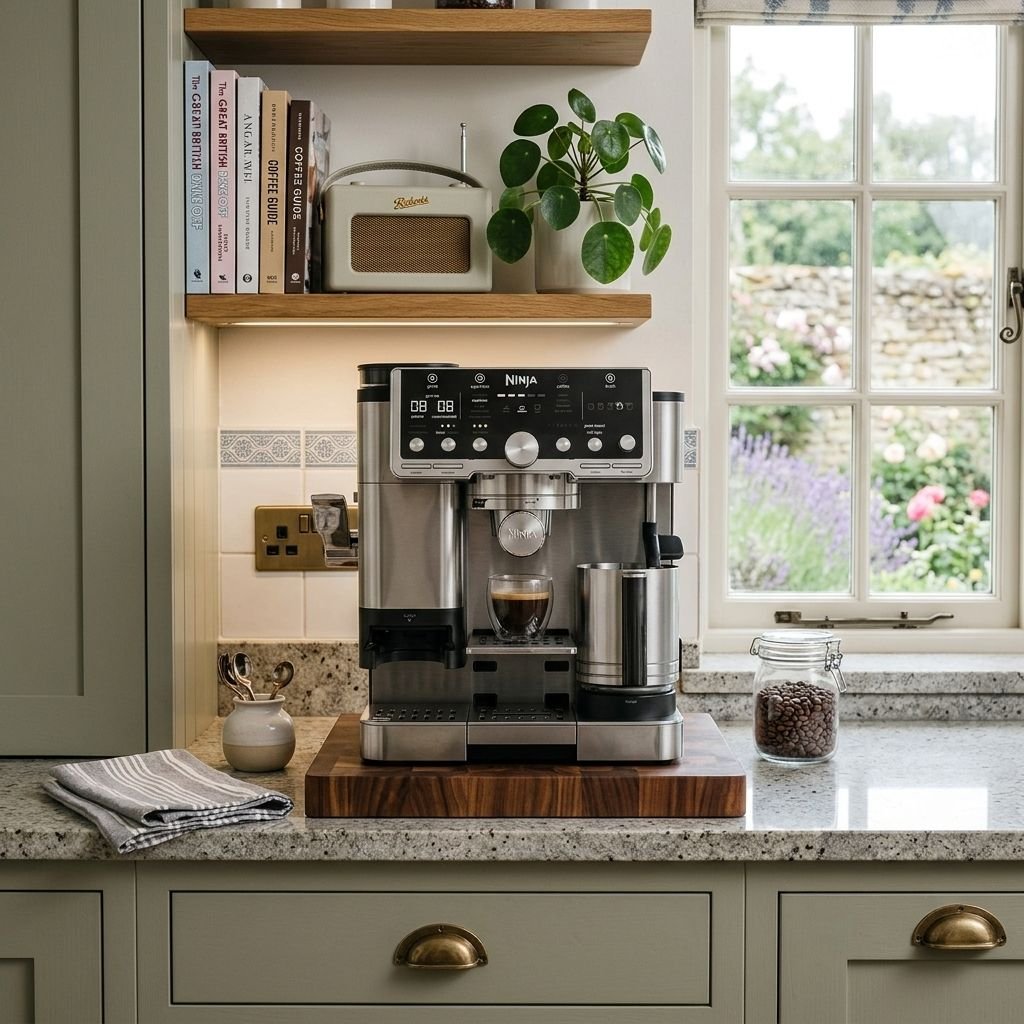
On the espresso side, Ninja’s Barista Assist suggests a grind setting, a built-in scale doses the coffee by weight, and a lever-operated tamper presses the puck for you. You still handle the portafilter, but most of the guesswork is gone. The conical burr grinder has 25 settings, and the machine makes filter coffee and cold brew as well, which is handy if not everyone at home drinks lattes. It’s a big machine though, at 37.7cm tall and 35.5cm deep, so check it against your worktop and wall cupboards before ordering. We compare it head to head with Sage’s equivalent in our Ninja Luxe Cafe Pro vs Sage Barista Express Impress guide.
Key Specifications
| Specification | Details |
|---|---|
| Machine type | Espresso machine with built-in grinder (espresso, filter coffee and cold brew) |
| Milk system | Dual Froth System: steam wand plus removable whisk in an XL jug |
| Milk settings | 5 presets (Steamed Milk, Thin, Thick, Extra-Thick, Cold Froth), plus manual frothing |
| Grinder | Conical burr, 25 settings, with built-in scale and assisted tamper |
| Water tank | 2 litres |
| Bean hopper | 250g |
| Dimensions (W x D x H) | 33.7 x 35.5 x 37.7cm |
| Guarantee | 2 years when registered with Ninja |
| Typical UK price | RRP around £700 to £730, often seen around £550 |
How it handles cappuccinos and lattes
| What to expect | |
|---|---|
| Milk texturing | Hands-free hot or cold froth with five presets, or manual mode |
| Espresso base | Fresh-ground, weight-dosed and machine-tamped |
| Effort per drink | Grind into the portafilter, pull the tamp lever, brew, then start a froth preset |
| Milk cleaning | Auto purge cleans inside the wand. Wipe the outside and wash the jug and whisk. |
| Best for | People who want fresh beans and automatic milk without going fully bean-to-cup |
Pros and cons
- Hands-free milk with presets that map well to latte, cappuccino and iced drinks
- Grinder, scale and assisted tamper take most of the guesswork out of espresso
- Also makes filter coffee and cold brew
- Auto purge keeps the inside of the wand clean
- Many parts, including the drip tray, water tank and bean hopper, are top-rack dishwasher safe
- Large footprint that won’t suit every kitchen
- More steps per drink than a bean-to-cup machine
- The whisk is one more part to wash after each milk drink
- Less fine control over milk than a fully manual wand in skilled hands
Buy it if: you want freshly ground espresso and automatic milk in one box, and you like the idea of filter and cold brew too.
Skip it if: counter space is tight, or you’d rather have push-button drinks with no portafilter at all.
3. Philips 5500 Series LatteGo: best for one-touch cappuccinos and lattes
If you want a cappuccino or latte with as little involvement as possible, a bean-to-cup machine with an integrated milk system is the easiest way to get there, and the Philips 5500 (EP5546/70) is one of the better ones to look at. You pour milk into the LatteGo carafe, clip it onto the front, and pick a drink on the display. The machine grinds, brews and froths straight into your cup. Its 20 recipes include cappuccino, caffè latte, latte macchiato, flat white and cafe au lait, plus iced versions of several. You can tweak strength, coffee length and milk quantity, then save favourites to one of four user profiles, which is useful when everyone at home likes their latte a bit differently.
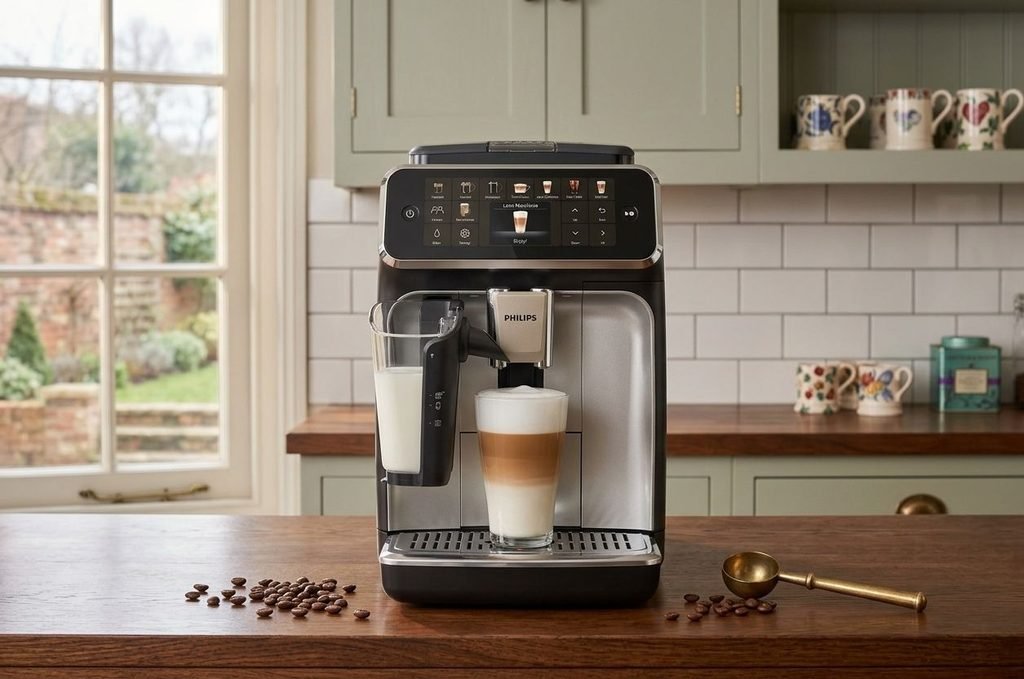
What made us pick this one over other bean-to-cups is how easy the milk system is to clean. LatteGo is just two parts with no tubes, and Philips says it rinses clean in under ten seconds, under the tap or in the dishwasher. That’s a bigger deal than it sounds. If a frother is a faff to clean, it’s usually the bit that ends up in the cupboard. It’s not perfect, though. The carafe holds 0.26 litres, so you’ll be topping it up if you make several large lattes in a row. Philips doesn’t offer automatic milk cleaning either, so the rinse is down to you. And like most bean-to-cups, the espresso tends to be milder than a well-made manual shot. The extra shot function helps if you like a stronger milk drink.
Key Specifications
| Specification | Details |
|---|---|
| Machine type | Bean-to-cup (fully automatic) |
| Milk system | LatteGo integrated carafe, froths directly into the cup |
| Milk capacity | 0.26 litres |
| Drinks | 20 hot and iced recipes, plus frothed milk and hot water |
| Grinder | Ceramic, 12 settings |
| Water tank | 1.8 litres |
| Bean hopper | 275g |
| Dimensions (W x D x H) | 24.6 x 43.3 x 37.1cm |
| Guarantee | 2 years |
| Typical UK price | RRP £669.99, often seen around £500 to £550 |
How it handles cappuccinos and lattes
| What to expect | |
|---|---|
| Milk texturing | Automatic and straight into the cup. You adjust milk quantity rather than foam texture. |
| Espresso base | Freshly ground beans, with an extra shot option for stronger drinks |
| Effort per drink | Fill the carafe, clip it on, press a button |
| Milk cleaning | Two parts, no tubes. Rinse under the tap or put it in the dishwasher. |
| Best for | Households who want cafe-style drinks at the touch of a button |
Pros and cons
- True one-touch cappuccinos, lattes and flat whites
- LatteGo carafe is very simple to clean, with no milk tubes
- 20 hot and iced recipes and four user profiles
- SilentBrew technology, with Quiet Mark certification
- AquaClean filter can extend descaling intervals to up to 5,000 cups (with regular filter changes)
- Small 0.26-litre carafe for big lattes or several drinks
- No control over foam texture, so no latte art
- Espresso is milder than you’d get from a portafilter machine
- Milk system needs rinsing by hand or in the dishwasher, as there’s no automatic milk clean
Buy it if: you want proper cappuccinos and lattes at the press of a button and a milk system that’s quick to rinse.
Skip it if: you want to control milk texture yourself, pour latte art, or you prefer a strong, punchy espresso base.
Want to see more push-button options? Our guide to the best bean-to-cup coffee machines in the UK covers more fully automatic machines, including other models with integrated milk systems.
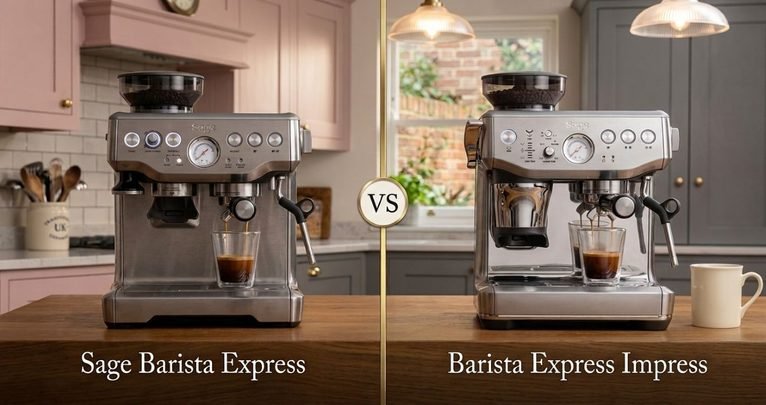
4. Sage Barista Express Impress: best for learning to steam milk like a barista
If you’d like to learn to steam milk yourself, this is the one we’d point you towards. The wand is fully manual with a 360° swivel, and Sage rates the steam at 130°C. You control how much air goes in and how the milk spins, which means you decide exactly how thick the foam is. That’s how you get silky milk for a latte one morning and a taller, foamier cappuccino the next, and it’s how you learn latte art properly. Be warned, it takes practice. Your first few jugs will probably be bubbly, and that’s completely normal.
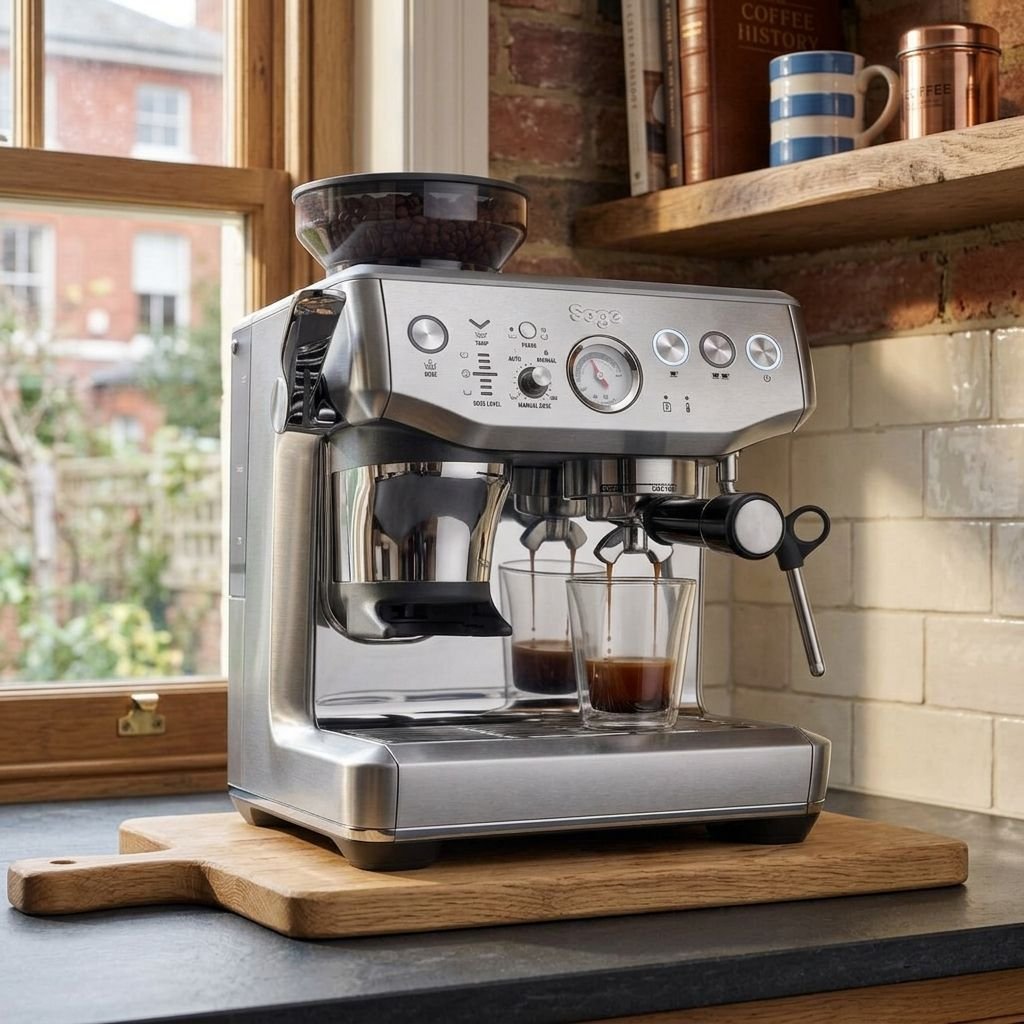
The espresso side is where Sage gives you a helping hand. The Impress Puck System doses ground coffee from the built-in conical burr grinder (25 settings), tells you if the dose needs adjusting next time, and tamps with a lever and a 7° twist finish. There’s also a pressure gauge, so you get feedback on every shot. Brewing and steaming share one heating system, so you pull your shot first and then switch to steam. For a closer look at the machine on its own, see our full Sage Barista Express Impress review, or our Barista Express vs Barista Express Impress comparison if you’re weighing it against the cheaper original.
Key Specifications
| Specification | Details |
|---|---|
| Machine type | Manual espresso machine with built-in grinder and assisted tamping |
| Milk system | Manual steam wand, 360° swivel |
| Grinder | Conical burr, 25 settings |
| Portafilter | 54mm stainless steel |
| Water tank | 2 litres |
| Bean hopper | 250g |
| Milk jug included | 480ml stainless steel |
| Dimensions (W x D x H) | 33 x 38 x 41cm |
| Guarantee | 2 years |
| Typical UK price | RRP around £730, often seen around £600 |
How it handles cappuccinos and lattes
| What to expect | |
|---|---|
| Milk texturing | Fully manual, with complete control over foam and temperature |
| Espresso base | Fresh-ground, with assisted dosing and tamping, plus a pressure gauge |
| Effort per drink | The most hands-on here: grind, tamp, brew, then steam by hand |
| Milk cleaning | Wipe and purge the wand straight after every jug |
| Best for | Hands-on coffee lovers who want to learn microfoam and latte art |
Pros and cons
- Full control over milk texture, from flat white silk to cappuccino foam
- Built-in grinder means one machine from beans to cup
- Assisted tamping cuts mess and makes shots more consistent
- Pressure gauge helps you learn what a good shot looks like
- Milk steaming has a real learning curve
- No automatic milk option for busy mornings
- Milk dries hard on the wand if you don’t wipe it straight away
- Tall and fairly deep, so check the space under your cupboards
Buy it if: you enjoy the process, want to pour latte art, and like the idea of getting better with practice.
Skip it if: you want consistent milk drinks with no effort, or other people at home need to use it without a lesson.
5. Nespresso Creatista Plus by Sage: best capsule machine for milk drinks
With capsules, the coffee bit takes no effort at all. What makes the Creatista Plus different is the milk side, which has far more settings than most capsule machines. Its automatic steam wand has 8 texture levels and 11 temperatures, from 56°C to 76°C according to the manual. Recipes on the display include cappuccino, cafe latte, flat white and latte macchiato. As with the Bambino Plus, milk is textured in a stainless steel jug rather than a sealed frother, so you can pour it yourself and have a go at simple latte art.
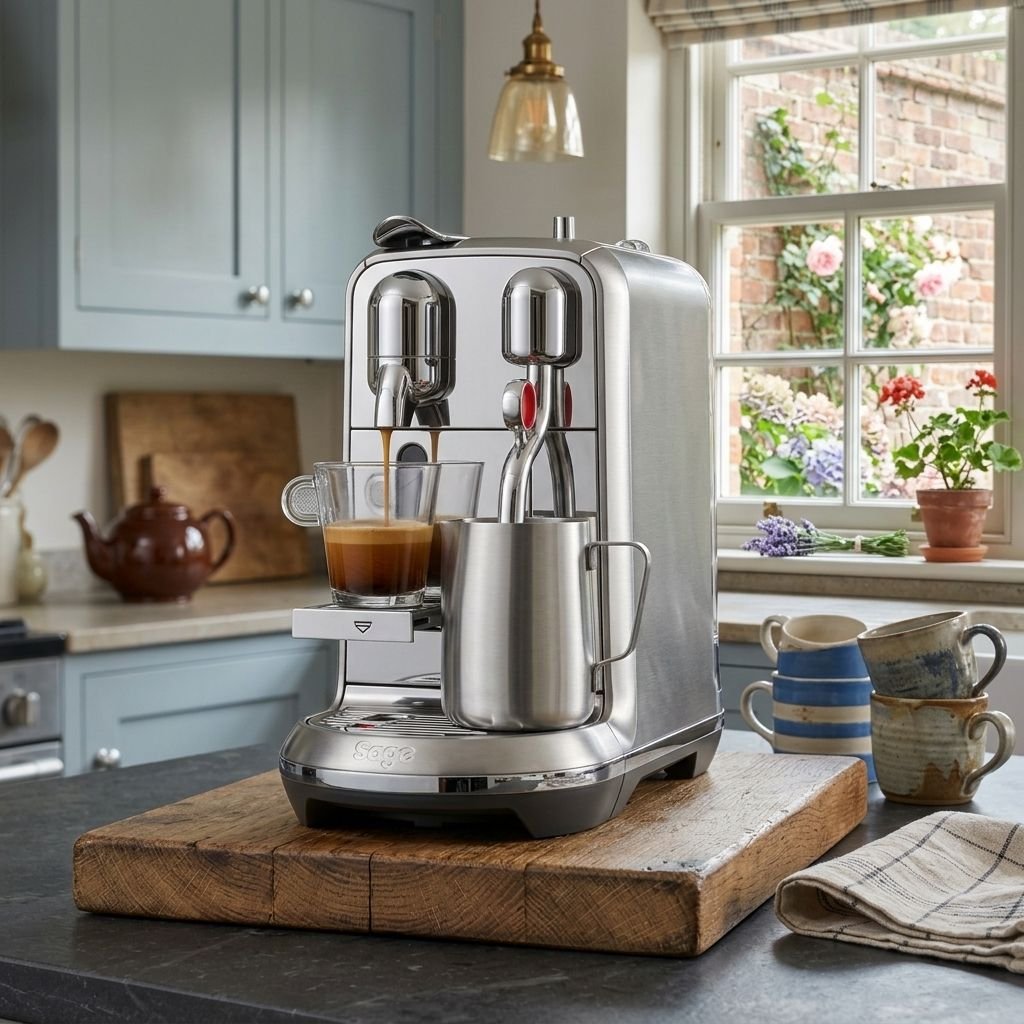
Where it falls short is the coffee. It uses Nespresso Original capsules, so the espresso is consistent and tidy, but you can’t change the grind or dose, only the coffee volume (25ml to 60ml). Running costs are higher than buying beans: Nespresso’s own Original capsules typically cost somewhere around 40p to 80p each, although compatible capsules from other brands are widely sold in UK supermarkets for less. The 1.5-litre water tank is also the smallest in this round-up.
Key Specifications
| Specification | Details |
|---|---|
| Machine type | Capsule machine (Nespresso Original) |
| Milk system | Automatic steam wand with jug temperature sensor and auto purge |
| Milk settings | 8 texture levels, 11 temperatures (56°C to 76°C) |
| Coffee | Nespresso Original capsules, coffee volume adjustable from 25ml to 60ml |
| Water tank | 1.5 litres |
| Used capsule container | Holds 12 capsules |
| Dimensions (W x D x H) | Approx. 17.1 x 40.8 x 31cm |
| Typical UK price | RRP £499.95, sometimes seen nearer £470 |
How it handles cappuccinos and lattes
| What to expect | |
|---|---|
| Milk texturing | Automatic, with the widest range of milk settings in this guide |
| Espresso base | Consistent capsule espresso, with no grind or dose adjustment |
| Effort per drink | Pop in a capsule, fill the jug, choose a recipe |
| Milk cleaning | Wand purges itself. Wipe the wand and wash the jug. |
| Best for | Convenience-first drinkers who still care about milk texture |
Pros and cons
- Very fine milk control for a capsule machine
- Quick, clean and consistent, with no grinding or tamping
- Slim, at around 17cm wide
- Guided recipes on the display, which you can personalise
- Auto purge keeps the wand clear
- Ongoing capsule costs add up if you drink several coffees a day
- No control over the espresso beyond volume
- Smallest water tank here
- Pricey for a capsule machine
Buy it if: you want good milk texture with capsule convenience and don’t mind paying more per cup.
Skip it if: you drink a lot of coffee, want the lowest running costs, or care about choosing fresh beans.
Cappuccino vs latte: what’s the difference when you make them at home?
Both drinks are espresso plus steamed milk. The difference is the balance. A cappuccino is smaller, with a thicker layer of foam on top. A latte is longer and milkier, with only a thin layer of foam. Recipes vary between cafes (and between machines), so think of these as typical rather than fixed rules.
| Drink | Typical make-up | Foam | Typical size |
|---|---|---|---|
| Cappuccino | Espresso, steamed milk and a generous foam cap | Thick and airy | Smaller cup |
| Latte | Espresso topped up with plenty of steamed milk | Thin and silky | Larger cup or glass |
| Flat white | Espresso with a smaller amount of very silky milk | Very thin | Small cup |
At home, the real question is how much control you have over that foam. That comes down to the type of milk system:
- Manual steam wand: the most control. You decide how much air goes in, so you can make thick cappuccino foam or silky latte milk. It takes practice.
- Automatic steam wand: you pick a foam level and temperature, and the machine does the steaming in a jug. Consistent results, and you still pour the milk yourself.
- Integrated milk system (bean-to-cup): the most convenient. Milk goes straight into the cup at the press of a button, with the foam set by the recipe.
- Capsule machine with milk: simple and quick. How much milk control you get depends entirely on the model.
We wouldn’t say one is better than the others. It mostly comes down to whether you enjoy the process or just want your coffee.
Manual vs bean-to-cup vs capsule machines for milk drinks
| Machine type | Convenience | Control | Milk preparation | Best for |
|---|---|---|---|---|
| Manual espresso | Low to medium | High | Manual or automatic steam wand, depending on model | People who enjoy the process and want cafe-style results |
| Assisted espresso with grinder | Medium | Medium to high | Often automatic frothing, sometimes with a manual option | Fresh beans with help on the tricky steps |
| Bean-to-cup | High | Low to medium | Integrated carafe or automatic frother | One-touch drinks for busy households |
| Capsule | High | Low (coffee), varies (milk) | Separate frother, built-in system or automatic wand | Speed and tidiness, with higher running costs |
If you want a broader look beyond milk drinks, our guides to the best espresso machines in the UK and the best coffee machines in the UK cover every type of machine.
What to look for in a coffee machine for cappuccino and latte
Milk system
This is the big one. A manual steam wand gives you full control but needs technique. An automatic steam wand, like the ones on the Bambino Plus and Creatista Plus, textures milk in a jug to the temperature and foam level you choose. An integrated milk carafe, like Philips’ LatteGo, froths straight into the cup. Ninja’s steam-and-whisk jug sits somewhere between, with hands-free presets and a manual option.
Milk texture and microfoam
Good milk for a latte is glossy and smooth, with bubbles too small to see. That’s what people mean by microfoam. It tastes sweeter and blends into the espresso rather than sitting on top of it. Steam wands, manual or automatic, are generally best at this. Integrated carafes tend to make a lighter, airier foam that suits cappuccinos well but isn’t designed for latte art.
Espresso quality
Even in a big latte, the espresso still carries the flavour. A weak or sour shot gets lost in the milk, while a well-extracted one comes through clearly. Freshly ground beans, consistent dosing and stable brewing temperature all help, which is why grinder quality and temperature control are worth paying attention to.
Ease of use
Think about what your mornings actually look like. If you want a latte in under a minute with no thought, look at bean-to-cup or capsule machines. If you’re happy to spend a few minutes and enjoy the ritual, a manual or assisted espresso machine will give you more control. Programmable settings and user profiles help when several people share one machine.
Cleaning
Milk is the messy part of any coffee machine. Dried milk on a steam wand is hard to shift and can block the tip, and milk left in tubes or carafes can go off. Look for auto purge on steam wands, removable and dishwasher-safe milk parts, and as few milk-contact pieces as possible.
Machine size
Counter space is precious in a lot of UK kitchens, and coffee machines vary more than you might expect. Measure the depth of your worktop and the height under your wall cupboards, and remember you may need room to lift a lid or slide out a water tank.
| Machine | Width | Depth | Height |
|---|---|---|---|
| Sage Bambino Plus | 19.4cm | 36.2cm | 30.4cm |
| Nespresso Creatista Plus | Approx. 17.1cm | Approx. 40.8cm | Approx. 31cm |
| Philips 5500 LatteGo | 24.6cm | 43.3cm | 37.1cm |
| Ninja Luxe Cafe Pro Series | 33.7cm | 35.5cm | 37.7cm |
| Sage Barista Express Impress | 33cm | 38cm | 41cm |
Price
The machines here run from around £330 (the Bambino Plus on offer) to around £730 at full price (the Barista Express Impress and Ninja Luxe Cafe Pro). Remember to factor in the extras. The Bambino Plus needs a grinder unless you use pre-ground coffee, and the Creatista Plus has ongoing capsule costs. Bean-based machines usually cost less per cup over time.
Grinder
A built-in grinder means fresher coffee and one less gadget on the worktop. Coffee starts losing its aroma soon after grinding, so grinding just before brewing makes a noticeable difference, even under milk. The Ninja, Philips and Barista Express Impress all have one. With the Bambino Plus, a separate grinder gives you more choice over grinder quality, but it adds cost and space.
Which machine suits you?
| If you’re… | Our pick | Why |
|---|---|---|
| A beginner who wants cafe-style milk | Sage Bambino Plus | Automatic microfoam with simple controls |
| After one-touch cappuccinos and lattes | Philips 5500 LatteGo | Grinds, brews and froths into the cup, with easy milk cleaning |
| Keen on fresh beans with less effort | Ninja Luxe Cafe Pro Series | Grind guidance, built-in scale, assisted tamping and hands-free froth |
| A hands-on coffee enthusiast | Sage Barista Express Impress | Manual wand for full milk control, plus a built-in grinder |
| All about convenience | Nespresso Creatista Plus | Capsule simplicity with detailed milk settings |
New to home espresso in general? Our guide to the best coffee machines for beginners looks at easy-to-use machines across every budget.
How to make better cappuccinos and lattes at home
- Start with cold milk. Milk straight from the fridge gives you more time to build foam before it gets too hot. Nespresso’s Creatista manual, for example, recommends refrigerated milk at around 4°C to 6°C.
- Choose milk for the drink. Whole milk gives a richer, creamier foam. Semi-skimmed foams well but tastes lighter. For plant milk, look for “barista” versions, which are made to foam more like dairy.
- Don’t overheat it. Around 60°C to 65°C is a good target. Much hotter and milk starts to lose its natural sweetness and can taste cooked.
- Fill the jug sensibly. Milk expands as you steam it. Fill to just below the spout, or follow your machine’s minimum and maximum marks.
- Use fresh coffee. Beans used within a few weeks of their roast date taste noticeably better. Grind just before brewing if you can.
- Get the grind right. If your shot runs too fast and tastes sour, go finer. If it drips slowly and tastes bitter, go coarser.
- Warm your cup. A cold mug cools the drink quickly. Rinsing it with hot water first helps keep your latte warm.
- Tap and swirl. After steaming, tap the jug on the counter to pop big bubbles, then swirl until the milk looks glossy before pouring.
Cleaning and maintenance for milk-based coffee machines
Milk systems need more attention than any other part of a coffee machine. Milk proteins dry hard quickly, and leftover milk can go sour and affect the taste of your next drink. A minute of cleaning after each milk drink saves a lot of scrubbing later.
| Task | How often | Applies to |
|---|---|---|
| Wipe the steam wand with a damp cloth and purge it | After every milk drink | All steam wand machines (Bambino Plus, Ninja, Barista Express Impress and Creatista Plus auto purge, but still need a wipe) |
| Rinse the milk carafe and frothing parts | After use, or as the machine prompts | Philips LatteGo (tap or dishwasher) |
| Wash the milk jug and whisk | After each use | Steam wand machines, plus Ninja’s removable whisk |
| Run a cleaning cycle with tablets | When the machine prompts or the manual advises | Espresso and bean-to-cup machines |
| Replace the water filter | As the manufacturer recommends | Machines with filters, such as Sage’s Claro Swiss and Philips AquaClean |
| Descale | When prompted, more often in hard water areas | All machines |
Hard water is common across much of England, especially in the south and east, and limescale is the most common cause of coffee machine problems. The Ninja and Philips both come with a water hardness test in the box, and it’s worth setting the hardness level on any machine that asks for it when you first switch on. Stick to the descaler and cleaning products recommended in your manual.
Frequently asked questions
What type of coffee machine is best for cappuccino and latte?
It depends on how involved you want to be. For the most control over milk texture, choose an espresso machine with a steam wand. For push-button convenience, a bean-to-cup machine with an integrated milk system is easiest. An automatic steam wand, like the Sage Bambino Plus has, is a good middle ground.
Can any espresso machine make a cappuccino?
Only if it has a way to froth milk. Most espresso machines include a steam wand, but some compact or capsule models don’t. Without one, you’d need a separate milk frother, which works but adds another gadget to clean.
Is a bean-to-cup machine good for lattes?
Yes, if convenience matters most. Models with an integrated milk system, like the Philips 5500 LatteGo, make lattes at the press of a button using freshly ground beans. The foam is usually lighter than steam wand microfoam, and you can’t adjust its texture as much.
Are automatic milk systems better than steam wands?
Neither is better across the board. Automatic systems are more consistent and need no skill. Manual steam wands give you more control over texture and are the only real option for detailed latte art. Automatic steam wands sit in between, giving you microfoam in a jug without needing technique.
What is the easiest coffee machine for making cappuccinos at home?
A bean-to-cup machine with one-touch milk drinks, such as the Philips 5500 LatteGo, is the least effort. If you’d rather have cafe-style microfoam and don’t mind a little hands-on work with the coffee, the Sage Bambino Plus’s automatic wand is easy to get the hang of.
Do I need a grinder for cappuccino and latte?
You don’t strictly need one, as pre-ground coffee works, especially with dual-wall baskets. But freshly ground beans taste noticeably better, even under milk. If your machine doesn’t have a built-in grinder, a separate burr grinder is one of the best upgrades you can make.
How do I get creamy milk foam for a cappuccino?
Use cold, fresh whole or semi-skimmed milk (or a barista plant milk), and introduce air early in steaming while the milk is still cool. Stop at around 60°C to 65°C. Then tap and swirl the jug before pouring. On an automatic wand, just pick a higher foam setting.
Final verdict: the best coffee machine for cappuccino and latte
There’s no single winner here, because so much depends on how you like to make your coffee. But here’s where we’d land.
If you want the most convenience, the Philips 5500 LatteGo does it all at the press of a button and has one of the simplest milk systems to clean. If you’d like convenience with cafe-style milk texture, the Sage Bambino Plus is the one we’d go for, as long as you’re happy to add a grinder or use pre-ground coffee.
For fresh beans and hands-free milk in one machine, the Ninja Luxe Cafe Pro Series takes the guesswork out of espresso and handles hot and cold froth with presets. If you want the hands-on barista experience and full control over milk, the Sage Barista Express Impress gives you the most room to improve. And if capsules suit your routine, the Nespresso Creatista Plus gives you far more milk control than a typical pod machine.
Whatever you end up buying, start with cold milk and wipe the wand straight after steaming. Those two habits alone will make your cappuccinos and lattes noticeably better.

One Comment