Sage Bambino Plus vs De’Longhi Dedica Style: Is Sage Worth More?
If you’ve been looking at small espresso machines, you’ve almost certainly come across both of these. The Sage Bambino Plus and the De’Longhi Dedica Style are slim, they both use a portafilter and a steam wand, and they’ll both fit on a cramped worktop.
What they don’t share is a price tag. On 24 October 2026, Sage was charging £399.95 for the Bambino Plus and De’Longhi had the Dedica Style down to £149.99. So the Sage costs £250 more for what looks like the same set of drinks. I wanted to work out what that extra money actually gets you, and who really benefits from it.
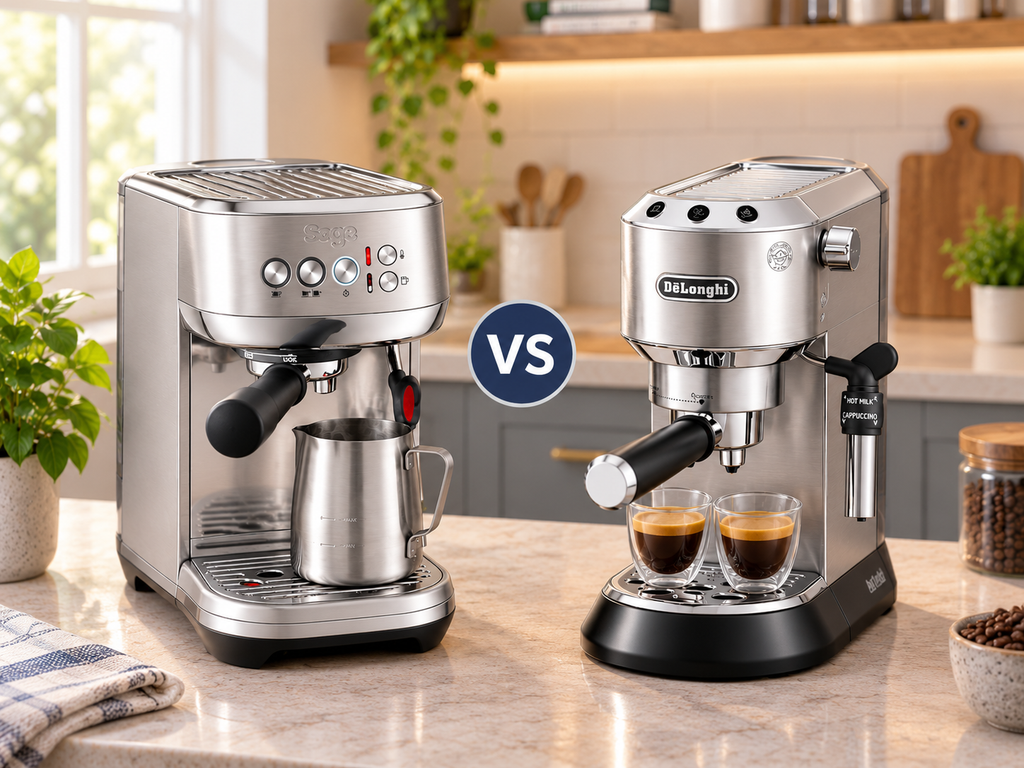
Quick verdict: if you drink lattes, flat whites or cappuccinos most days, I’d pay the extra for the Bambino Plus. The automatic milk wand alone is worth it, and the baskets will reward a decent grinder if you buy one later. If you’re mostly an espresso or americano person using pre-ground coffee or ESE pods, or you don’t want to spend more than about £150, the Dedica Style does the job and you keep the change.
| Sage Bambino Plus | De’Longhi Dedica Style | |
|---|---|---|
| Best for | Daily milk drinks, and fresh beans with a proper grinder | Espresso and americanos, pre-ground coffee and ESE pods |
| Price (24 October 2026) | £399.95 at Sage | £149.99 at De’Longhi (RRP £229.99) |
| Milk | Automatic, stops at your chosen temperature | Manual, with a sleeve that adds air for you |
| Needs a grinder to shine | Yes, to get the most from its single wall baskets | No, it’s built around pressurised filters |
| Biggest compromise | Price, especially once you add a grinder | Milk control and a limited upgrade path |
For more on the Sage by itself, including what it’s like to live with day to day, see our full Sage Bambino Plus review.
Sage Bambino Plus vs De’Longhi Dedica Style: specifications
| Specification | Sage Bambino Plus | De’Longhi Dedica Style |
|---|---|---|
| UK model | SES500 | EC685 (for example EC685.BK or EC685.M) |
| Price (24 October 2026) | £399.95 (Sage) | £149.99 (De’Longhi, RRP £229.99) |
| Heating | ThermoJet | Thermoblock |
| Heat-up | 3 seconds (Sage’s figure) | Around 40 seconds (retailer listings) |
| Pressure | 15-bar pump, low-pressure pre-infusion then 9-bar extraction | 15-bar pump |
| Brew temperature | Digital control, not adjustable | 3 settings in the menu |
| Portafilter | 54mm stainless steel | 51mm |
| Filters | 1 and 2 cup single wall, 1 and 2 cup dual wall | 1 cup and 2 cup pressurised, plus an ESE pod filter |
| Dose | 16 to 19g in the 2 cup basket | Roughly 7g per cup (De’Longhi’s guidance) |
| ESE pods | No | Yes |
| Milk | Automatic wand, 3 temperatures, 3 foam levels, plus manual mode | Adjustable Cappuccino System, hot milk or foam setting |
| Milk jug | 480ml stainless steel, included | Not included |
| Shot buttons | 1 and 2 cup, programmable | 1 and 2 cup, programmable |
| Water tank | 1.9 litres | 1.1 litres |
| Size (W x D x H) | 19.4 x 36.2 x 30.4cm | 14.9 x 33 x 30.5cm |
| Weight | About 4.95kg | 4.22kg |
| Tallest cup | Not published | 12cm, using the two-level drip tray |
| Power | 1,300 to 1,600W | 1,450W (De’Longhi UK listing) |
| Maintenance alerts | Cleaning cycle every 200 shots, plus descale | Descale |
| Guarantee | 2 years | 2 years |
One thing to watch when you’re comparing listings: the Dedica Style is the EC685, usually with a colour code on the end (EC685.BK is the black one, EC685.M the metal finish). The Dedica Arte (EC885) and Dedica Duo (EC890) are different machines, even though the names are close. Sage has a similar trap. The Bambino Plus is the SES500, while the plain Bambino (SES450) has a manual wand, so the milk section below doesn’t apply to it.
Espresso quality: why the baskets matter more than “15 bar”
De’Longhi puts 15 bar front and centre, and I can see why people take that to mean the Dedica is the stronger machine. It’s not that simple. The Bambino Plus has a 15-bar pump as well, and Sage says it actually brews at 9 bar after a low-pressure pre-infusion. The number on the box is what the pump can manage, not the pressure your coffee gets, so I wouldn’t use it to choose between these two.
The filter basket is a much bigger deal. The Dedica only comes with pressurised filters. These have a tiny hole in the bottom that holds the water back for you, so you still get a shot with crema on top even if your coffee is a bit coarse or past its best. It’s a big part of why the Dedica copes so well with supermarket pre-ground coffee and ESE pods.
The downside is that the same filter evens out the difference between ordinary coffee and really good coffee. Freshly ground speciality beans will taste fresher through it, sure, but not by as much as you’d hope, because the filter is doing the job a good grinder would normally do.
The Bambino Plus gives you those forgiving dual wall baskets too, plus a pair of single wall ones. Single wall baskets have no safety net. Pair them with a proper espresso grinder and you can change how a shot tastes by adjusting the grind and the dose, and that’s where the Sage really earns its price. Use them with supermarket pre-ground, though, and you’ll mostly get thin, sour shots that run through too fast.
A few other things separate them on the espresso side:
- The Sage’s 2 cup basket takes 16 to 19g of coffee. De’Longhi suggests roughly 7g per cup for the Dedica, so about 14g in the double filter. More coffee usually means a fuller-bodied shot.
- The Sage soaks the coffee gently before full pressure kicks in, which helps the water run through evenly. Hold the button down and you can stretch that soak out yourself.
- Brew temperature goes the Dedica’s way. It has three settings in its menu, while the Bambino Plus is fixed. Useful if you swap between light and dark roasts.
- The Sage uses a 54mm portafilter and the Dedica a 51mm one. Neither is the 58mm size cafés use, but 51mm accessories are harder to find and mostly come from third-party brands.
| Your coffee | Sage Bambino Plus | De’Longhi Dedica Style |
|---|---|---|
| Supermarket pre-ground | Good, using the dual wall baskets | Good, it’s what the machine is built around |
| ESE pods | Not compatible | Yes, with the pod filter |
| Fresh beans and a blade or budget grinder | Stick with the dual wall baskets, so little advantage | Fine, the pressurised filter hides uneven grinding |
| Fresh beans and a proper espresso grinder | Excellent with the single wall baskets | Better than pre-ground, but the filter holds it back |
Winner: the Bambino Plus, as long as you’ve got a proper grinder. On pre-ground coffee, the difference in the cup is nowhere near £250.
Milk frothing: Sage’s automatic wand vs De’Longhi’s Adjustable Cappuccino System
If you drink milky coffee, this is probably where you’ll make up your mind.
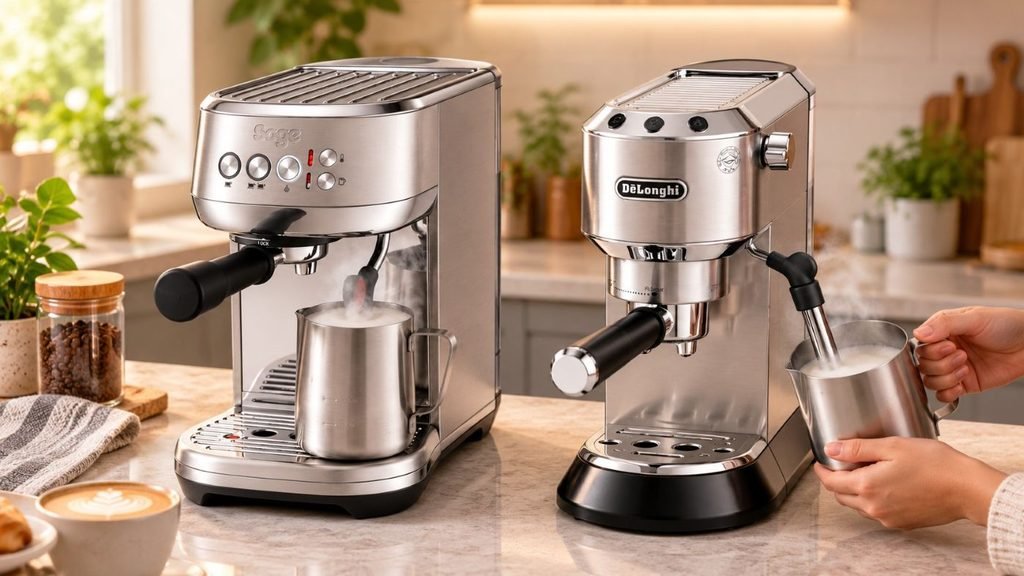
The Bambino Plus has a temperature sensor in the drip tray. You fill the supplied 480ml jug, stand it on the sensor, choose a temperature (Warm, Ideal or Hot) and a foam level (Low, Medium or High), then press steam. It stops on its own when the milk’s hot enough and clears the wand out when you lower it. Sage says the foam is fine enough for latte art, and there’s a manual mode if you’d like to learn to steam yourself.
De’Longhi’s Adjustable Cappuccino System on the Dedica works differently. The wand has a sleeve that pulls air into the milk, and you twist it between a hot milk setting and a cappuccino foam setting. It’s more forgiving than a plain wand because you don’t have to work the air in yourself. But you’re still holding the jug, deciding when to stop and checking the temperature with your hand or a thermometer, because there’s no temperature setting.
Wands like this usually give you airier, bubblier foam. That’s lovely on a classic cappuccino but less suited to a silky flat white, and latte art takes a fair bit of practice. Oh, and you’ll need to buy a milk jug, because there isn’t one in the box.
| Sage Bambino Plus | De’Longhi Dedica Style | |
|---|---|---|
| Who controls the temperature | The machine, with 3 settings | You, by feel |
| Who controls the texture | The machine (3 levels), or you in manual mode | Partly the sleeve, partly you |
| Can you walk away while it steams | Yes | No |
| Learning curve | Very low | Moderate |
| Latte art | Achievable once you learn to pour | Harder |
| Milk jug | Included, and needed for automatic mode | Buy separately, any suitable jug works |
The one catch with the Sage is that automatic mode only works with its own jug. Making three or four big lattes means steaming in rounds. If milk drinks are your thing and you’d like to see other options, our guide to the best coffee machines for cappuccino and latte includes machines that do the whole milk job for you.
Winner: the Bambino Plus, and it isn’t close. Honestly, this is most of what the extra money pays for.
Heat-up time and making a second drink
Sage says the Bambino Plus is ready in 3 seconds. The Dedica’s thermoblock takes around 40 seconds, going by retailer listings. That sounds like a big gap, but in real life you switch the Dedica on, scoop or grind your coffee, tamp it, and by then it’s usually ready anyway.
Where it does make a difference is with milk drinks. Both machines have one heater, so you make the espresso first and steam afterwards. Once you’ve steamed, the heater’s too hot for good espresso straight away.
The Bambino Plus deals with that for you. When you lower the wand, it flushes hot water into the drip tray and brings itself back down to brewing temperature.
On the Dedica, it’s a manual job. According to De’Longhi’s support pages, if both coffee buttons start flashing after you’ve frothed milk, the machine is too hot to brew. You open the steam dial, let water run out until it stops, and then you can carry on.
It only takes a moment, but you’ll be doing it every time someone wants a second latte, or an espresso after you’ve steamed. One side effect of the Sage’s flushing, by the way: the drip tray fills up quickly, so you’ll be emptying it a lot.
Winner: the Bambino Plus. Quicker to heat and less faff between drinks.
Ease of use if you’re coming from pods or instant
If you’re moving on from a Nespresso or Dolce Gusto, I think the Dedica Style is the easier jump. Its pod filter takes ESE pods (the flat paper ones), so on a lazy morning you can pop one in, lock the handle and press a button. With pre-ground coffee, you scoop it into the pressurised filter, press it down lightly and brew. It’s hard to get badly wrong.
There’s also a small settings menu, which I didn’t expect at this price. You can change the brew temperature, set your water hardness and choose how long it waits before switching itself off, anywhere from 9 minutes to 3 hours.
The Bambino Plus isn’t hard to use either. There are three buttons, the shot volumes can be programmed and the milk takes care of itself. What takes learning is the coffee. Once you move to fresh beans and the single wall baskets, every new bag needs dialling in, which just means tweaking the grind and dose until the shot runs properly. Start on the dual wall baskets with pre-ground and it’s about as easy as the Dedica, only with much better milk.
Whichever you pick, it’s more hands-on than pods or instant. There’s tamping, knocking out the used coffee and wiping the wand, every single day. If that’s more than you want before work, our guide to the best coffee machines for beginners and our Nespresso vs Dolce Gusto comparison have easier options.
Winner: the Dedica Style if you just want espresso without the fuss. The Bambino Plus if you drink milk coffee.
Size and small kitchens
The Dedica is 14.9cm wide and the Bambino Plus is 19.4cm, so you save about 4.5cm. In a tight kitchen, that can decide whether it fits beside the kettle. They’re both just over 30cm tall, which clears standard wall cupboards. Depth is a bit confusing on the Sage. Sage says 36.2cm, some retailers say 32cm, so I’d measure for the bigger figure. The Dedica is 33cm deep. Both tanks are at the back, so you’ll need room to lift them out, or a jug to top them up where they sit.
The Sage’s tank is bigger, 1.9 litres against 1.1, so it holds roughly 70% more water. That matters more than it sounds, because the Sage also uses water every time it flushes after steaming. Both machines are fairly light (4.22kg for the Dedica, just under 5kg for the Sage), so hold them steady with your other hand when you twist the portafilter in.
The real space question is the grinder. Buy the Bambino Plus for fresh beans and you’ll want a grinder next to it, which roughly doubles the width you need, since Sage’s own grinders are about as wide as the machine. Run the Dedica on pre-ground or pods and it’s just the one slim box.
Winner: the Dedica Style, especially if you’re not planning on a grinder.
Build, cleaning and running costs
Both have metal bodies and feel solid enough for what they cost. The Sage comes with a stainless steel portafilter and a proper 54mm tamper. The Dedica gives you a plastic scoop that doubles as a tamper, and that’s usually the first thing people replace.
Daily cleaning is the same routine on either: knock out the coffee, rinse the basket, wipe and purge the wand, empty the drip tray. Where they differ is in what you have to keep buying.
The Bambino Plus reminds you to run a cleaning cycle with a tablet every 200 shots, and it tells you when to descale. It also comes with a water filter that Sage says to change every three months or 40 litres, whichever comes first. Keep its parts out of the dishwasher too, as Sage’s manual says not to.
The Dedica has a descale alert and a water hardness setting, and that’s about it. There’s no tablet cleaning cycle, and a water filter is an optional extra rather than something you’re expected to keep replacing.
For a household making two drinks a day, a year of upkeep looks like this. I’ve assumed both get descaled 4 to 6 times a year, which is Sage’s 60 to 90-day guidance, because De’Longhi’s alert depends on the hardness level you set.
| Yearly cost (October 2026 prices) | Sage Bambino Plus | De’Longhi Dedica Style |
|---|---|---|
| Descaling | About £11 to £17 (Sage descaler) | About £10 to £14 (De’Longhi EcoDecalk, £11.99 for 5 doses) |
| Cleaning tablets | About £7 | Not needed |
| Water filter | About £60 (4 a year at £14.95) | Optional, not included |
| Total | About £78 to £84 | About £10 to £14 |
Electricity isn’t worth worrying about on either machine. At the current Ofgem cap of 26.32p per kWh, the Bambino Plus running at its full 1.6kW for 90 seconds uses 0.04kWh (1.6 x 90 ÷ 3,600), which is about 1p. Give the Dedica 40 seconds to heat up and 90 seconds to brew and steam at 1.45kW and it’s about 0.052kWh, or around 1.4p. Your coffee and milk will cost far more than that.
Winner: the Dedica Style, by a long way. Most of the Sage’s extra running cost is that water filter.
What each setup really costs
The price tags don’t tell you much on their own, because what you already own changes the gap. These figures use the prices from 24 October 2026 (£399.95 for the Bambino Plus and £149.99 for the Dedica Style), plus Sage’s Dose Control Pro at £169.95 and Smart Grinder Pro at £209.95 from our October 2026 checks.
| Your situation | Bambino Plus total | Dedica Style total | What the Sage’s extra money buys |
|---|---|---|---|
| Pre-ground coffee, no grinder | £399.95 | £149.99, plus a milk jug | Automatic milk and a bigger tank. The espresso difference is modest |
| You already own a good espresso grinder | £399.95 | £149.99, plus a milk jug | Single wall baskets that make full use of your grinder, plus automatic milk |
| Buying a Sage grinder as well | £569.90 to £609.90 | £319.94 to £359.94 | The full benefit of fresh beans. On the Dedica, the pressurised filters limit what the grinder can do |
Cost per drink is another useful way to see it. Say you make two drinks a day for three years, which is 2,190 drinks, and add the running costs from the table above (taking the middle of each range). The Bambino Plus comes to about £643 in total, £399.95 for the machine and around £243 to keep it going, so roughly 29p a drink. The Dedica comes to about £186, which is £149.99 plus around £36, or roughly 8.5p a drink. That’s before coffee and milk.
That makes the Sage about 21p a drink dearer, or around £2.94 a week. If having better milk at home stops you buying even one £3.50 latte on the way to work each week, it’s covered. If you drink espresso and you’re happy with what the Dedica makes, you’d be paying that for things you won’t use.
Two more things to bear in mind. You could skip the Sage’s water filter, which is where most of that running cost comes from, but Sage says the filter means less descaling, so you wouldn’t save as much as it looks. And prices move around a lot. The Bambino Plus has been about £349 in previous sales and the Dedica Style is discounted often, so check both on the day you buy.
Pros and cons
Sage Bambino Plus
- Automatic milk with three temperatures and three foam levels
- Ready to brew about 3 seconds after you switch it on
- Single wall and dual wall baskets, so it gets better with a better grinder
- Bigger 16 to 19g dose in a 54mm stainless steel portafilter
- Flushes itself after steaming, so second drinks are easy
- 1.9-litre tank, and the milk jug is included
- Reminds you when to clean and descale
- Around £250 more than the Dedica at current prices
- Needs a proper grinder to clearly beat the Dedica on espresso
- You can’t adjust the brew temperature
- Doesn’t take ESE pods
- Automatic milk only works with the supplied jug
- Costs more to run, mostly because of the water filter
Buy it if you drink milk coffee most days, want it to come out the same every time, and own (or plan to buy) a decent espresso grinder.
Skip it if you mostly drink espresso made with pre-ground coffee, or that extra £250 would be better spent on beans or a grinder.
De’Longhi Dedica Style
- £149.99 at the time of writing
- Only 14.9cm wide
- Pressurised filters are forgiving with pre-ground coffee
- Takes ESE pods
- Three brew temperature settings
- Very cheap to keep running
- Milk frothing is manual, with no temperature control
- Pressurised filters only, so a good grinder adds less
- You have to flush it to cool down after steaming before the next shot
- Smaller 1.1-litre tank
- Plastic scoop and tamper, and no milk jug in the box
- 51mm accessories are harder to find
Buy it if you mainly drink espresso, americanos or the odd cappuccino, use pre-ground coffee or pods, and want a slim machine for around £150.
Skip it if you want silky, consistent milk without the effort, or you’re planning to get serious about fresh beans.
Who should buy which
| If you… | Choose |
|---|---|
| Drink lattes or flat whites every day | Sage Bambino Plus |
| Share the machine with people who won’t learn to steam milk | Sage Bambino Plus |
| Already own a good espresso grinder | Sage Bambino Plus |
| Want to learn espresso properly and upgrade over time | Sage Bambino Plus |
| Mainly drink espresso or americanos | De’Longhi Dedica Style |
| Want to stick with pre-ground coffee or ESE pods | De’Longhi Dedica Style |
| Have a very narrow gap on the worktop | De’Longhi Dedica Style |
| Are upgrading from pods and aren’t sure you’ll stick with it | De’Longhi Dedica Style |
Is Sage worth more? Our verdict
If you drink milk coffee, yes. Nothing on the Dedica comes close to the Bambino Plus’s automatic milk, however much you practise, and for most people that’s reason enough to pay more. You also get single wall baskets that make the most of a good grinder, and a machine that sorts itself out between drinks. The extra £250 goes on things you’ll notice every morning.
If you drink espresso and use pre-ground coffee or pods, I wouldn’t bother. Both machines are relying on forgiving pressurised baskets in that case, so the coffee won’t taste very different. The Dedica also lets you change the brew temperature, it’s narrower, and it costs much less to run.
The awkward one is if you want fresh beans but haven’t got a grinder yet. That takes the Sage route to around £570 to £610, which isn’t far off what you’d pay for a machine with a grinder built in. I’d read our Sage Bambino Plus vs Barista Express comparison before deciding, and our guide to the best coffee machines under £500 if you’d like to see what else that money gets you.
FAQs
Can the De’Longhi Dedica Style make latte art?
You can, but it’s harder than on the Bambino Plus. The sleeve on the Dedica’s wand adds air for you, which makes foam easy, but it doesn’t give you much control over the smooth, glossy texture you need to pour a pattern.
Can I use ESE pods in the Sage Bambino Plus?
No, it only takes ground coffee. If you like the idea of using pods on busy days, that’s a genuine point in the Dedica’s favour.
Is the Dedica Style the same as the Dedica Arte or Dedica Duo?
No. The Dedica Style is the EC685. The Arte (EC885) and the Duo (EC890) are separate models with different features and prices, so check the model number on the listing before you buy.
Can I fit non-pressurised baskets to the Dedica Style?
Yes, third-party brands sell 51mm non-pressurised baskets and portafilters for the Dedica range, though De’Longhi doesn’t include one. They’re only worth it if you have a grinder that can grind finely and evenly enough for espresso. Check they fit your exact model, and keep an eye on the total, because a grinder plus upgrades soon gets close to the price of the Bambino Plus.
Do I need a grinder for either machine?
Not to start with. Both work fine with pre-ground coffee in their pressurised or dual wall baskets. A good grinder makes a much bigger difference on the Bambino Plus, though, because its single wall baskets can actually make use of it.
Which machine is quieter?
The Bambino Plus has Quiet Mark approval, according to UK retailers. De’Longhi doesn’t publish anything similar for the Dedica Style. Both still make the usual pumping noise when they brew and steam.