
Ninja vs Philips Air Fryer: Which Is Better in 2026?
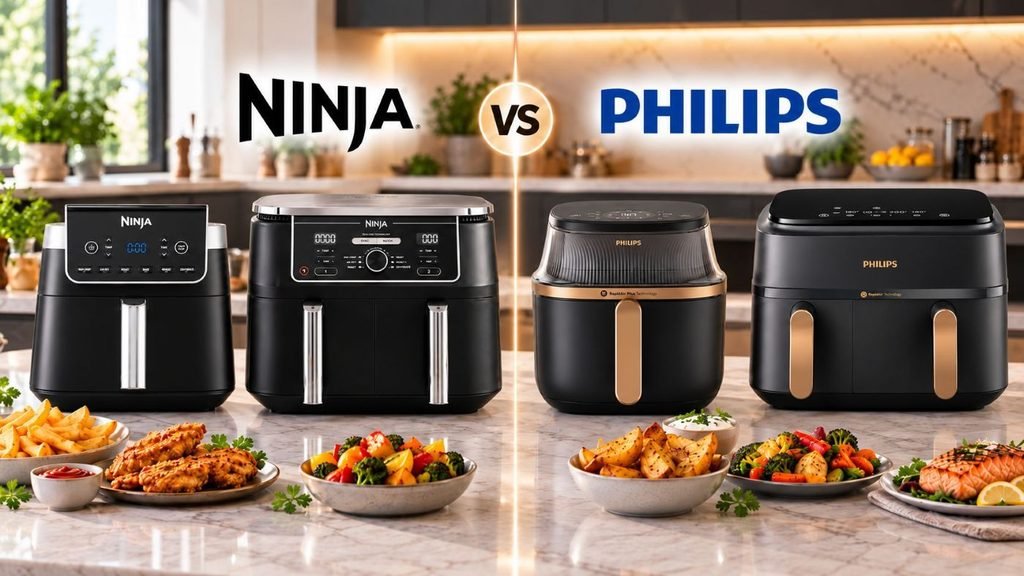
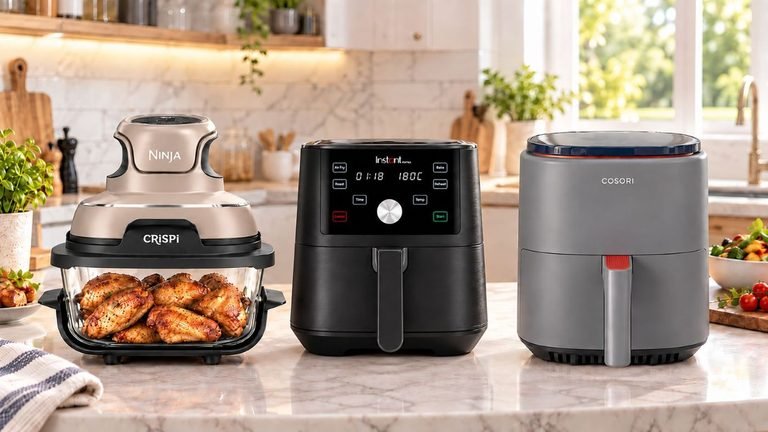
Ninja and Philips are the two names most UK shoppers end up deciding between. Which one is better depends a lot on the type of air fryer you’re after, so rather than compare the brands in the abstract, this Ninja vs Philips air fryer comparison lines up eight models in four formats: single drawer, side-by-side dual basket, stacked dual basket and flexible drawer. Each Ninja is matched with the closest Philips, which keeps the focus on how they’re designed rather than on whoever prints the biggest litre figure on the box.
Quick verdict
For most UK buyers, Ninja is still the better all-round brand in 2026. Philips runs it much closer than the brand rankings suggest, though, and in some kitchens it’s the one we’d buy.
Ninja’s strengths are Max Crisp, two equal drawers on its standard dual-zone model and a far bigger flexible drawer. Philips fights back with viewing windows on two of its four models, a very slim stacked design and a two-year guarantee you don’t have to register for.
A couple of things only show up once you dig into the manuals. Ninja’s 240°C is a Max Crisp figure. Air Fry, Roast and Bake stop at 210°C, which is only 10 degrees above the Philips models. And when you add the ventilation space each brand asks for, the Philips needs less worktop in three of the four pairings.
Overall winner: Ninja, narrowly
Ninja wins on breadth, with Max Crisp, the equal-zone AF400UK and the big AF500UK. Go for Philips if a slim stacked machine, a viewing window or a compact flexible drawer matters more to you than outright capacity.
Ninja vs Philips air fryer at a glance
| Comparison | Ninja | Philips | Which has the edge? |
|---|---|---|---|
| Single drawer | MAX PRO AF180UK, 6.2L | 3000 Series NA332/09, 6.2L | Ninja, narrowly: smaller body and Max Crisp; Philips adds a window |
| Dual basket | Foodi MAX AF400UK, 9.5L (2 × 4.75L) | 3000 Series NA352/00, 9L (6L + 3L) | Ninja: two equally useful drawers |
| Stacked dual basket | Double Stack XL SL400UK, 9.5L | 4000 Series NA462/79, 10L | Philips: narrower, has windows and needs less space overall |
| Flexible drawer | Foodi FlexDrawer AF500UK, 10.4L | 1000 Series NA150/09, 7.1L | Depends: Ninja for capacity, Philips for space |
| Top temperature | 240°C on Max Crisp; 210°C in everyday modes | 200°C | Ninja, by less than the headline suggests |
| Viewing windows | None on these four models | NA332/09 and NA462/79 | Philips |
| Guarantee | 1 year; 2 years if registered within 28 days | 2 years as standard | Philips: simpler terms |
| Overall | Larger capacities, Max Crisp, consistent controls | Space-saving designs, windows, varied basket layouts | Ninja, narrowly |
The eight models and why they’re paired this way
Comparing brands only makes sense if the machines are like for like, so each pairing below shares a basic layout: a mainstream single drawer, a side-by-side dual basket, a stacked dual basket and a flexible drawer that can run as one big space or two zones. If you haven’t decided between one drawer and two yet, our single vs dual air fryer guide is a good place to start.
| Layout | Ninja model | Philips model | Why this pairing matters |
|---|---|---|---|
| Single drawer | Ninja MAX PRO AF180UK | Philips 3000 Series NA332/09 | Two 6.2L air fryers: Max Crisp against a viewing window |
| Dual basket | Ninja Foodi MAX Dual Zone AF400UK | Philips 3000 Series NA352/00 | Two equal zones against a big main basket and a smaller side one |
| Stacked dual basket | Ninja Double Stack XL SL400UK | Philips 4000 Series NA462/79 | Two vertical designs built to save worktop width |
| Flexible drawer | Ninja Foodi FlexDrawer AF500UK | Philips 1000 Series NA150/09 | A huge MegaZone against a much more compact divided drawer |
Key specifications compared
| Model | Capacity | Power | Temperature | Cooking options | H × W × D |
|---|---|---|---|---|---|
| Ninja AF180UK | 6.2L | 2,000W | 40–240°C (210°C outside Max Crisp) | 6 functions | 30.5 × 28 × 36cm |
| Philips NA332/09 | 6.2L | 1,700W | 40–200°C | 16 advertised functions | 30.3 × 32.4 × 43.6cm |
| Ninja AF400UK | 9.5L (2 × 4.75L) | 2,470W | 40–240°C (210°C outside Max Crisp) | 6 functions | 32.5 × 41.5 × 27cm |
| Philips NA352/00 | 9L (6L + 3L) | 2,750W | 40–200°C | 8 presets | 31.4 × 38.3 × 44.4cm |
| Ninja SL400UK | 9.5L (2 × 4.75L) | 2,470W | 40–240°C (210°C outside Max Crisp) | 6 functions | 38.5 × 28 × 47cm |
| Philips NA462/79 | 10L (2 × 5L) | 2,750W | 40–200°C | 6 presets, 12 cooking methods | 39.9 × 23.3 × 46.9cm |
| Ninja AF500UK | 10.4L (2 × 5.2L) | 2,470W | 40–240°C (210°C outside Max Crisp) | 7 functions | 32.7 × 49.6 × 31.6cm |
| Philips NA150/09 | 7.1L (2 × 3.55L) | 2,450W | 40–200°C | 6 presets | 29.5 × 30.1 × 43.8cm |
A few notes on the table. Capacities are the manufacturers’ own figures, and dimensions come from the manufacturer or its UK retailers. Litres say nothing about basket shape, and power is an input rating rather than a measure of how well something cooks. Philips also counts manual cooking methods in some of its function totals, so don’t compare that column number for number.
1. Single drawer: Ninja AF180UK vs Philips 3000 Series NA332/09

Ninja MAX PRO AF180UK
The AF180UK is the smaller of the two. You get a square 6.2L drawer and Ninja’s usual six functions (Air Fry, Max Crisp, Roast, Bake, Reheat and Dehydrate), and the crisper plate can sit low for crisping or higher up for baking smaller bits. Ninja says it’ll take four chicken breasts or a 1.6kg chicken.
What sets it apart from the Philips is Max Crisp, a 240°C setting meant for smaller batches of frozen food. Air Fry itself only goes to 210°C, though, so day to day you’re getting 10 degrees more than the Philips rather than 40. There’s no window either, which means pulling the drawer out to check on things.
Philips 3000 Series NA332/09
Philips matches the 6.2L capacity but goes about things differently. The NA332/09 uses RapidAir Plus, has a see-through cooking window and is sold as having 16 cooking functions. That number mixes one-touch presets with cooking methods you set yourself, so it’s less impressive than it sounds. At 1,700W it’s the lowest-powered machine here, and Philips reckons the basket holds eight drumsticks.
The window is handy for keeping an eye on browning. The catch is size. At 32.4cm wide and 43.6cm deep it takes up about 1,413cm² of worktop, against roughly 1,008cm² for the Ninja, so the Ninja’s body is around 29% smaller.
That gap mostly disappears once the machines are switched on. Ninja’s manuals ask for 15cm of clear space around its air fryers and Philips asks for 10cm. Add that to the sides and back and the AF180UK needs about 58 × 51cm of worktop, while the NA332/09 needs about 52 × 54cm. Near enough the same. Where the smaller Ninja really helps is if you put it away in a cupboard after use.
Single-drawer winner: Ninja, narrowly
If you just want a good 6.2L air fryer, we’d lean towards the Ninja. It’s smaller to store, more powerful and has Max Crisp. The Philips makes more sense if you’d like a window and more guided presets and aren’t bothered about the extra heat.
2. Dual basket: Ninja AF400UK vs Philips 3000 Series NA352/00

Ninja Foodi MAX Dual Zone AF400UK
The AF400UK is all about symmetry. Its 9.5L is split into two 4.75L drawers, and Ninja says each one takes a 2kg chicken or 1.4kg of fries, so it doesn’t matter which side gets the main. SYNC gets both drawers finishing together even on different programmes, and MATCH copies one side’s settings to the other. That’s useful if what you cook changes a lot from one day to the next.
It has the same six functions as the AF180UK. That consistency is one of Ninja’s quieter advantages, because if you move from one Ninja to another, the buttons all mean the same thing. The body is wide at 41.5cm but only 27cm deep, which helps on a shallow worktop.
Philips 3000 Series NA352/00
Philips splits its 9L differently, with a 6L main basket and a 3L side basket. For something like chicken and veg, where the two parts rarely need the same amount of room, that can work better. There are eight presets, a 200°C ceiling and Philips’ own sync and copy functions, so you don’t give up the finish-together trick by going with Philips.
Where the uneven split falls down is when you want two big portions at once. The Ninja’s matching drawers cope with that more easily. The shape is the opposite of the Ninja’s too, narrower at 38.3cm but a lot deeper at 44.4cm. And at 2,750W it shares the top power rating in this comparison with the NA462/79.
Dual-basket winner: Ninja
Ninja is the better all-rounder here, with a bit more capacity, two equally useful drawers and Max Crisp. The Philips is still worth a look if most of your meals are a big main and a smaller side. There are more options in our best dual air fryers guide.
3. Stacked dual basket: Ninja SL400UK vs Philips 4000 Series NA462/79
Ninja Double Stack XL SL400UK
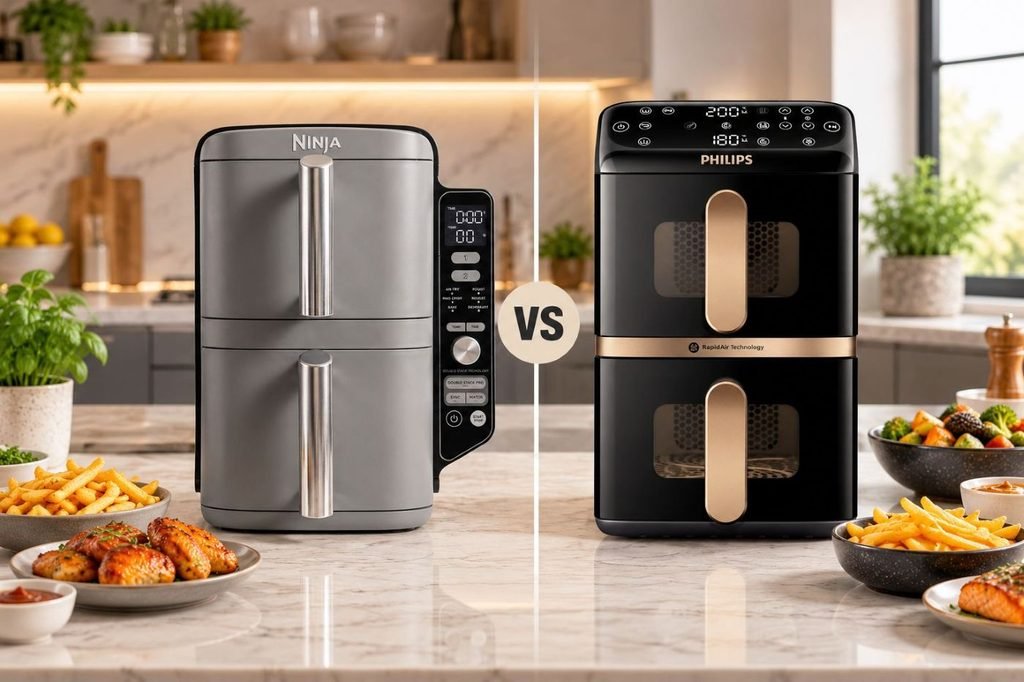
The SL400UK takes Ninja’s 9.5L dual-zone idea and stands it on end. The two 4.75L drawers sit in a body 28cm wide, and two stainless steel racks come in the box, so you can cook on four levels at once. Ninja suggests using its Double Stack Pro function when you do. The six functions are the same as the AF400UK’s.
Oddly, the drawers are the same 4.75L as the AF400UK’s, but Ninja only quotes a 1.4kg chicken per drawer rather than 2kg. The stacked drawers are shallower (12.5cm inside), which is a good reminder that litres don’t tell you what will actually fit.
Check the height as well. Ninja says the 38.5cm body is designed to fit under kitchen cabinets, yet the manual asks for 15cm of space above it. That’s 53.5cm in total, and most UK kitchens have something like 45 to 50cm between the worktop and the wall units. So expect to slide it forward before you switch it on.
Philips 4000 Series NA462/79
Philips takes the stacked idea a step further. The NA462/79 has two 5L baskets, 10L in all, in a body just 23.3cm wide. It uses what Philips calls Vertical RapidAir, the two zones can be synced to finish together, and both drawers have windows. There’s a shake reminder too, and Philips describes the coating as PFAS-free, which matters to some buyers. Our glass and PFAS-free air fryers guide has more on that.
Philips quotes a 1.2kg chicken per basket, or up to 1.4kg of fries across both, and it tops out at 200°C. Height is close to the limit here as well, since 39.9cm plus Philips’ 10cm clearance comes to just under 50cm. Being newer, it also has fewer owner reviews to go on. That’s a gap in the evidence, not a sign it’s less reliable.
Stacked winner: Philips
Philips wins this one. It has a little more capacity, a narrower body and windows on both drawers, and once you add the clearances it needs about 43cm of worktop width to the Ninja’s 58cm. Pick the SL400UK if you want the extra racks, Max Crisp or Ninja’s familiar controls.
4. Flexible drawer: Ninja AF500UK vs Philips 1000 Series NA150/09
Ninja Foodi FlexDrawer AF500UK
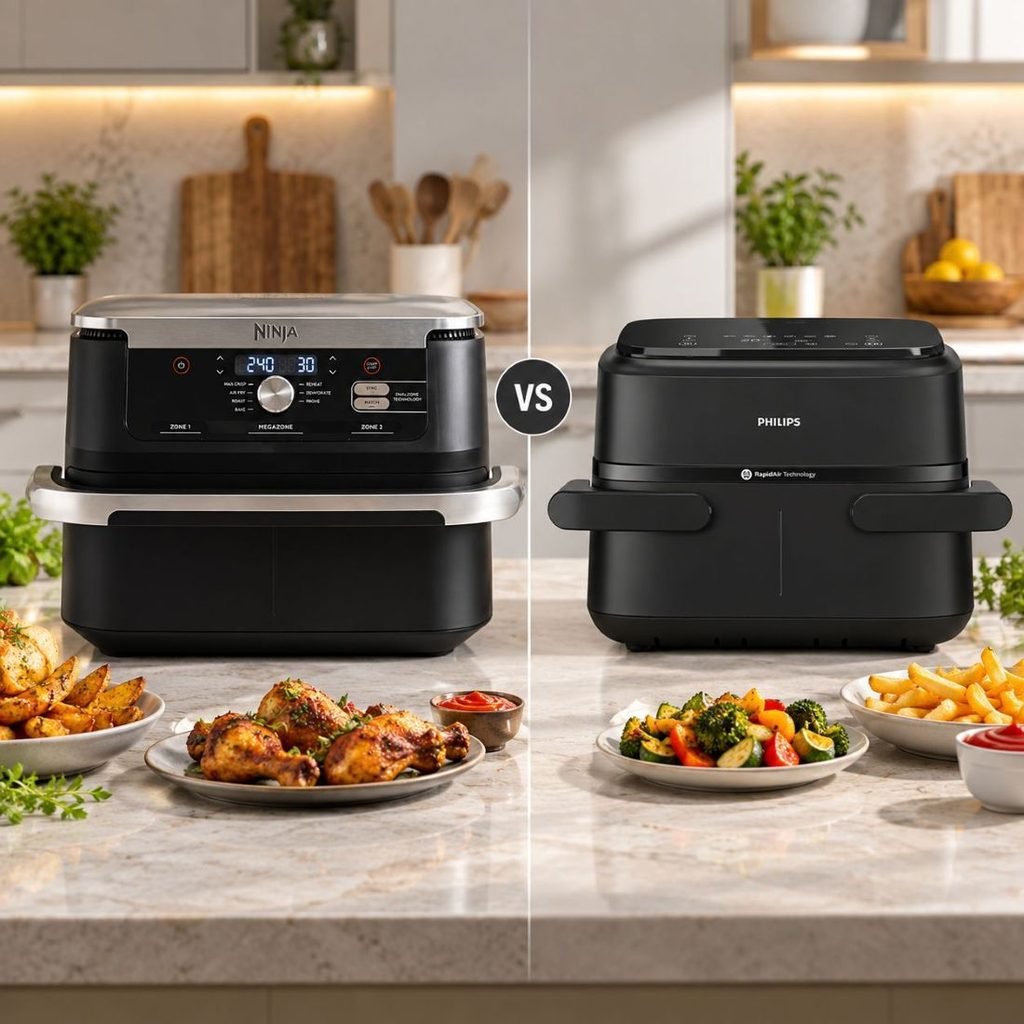
The AF500UK is built for big meals. Take the divider out and the two 5.2L zones become one 10.4L MegaZone, which Ninja says fits a 2.3kg joint or a 2kg leg of lamb. Put the divider back and it works like any other dual-zone model. It has seven functions, with Prove added to the usual Ninja list.
All that space makes for a wide machine. Ninja lists it at 49.6cm across, and with 15cm either side you’re looking at nearly 80cm of clear worktop. The one-piece drawer is big to wash too and will hog most of a dishwasher’s bottom rack. Owner reviews are more mixed than for the other Ninjas here, so read a few recent ones before you buy.
Philips 1000 Series NA150/09
Philips goes much smaller. The NA150/09’s 7.1L drawer splits into two 3.55L zones or opens up into one, and the whole thing is only about 30.1cm wide, or around 50cm with clearance. It has six presets and the usual 40–200°C range, and the two zones can be synced.
These two aren’t capacity equivalents, and it would be unfair to pretend otherwise. Philips gives up 3.3L and suggests up to 800g of chips or 1.2kg of veg with the divider out. One quirk that’s been reported is that, with the divider removed, small pieces can drop into the channel it normally sits in. Cut chips evenly, or leave the divider in for small stuff.
Flexible-drawer winner: depends on your space
If you want the biggest flexible drawer you can get, it’s the Ninja. 10.4L against 7.1L is a big difference, and our large air fryers guide has more at that size. If worktop width is tight, the Philips is the sensible pick. It really comes down to space against capacity.
Things to check before you buy
Ninja’s 240°C is a Max Crisp figure
Ninja isn’t wrong about 240°C, but that’s Max Crisp, which it pitches at smaller batches of frozen food. Air Fry, Roast, Bake and Reheat stop at 210°C. All four Philips models run from 40 to 200°C. The extra 10 degrees can help a bit with crisping, but most everyday recipes don’t get near either limit, as our air fryer cooking times and temperature chart shows.
Worktop space with ventilation included
Air fryers push out hot air, so both brands ask for clear space around them. Ninja’s manuals say at least 15cm above and on all sides, and Philips’ say 10cm behind, at the sides and above. The table adds those figures to the published sizes. We’ve counted the sides and back but not the front, since that’s where the drawer comes out.
| Model | Body W × D | Clear space needed (W × D) | Height needed | Worktop area needed |
|---|---|---|---|---|
| Ninja AF180UK | 28 × 36cm | 58 × 51cm | 45.5cm | about 2,960cm² |
| Philips NA332/09 | 32.4 × 43.6cm | 52.4 × 53.6cm | 40.3cm | about 2,810cm² |
| Ninja AF400UK | 41.5 × 27cm | 71.5 × 42cm | 47.5cm | about 3,000cm² |
| Philips NA352/00 | 38.3 × 44.4cm | 58.3 × 54.4cm | 41.4cm | about 3,170cm² |
| Ninja SL400UK | 28 × 47cm | 58 × 62cm | 53.5cm | about 3,600cm² |
| Philips NA462/79 | 23.3 × 46.9cm | 43.3 × 56.9cm | 49.9cm | about 2,460cm² |
| Ninja AF500UK | 49.6 × 31.6cm | 79.6 × 46.6cm | 47.7cm | about 3,710cm² |
| Philips NA150/09 | 30.1 × 43.8cm | 50.1 × 53.8cm | 39.5cm | about 2,700cm² |
With clearance included, the Philips needs less worktop in three of the four pairings, and that includes the single drawer, where the Ninja is the smaller machine. Only the AF400UK stays ahead, thanks to its shallow body. If the gap under your wall units is around 45 to 50cm, the stacked Ninja is the one most likely to need pulling forward. Our guide to air fryer safety goes into placement in more detail.
What fits in each one
| Model | Manufacturer’s example of what fits |
|---|---|
| Ninja AF180UK (6.2L) | Up to 4 chicken breasts or a 1.6kg whole chicken |
| Philips NA332/09 (6.2L) | Up to 8 chicken drumsticks |
| Ninja AF400UK (2 × 4.75L) | A 2kg chicken or 1.4kg of fries in each drawer |
| Philips NA352/00 (6L + 3L) | Up to 1.5kg of food across both baskets |
| Ninja SL400UK (2 × 4.75L) | A 1.4kg whole chicken in each drawer, plus racks for a second layer |
| Philips NA462/79 (2 × 5L) | A 1.2kg chicken in each basket, or up to 1.4kg of fries in total |
| Ninja AF500UK (10.4L) | A 2.3kg roasting joint or 2kg leg of lamb with the divider out |
| Philips NA150/09 (7.1L) | Up to 800g of chips or 1.2kg of vegetables with the divider out |
These are the manufacturers’ own examples rather than a side-by-side test, but they show why basket shape matters as much as volume. As a rough guide, equal zones suit families who often cook two decent-sized things at once. An uneven pair suits a main that needs more room than its side. A flexible drawer helps if you sometimes need one big space, and a stacked machine is mostly about saving width.
Running costs
A higher wattage looks like it should cost more, but per meal the difference is tiny. The table below assumes each air fryer runs at full rated power for the whole cook, using the Ofgem price cap rate of 26.32p per kWh that applies from 1 October to 31 December 2026. The sum is simply kW × hours × 26.32p.
| Model | Rated power | 20-minute cook (maximum) | One hour (maximum) |
|---|---|---|---|
| Philips NA332/09 | 1,700W | 14.9p | 44.7p |
| Ninja AF180UK | 2,000W | 17.5p | 52.6p |
| Philips NA150/09 | 2,450W | 21.5p | 64.5p |
| Ninja AF400UK, SL400UK, AF500UK | 2,470W | 21.7p | 65.0p |
| Philips NA352/00, NA462/79 | 2,750W | 24.1p | 72.4p |
Real costs will be lower than this, because the heater switches on and off once it’s up to temperature, and a dual model only gets near its full rating with both zones going. Even at these worst-case figures, there’s less than 10p between the cheapest and dearest model for a 20-minute cook, so running costs shouldn’t decide this one. The bigger saving is against your oven, which our air fryer vs oven comparison covers.
Use a wall socket
The 2,750W Philips models draw about 12A and the 2,470W Ninjas about 10.7A. Electrical Safety First points out that most extension leads are rated at 13A and some at only 10A. So don’t put one of the bigger models here on the same lead as a kettle, and don’t use a 10A lead at all. A wall socket of its own is the safest bet for any of them.
Cooking functions: modes or presets?
Take function counts with a pinch of salt. The NA332/09’s 16 functions include cooking methods you set by hand as well as one-touch presets, and the two brands don’t use words like functions, presets and programmes in the same way.
Ninja keeps things consistent. The AF180UK, AF400UK and SL400UK all have the same six modes, with Max Crisp the one that stands out, and the AF500UK adds Prove. Philips varies more from model to model, with eight presets on the NA352/00 and six on the NA462/79 and NA150/09. If you like a few broad modes and setting things yourself, Ninja’s approach is cleaner. Philips gives you a bit more hand-holding, and its models work with the HomeID recipe app.
Cleaning and day-to-day ownership
All eight have dishwasher-safe removable parts, but check the manual for exactly which bits and how to look after them. Bigger drawers eat dishwasher space, and the AF500UK’s one-piece drawer is often easier to wash by hand. Our guide on how to clean an air fryer covers looking after non-stick coatings.
The windows on the NA332/09 and NA462/79 are a small thing that makes a difference most days, because you’re not pulling a drawer out just to see how brown something is. Ninja’s answer is controls that work the same way across its range. Neither makes the food any better, but both make the machine nicer to live with.
Guarantee and owner feedback
Philips gives two years on these models as standard, and its UK support pages offer an extended warranty if you register within 90 days (conditions apply). Ninja gives one year, or two if you register within 28 days of buying. If you buy direct from Ninja, that’s done for you. Otherwise it’s easy to forget, so do it the day the box turns up. Either way, your statutory rights against the retailer still apply.
Owner feedback broadly backs up the comparisons above. People tend to like the established Ninjas for their simple controls, quick cooking and easy cleaning, while reviews of the AF500UK are more mixed. The Philips models have fewer UK reviews, especially the newer NA462/79 and NA150/09, so it’s too early to say much about how they hold up over the long term.
Ninja vs Philips: pros and cons
Ninja
Pros
- Max Crisp reaches 240°C for frozen food, and everyday modes go to 210°C
- Two equal drawers on the AF400UK suit varied family meals
- The AF500UK has the biggest flexible cooking space here
- The same core functions across models make switching easy
Cons
- No viewing windows on these four models
- You only get two years of cover if you register within 28 days
- The 15cm clearance means the SL400UK and AF500UK take up a lot of room in use
Philips
Pros
- Viewing windows on the NA332/09 and NA462/79
- The NA462/79 is only 23.3cm wide and needs the least worktop of the dual models
- Two-year guarantee as standard
- The 6L + 3L NA352/00 suits main-and-side meals
Cons
- 200°C maximum on all four models
- The NA150/09’s 7.1L is a lot smaller than Ninja’s flexible drawer
- Fewer UK reviews for the newer models
Ninja vs Philips: category winners
| Category | Winner | Why |
|---|---|---|
| Best single drawer | Ninja AF180UK | Same 6.2L capacity in a smaller body, plus Max Crisp |
| Best side-by-side dual basket | Ninja AF400UK | 9.5L split into two equal 4.75L drawers |
| Best stacked dual basket | Philips NA462/79 | 10L in a 23.3cm-wide body, with windows on both drawers |
| Best large flexible drawer | Ninja AF500UK | 10.4L MegaZone for joints and traybakes |
| Best compact flexible drawer | Philips NA150/09 | Divided 7.1L drawer in a body about 30cm wide |
| Best for high-temperature crisping | Ninja | Max Crisp at 240°C; 210°C in everyday modes |
| Best for watching food cook | Philips | Windows on the NA332/09 and NA462/79 |
| Best overall brand for most buyers | Ninja | Better mix of capacity, temperature and equal-zone flexibility |
Which should you buy?
Choose Ninja if…
- You want Max Crisp for frozen food and a little more heat in everyday modes.
- You want two equally sized drawers in a conventional dual-zone air fryer.
- You want the biggest flexible drawer here and have the worktop width for it.
- You like the same cooking modes across different models.
- You want a 6.2L single drawer that’s easy to store away.
Choose Philips if…
- Worktop width is tight. The NA462/79 is only 23.3cm wide.
- You want a viewing window on a single-drawer or stacked model.
- A bigger main basket and a smaller side basket suit the way you cook.
- You want a divided drawer without the width of the AF500UK.
- You’d rather have a two-year guarantee without registering.
If size matters more to you than brand, our small air fryers guide includes compact models from other makers too.
Final verdict: is Ninja or Philips better?
For most UK buyers, Ninja is the better all-round air fryer brand in 2026, but not by much. Max Crisp, consistent controls, the equal drawers on the AF400UK and the sheer size of the AF500UK all count in its favour. Our best Ninja air fryers guide covers the rest of the range.
Philips has some smart ideas of its own. The NA352/00’s 6L + 3L split suits a main-and-side meal better than two identical drawers. The NA462/79 is the pick of the Philips models here, with 10L in a 23.3cm-wide body, windows on both drawers and the smallest worktop needs of any dual model once you allow for ventilation. And the NA150/09 brings a flexible drawer to kitchens where something 50cm wide just won’t fit.
In short, go for the AF180UK if you want a compact 6.2L single drawer with Max Crisp, the AF400UK for an equal-zone dual basket and the AF500UK if flexible capacity is what matters. Go for the Philips NA462/79 if worktop width decides it, and the NA150/09 for a divided drawer in a much narrower machine. If you’re looking at other brands too, see our Ninja vs Tefal and Ninja vs Bosch comparisons.
FAQs
Is Philips better than Ninja for air fryers?
Not overall, based on these eight models. Ninja gets the wider recommendation thanks to Max Crisp, its consistent functions and bigger capacity in key formats. Philips is better in some situations, especially stacked cooking, where the NA462/79 fits 10L into a very narrow body.
Do Philips air fryers get as hot as Ninja?
Not quite. All four Philips models here reach 200°C. Ninja’s Max Crisp mode goes to 240°C, but its everyday Air Fry, Roast and Bake modes stop at 210°C, so for most cooking the difference is 10 degrees.
Which is better: Ninja AF400UK or Philips NA352/00?
The AF400UK is the more flexible of the two because its 9.5L is split into two equal 4.75L drawers. The NA352/00 uses a 6L + 3L layout, which can suit you better if your meals need more space for the main than the side. Both can sync their baskets to finish together.
Which is better: Ninja Double Stack or Philips 4000 Series stacked?
Philips has the edge. The NA462/79 gives you 10L across two 5L baskets, is only 23.3cm wide and has viewing windows. The SL400UK is still a good choice if you want its extra racks, Max Crisp and Ninja’s familiar six functions.
Which flexible-drawer air fryer is better: Ninja AF500UK or Philips NA150/09?
For capacity, it’s the Ninja, with 10.4L against 7.1L. For a smaller kitchen, the Philips makes more sense. Its body is about 30cm wide against 49.6cm for the Ninja, and that grows to around 50cm against 80cm once you add the clearance each manual asks for.
Does higher wattage mean an air fryer cooks better?
No. Wattage is the electrical input rating, not a measure of crispness, speed or cooking quality. Heating design, airflow, basket shape, how much you load in and temperature control all play a part. It does affect the maximum running cost, but between these models that’s only a few pence per meal.
Do I need to register a Ninja air fryer?
Not to use it, but you should if you want the full two years of cover. Ninja’s guarantee is one year as standard and two if you register within 28 days. If you bought it direct from Ninja, registration happens automatically. Philips gives two years without registration.
Which brand is better for a small kitchen?
It depends on the format. The Ninja AF180UK has a smaller body than the Philips NA332/09, which helps if you store it in a cupboard. On the worktop, Philips has the better space-saving options, as the NA462/79 and NA150/09 need far less width than their Ninja rivals, even after allowing for ventilation.
How this comparison was researched
We put this comparison together from current UK manufacturer pages, instruction manuals, specification sheets, guarantee terms and UK retailer listings. The eight models were paired by layout rather than price or headline capacity. We cross-checked capacity, power, temperature range, functions, basket layout, dimensions, clearance requirements and dishwasher-safe parts where we could, and read owner reviews alongside the specs to pick out the strengths and complaints that keep coming up.
The category winners and overall verdict are our editorial judgement based on all of that. Information is correct as of October 2026, and running costs use the Ofgem price cap for 1 October to 31 December 2026. Prices, stock, guarantee terms and reviews change, so check them before you buy.
One Comment