De’Longhi Magnifica Evo vs Philips 3300 LatteGo: Which Bean-to-Cup Machine Is Better?
Put these two side by side on a shop page and it’s hard to tell them apart. Both grind beans, both have a milk jug that clips onto the front, both make a cappuccino at one touch, and both have a 1.8-litre tank and a 15-bar pump. The list prices are within about £20 of each other, too. No wonder they keep ending up on the same shortlist.
Once you own one, the differences start to show. Cleaning the milk system is a different job on each. So is the maintenance you do once a month, and the drink buttons aren’t the same either. One of them is also built to be a lot quieter at six in the morning. Those are the things we’ve focused on here, because they’re what you’ll notice every day.
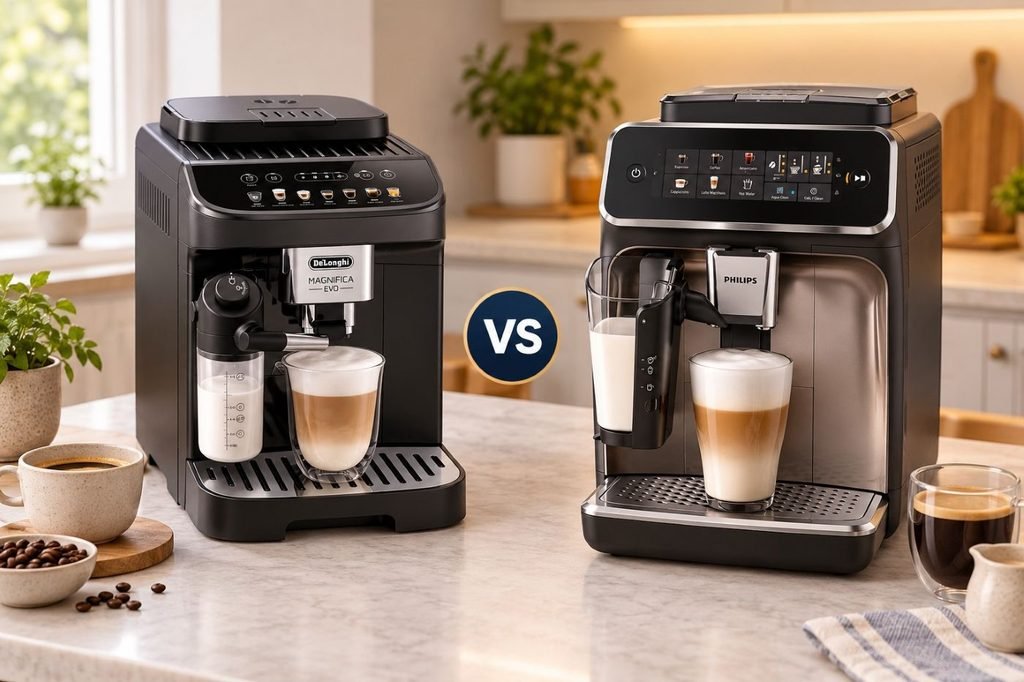
A quick word on names before we start. In the UK, “Magnifica Evo” covers at least seven different machines, and only three of them froth milk for you. We’ve compared the Philips 3300 LatteGo EP3347/90 with those three, using the ECAM292.81.B as the main one, and pointed out where the other Evo models are different.
Quick verdict
For a house that mostly drinks milky coffee, we’d go for the Philips 3300 LatteGo. It makes more drinks, including iced coffee and latte macchiato. Its milk jug is two pieces to wash and nothing else, it has more grind settings, and Philips has put real effort into making it quiet.
The De’Longhi Magnifica Evo is the better pick if you like to pour in exactly the milk you want and have the machine use the lot. It’s also the one to get if someone wants hot chocolate (that’s the ECAM290.83.TB only), or if greasing a brew unit every couple of months sounds like a chore you’d skip. It’s often the cheaper of the two as well, and when it is, it’s an easy one to justify.
De’Longhi Magnifica Evo vs Philips 3300 LatteGo: at a glance
| Category | De’Longhi Magnifica Evo ECAM292.81.B | Philips 3300 LatteGo EP3347/90 |
|---|---|---|
| Best for | Milk drinks made to your own measure, with less to do inside the machine | The widest drink list and the quickest milk clean-up |
| One-touch drinks | 7 (5 to 7 depending on the Evo model) | 6, including iced coffee |
| Milk system | LatteCrema Hot carafe, 220ml | LatteGo, 260ml, two parts, no tubes |
| Milk cleaning | Automatic flush after each milk drink; five parts for a full clean | Rinse or dishwasher after each use; no automatic cleaning |
| Grinder | Conical burr, 7 settings | Ceramic, 12 settings |
| Strength / temperature | 3 levels / 3 levels | 3 levels / 3 levels |
| Brew unit care | Rinse in plain water | Rinse weekly, cleaning tablet monthly, grease every 2 months |
| Descaling | When prompted; water filter changed every 2 months | Not needed for up to 5,000 cups with AquaClean filters |
| Noise | No noise claim | SilentBrew, Quiet Mark certified |
| Size (H × W × D) | 36 × 24 × 44cm, 9.6kg | 37.1 × 24.6 × 43.3cm, 8kg |
| Bean hopper / water tank | 250g / 1.8 litres | 275g / 1.8 litres |
| Guarantee | 2 years | 2 years |
| List price | £529.99 | Around £550 |
| Overall | Best for MyLatte fans and hot chocolate households | The better all-rounder |
Prices move around a lot and both machines go on offer often, so take the list prices as a rough guide.
Which models are we comparing?
De’Longhi Magnifica Evo UK models
This is where the Evo gets confusing. Some versions have an old-fashioned steam wand, so you froth the milk yourself. Others come with the LatteCrema Hot carafe and do it all for you. They look much the same in photos. The model number is the only reliable way to tell them apart, and the drink buttons vary from one to the next as well.
| Model | Milk system | One-touch drinks | De’Longhi UK price (22 October 2026) |
|---|---|---|---|
| ECAM292.81.B | LatteCrema Hot carafe | 7: espresso, coffee, long, cappuccino, latte macchiato, MyLatte, hot water | £529.99 |
| ECAM290.83.TB | LatteCrema Hot carafe | 7: espresso, coffee, Doppio+, cappuccino, hot milk, MyLatte, hot water | £579.99 |
| ECAM290.61.SB | LatteCrema Hot carafe | 5: espresso, coffee, cappuccino, MyLatte, hot water | £529.99 list (£345 on offer, out of stock) |
| ECAM292.33.SB | Manual steam wand | 5 | £439.99 |
| ECAM290.31.SB | Manual steam wand | 5 | £419.99 list (£299.99 on offer) |
| ECAM290.21.B / ECAM290.22.B | Manual steam wand | 4 | £419.99 list |
There’s also the Magnifica Evo Next (ECAM310.80.SB), but that’s really a different machine, with 13 drinks and user profiles, so we’ve left it out. You might read about an Evo with an iced coffee or “over ice” button. That’s an overseas model, and none of the UK versions above have one. Retailer listings sometimes get the drinks wrong too, so have a look at the buttons in the product photos before you buy.
Philips 3300 LatteGo UK model
The Philips is much easier. The EP3347/90, in black and chrome, is the one UK shops sell. You may spot EP3341/50, EP3343/50, EP3343/90 or EP3349/70 as well, usually from sellers in mainland Europe. They’re the same six-drink machine in different colours. Just don’t confuse it with the Series 2300 LatteGo, which has fewer drinks, or the older Series 3200. That one looks almost identical but doesn’t have SilentBrew.
De’Longhi Magnifica Evo: what you’re actually getting
Like any bean-to-cup machine, the Evo grinds, doses, tamps and brews without you lifting a finger. It has a 15-bar pump, a 250g bean hopper and a soft-touch panel with a coloured icon for each drink. The ECAM292.81.B has seven: espresso, coffee, long, cappuccino, latte macchiato, MyLatte and hot water. There are three strength levels and three temperatures. If a drink comes out too big or too small, hold its button down next time and let go when the cup looks right. The machine remembers that amount.
MyLatte is the clever bit. Pour however much milk you fancy into the carafe and press the button. The machine froths all of it into your cup, then adds the espresso on top. There’s nothing left in the jug afterwards, so nothing to put back in the fridge. If your drink is a different size every morning, you’ll probably use it a lot. The carafe itself only holds 220ml. After a milk drink you leave it in place and press Clean, and the machine pushes hot water and steam through the spout. Got milk left over after a normal cappuccino? De’Longhi says to run the clean, put the carafe in the fridge and use the milk within two days.
Where the Evo falls a bit short is the grinder. It goes from 1 (finest) to 7 (coarsest), and you’re meant to turn the dial only while it’s grinding, then wait a couple of cups to taste the change. For most beans that’s plenty. If you like to fiddle, though, the Philips gives you more to play with. One small thing that catches people out is the grounds bin. The machine asks you to empty it 72 hours after the first coffee, full or not, and the timer only runs if the machine stays plugged in. It’s a hygiene thing, so expect to empty it at least every three days.
| Specification | Detail |
|---|---|
| Model | De’Longhi Magnifica Evo ECAM292.81.B |
| Type | Fully automatic bean-to-cup machine |
| One-touch drinks | 7: espresso, coffee, long, cappuccino, latte macchiato, MyLatte, hot water |
| Milk system | LatteCrema Hot carafe, 220ml, automatic clean cycle, dishwasher-safe parts |
| Grinder | Built-in conical burr grinder, 7 settings |
| Strength | 3 levels (mild, medium, strong) |
| Temperature | 3 levels (low, medium, high) |
| Pump pressure | 15 bar |
| Bean hopper | 250g |
| Water tank | 1.8 litres |
| Maximum cup height | 14cm |
| Pre-ground coffee | Yes, one dose at a time |
| Two espressos at once | Yes |
| Power | 1,450W |
| Dimensions (H × W × D) | 36 × 24 × 44cm |
| Weight | 9.6kg |
| Guarantee | 2 years |
Pros and cons
- MyLatte uses all the milk you pour in, so there are no leftovers to store or tip away
- One press of Clean rinses the milk spout after each drink, and the carafe stays on
- The brew unit just gets a rinse under the tap, with no tablets or grease
- The 81.B and 83.TB have seven drinks, and the 83.TB has a hot milk button
- Makes two espressos at once, and takes pre-ground coffee for a late-night decaf
- Goes on offer a lot, so it’s often the cheaper way to get automatic milk
- The 220ml carafe is small, and it comes apart in five pieces when you wash it properly
- Seven grind settings, and you can only change them mid-grind
- None of the UK models makes iced coffee
- The drinks change from model to model, which makes it easy to buy the wrong one
- You still have to descale it, even with the water filter in
- 1.6kg heavier than the Philips, and De’Longhi says nothing about noise
Buy it if you want milk drinks made to the exact size you like with nothing left in the jug, someone in the house wants hot chocolate (get the ECAM290.83.TB), or you’d like as little maintenance inside the machine as possible.
Skip it if you want iced coffee, more control over the grind, or a milk jug that comes apart in two pieces rather than five.
Philips 3300 LatteGo EP3347/90: what you’re actually getting
The 3300 sits in the middle of Philips’ LatteGo range. Like the Evo, it takes you from beans to a finished cup with one press. The colour touchscreen has six drinks: espresso, coffee, cappuccino, latte macchiato, iced coffee and hot water. Before you brew, a feature Philips calls My Coffee Choice lets you change the strength (three levels), how long the coffee is and how much froth you get. You can set the temperature to one of three levels. The grinder is ceramic with 12 settings, and the hopper takes 275g of beans.
Most people buy this machine for LatteGo. It’s a jug that clips onto the front, and it has two parts and no tubes at all. The milk gets frothed inside the jug, and Philips says plant milks work in it as well. It holds 0.26 litres. When you’re done, pull the two halves apart and rinse them, or put them in the dishwasher. Philips says it ran LatteGo through 600 dishwasher cycles in testing, which is about two years of daily washing. There’s no automatic clean, and Philips doesn’t pretend otherwise. If there’s milk left, the box includes a lid so you can put the jug in the fridge.
Philips also makes a lot of noise about quiet. SilentBrew adds sound shielding and a quieter grinder, which Philips says makes it 40% quieter than its older machines, and the 3300 is Quiet Mark certified. Then there’s the AquaClean water filter. Swap it each time the machine asks and you won’t need to descale for up to 5,000 cups, which is eight filters’ worth. What you don’t see on the box is the brew group routine. Philips wants it rinsed weekly, cleaned with a coffee oil remover tablet once a month and greased every two months. The thing owners grumble about most is temperature, especially on milk drinks. Turn the temperature up to its highest level and warm your cup with hot water first, and it helps.
| Specification | Detail |
|---|---|
| Model | Philips Series 3300 LatteGo EP3347/90 |
| Type | Fully automatic bean-to-cup machine |
| One-touch drinks | 6: espresso, coffee, cappuccino, latte macchiato, iced coffee, hot water |
| Milk system | LatteGo, 2 parts, no tubes, 0.26 litres, rinse or dishwasher |
| Grinder | Ceramic, 12 settings |
| Strength | 3 levels, plus adjustable coffee and milk length |
| Temperature | 3 levels |
| Pump pressure | 15 bar |
| Bean hopper | 275g |
| Water tank | 1.8 litres, front access |
| Grounds container | 12 servings, front access |
| Spout height | Adjustable, 8.5 to 14.5cm |
| Water filter | AquaClean, up to 5,000 cups without descaling (8 filter changes) |
| Noise | SilentBrew, Quiet Mark certified |
| Pre-ground coffee | Yes |
| Power | 1,500W |
| Dimensions (H × W × D) | 37.1 × 24.6 × 43.3cm |
| Weight | 8kg |
| In the box | Measuring scoop, water hardness test strip, AquaClean filter, brew group grease, LatteGo storage lid |
| Guarantee | 2 years |
Pros and cons
- Six drinks, iced coffee and latte macchiato among them
- LatteGo is just two parts with no tubes, and both can go in the dishwasher
- The jug holds 260ml, a bit more than the Evo’s 220ml
- 12 grind settings, handy if you change beans often
- Built to be quiet, with Quiet Mark certification to back it up
- Change the AquaClean filter when asked and you can skip descaling for up to 5,000 cups
- 8kg, and the water tank and grounds drawer both pull out from the front
- No automatic milk clean, so LatteGo needs a rinse every time
- The brew group wants a cleaning tablet every month and grease every two
- No hot milk button, so no hot chocolate at one touch
- The iced coffee is just coffee brewed over ice you add yourself, with no cold foam
- Plenty of owners say milk drinks could be hotter
Buy it if your house drinks a bit of everything, from cappuccinos and latte macchiatos to an iced coffee in summer, you want the milk jug cleaned in seconds, or you’re up making coffee while everyone else is asleep.
Skip it if you don’t want to be greasing a brew group, you want hot chocolate at one touch, or you like your milk drinks properly hot.
De’Longhi Magnifica Evo vs Philips 3300: the key differences
A lot of the spec sheet is shared. Here’s what actually separates them.
- Milk cleaning. The Evo rinses its own milk spout, but the carafe is five parts when you wash it properly. LatteGo doesn’t clean itself, although there are only two bits to rinse.
- Drinks. The Philips has iced coffee, and every version has latte macchiato. The Evo has MyLatte, and the ECAM290.83.TB has a hot milk button too.
- Maintenance inside the machine. On the Philips, the brew group needs a tablet every month and grease every two. The Evo’s just gets rinsed.
- Noise and grinding. The Philips has SilentBrew and 12 grind settings. De’Longhi doesn’t claim anything on noise, and the Evo has 7 settings.
Drink options
| Drink | Philips EP3347/90 | Evo ECAM292.81.B | Evo ECAM290.83.TB | Evo ECAM290.61.SB |
|---|---|---|---|---|
| Espresso | ✓ | ✓ | ✓ | ✓ |
| Coffee | ✓ | ✓ | ✓ | ✓ |
| Long | ✗ | ✓ | ✗ | ✗ |
| Doppio+ | ✗ | ✗ | ✓ | ✗ |
| Cappuccino | ✓ | ✓ | ✓ | ✓ |
| Latte macchiato | ✓ | ✓ | ✗ | ✗ |
| MyLatte | ✗ | ✓ | ✓ | ✓ |
| Hot milk | ✗ | ✗ | ✓ | ✗ |
| Iced coffee | ✓ | ✗ | ✗ | ✗ |
| Hot water | ✓ | ✓ | ✓ | ✓ |
| Total | 6 | 7 | 7 | 5 |
Against the ECAM292.81.B there isn’t much in it. Both do espresso, coffee, cappuccino, latte macchiato and hot water. The Evo adds a long coffee and MyLatte, and the Philips has iced coffee instead. The other Evo models are a different story. The 61.SB loses long and latte macchiato altogether, and the 83.TB replaces them with Doppio+ and hot milk.
Iced coffee on the Philips is simple enough. You fill a glass with ice, and the machine brews more slowly and at a lower temperature so it doesn’t come out watery. You won’t get cold foam, but of these two it’s the only UK machine that does an iced drink. The hot milk button on the 83.TB sounds like a small extra. If you’ve got kids who want hot chocolate, though, it’s a big deal, because none of the other machines here can froth milk on its own.
Neither can make two milk drinks at the same time. Two espressos at once is fine on both.
Winner: Philips 3300 LatteGo for range. If hot chocolate matters in your house, the ECAM290.83.TB.
Milk system and milk drinks
The two milk systems are built quite differently. With LatteGo, the milk is frothed inside the jug as it passes through, so there are no tubes for it to sit in. The LatteCrema Hot carafe sucks milk up a tube and mixes it with steam in the lid. That’s why it needs a rinse cycle afterwards. De’Longhi talks up its foam as dense, long-lasting and properly hot. Owners usually describe LatteGo foam as thick and plentiful, which is what you want on a cappuccino.
Neither will give you the silky, pourable milk a good flat white needs, though. For that you want a steam wand and a bit of practice. If flat whites are your thing, look at the steam-wand Evo models in the table above, or have a look at our guide to the best espresso machines in the UK.
Neither jug is big. LatteGo takes 260ml and the Evo carafe 220ml, which is enough for one or two drinks rather than a round for the whole family. The bigger difference is what happens to the milk you don’t use. With MyLatte you can avoid leftovers altogether, because you only pour in what you need. With LatteGo, you pop the lid on and put the jug in the fridge.
Both brands say plant milks are fine. In reality, barista oat and soya milks froth far better than the standard cartons in any automatic machine. If milky drinks are the main reason you’re buying, our guide to the best coffee machines for cappuccino and latte has more options.
Winner: De’Longhi Magnifica Evo, just, thanks to MyLatte and less milk going down the sink.
Coffee quality and grinding
Honestly, the beans you buy and how fresh they are will make more difference to the taste than which of these you choose. They both use a 15-bar pump, grind fresh for every cup and have three strength and three temperature settings. Philips also has something called pre-brew aroma control. It dampens the coffee for a moment before the full brew starts.
The grinder is where they really differ. The Philips has 12 settings to the Evo’s seven, so each click is a smaller step. That helps when you move from a dark supermarket roast to something lighter and only want to tweak the grind a little. Whichever you buy, steer clear of oily, flavoured or caramelised beans, because they can clog the grinder.
Winner: Philips 3300 LatteGo, for more grind settings.
Ease of use and customisation
Neither is hard to use. Fill the tank, top up the beans, press a button. On the Philips, you can change strength, size and froth on the screen before each drink, which is handy if everyone at home has their own order. The Evo has buttons for strength and remembers the last one you picked. To change how big a drink is, though, you hold its button and let go when the cup’s full enough. Temperature is tucked away in a settings menu.
Neither has user profiles, so if you want those you’re looking at the Magnifica Evo Next or Philips’ Series 4400. Philips’ HomeID app has guides and recipes. Both machines take pre-ground coffee, one scoop at a time, if you want the odd decaf.
Winner: Philips 3300 LatteGo, by a nose, because the settings are right there on screen.
Cleaning and maintenance
We’d spend the most time on this bit before deciding. Both need looking after, just in different ways.
| Task | De’Longhi Magnifica Evo | Philips 3300 LatteGo |
|---|---|---|
| After each milk drink | Press Clean with the carafe attached; hot water and steam flush the spout | Pull LatteGo apart and rinse both parts (about 10 seconds), or dishwasher |
| Leftover milk | Run the clean cycle, refrigerate the carafe, use within 2 days | Fit the storage lid and refrigerate |
| Full milk system clean | 5 parts; dishwasher top rack or hot soapy water | 2 parts; dishwasher or tap |
| Drip tray | Empty daily | Empty daily |
| Grounds container | Empty when prompted; alert also appears after 72 hours | Empty when prompted, wash weekly |
| Brew unit | Rinse in plain water; no detergent, no dishwasher | Rinse weekly, coffee oil remover tablet monthly, grease every 2 months |
| Water | Change filter every 2 months; descale when prompted | Change AquaClean filter when prompted |
Say you make a latte and rush out the door. With the Evo you press Clean and go. The downside comes later, because the carafe has five parts, and De’Longhi says to take it all apart and wash it if it’s been sitting out for more than half an hour. LatteGo needs a rinse every single time. That’s ten seconds under the tap, and there are only two pieces to it.
It’s the other way round with the brew unit. On the Philips you drop in a coffee oil remover tablet once a month and smear on a little grease every two months. It’s not hard, but it’s one more thing to remember, and the tablets and grease cost money. With the Evo, De’Longhi just says to rinse the brew unit in water.
Winner: it’s split. The Philips wins on the milk side, and the Evo wins on the brew unit. A quick rinse after each latte suits the Philips. If you’d sooner press a button now and have no monthly jobs, go for the Evo.
Water filters, descaling and running costs
Beans cost the same whichever machine you buy. The bits that differ are the filters and cleaning products. We’ve worked out a year’s worth at two drinks a day, which comes to about 730 cups.
| Item | De’Longhi Magnifica Evo | Philips 3300 LatteGo |
|---|---|---|
| Water filter | DLSC002, replaced at least every 2 months: about 6 a year | AquaClean, rated for up to 625 cups each, with a recommended change about every 3 months: about 4 a year |
| Descaling | When prompted, using a 100ml dose of EcoDecalk in a cycle of about 30 minutes; frequency depends on your water | Not needed for up to 5,000 cups if you change the filter when prompted |
| Brew unit | Nothing extra | Coffee oil remover tablets (12 a year) and brew group grease |
| Beans | Same for both | Same for both |
If you live somewhere with hard water, and a lot of England does, including London and the South East, AquaClean is a real plus. Philips’ 5,000 cups is spread over eight filters, so 625 cups each. While a filter’s fitted, the machine turns its descaling reminder off. De’Longhi’s filter cuts down on limescale, but you’ll still have to descale whenever the Evo tells you to. How often depends on how hard your water is, which you tell the machine when you set it up.
Overall there’s not much in it. You’ll get through a few filters a year with either one. With the Philips you buy tablets and grease. With the Evo you buy descaler.
Winner: Philips 3300 LatteGo, narrowly. If your kettle furs up fast, it’s a clearer win.
Noise
There’s no such thing as a silent bean-to-cup machine, because grinding is noisy. Philips has at least tried. It says SilentBrew makes the 3300 40% quieter than its older models, and the 3300 has Quiet Mark certification. Just remember that 40% is compared with Philips’ older machines, not with the Evo. De’Longhi hasn’t published anything on noise for the Evo.
In a small open-plan flat, or a house where someone sleeps during the day, we’d take the quieter machine over an extra drink button.
Winner: Philips 3300 LatteGo.
Size and kitchen fit
| Measurement | De’Longhi Magnifica Evo | Philips 3300 LatteGo |
|---|---|---|
| Height | 36cm | 37.1cm |
| Width | 24cm | 24.6cm |
| Depth | 44cm | 43.3cm |
| Weight | 9.6kg | 8kg |
| Maximum cup height | 14cm | 14.5cm |
| Bean hopper | 250g | 275g |
| Water tank | 1.8 litres | 1.8 litres |
Size-wise you could swap one for the other and barely notice. They’re both slim enough for a corner and about 44cm deep, which sits comfortably on a normal 60cm worktop. Wall cupboards are usually 45 to 50cm above the worktop, so both will fit under them. You do need space to lift the lid on the bean hopper, though, or you’ll be pulling the machine forward every time you top up.
The Philips weighs 1.6kg less, and the water tank and grounds drawer both come out from the front. That’s handy when it lives under a cupboard. If you use tall latte glasses, measure one first. The Evo takes up to 14cm and the Philips 14.5cm.
Winner: pretty much a draw. The Philips edges it because it’s lighter and everything comes out the front.
Price and value
Full price, they’re almost level. When we checked on 22 October 2026, De’Longhi’s UK site had the ECAM292.81.B at £529.99 and the ECAM290.83.TB at £579.99. The Philips EP3347/90 usually lists at around £550. You’ll rarely need to pay that much for either, though. UK shops have often had the Philips for around £350, and De’Longhi was selling the ECAM290.61.SB for £345 on its own site, although it was out of stock when we looked.
If both are the same price, the Philips is the better buy. You get more drinks, iced coffee, more grind settings and a quieter machine. The Evo makes more sense once a LatteCrema model is £50 or so cheaper. The 61.SB is a good shout if you can live without latte macchiato. On a tighter budget? Our guide to the best coffee machines under £500 has plenty more.
Winner: the Philips if prices are level. If the Evo is cheaper, go for the Evo.
Which one should you buy?
Choose the Philips 3300 LatteGo EP3347/90 if:
- you want iced coffee or latte macchiato at one touch
- you’d rather give the jug a ten-second rinse than wash a five-part carafe
- you make coffee early, or in a kitchen that’s open to the living room
- your water is hard and you’d like to avoid descaling
- you like trying different beans and want more grind settings
Choose the De’Longhi Magnifica Evo if:
- you like to pour in just the milk you want and have nothing left over
- someone at home wants hot chocolate (get the ECAM290.83.TB)
- you don’t want to be greasing a brew group or buying cleaning tablets
- you’d like to clean the milk spout with one press and get on with your day
- you’ve spotted a LatteCrema model for a fair bit less than the Philips
If what you really want is a proper flat white, or you’d like to try latte art, neither of these is the one. Go for a steam-wand Evo or a manual espresso machine. Still not sure? Our round-up of the best bean-to-cup coffee machines in the UK covers machines with user profiles and bigger milk jugs.
Final verdict
For most people, we’d buy the Philips 3300 LatteGo. It makes more drinks, the milk jug is the easier of the two to keep properly clean, you get more grind settings, and it’s designed to be quiet. The catch is the brew group. A cleaning tablet once a month and a bit of grease every couple of months isn’t much, but nobody mentions it on the box.
The De’Longhi Magnifica Evo is the one for you if you love the idea of MyLatte, if you need hot chocolate (the ECAM290.83.TB), or if you just want less to do inside the machine. Go by the model number rather than the name, though. “Magnifica Evo” on the box doesn’t tell you which machine you’re getting.
Both make good coffee for the money. If you’re still stuck, think about which cleaning routine you’ll actually stick to, because a machine that gets looked after properly will keep making better coffee.
Frequently asked questions
Is the Philips 3300 LatteGo better than the De’Longhi Magnifica Evo?
If you mostly drink milky coffee, we think so. It has iced coffee and latte macchiato, a milk jug with just two parts, 12 grind settings and SilentBrew. The Evo is the better choice if you like MyLatte, want a hot milk button (ECAM290.83.TB) or want less upkeep on the brew unit. It’s also worth it if you can get it for noticeably less.
Which is easier to clean, LatteGo or LatteCrema?
It depends what you mean by easy. LatteGo is quicker to wash properly, since it’s two parts and no tubes. LatteCrema is less effort straight after a drink, because you just press Clean, but the carafe comes apart in five pieces when it needs a proper wash.
Does the De’Longhi Magnifica Evo make iced coffee?
Not in the UK. A few Evo models sold abroad have an iced or over-ice button, so you’ll see it mentioned in overseas reviews. Of these two machines, only the Philips 3300 LatteGo does iced coffee in the UK.
Which Magnifica Evo is the closest rival to the Philips 3300?
The ECAM292.81.B. It has the LatteCrema Hot carafe and the closest set of drinks, cappuccino and latte macchiato included. The ECAM290.83.TB swaps latte macchiato for hot milk and Doppio+, and the ECAM290.61.SB has five drinks and no latte macchiato. Steam-wand models like the ECAM290.21.B are a different sort of machine altogether.
Can you keep milk in the jug in the fridge?
Yes, with both. LatteGo comes with a lid for exactly that. On the Evo, run the clean cycle first, then put the carafe in the fridge and use the milk within two days. Or use MyLatte and you won’t have any left over to begin with.
Can either machine make two drinks at once?
Both will do two espressos together. Milk drinks are one at a time on both, so two cappuccinos means making one and then the other.
Do they work with oat milk?
Philips and De’Longhi both say their milk systems handle plant milks. You’ll get better foam from a barista oat or soya milk, used cold from the fridge.
Is the Philips 3300 quieter than the Magnifica Evo?
It’s the one designed to be quieter. Philips says SilentBrew makes it 40% quieter than its older machines, and it’s Quiet Mark certified. De’Longhi hasn’t published a noise figure for the Evo, so there’s nothing official to put next to it.