
Sage Bambino Plus Review UK: Is It Worth Buying?
The Sage Bambino Plus is the machine a lot of people land on when they want proper espresso and café-style milk drinks at home but don’t want a big, complicated setup. It’s small, it’s ready almost the moment you switch it on, and it steams milk for you.
What it doesn’t do is grind coffee. That one fact shapes the real cost, the real footprint and the real quality of what ends up in your cup, and it’s where a lot of buyers get caught out. This Sage Bambino Plus review covers what the machine does well, what it leaves to you, and what owning one actually costs in the UK.
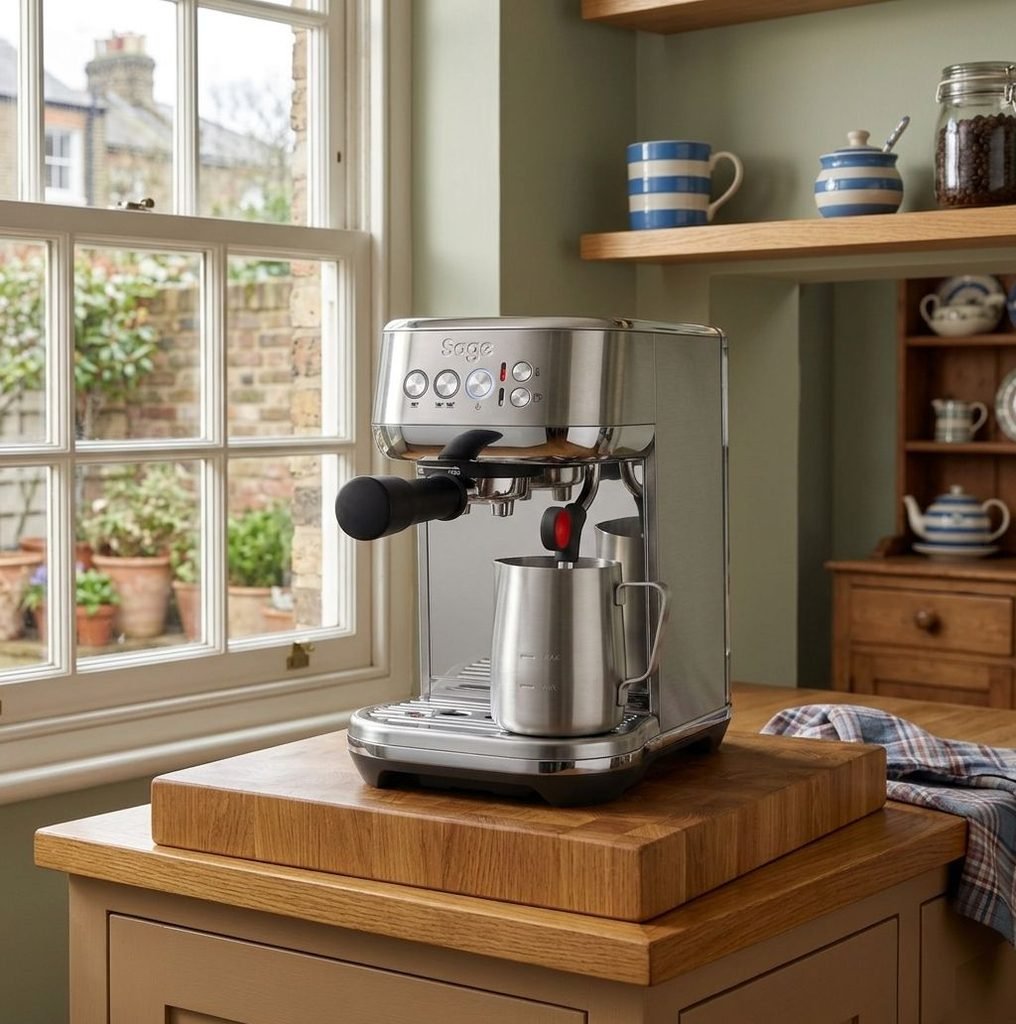
Quick verdict: If you mostly drink lattes, flat whites or cappuccinos, you want consistent milk without learning to steam, and you’re happy to use pre-ground coffee or add a separate grinder, the Bambino Plus is one of the easiest machines to recommend. Its biggest strength is the automatic milk wand. Its biggest compromise is that the espresso is only ever as good as the coffee and grinder you feed it, and once you add a grinder, it’s no longer the cheap or tiny option it first appears to be.
Sage Bambino Plus specifications
| Specification | Sage Bambino Plus (SES500) |
|---|---|
| Price | £399.95 at Sage and Argos, £399.99 at Currys (October 2026). Has dropped to around £349 in previous sales |
| Machine type | Compact manual espresso machine. Ground coffee only, no grinder, no pods |
| Heating system | ThermoJet, ready in 3 seconds (Sage’s figure) |
| Pump and pressure | 15-bar pump, low-pressure pre-infusion then 9-bar extraction |
| Temperature control | Digital (listed as PID by retailers) |
| Portafilter | 54mm stainless steel |
| Filter baskets | 1 and 2 cup single wall, 1 and 2 cup dual wall. 2 cup basket designed for 16 to 19g |
| Shot controls | 1 CUP and 2 CUP buttons (about 30ml and 60ml presets), both programmable, plus manual pre-infusion |
| Milk | Automatic steam wand with 3 temperatures (Warm, Ideal, Hot) and 3 foam levels (Low, Medium, High), plus a manual mode |
| Hot water | Through the steam wand, using a button combination |
| Water tank | 1.9 litres, removable, at the back |
| Power | 1,300 to 1,600W |
| Dimensions (W x D x H) | 19.4 x 36.2 x 30.4cm |
| Weight | About 4.95kg |
| In the box | Portafilter, tamper, Razor dose trimming tool, 480ml stainless steel milk jug, 4 filter baskets, water filter and holder, cleaning tool, cleaning disc, starter cleaning tablets and descaling powder |
| Guarantee | 2-year Sage manufacturer’s guarantee |
A couple of retailer listings show a 1.5-litre tank. Sage’s own UK manual says 1.9 litres, so that’s the figure I’d trust. Prices for Sage machines move around a lot, especially near Black Friday, so check on the day.
What makes the Bambino Plus worth considering?
Strip away the marketing and the Bambino Plus is built around three ideas: no waiting, no milk skills needed, and no wasted counter space.
The 3-second heat-up is real convenience, but it isn’t the whole story. ThermoJet heats water as it’s needed rather than keeping a boiler hot, so you don’t switch it on and go away for 15 minutes. That said, a fast machine doesn’t make a fast drink. Grinding, dosing and tamping still take the same time they would on any manual espresso machine. More on that in the workflow section.
The automatic milk wand is the main reason to buy it. A temperature sensor in the drip tray reads the jug and stops steaming at your chosen temperature. You pick one of three foam levels and walk away. Most manual espresso machines leave milk steaming entirely to you, so this is the feature that sets it apart.
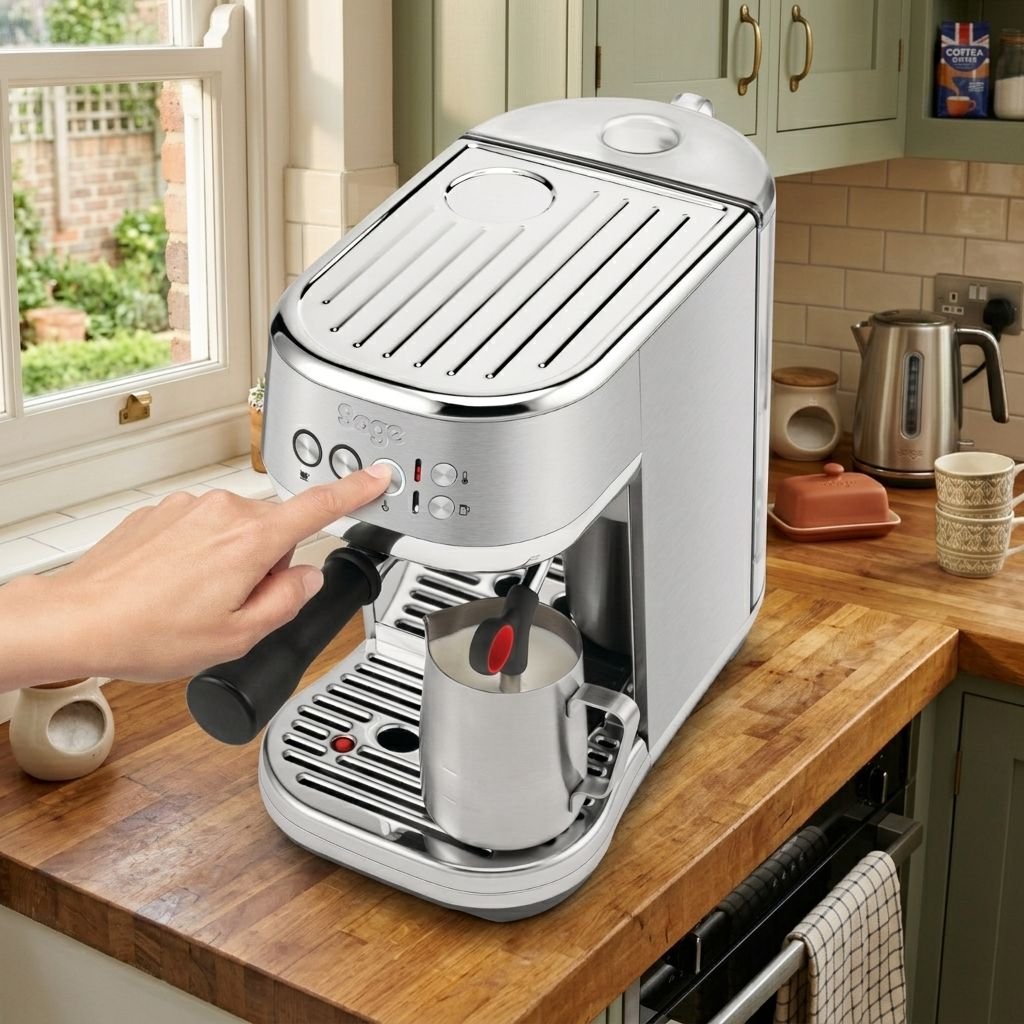
It uses proper espresso hardware. The 54mm stainless steel portafilter takes standard-sized doses, and you get two kinds of basket. Single wall baskets are for freshly ground beans and give you full control. Dual wall (pressurised) baskets are much more forgiving and are meant for pre-ground coffee or beans that are past their best.
It reminds you about maintenance. The machine counts extractions and asks for a cleaning cycle every 200 shots, and it flashes when it’s time to descale. On a machine aimed at beginners, that’s more useful than it sounds.
Espresso quality: what the machine controls and what it doesn’t
On paper, the Bambino Plus has everything a good shot needs: stable digital temperature control, low-pressure pre-infusion (a gentle soak that helps water pass evenly through the coffee) and around 9 bar during extraction. There’s no pressure gauge, and you can’t adjust brew temperature.
Here’s the bit that matters more than any spec. The machine doesn’t choose your grind size, your dose or your beans, and those three things decide most of what you taste. Sage’s own manual says as much: when a shot runs too fast or too slow, nearly every fix it suggests is about the grind, the dose or the tamp, not the machine.
Pre-ground vs a separate grinder
| Your setup | Basket to use | What to expect |
|---|---|---|
| Supermarket pre-ground coffee | Dual wall | Easy and forgiving, but flatter flavour and no way to adjust the grind |
| Fresh pre-ground from a roaster | Dual wall | Fresher, as long as you follow Sage’s advice to use pre-ground coffee within a week of grinding |
| Fresh beans plus an espresso grinder | Single wall | The full potential of the machine, but you’ll need to dial in each new bag |
| Fresh beans plus a blade or cheap burr grinder | Dual wall | Usually disappointing. Most can’t grind fine or evenly enough for single wall baskets |
Dose: 18g is a target, not a guarantee
Sage’s UK page talks about an 18g dose. The manual is a bit more precise: the 2 cup baskets are designed for 16 to 19g and the 1 cup baskets for 8 to 11g. Without scales, “a scoop” can easily be a couple of grams either way, and that’s enough to turn a balanced shot sour or bitter.
The supplied Razor tool helps by trimming the puck to a consistent height after tamping, but it can’t fix a dose that’s well off. If you’re using fresh beans, a cheap set of kitchen scales that read to 0.1g is one of the best value extras you can buy.
The 1 CUP and 2 CUP buttons stop at a preset volume (roughly 30ml and 60ml out of the box), not a weight. Crema makes volume an unreliable measure, so if a shot tastes thin or harsh, it’s worth reprogramming the button to stop a little earlier or later rather than assuming the beans are wrong.
Bean freshness and the bag size that suits you
This is something most reviews skip. Sage’s manual recommends using beans between 5 and 20 days after their roast date, and switching to the dual wall baskets once they’re more than 30 days old. In other words, you’ve got about 15 days to get through each bag, so the size of bag you buy matters more than you’d think.
Here’s the bag size that fits inside that window, based on an 18g dose per double shot:
| Double shots per day | Coffee used per day | Bag size that stays fresh | How long a 1kg bag would last |
|---|---|---|---|
| 1 | 18g | 250g (lasts about 14 days) | About 56 days |
| 2 | 36g | 500g (lasts about 14 days) | About 28 days |
| 3 | 54g | 500g (lasts about 9 days) | About 19 days |
| 4 | 72g | 1kg (lasts about 14 days) | About 14 days |
This assumes you open each bag about 5 days after its roast date. For most two-coffee households, a 500g bag is about right. A 1kg bag works out cheaper per gram, but unless you’re getting through four doubles a day, the last third or so will be past Sage’s suggested window by the time you reach it. To work it out for yourself, multiply your daily double shots by 18g, then by 15 days.
Automatic milk texturing: who it really suits
Steaming milk well is the skill most new home baristas struggle with. You have to get air in early, stop at the right moment, and not overheat it. The Bambino Plus takes all of that away. Fill the supplied jug between the MIN and MAX marks, sit it on the sensor, pick your settings and press steam. When the wand stops and you lower it, it purges itself.
The three foam levels roughly cover the main milk drinks. Sage doesn’t publish a drink-by-drink guide, so treat these as starting points:
| Drink | Foam setting to start with | Why |
|---|---|---|
| Flat white | Low | Thin, silky microfoam that sits close to the espresso |
| Latte | Medium | A bit more texture, still easy to pour |
| Cappuccino | High | Thicker, airier foam that stands up on top |
| Anyone who prefers a less hot drink | Any, with the Warm temperature setting | The sensor stops steaming at a lower temperature |
The limits worth knowing before you buy
- You’re tied to the supplied jug. The automatic mode depends on the jug sitting on the sensor, and the manual says to use only the supplied 480ml stainless steel jug. You can’t swap in a bigger jug to steam for three people at once.
- Batch size is set by the jug’s MAX line, not your mug. Depending on how big your cups are, two large lattes may mean two rounds of steaming.
- Latte art is still on you. Sage says the wand makes microfoam suitable for latte art, but pouring a pattern is a separate skill.
- Manual mode exists, but it switches off the safety nets. In manual mode, automatic texturing and the automatic stop are both disabled. The manual’s target is 60 to 65°C, which is when the jug becomes hot to touch.
So who benefits most? Households where several people make their own coffee and want the same result every time, and anyone who drinks milk-based coffee daily and has no interest in learning to steam. If you actually want to practise steaming, the manual mode lets you, but you’d get more out of a machine designed around a manual wand. If milk drinks are your main focus, our guide to the best coffee machines for cappuccino and latte covers other ways to get there.
Everyday workflow: what it’s actually like to make a latte
“Ready in 3 seconds” is true, but it only covers the first step. This is the full sequence for a latte with fresh beans, based on Sage’s manual:
| Step | Who does it | What the manual says |
|---|---|---|
| 1. Switch on | Machine | Ready to brew in about 3 seconds |
| 2. Grind and dose | You and your grinder | 2 cup basket takes 16 to 19g |
| 3. Distribute and tamp | You | Tamp at roughly 10 to 15kg; consistency matters more than force |
| 4. Trim the puck | You | Use the Razor after tamping, then wipe the basket rim |
| 5. Flush the group head | You, one button | A short flush stabilises the temperature |
| 6. Pull the shot | Machine stops itself | Coffee should start flowing after about 8 to 12 seconds |
| 7. Steam the milk | Machine | Stops at your chosen temperature, then purges when the wand is lowered |
| 8. Clean up | You | Knock out the puck, rinse the basket and portafilter, wipe the wand, empty the drip tray |
Steps 2 to 4 are where your time goes, and the machine doesn’t help with any of them. With pre-ground coffee and the dual wall baskets, you can skip most of the fiddliness, which is why that setup feels so quick.
There’s one heating system, so you pull the shot first and steam second. You can’t do both at once. The automatic milk does help here, though: while the jug steams on its own, you’re free to knock out the puck and rinse the portafilter, which is where a hands-free wand saves real time on a busy morning.
Two things that surprise new owners. First, after every steam the machine purges hot water into the drip tray to bring the heater back to brewing temperature. That’s why owners often mention the drip tray filling up quickly, and it’s why the manual tells you to empty it after each use. Second, at just under 5kg, the machine is light. Owners regularly say it shifts on the worktop when they twist the portafilter in, so it helps to steady the top with your other hand.
One more detail from the manual that’s easy to miss: if the machine suddenly stops working mid-use, a thermal cut-out may have tripped because the pump overheated, and Sage suggests letting it cool for 30 to 60 minutes. It’s a safety feature rather than a common complaint, but it’s a reminder that this is a household machine, not one for knocking out a long queue of flat whites at a dinner party.
Sage Bambino Plus pros and cons
- Automatic milk that stops at the same temperature and texture every time
- Ready to brew about 3 seconds after switching on
- Under 20cm wide and just over 30cm tall, so it fits under most wall cupboards
- Proper 54mm portafilter with both forgiving and full-control baskets
- Programmable shot volumes and manual pre-infusion for when you want more control
- Built-in cleaning and descaling reminders
- Works with any grinder you choose, and you can upgrade the grinder later
- No grinder, so fresh-bean espresso needs another £170 to £210 of kit
- No pressure gauge or brew temperature adjustment to help you diagnose a bad shot
- Automatic milk only works with the supplied jug, which limits batch size
- Small drip tray that also collects purge water, so it needs emptying often
- Light enough to move when you lock in the portafilter
- The supplied tamper is basic, and many owners replace it
Buy it if you drink lattes, flat whites or cappuccinos most days, want reliable milk without learning to steam, and either already own a decent espresso grinder or are happy starting with good pre-ground coffee.
Skip it if you want one appliance that goes from whole beans to espresso, you mostly drink straight espresso, or you’re excited about learning to steam milk by hand.
Running costs and the equipment you may need
The £399.95 price tag is only the starting point. Here’s what else to budget for, split into what you need and what’s optional. Prices were checked in October 2026 and will change.
Extra kit: essential vs optional
| Item | Do you need it? | UK price (October 2026) |
|---|---|---|
| Espresso grinder | Essential for fresh beans, not needed with pre-ground | Sage Dose Control Pro £169.95 (Currys), Sage Smart Grinder Pro £209.95 (Sage) |
| Milk jug | Included | £0 |
| Tamper | Included, upgrade optional | Varies |
| Kitchen scales (0.1g) | Strongly recommended with fresh beans | Varies |
| Knock box | Optional, but saves mess | Sage Knock Box 10 £29.95 (Sage) |
| Cleaning tablets and descaler | Starter supply included, then ongoing | See the table below |
Yearly maintenance costs
This assumes two drinks a day (730 a year) and uses Sage’s own consumables.
| Task | When the manual says to do it | For a two-drink household | Cost per year |
|---|---|---|---|
| Cleaning cycle | Machine alerts after 200 extractions | About every 100 days, so 3 to 4 a year | About £7 (one tablet per cycle, £14.95 for 8) |
| Descale | Every 90 days at Sage’s hardness level 4, every 60 days at level 6 | 4 to 6 a year, depending on your water | About £11 to £17 (around £2.83 a sachet in a 6-pack at £16.95) |
| Water filter | Every 3 months, or 40 litres | 4 a year | About £60 (£14.95 each) |
| Total | About £78 to £84 |
The surprise here is that the water filter, not the descaler, is the biggest ongoing cost. And there’s a catch in the filter’s rating: it lasts 3 months or 40 litres, whichever comes first. Forty litres is about 21 full tanks. If you’re refilling the full 1.9-litre tank roughly every four days or more often, you’ll hit the 40-litre limit before three months are up.
Some retailer copy for the filter says you won’t need to descale if you use it. Sage’s Bambino Plus manual still gives a descaling schedule, and the machine will still prompt you, so I’d follow the manual. If you’re in a hard water area, which covers London and much of the south and east of England, plan on the 60-day end of the range.
Two more things from the manual that can save you money. Don’t use distilled, de-mineralised or heavily filtered water to avoid scale, because Sage says it can affect both taste and how the machine works. And don’t put the parts in the dishwasher, even though some retailer listings say they’re dishwasher safe. The manual says not to.
What does a home latte actually cost?
Here’s a worked example for one latte, with the assumptions spelled out so you can swap in your own numbers.
| Cost | Assumption | Per latte |
|---|---|---|
| Coffee (speciality beans) | £9 per 250g bag, 18g per double shot | 65p |
| Coffee (budget beans) | £15 per 1kg bag, 18g per double shot | 27p |
| Milk | 200ml from a £1.65 four-pint (2.272 litre) bottle | 15p |
| Electricity | Full 1.6kW for 90 seconds at 26.32p/kWh (Ofgem cap, October to December 2026). This is a worst case | About 1p |
| Maintenance | £84 a year spread over 730 drinks | 11p |
| Total | About 92p (speciality) or 54p (budget) |
Electricity barely registers. ThermoJet only heats when you use it, and even the worst-case figure is around a penny a drink. Coffee is the cost that matters.
To put the upfront cost in context: a Bambino Plus at £399.95 plus a Dose Control Pro at £169.95 comes to £569.90. If each home latte replaces a café one you’d otherwise pay £3.50 for, you save about £2.58 a drink, so the setup pays for itself after roughly 220 drinks. That’s around 16 weeks at two a day. Use your own café price and drink count, because that’s the number that decides it.
Is it really good for small kitchens?
On its own, yes. At 19.4cm wide and 30.4cm tall, the Bambino Plus is one of the smallest espresso machines Sage makes, and it’ll sit under most wall cupboards without a second thought. Sage lists the depth as 36.2cm, while retailers quote 32cm, so measure with the larger figure to be safe. The tank sits at the back. You can either lift it out or take the lid off and top it up in place with a jug.
The picture changes once you add a grinder, which most fresh-bean drinkers will:
| Setup | Combined width | Tallest item |
|---|---|---|
| Bambino Plus alone | 19.4cm | 30.4cm |
| Bambino Plus + Dose Control Pro | About 40cm | 34.2cm (the grinder) |
| Bambino Plus + Smart Grinder Pro | About 41cm | 38.9cm (the grinder) |
| Barista Express Impress (grinder built in) | 42.2cm | 31cm |
Widths are from Sage and retailer listings, with no gap between units, so allow a few centimetres more in practice, plus space for a knock box and the milk jug. Two things stand out. Side by side, a Bambino Plus and grinder take up almost exactly as much width as an all-in-one machine. And under low wall cupboards, it’s the grinder’s bean hopper, not the espresso machine, that’s most likely to be the problem.
The real space advantage of the Bambino Plus is flexibility. You can put the grinder in a different spot, store it in a cupboard, or skip it altogether with pre-ground coffee. An all-in-one machine doesn’t give you those options.
Who should buy the Sage Bambino Plus?
- You drink milk-based coffee most days and want it the same every time
- Several people in your home make their own coffee, and not all of them want to learn to steam milk
- You already own a good espresso grinder, so you’d be paying twice for a machine with one built in
- You’re moving up from pods and are happy to start with pre-ground coffee before deciding on a grinder
- Your kitchen is small or your wall cupboards are low, and you want the option to keep the grinder elsewhere
If you’re new to all this and want to see a few easier options side by side, our guide to the best coffee machines for beginners includes the Bambino Plus alongside simpler machines.
Who should avoid it?
- You want one machine for everything. If the idea of buying, positioning and cleaning a separate grinder puts you off, an espresso machine with a grinder built in will suit you better.
- You want push-button coffee. Even with automatic milk, you still dose, tamp and clean. A bean-to-cup coffee machine does all of that for you, and if you want the simplest possible route, a pod machine is simpler still. Our Nespresso vs Dolce Gusto comparison covers that end of the market.
- You mainly drink espresso and want to tinker. Without a pressure gauge or temperature adjustment, there’s less on the machine to help you fine-tune a shot.
- You make lots of milk drinks in one go. One jug size, one heating system and a small drip tray make it better for a couple of drinks at a time than for a crowd.
- You want to learn to steam milk properly. Manual mode is there, but a machine built around a manual wand will teach you more.
Sage Bambino Plus vs Bambino vs Barista Express Impress
| Feature | Sage Bambino (SES450) | Sage Bambino Plus (SES500) | Sage Barista Express Impress (SES876) |
|---|---|---|---|
| Sage UK price (October 2026) | £329.95 (out of stock at Sage at the time of writing) | £399.95 | £599.95 (RRP £729.95) |
| Grinder | None | None | Built in, conical burr, 25 settings |
| Milk | Manual steam wand | Automatic wand with manual mode | Manual steam wand |
| Portafilter | 54mm aluminium | 54mm stainless steel | 54mm stainless steel |
| Tamping | Separate plastic tamper | Separate tamper | Assisted tamping (10kg) |
| Heating | ThermoJet, 3 seconds | ThermoJet, 3 seconds | Thermocoil with PID, 93°C |
| Water tank | 1.4 litres | 1.9 litres | Not listed on Sage’s UK page |
| Width | Similarly compact | 19.4cm | 42.2cm |
| Best for | Tight budgets, people happy to steam by hand | Milk drinkers who want it done for them | One-machine setups from whole beans |
Bambino Plus vs the original Bambino
At list price, the gap is £70. For that, the Plus gets you automatic milk with a temperature sensor, a stainless steel portafilter rather than aluminium, and a bigger 1.9-litre tank. The espresso side is very similar: same 54mm basket size, same ThermoJet heating and same pre-infusion approach.
So the decision comes down to milk. If you mostly drink espresso or americanos, or you’d enjoy learning to steam, the original Bambino is the better-value machine whenever it’s in stock. If you drink milk coffee daily and want it hands-free, the extra £70 buys you exactly that.
Bambino Plus vs Barista Express Impress
This is where the numbers get interesting. At October 2026 prices, the Barista Express Impress is £599.95 with its grinder built in. A Bambino Plus plus a Dose Control Pro is £569.90, and with a Smart Grinder Pro it’s £609.90. Once you need a grinder, the price advantage of the Bambino Plus mostly disappears.
What you’re really choosing between is automatic milk and a separate grinder you can upgrade (Bambino Plus), or one appliance with dosing and tamping help but manual milk (Impress). If you want to dig into the Impress, have a look at our full Sage Barista Express Impress review. If you’re weighing it against the standard Barista Express instead, our Sage Bambino Plus vs Barista Express comparison goes through that decision in detail.
How to get the best value
- Don’t pay over the odds. The usual price is £399.95, and in previous sales it has dropped to around £349 at Sage and major retailers. If you’re not in a hurry, Black Friday has been the most reliable time for a discount.
- Look at grinder bundles. Some specialist UK coffee retailers sell the Bambino Plus bundled with a Sage grinder for less than buying both separately. Compare the bundle against the two current prices added together.
- Claim the coffee offer. At the time of writing, Sage and some retailers include two free bags of speciality beans and a discount on further bags, claimed after purchase. Check the terms where you buy.
- Think twice about second-hand. Sage’s 2-year guarantee only covers the first person who bought the machine and can’t be transferred. A used Bambino Plus may be cheaper, but it won’t come with Sage’s guarantee.
- Keep up with maintenance. Sage’s guarantee excludes damage caused by not descaling or not using suitable water filtration as described in the manual. The descale alert can be dismissed with a button press, but it’s worth not making a habit of it.
- Keep your receipt and serial number. Claims under Sage’s guarantee go to Sage directly rather than the retailer, and you’ll need proof of purchase. Your statutory rights against the retailer still apply as well.
FAQs
Do I need a grinder for the Sage Bambino Plus?
Not to get started. It works with pre-ground coffee in the dual wall baskets. To get the best from fresh beans, though, you’ll need a separate grinder that can grind fine and evenly enough for espresso.
Can the Bambino Plus use pods?
No. It’s designed for ground coffee only and doesn’t take capsules or ESE pods.
Can it make two drinks at once?
It can pull two shots at once into two cups using the 2 cup basket. Milk is a different story: there’s one heating system and one jug, so you brew first, then steam, and larger orders may need more than one round of steaming.
Can I make an americano?
Yes. Hot water comes out of the steam wand when you press the 1 CUP and MILK FOAM buttons together. Sage warns the water is around 90°C, so take care.
How often do I need to clean and descale it?
Day to day, rinse the basket and portafilter, wipe the steam wand and empty the drip tray. The machine asks for a cleaning cycle with a tablet every 200 shots. Sage recommends descaling every 60 to 90 days depending on water hardness and changing the water filter every three months.
Is the Sage Bambino Plus good for beginners?
Yes, especially for milk drinkers, because it removes the trickiest skill. Start with pre-ground coffee and the dual wall baskets, then move to fresh beans and the single wall baskets once you’re comfortable.
Is the Sage Bambino Plus worth it?
For a milk drinker who already has a grinder, or who’s happy with pre-ground, it’s very good value. If you need to buy a grinder too, the total ends up close to a machine with a grinder built in, so it’s worth comparing both routes before you decide.
Sage Bambino Plus review: our verdict
The Bambino Plus does one thing better than almost anything else at its price: it makes consistent, café-style milk without asking you to learn how. Add the 3-second heat-up and the tiny footprint, and it’s an easy machine to live with every day.
The main reason to buy it is that automatic milk wand, especially in a home where more than one person makes coffee. The main reason not to is the grinder question. With pre-ground coffee it’s simple but limited, and with a proper grinder it’s excellent but no longer cheap or especially compact.
If you already own a grinder, or you’re happy to start with good pre-ground coffee, I’d buy it, ideally on offer. If you’re starting from nothing and want fresh beans, price up the Bambino Plus and grinder together against an all-in-one first. For more options at different budgets, see our guide to the best espresso machines in the UK.


One Comment