9kg vs 10kg Washing Machine: Is the Bigger Drum Worth It?
On paper, choosing between a 9kg and a 10kg washing machine is easy, because one of them holds an extra kilo of washing. In practice that kilo only helps if your loads are big enough to use it, and plenty of households never get there.
For a lot of UK homes 9kg is already plenty, and 10kg starts to make sense when big loads happen every week rather than now and then. To see what the extra kilo is really worth, we compared the energy label rules, manufacturer manuals and a 9kg and 10kg Hotpoint from the same range. The duvet section is worth reading before you buy anything.

Quick answer:
- Three or four people: 9kg is the better all-rounder, and it’s already a big drum.
- Five or more, or a laundry pile that never seems to shrink: 10kg is worth it.
- What you actually gain: about one extra bath towel (or two sheets) per load.
- Running costs: a few pounds a year either way.
- Duvets: not a reason to upsize on its own. Both Hotpoints we looked at cap the Duvet programme at 3.5kg.
9kg vs 10kg washing machine at a glance
| 9kg washing machine | 10kg washing machine | |
|---|---|---|
| Rated load | 9kg of dry cotton on Eco 40-60 | 10kg of dry cotton on Eco 40-60 |
| Extra capacity | Baseline | 11% more, about one bath towel |
| Beko’s load examples | 4 double bed sets, 12 towels or 45 shirts | 4 double bed sets, 13 towels or 50 shirts |
| Usual household fit (Bosch) | 3 to 4 people, and still fine for 5 | 5 or more |
| Most energy it can use and still be A-rated | 49kWh per 100 cycles | 51kWh per 100 cycles |
| Most water allowed per Eco 40-60 cycle | 50 litres | About 52 litres |
| Longest Eco 40-60 cycle allowed at full load | 3 hours 48 minutes | 3 hours 59 minutes |
| Water left in a full load after a class B spin | About 4.1 to 4.9 litres | About 4.5 to 5.4 litres |
| Typical size (Beko UK guide) | 60cm wide, 58 to 64cm deep, 82 to 84.5cm tall | 60cm wide, 58 to 64cm deep, 84 to 84.5cm tall |
The energy, water and cycle-time rows are the legal limits for each size, worked out from the UK energy label and ecodesign formulas, so they aren’t measurements of any one machine. The load examples and sizes come from Beko’s UK guides, and the household fit is Bosch’s.
What does the extra kilo actually hold?
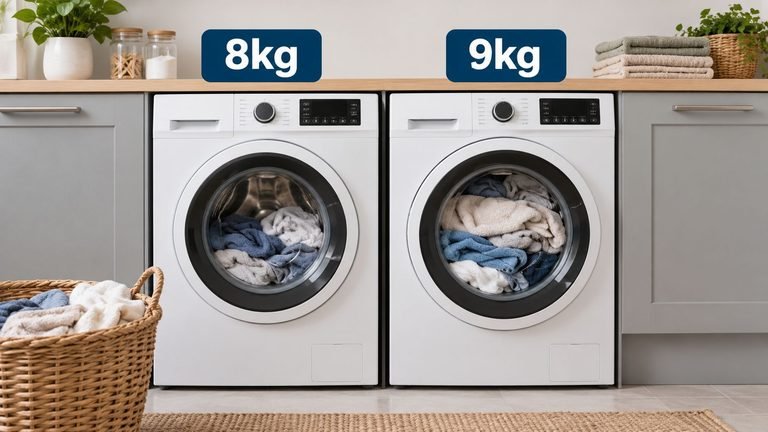
The kg figure is the most dry laundry the machine is rated to wash on Eco 40-60. It has nothing to do with how much the machine weighs, and it isn’t the drum volume either. Going from 9kg to 10kg adds about 11%.
That’s less than it sounds. Samsung UK reckons a bath towel weighs about 0.75kg and a full-size bed sheet or large sweatshirt about 0.5kg, so the extra kilo works out at one more bath towel, or a couple of sheets, per load. Beko’s figures say much the same. It rates its 9kg and 10kg machines for the same four double bed sets, and the 10kg gets one more towel (13 instead of 12) or five more shirts.
Bulky things run out of room before they hit the weight limit, too. Towels, hoodies and bedding fill a drum quickly, and Samsung’s advice is to keep the laundry in a loose pile and stop as soon as you’d have to push it down. That goes for both sizes.
If you’re not sure which camp you’re in, weigh your biggest normal load. Stand on the bathroom scales holding the basket, then without it, and take one reading from the other. If it’s usually under 9kg, the bigger drum won’t do much for you. If it’s regularly over, or you keep splitting loads that could have gone in together, 10kg starts to make sense.
Which programmes get the extra kilo?
That 9kg or 10kg rating only applies to Eco 40-60 and the cotton programmes that share its limit. Every other programme has its own lower limit, so it’s worth checking whether the extra kilo actually reaches the cycles you use most. Here’s how it plays out on a 9kg and a 10kg Hotpoint from the same range, both with the same 16 programmes:
| Programme | Hotpoint 9kg (NSWM 945C) | Hotpoint 10kg (NSWM 1046) | Extra on the 10kg |
|---|---|---|---|
| Eco 40-60, Cotton, Mixed, 20°C, White | 9kg | 10kg | 1kg |
| Full Load 45 min, Anti Stain 40° | 9kg | 10kg | 1kg |
| Synthetics, Delicates | 4.5kg | 5.5kg | 1kg |
| 30 min | 4.5kg | 5.5kg | 1kg |
| Anti Allergy | 5kg | 5.5kg | 0.5kg |
| Wool | 2kg | 2.5kg | 0.5kg |
| Baby | 4kg | 4kg | None |
| Duvet | 3.5kg | 3.5kg | None |
This pair does better than most people would guess. The 10kg keeps its full extra kilo on synthetics, delicates and the 30-minute wash, which doesn’t always happen. When we looked at Hotpoint’s 8kg and 9kg models for our 8kg vs 9kg washing machine guide, the gap on those programmes was only half a kilo. The Baby and Duvet cycles get nothing extra at all.
Don’t assume other brands work the same way. In our best washing machines under £400 guide, the 10kg Haier’s 15-minute Super Fast programme only takes 1kg, but the 10kg Beko will wash a full 10kg on its 28-minute Quick setting. You’ll only find this in the wash cycle table in the manual, so have a look before you order.
Which size suits your household?
| Household or laundry pattern | Better starting point | Why |
|---|---|---|
| 1 to 2 people, normal laundry | Under 9kg is usually enough | 9kg or 10kg is more drum than most small households fill |
| 3 to 4 people | 9kg | Plenty of room for family loads without paying for space you’ll rarely use |
| 5 or more | 10kg | Extra room for consistently large loads, though 9kg can still cope |
| Smaller household, heavy laundry | 9kg or 10kg | Choose by how much washing you do, not how many people there are |
| Frequent bedding and towel washes | 10kg | More headroom for bulky cotton loads |
Bosch’s buying guide lands in roughly the same place. It matches 8kg and 9kg machines to homes of three or four and 10kg to five or more, although it adds that 9kg is still enough for a family of five.
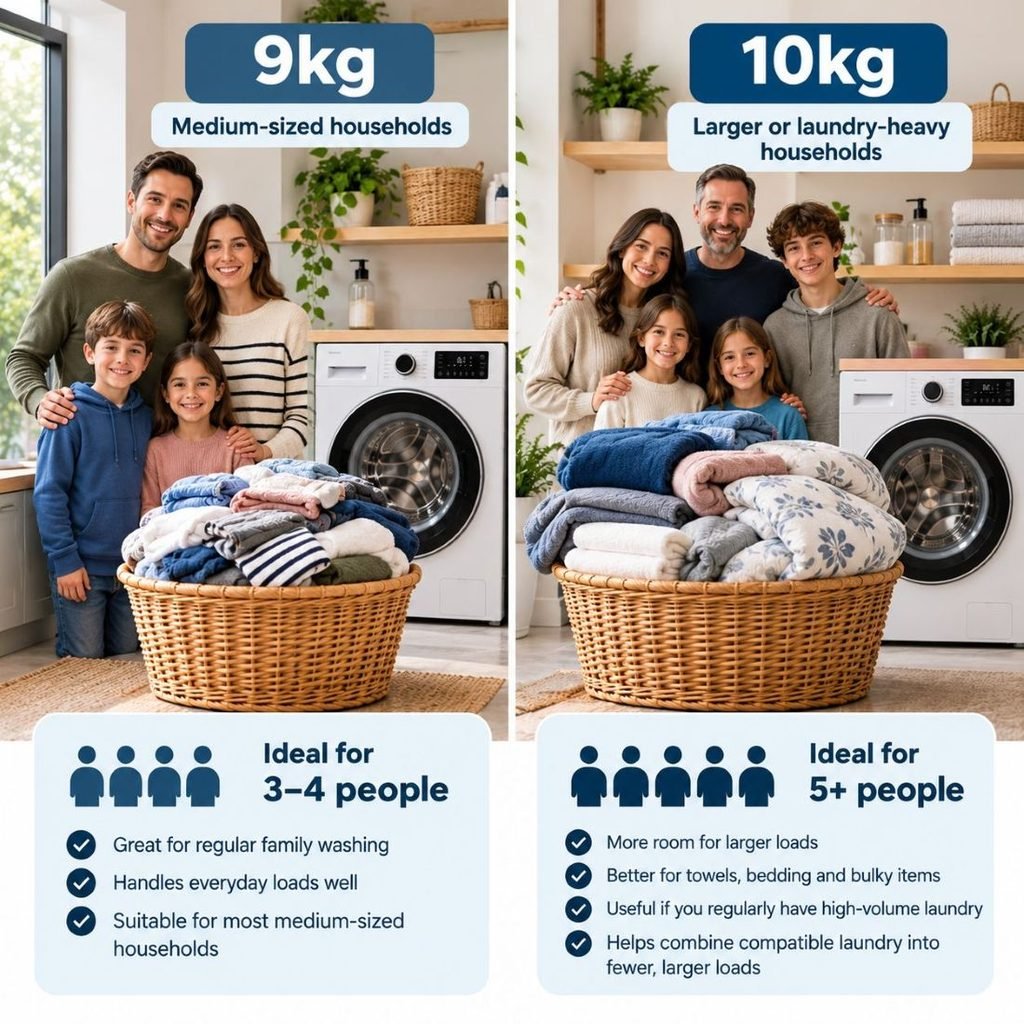
So headcount is only a rough guide. A five-person household that washes most days may be perfectly happy with 9kg, while three people getting through sports kits, towels and bedding every week might be glad of 10kg.
9kg vs 10kg washing machine for bedding and duvets
Bedding is where a bigger drum sounds most useful. Bulky items need space to soak through, move about and rinse properly, and on the cotton programmes a 10kg drum does give you a bit more of that.
The duvet programme is another matter. On the Hotpoint pair above it’s limited to 3.5kg on both machines. Hotpoint’s manual for the 9kg model says it’s meant for goose-down items such as single duvets under 3.5kg, cushions and down jackets, loaded with the edges folded in and taking up no more than three-quarters of the drum. Paying for the 10kg version gets you nothing extra on that cycle.

If washing a double or king-size duvet at home is one of the main reasons you’re buying, look for a bedding or duvet programme with a stated load in the manual, and check the duvet’s care label before anything else. If you have to force a duvet in, it won’t wash or rinse properly, whichever size machine it’s in.
Sheets, duvet covers and pillowcases are fine in either. Beko rates both sizes for four double bed sets.
Does a 10kg washing machine use more electricity and water?
Usually a little more per wash, but drum size alone won’t tell you, and the energy class letter can point you the wrong way if you compare the two sizes.
Why an A-rated 10kg can use more than an A-rated 9kg
The energy class isn’t a straight measure of electricity use. It compares each machine’s Eco 40-60 figure with a standard allowance, and that allowance goes up with drum size. Work through the UK formula and a 9kg machine can use up to 49kWh per 100 cycles and still be rated A, while a 10kg machine can use up to 51kWh. The same 51kWh on a 9kg machine would only earn a B.
Hotpoint’s 9kg and 10kg models in the same range sit right at those limits:
| Hotpoint NSWM 946 (9kg) | Hotpoint NSWM 1046 (10kg) | |
|---|---|---|
| Energy class | A | A |
| Energy per 100 Eco 40-60 cycles | 49kWh | 51kWh |
| Water per Eco 40-60 cycle | 50 litres | 52 litres |
| Eco 40-60 at full load | 3 hours 45 minutes | 3 hours 55 minutes |
| Spin-drying class | B | B |
| Spin noise | 76dB, class B | 76dB, class B |
| Size (H × W × D) | 85 × 59.5 × 60.5cm | 85 × 59.5 × 60.5cm |
Both are A-rated, equally loud and exactly the same size. The 10kg uses 2kWh more per 100 cycles and two more litres a wash, and its Eco cycle runs ten minutes longer, which is all within what its bigger drum allows. So if two machines show the same letter, look at the kWh and litre figures instead.
None of this means a 10kg machine is always the thirstier one. The 10kg Haier X5 Plus in our under-£400 guide is rated at 41kWh per 100 cycles, which is well below this 9kg Hotpoint. A well-made 10kg can easily use less than an average 9kg.
What a full 10kg wash really uses
It’s easy to assume the label figure is what one full wash uses, but it isn’t. It’s a weighted average of tests at full, half and quarter load. On a 10kg machine the quarter-load test, with only 2.5kg of washing, makes up 45% of the result and the full-load test about 30%. For a 9kg machine it’s 40% and 34%.
Hotpoint’s manual for the 10kg NSWM 1046 lists the figures that go into its label:
| Eco 40-60 load | Energy | Water | Time | Energy per kg | Water per kg |
|---|---|---|---|---|---|
| Full (10kg) | 0.82kWh | 69 litres | 3:55 | 0.08kWh | 6.9 litres |
| Half (5kg) | 0.55kWh | 56 litres | 3:00 | 0.11kWh | 11.2 litres |
| Quarter (2.5kg) | 0.29kWh | 38 litres | 2:30 | 0.12kWh | 15.2 litres |
A full 10kg load uses a fair bit more than the 0.51kWh and 52 litres on the label, so don’t use the label number as the cost of one packed wash. Smaller loads also cost more per kilo, and the difference is biggest with water. A quarter load uses about 35% of the full-load energy but 55% of the water, for a quarter of the washing.
On the other hand, the label already expects you to run the drum part-full a lot of the time, so a 10kg machine isn’t marked down for it. But if your loads rarely go above 5kg, you’d be paying for drum space you don’t need.
What the difference costs a year
Here’s the yearly cost for the same Hotpoint pair in two scenarios. In the first, the 10kg runs just as often as the 9kg. In the second, every load is packed to the full 10kg, so you need one wash in ten fewer.
| 9kg (49kWh, 50 litres) | 10kg, same number of washes | 10kg, every load full | |
|---|---|---|---|
| Electricity per wash | 12.9p | 13.4p | 13.4p |
| Water per wash (metered) | 21.0p | 21.9p | 21.9p |
| Washes a year | 220 | 220 | 198 |
| Yearly cost | £74.65 | £77.66 | £69.89 |
Assumptions: electricity at 26.32p per kWh, the Ofgem price cap average for Direct Debit customers from 1 October to 31 December 2026 (VAT is currently off household electricity). Water at Thames Water’s 2026/27 metered rates of £2.7346 per cubic metre for clean water plus £1.4721 for wastewater. 220 Eco 40-60 washes a year, the figure the old EU energy label used. Standing charges left out. The label figures are a weighted mix of load sizes, so treat these as a like-for-like comparison rather than an exact bill.
Formula: (kWh per 100 cycles ÷ 100 × 26.32p) + (litres ÷ 1,000 × £4.2067), multiplied by the number of washes. The 198 comes from 220 × 9 ÷ 10.
If you run the 10kg as often as you would the 9kg, it costs about £3 a year more. Fill it every time and it saves about £5. Most homes will end up somewhere in between, since sorting by colour and fabric means not every wash will be full. Without a water meter, the difference drops to a pound or two either way, which isn’t enough to base the decision on.
A bigger load means more water to dry
If your washing dries indoors, this matters more than the energy figures. Both Hotpoints leave 53% moisture in a full Eco 40-60 load after the spin, which is spin-drying class B. That’s roughly 4.8 litres of water in a full 9kg load and 5.3 litres in a full 10kg one, so every full load gives you an extra half litre to dry out. You’ll notice that in winter if everything goes on an airer.
Spin class makes more difference than drum size here. A 10kg machine rated A for spin (under 45% moisture) leaves less than 4.5 litres in a full load, which is less than the 9kg Hotpoint leaves. The 10kg LG in our under-£400 guide is one of these, at 44.9%. A faster spin speed doesn’t guarantee a better class, which we go into in our 1200 vs 1400 vs 1600rpm washing machine comparison.
All that water ends up in the room. A dehumidifier built for drying clothes will clear it far quicker than radiators, and if you haven’t decided how you’ll dry yet, our dehumidifier vs tumble dryer comparison is worth a read.
If you’ve already got a tumble dryer, check its capacity. Dryers are rated by dry weight too, so a full 10kg wash won’t fit in an 8kg or 9kg dryer in one go, and you’ll end up splitting it.
Is a 10kg washing machine physically bigger?
Not necessarily. A lot of full-size front loaders use roughly the same cabinet, and the capacity comes down to the drum and cabinet design. Beko’s UK size guide gives the same 58 to 64cm depth range for its 9kg and 10kg machines, and the two Hotpoints are identical at 85 × 59.5 × 60.5cm.
Some 10kg machines are actually quite shallow. The 10kg Hoover and Haier in our under-£400 guide are both about 52cm deep, so drum size really doesn’t tell you much about whether a machine will fit.
Measure your space and check the exact dimensions of the model you’re looking at, leaving room for the hoses, the plug behind it and the door opening. Depth is the one that catches people out. The 9kg Hotpoint is 60.5cm deep but 63.7cm with the door closed, so it may stick out past a standard 60cm worktop.
Will a 10kg machine mean fewer washes?
Only if you regularly have enough of the same kind of washing to fill it. Even with every load packed to the limit, 10kg saves you one wash in ten. If you do around four washes a week, that’s one fewer every two and a half weeks or so.
And if you sort by colour, fabric or care label, you’ll still need separate loads whatever the drum size. Waiting until there’s enough to fill a bigger machine isn’t always practical either, especially when someone needs a clean school uniform tomorrow. It makes more sense to buy for the loads you already produce.
Is a 10kg washing machine worth paying extra for?
Paying more for 10kg makes sense if the extra room fixes a real problem, like loads that are always big, lots of bulky washing, a larger household, or simply preferring fewer, fuller washes.
Often the price difference is small anyway. When we checked prices for our under-£400 guide, four 10kg machines were cheaper than an 8kg Samsung. That’s why it’s worth looking at the whole machine rather than just the drum. A 9kg model with better energy and spin classes, the programmes you’d actually use and a longer guarantee may well be the better buy. If you’re working to a tighter budget, our best washing machines under £300 guide is a good place to start.
| Choose a 9kg washing machine if… | Choose a 10kg washing machine if… |
|---|---|
| You’re a household of three or four | There are five or more of you, or laundry is a daily job |
| You wash regularly rather than saving up big loads | Towels, kit and bedding regularly back up |
| Your biggest sorted loads fit comfortably in 9kg | You often split loads that could go in together |
| You dry indoors and the 9kg option has the better spin class | Your tumble dryer can take 10kg, or you line-dry |
| The 9kg model is better value or better specified | The price gap is small and nothing else gets worse |
Frequently asked questions
Is a 9kg washing machine big enough for a family of four?
For most families, yes. Bosch puts 8kg and 9kg machines in the three-to-four-person range. Go for 10kg if towels, kit and bedding regularly pile up between washes.
Is a 10kg washing machine too big for two people?
It’s more drum than most couples need, but running it part-full isn’t heavily penalised, as the energy label figure is mostly built from half and quarter loads. Just don’t pay much extra for space you won’t use.
What is the actual difference between 9kg and 10kg?
1kg of dry laundry on Eco 40-60 and similar cotton programmes, which is about 11% more. In practice that’s roughly one bath towel or two bed sheets per load, and some other programmes gain less.
Can I wash a king-size duvet in a 10kg washing machine?
Possibly, but the 10kg figure won’t tell you. Some 10kg machines cap their Duvet programme at 3.5kg, the same as the 9kg version. Check the duvet programme load in the manual and the duvet’s care label.
Does a 10kg washing machine cost more to run?
Slightly, if you use it the same way. On the Hotpoint pair we compared, the 10kg costs about £3 a year more at the current price cap and Thames Water metered rates, or about £5 less if you fill every load. Compare the kWh per 100 cycles and litres per cycle for the specific models you’re looking at.
Can I put 10kg of laundry on every programme in a 10kg machine?
No. Synthetics, delicates, wool, quick washes and specialist programmes usually have lower limits, which you’ll find in the wash cycle table in the manual.
Is 9kg or 10kg better for a family of five?
Bosch suggests 10kg for five or more, but says 9kg is still enough for five. If you wash most days, 9kg will cope. If you’d rather run fewer, bigger washes, go for 10kg.
Final verdict
For typical family washing, 9kg gives you the best balance of capacity and practicality. Go for 10kg if you know you’ll use the extra kilo.
Most UK households of three or four will find 9kg roomy enough. A 10kg model is worth it when big loads are a weekly thing, especially in larger families or homes that wash bedding and towels every week. Running costs hardly change either way, and on some machines the extra kilo does nothing for duvets.
So don’t choose on capacity alone. Compare the programme limits, the kWh and litre figures, the spin class, the depth and the price of the actual machines you’re considering, and pick the one that suits the washing you really do.