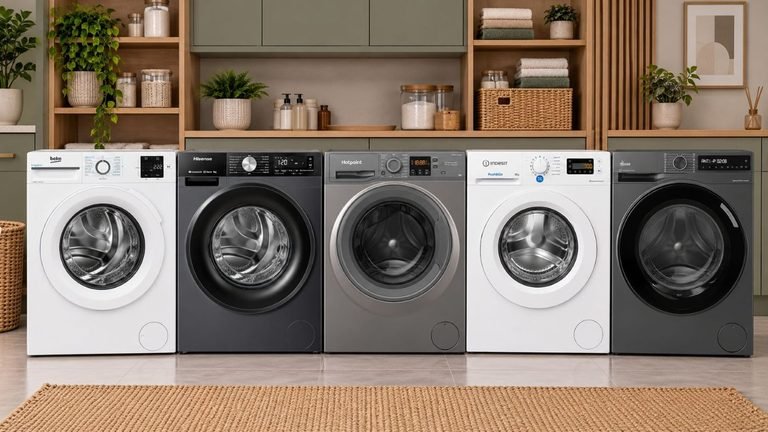
8kg vs 9kg Washing Machine: Which Size Do You Need?
An extra kilogram on the front of a washing machine sounds like a free upgrade. Sometimes it is. Quite often it’s just a bit of drum you’ll never fill.
The gap between 8kg and 9kg is smaller than most people expect, and the most useful differences aren’t where you’d look. We’ve gone through the UK energy label rules, manufacturer manuals and product sheets to work out what the extra kilo actually holds, what it costs to run and when it’s worth paying for.
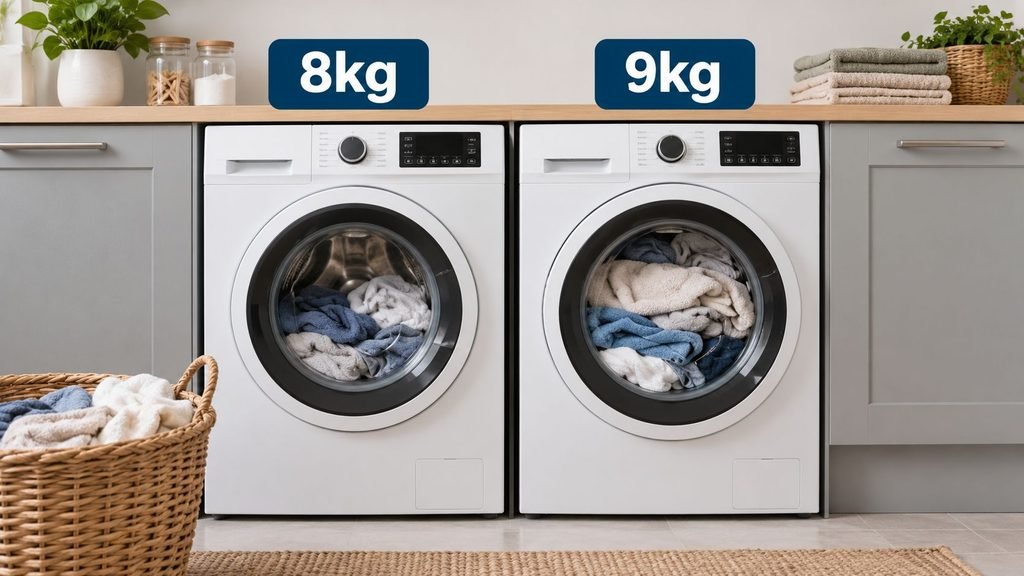
Quick answer:
- One or two people, or you wash most days: 8kg is plenty.
- Three or four people: either size works. Go for 9kg if towels, school uniform and bedding regularly pile up.
- Five or more: 9kg is the better of the two, and a 10kg machine is worth a look.
- Running costs: almost identical. Over a year the difference is a few pounds either way.
- Duvets: don’t buy 9kg for this alone. Some machines cap the duvet programme at the same weight whatever the drum size.
Neither size cleans better, spins quieter or is automatically cheaper to run. Those things come down to the individual model.
8kg vs 9kg washing machine at a glance
| 8kg washing machine | 9kg washing machine | |
|---|---|---|
| Rated load | 8kg of dry cotton on Eco 40-60 | 9kg of dry cotton on Eco 40-60 |
| What the extra kilo holds | Baseline | About two bed sheets or two large sweatshirts |
| Usual household fit | 1 to 4 people | 3 to 5 people |
| Most energy it can use and still be A-rated | 47kWh per 100 cycles | 49kWh per 100 cycles |
| Most water allowed per Eco 40-60 cycle | 48 litres | 50 litres |
| Longest Eco 40-60 cycle allowed at full load | 3 hours 38 minutes | 3 hours 48 minutes |
| Water left in a full load after a class B spin | About 3.6 to 4.3 litres | About 4.1 to 4.9 litres |
| Typical depth | 55 to 59cm | 58 to 64cm |
| Width and height | About 60cm wide, 82 to 84.5cm tall | About 60cm wide, 82 to 84.5cm tall |
The energy, water and cycle-time rows are the legal limits for each drum size under UK energy label and ecodesign rules, worked out from the official formulas. They aren’t measurements of any particular machine. Depths and heights are the typical ranges in Beko’s UK size guide, and plenty of individual models fall outside them.
What does 8kg or 9kg actually mean?
It’s the weight of dry laundry the machine is rated to wash in one go, not the weight of the machine or the water it uses. Officially it’s the maximum load of dry cotton on the Eco 40-60 programme, stated in half-kilo steps. A 9kg machine is rated for 12.5% more than an 8kg one, but only on that programme and the cotton-type washes that share its limit.
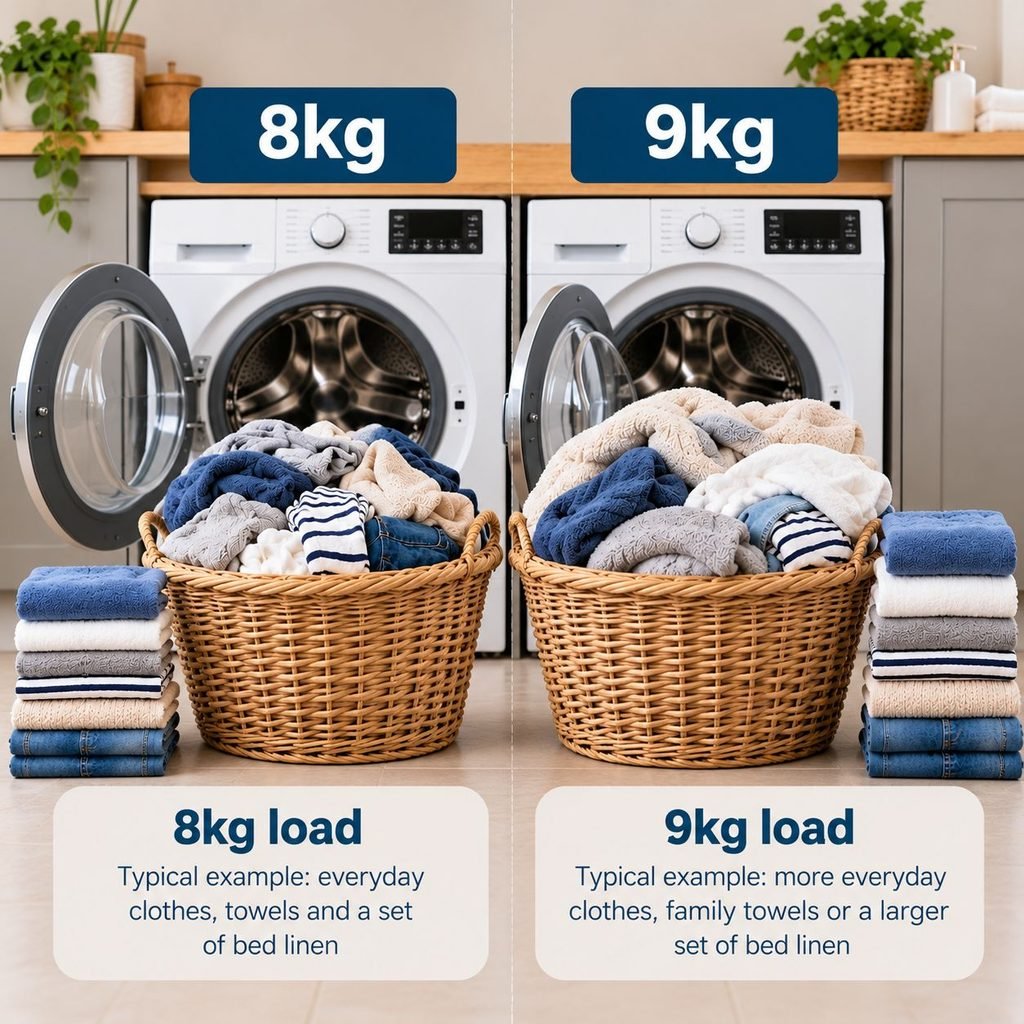
Everything else gets a lower limit, and the extra kilo shrinks as you move away from cotton. Two machines from the same Hotpoint range show how this works:
| Programme | Hotpoint 8kg (NSWM 846) | Hotpoint 9kg (NSWM 945) |
|---|---|---|
| Eco 40-60, Cotton, Mixed, 20°C | 8kg | 9kg |
| Full Load 45 min | 8kg | 9kg |
| Synthetics and Delicates | 4kg | 4.5kg |
| 30 min quick wash | 4kg | 4.5kg |
| Anti Allergy | 5kg | 5kg |
| Baby | 4kg | 4kg |
| Wool | 2kg | 2kg |
| Duvet | 3.5kg | 3.5kg |
Source: programme tables in each model’s user manual.
On these two, the extra kilo is a full kilo on cotton, half a kilo on synthetics and the 30-minute wash, and nothing at all on wool, baby, allergy or duvet washes. Other brands split it differently, which is why the programme table in the manual is worth five minutes before you buy. You’ll usually find the manual on the manufacturer’s website or the retailer’s product page.
How much washing fits in an 8kg or 9kg machine?
Counting T-shirts doesn’t get you far, because a kid’s T-shirt and a heavy hoodie are very different things. Weights are more useful, and Samsung UK gives some handy rough figures:
| Item | Approximate dry weight | How many fit in the extra 1kg |
|---|---|---|
| Bath towel | 0.75kg | One, with a little room to spare |
| Full-size bed sheet | 0.5kg | Two |
| Large sweatshirt | 0.5kg | Two |
Put simply, a 9kg machine takes roughly one more bath towel per load than an 8kg one. Handy if your towel wash never quite fits, but it won’t change your life.
Bulky fabrics also fill the drum before they hit the weight limit. Samsung’s advice is to keep the laundry in a loose pile and stop if you have to push it down. Towels and hoodies reach that point long before a load of thin cotton tops does.
The best test is your own biggest sorted load: the weekly darks, a family towel wash or a full set of bed linen. If those already fit comfortably in an 8kg drum, 9kg won’t make much difference. If you’re regularly splitting washing that could go in together, that’s when 9kg starts to make sense.
Which size suits your household?
Headcount is a starting point, but habits matter more. Two people washing gym kit, workwear and towels every few days can easily produce more laundry than a family of four with a lighter routine.
| Household | What it usually looks like | Better fit |
|---|---|---|
| 1 or 2 people | A few moderate loads a week | 8kg |
| 2 people with lots of kit or workwear | Frequent washes, heavy towels and sportswear | 8kg, or 9kg if you’d rather run fewer, bigger loads |
| 3 or 4 people | Regular washing, with towels and bedding on top | Either. 9kg if washing tends to back up |
| 5 or more | Daily washing and a constant pile | 9kg, and compare a 10kg too |
Manufacturers overlap here too. Beko’s UK size guide puts 8kg machines in its medium group for homes of two to four people, and lists 9kg in both its medium and large-capacity groups. In other words, three or four people is the zone where either size is a sensible buy, and your washing pattern should break the tie.
Is 9kg better for duvets and bedding?
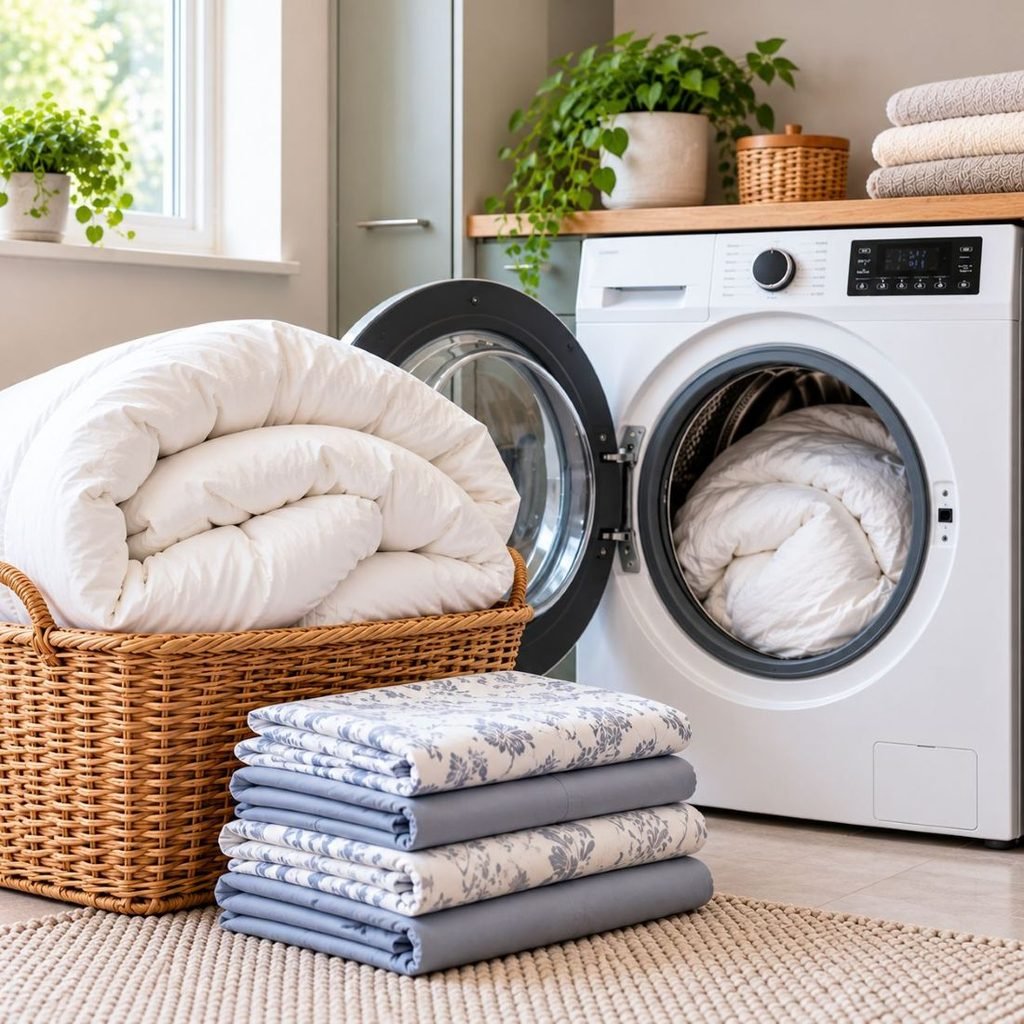
Not as much as you’d think. Look back at the Hotpoint table: the Duvet programme is limited to 3.5kg on both the 8kg and the 9kg machine. Both manuals describe it as suitable for goose-down items such as single duvets under 3.5kg, cushions and down jackets, loaded with the edges folded in and filling no more than three-quarters of the drum. The extra kilo makes no difference to that programme at all.
Other makes may allow more, so check the manual for the specific model. With bedding, the drum’s physical space matters as much as its kg rating, because the duvet has to move freely to get clean and rinse properly. If washing a double or king-size duvet at home is a big reason for buying, look for a dedicated bedding or duvet programme with a stated load and check the duvet’s care label before anything else. A duvet you can squeeze through the door isn’t necessarily a safe load.
For ordinary sheets, duvet covers and pillowcases, either size is fine.
Does a 9kg washing machine use more electricity and water?
Per wash, usually a little. Per kilo of washing, often a little less. The energy label makes this harder to see than it should be.
Why an A-rated 9kg can use more than an A-rated 8kg
The energy class isn’t a straight measure of electricity use. It compares the machine’s Eco 40-60 consumption with a standard figure that rises with drum size, so bigger machines get a bigger allowance. Under the UK formula, an 8kg machine can use up to 47kWh per 100 cycles and still be A-rated. A 9kg machine gets 49kWh. Put that same 49kWh figure on an 8kg machine and it drops to a B.
Hotpoint’s 8kg and 9kg models in the same range sit right on those limits:
| Hotpoint NSWM 846 (8kg) | Hotpoint NSWM 946 (9kg) | |
|---|---|---|
| Energy class | A | A |
| Energy per 100 Eco 40-60 cycles | 47kWh | 49kWh |
| Water per Eco 40-60 cycle | 48 litres | 50 litres |
| Spin-drying class | B | B |
| Spin noise | 76dB, class B | 76dB, class B |
| Size (H x W x D) | 85 x 59.5 x 60.5cm | 85 x 60 x 61cm |
Both get an A, they’re equally noisy and they’re practically the same size. The 9kg just uses the slightly bigger allowance its drum size gives it. The 48 litres on the 8kg model is also the most water an 8kg machine is allowed to use on Eco 40-60, and 50 litres is the cap for 9kg. When two machines both show an A, look at the kWh and litre figures. They tell you more than the letter does.
The label already allows for half-empty drums
A common worry is that a 9kg machine will be wasteful because you won’t fill it every time. The label figure already assumes you won’t. It’s a weighted average of tests at full, half and quarter load, and the weighting changes with drum size. For an 8kg machine the full-load test counts for about 38% of the figure. For a 9kg machine it’s about 34%, and the quarter-load test (just 2.25kg) counts for 40%, more than either of the others.
That means the kWh per 100 cycles on a 9kg label is mostly built from part-filled washes. Running it with a moderate load isn’t the waste some people assume, although filling it to the programme’s limit is still the most efficient way to use any machine. Manufacturers are actually required to say so in the manual.
What the difference actually costs
Here’s the yearly cost for the Hotpoint pair above, in two scenarios. One runs the 9kg as often as the 8kg. The other assumes every load is packed to the full 9kg, so you need about 11% fewer washes.
| 8kg (47kWh, 48 litres) | 9kg, same number of washes | 9kg, every load full | |
|---|---|---|---|
| Electricity per wash | 12.4p | 12.9p | 12.9p |
| Water per wash (metered) | 20.2p | 21.0p | 21.0p |
| Washes a year | 220 | 220 | 196 |
| Yearly cost | £71.64 | £74.65 | £66.50 |
Assumptions: 26.32p per kWh, the Ofgem price cap average for Direct Debit customers from 1 October to 31 December 2026 (VAT has been removed from electricity bills for this period). Water at Thames Water’s 2026/27 metered rates, £2.7346 per cubic metre for clean water plus £1.4721 for wastewater, applied to the full volume. 220 Eco 40-60 washes a year, the figure the old EU energy label used. Standing charges left out.
Formula: (kWh per 100 cycles ÷ 100 × 26.32p) + (litres ÷ 1,000 × £4.2067), multiplied by the number of washes. The 196 comes from 220 × 8 ÷ 9.
Even in the best case, the 9kg saves about £5 a year. Run it as often as the 8kg and it costs about £3 more. Real life lands somewhere in between, because sorting by colour and fabric means you’ll rarely consolidate perfectly. If you’re not on a water meter, the water part doesn’t change your bill at all and the gap shrinks to a pound or two either way. If you go for 9kg, do it for the convenience. The savings are too small to count.
A bigger load means more water to dry
This one rarely comes up, but it matters if you dry indoors. The spin-drying class on the label tells you how much water is left in the washing after the final spin, as a percentage of its dry weight. Class A is under 45%. Class B, which is common on mid-priced machines, is 45% to 54%.
Both Hotpoint manuals list 53% remaining moisture for a full Eco 40-60 load. That works out at about 4.2 litres of water in a full 8kg load and about 4.8 litres in a full 9kg load. Half a litre more each time doesn’t sound like much, but over a damp winter week it adds up on the airer and in the air. A 9kg machine with an A spin class would leave under about 4 litres in a full load, less than the 8kg Hotpoint’s 4.2 litres. If you dry indoors, the spin class matters at least as much as the drum size.
Whatever you wash in, that water has to go somewhere. A dehumidifier built for drying clothes pulls it out of the room much faster than radiators alone, and if you’re still deciding how to dry, we’ve compared a dehumidifier with a tumble dryer and with a heated airer for exactly this job.
One more thing if you’ve already got a tumble dryer. Dryers are rated by dry laundry weight too, so a full 9kg wash won’t go into an 8kg dryer in one load. Match the two, or plan to split.
Are 9kg washing machines physically bigger?
Usually only in depth, and often only slightly. Width is almost always about 60cm and height sits around 82 to 84.5cm for both sizes. Beko’s UK guide puts typical 8kg depths at 55 to 59cm and 9kg depths at 58 to 64cm, but the Hotpoint pair above differs by just half a centimetre.
Some 9kg machines are shallower than plenty of 8kg ones. The 9kg Hoover in our best washing machines under £300 guide is 52.1cm deep. So the drum size on its own tells you very little about fit.
Before ordering, check the full dimensions in the installation instructions, including the space for hoses and the plug behind the machine and enough room for the door to open fully. The depth on a product page usually doesn’t include the hoses. This matters most under a kitchen worktop or in a tight utility cupboard.
Quick washes, spin speed and noise
Judge these separately from capacity. A 15 or 30-minute programme usually takes a much smaller load, even on a 9kg machine. It’s 4.5kg on the 9kg Hotpoint in our programme table. If quick full loads matter to you, look for a fast programme rated for the full drum, like Hotpoint’s Full Load 45 min.
A higher maximum spin speed doesn’t guarantee drier washing either. The spin-drying class is the better guide. For an open-plan kitchen or a machine near bedrooms, check the spin noise in dB and the noise class letter on the label. There’s no reason to expect an 8kg machine to be quieter just because its drum is smaller, and the Hotpoint pair is identical on noise.
Is it worth paying extra for 9kg?
Pay for the extra kilo when it solves a real problem. If the 9kg version of a machine you like costs only a little more, the flexibility can be worth having. But a better energy and spin class, the programmes you actually use, decent guarantee terms and the right dimensions are all worth more than drum space you won’t fill.
A useful test is to think back over the last month of washing. How often did a load that could have gone in together have to be split? If it hardly ever happened, an 8kg machine deserves a serious look.
Choose an 8kg machine if
- Most of your washes are moderate and you don’t mind running a load most days.
- The 8kg model is better value or has better features than the 9kg alternative.
- You dry indoors and the 8kg option has a better spin class.
- Your tumble dryer is 8kg or smaller.
Choose a 9kg machine if
- Towels, kit and bedding regularly back up and you split loads that could go together.
- You’d rather do fewer, bigger washes on cotton or mixed programmes.
- There are four or more of you and laundry is a daily job.
- The price gap over the 8kg version is small and nothing else changes for the worse.
Five checks before you buy
- Read the programme table in the manual. The 8kg or 9kg rating only applies to cotton-type programmes.
- Compare kWh per 100 cycles and litres per cycle, not just the energy class letter.
- Check the spin-drying class if you dry indoors or use a tumble dryer.
- Measure the space using the full depth, hoses and door opening.
- Check the duvet or bedding programme load if washing bedding at home is part of the reason you’re buying.
Frequently asked questions
Is an 8kg washing machine enough for a family of four?
Often, yes. Both sizes are reasonable for four people. The deciding factor is how much laundry builds up between washes and how often you’re happy to run the machine.
Can I wash a king-size duvet in a 9kg washing machine?
Possibly, but the 9kg figure doesn’t tell you. Some 9kg machines limit their Duvet programme to 3.5kg and single duvets. Check the duvet programme load in the manual and the duvet’s care label.
Is a 9kg washing machine too big for two people?
Not really. The energy label figure is mostly based on half and quarter loads, so a 9kg machine isn’t badly penalised for running part-full. It may just be more capacity than you need, so make sure you’re not paying much extra for it.
Does a 9kg washing machine wash clothes better than an 8kg?
There’s no general reason to think so. Cleaning depends on the individual machine, the programme, the detergent, how full the drum is and how the washing is sorted.
Can I run a half load in a 9kg machine?
Yes. Many machines adjust water and energy to the load, and the label figures already include half and quarter loads. Don’t assume savings are proportional, though. A half load usually uses more than half the energy and water of a full one.
Should I buy 8kg or 9kg if I wash every day?
If your daily loads are fairly small, 8kg is enough. If you’d like to cut back to fewer wash days by combining loads, 9kg makes more sense.
Final verdict
For most UK households, an 8kg washing machine does the job. A 9kg machine is worth it when you regularly have more compatible washing than an 8kg drum can take, and when the price gap is small. Running costs barely change either way, the extra kilo shrinks on most programmes and it may do nothing for duvets.
Compare actual models, not just the number on the door. Check the programme limits, the kWh and litre figures, the spin class and the depth, and let your real weekly washing decide.