3 Best 9kg Washing Machines in the UK (2027)
A 9kg washing machine is a sensible middle ground for households that wash several substantial loads a week without needing an oversized drum. But capacity alone tells you very little about how convenient a machine will be on a Tuesday evening, or how much of its feature list you will actually use.
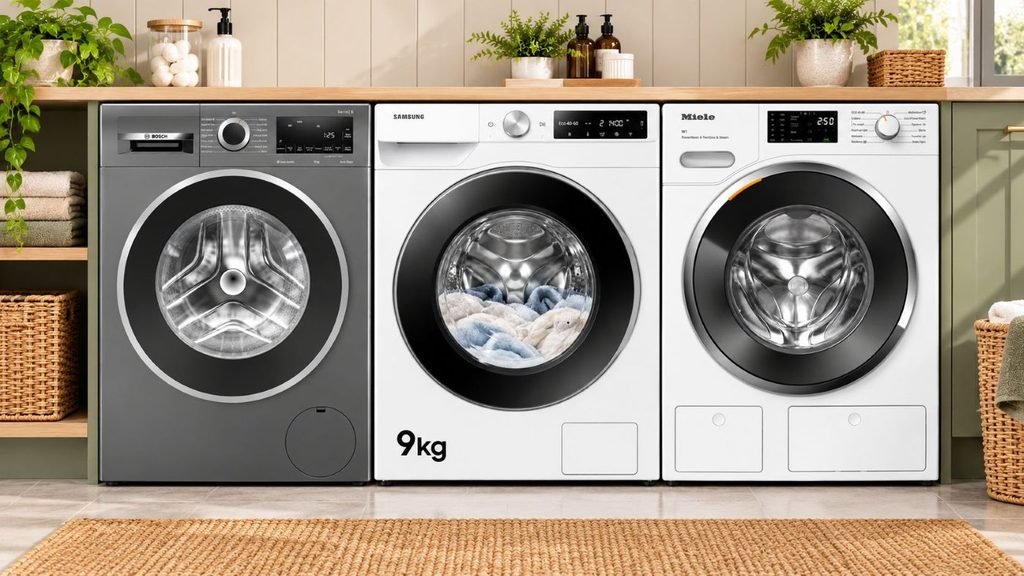
Below, I compare three of the best 9kg washing machines in the UK, from Bosch, Samsung and Miele. I’ve also looked at a few things the spec sheets don’t make obvious. Quick washes take far less than 9kg, the door adds several centimetres to the depth, and on one of these machines the detergent costs more than the electricity.
Quick verdict
- Best overall: Bosch Series 6 WGG244ZCGB. Good stain and steam options, simple controls and no app to deal with. Bosch’s 5-year warranty offer also runs until 31 March 2027.
- Best value: Samsung Series 6 WW90DG6U25LEU1. Usually the cheapest of the three, and it adds Wi-Fi, Ecobubble and a 39-minute cycle that handles a decent-sized load.
- Best premium: Miele WWG880 WCS. TwinDos dosing, SteamCare and the lowest energy use here. Its own-brand detergent isn’t cheap, though.
These are editorial selections based on published manufacturer information, comparative usefulness and publicly available owner feedback, not hands-on testing or measured cleaning results. I checked prices and offers in early November 2026, and they change often.
Quick comparison: which 9kg washer suits you?
| Model / award | Price when checked | Fastest wash and its load limit | Biggest strength | Main limitation |
|---|---|---|---|---|
| Bosch WGG244ZCGB · Best Overall | Mostly £599, lower at some retailers | Super Quick 15: up to 2kg | AntiStain, Iron Assist and SpeedPerfect | No Wi-Fi or automatic dosing |
| Samsung WW90DG6U25LEU1 · Best Value | About £399 to £479 | Quick Wash 15: up to 2kg; Super Speed: 39 min (based on 5kg) | Wi-Fi, Ecobubble and a 39-minute cycle for 5kg | No Auto Dispense or AI Wash on this model |
| Miele WWG880 WCS · Best Premium | £999 in Miele’s Black Friday sale (£1,479 full price) | Express 20: up to 3.5kg; QuickPowerWash: 49 min, up to 4kg | TwinDos, SteamCare and lowest Eco energy use | High price; TwinDos detergent costs more |
Fast programmes aren’t full-capacity shortcuts. Each one has its own load and soil limits, so check the programme chart before making the shortest cycle your usual wash.
Important specifications and editorial scores
| Specification | Bosch WGG244ZCGB | Samsung WW90DG6U25LEU1 | Miele WWG880 WCS |
|---|---|---|---|
| Editorial score* | 9.4/10 | 9.3/10 | 9.2/10 |
| Energy class | A | A | A (20% below the A threshold) |
| Energy per 100 Eco cycles | 49kWh | 44kWh | 40kWh |
| Water per Eco cycle | 50L | 50L | 50L |
| Eco 40-60 time (full load) | 3hr 48min | 3hr 48min | 3hr 49min |
| Spin-drying class | B | B | B |
| Spin noise | 71dB(A) | 72dB(A) | 72dB(A) |
| Full depth (manufacturer figure) | 63.6cm incl. door | 63cm incl. protruding parts | 64.3cm |
| Wi-Fi app | ✗ | ✓ SmartThings | ✓ Miele@home |
| Automatic dosing | ✗ | ✗ | ✓ TwinDos |
| Warranty | 2 years; 5 with registration | 2 years; 5 with registration | 2 years |
*Editorial scores reflect feature usefulness, value and suitability for the stated award, not laboratory performance. Energy, water and time figures refer to the regulated Eco 40-60 programme, not every wash. Warranty conditions are explained further down.
Samsung comes in just behind the Bosch. It uses less energy and has Wi-Fi, which the Bosch doesn’t, but it misses out on Bosch’s stain and steam options and puts some extras behind the app. The Miele has the most features of the three, yet it scores lowest because of the high price, the ongoing cost of UltraPhase detergent and the limited owner feedback on this exact model. If you’ll make full use of TwinDos and SteamCare, it can still be the best machine for you.
How these three were chosen
The shortlist starts with an exact 9kg capacity, then considers everyday washing performance, programme effectiveness, faster-wash options, ease of use and long-term ownership value. Published Eco energy, water and noise figures provide a consistent baseline, while dimensions, running costs and practical features help reveal less obvious compromises.
Official UK manufacturer specifications form the foundation of each recommendation, supported by available owner ratings and feedback on washing performance, everyday usability and recurring concerns. Review volumes differ between models, and owner experiences cannot establish long-term reliability. Miele’s smaller review base is weighed alongside its premium features rather than treated as equivalent evidence. If you’re open to other sizes and budgets, our best washing machines UK guide covers a wider range.
What matters when buying a 9kg washing machine?
Nine kilograms is a maximum, not a target
A 9kg drum can suit many families and households regularly washing bedding, towels and everyday clothes. You don’t need to fill it completely, but shorter programmes allow only a fraction of the rated capacity. This is how much each manufacturer allows on its fastest cycles.
| Programme | Time | Load | Share of the 9kg drum |
|---|---|---|---|
| Bosch Super Quick 15 | 15 min | Up to 2kg | About 22% |
| Samsung 15′ Quick Wash | About 15 min | Up to 2kg | About 22% |
| Miele Express 20 | 20 min | Up to 3.5kg | About 39% |
| Miele QuickPowerWash | 49 min | Up to 4kg | About 44% |
| Samsung Super Speed | 39 min | 5kg (the load Samsung’s timing is based on) | About 55% |
To put 2kg in perspective, Miele’s manuals say five or six shirts weigh about that much. So a 15-minute wash will handle a football kit or a couple of work outfits, but not a week of school uniforms. For bulky duvets, check the care label and the machine’s bedding programme rather than assuming anything that fits can be washed safely. If you’re still weighing up drum size, our 8kg vs 9kg and 9kg vs 10kg comparisons go into more detail.
Compare the kWh figure, not only the A rating
All three machines are A-rated, but their electricity use ranges from 40 to 49kWh per 100 Eco cycles. That’s because the A band is quite wide. The Bosch only just gets in, while Miele says its machine is 20% better than the A threshold and Samsung claims 10% better. In pounds, the gap between Bosch and Miele is about £5 a year at the current price cap. So a machine costing hundreds more won’t pay for itself through electricity savings.
1400rpm doesn’t guarantee drier clothes
All three spin at up to 1400rpm and all three are spin-drying class B, which means between 45% and 54% of the moisture is left in the load after the Eco programme. Bosch’s product information sheet even lists 1351rpm as the speed reached on Eco 40-60. If you tumble dry most loads, don’t pay extra for a higher spin figure on its own. Our 1200 vs 1400 vs 1600rpm guide explains when it’s worth it.
Decide whether dosing and connectivity matter
Miele’s TwinDos measures and adds the detergent for you, which saves a job if you wash every day. It only works with Miele’s UltraPhase cartridges, though (more on the cost below). Samsung gives you SmartThings monitoring and energy features, but this exact model doesn’t have Auto Dispense, whatever some retailer listings say. Bosch suits anyone who’d rather use buttons and a dial than an app.
Measure the whole installation
Cabinet depth leaves out the door and anything that sticks out, so it can make a machine look slimmer than it is.
| Measurement | Bosch | Samsung | Miele |
|---|---|---|---|
| Height × width | 84.5 × 59.8cm | 85 × 60cm | 85 × 59.6cm |
| Cabinet depth | 59cm | 55cm | Not listed separately |
| Full depth | 63.6cm incl. door | 63cm incl. protruding parts | 64.3cm |
| Depth with door open | 107.3cm | Not listed | 107.7cm |
| Door hinge | Left | Not stated | Right |
Samsung’s 55cm cabinet looks a lot slimmer, but add the door and fittings and all three end up within about 1.3cm of each other. You’ll also need space behind for the hoses and plug, and roughly 1.1 metres clear in front to open the door fully. In a narrow utility room or galley kitchen, that door clearance and which side the door opens usually matter more than a centimetre of cabinet depth.
Register the warranty on time
| Brand | Standard cover | Extended offer (when checked) | What you must do |
|---|---|---|---|
| Bosch | 2 years | 5 years in total for purchases from 1 April 2026 to 31 March 2027 | Register within 3 months of purchase |
| Samsung | 2 years | 5 years in total for purchases from 1 October to 1 December 2026 at participating UK retailers | Register on Samsung’s five-year warranty page within 90 days of the invoice date |
| Miele | 2 years | None listed for this model; current Black Friday offer is a detergent voucher instead | Register with Miele to activate the 2-year guarantee |
If you miss the registration window, you only get the standard 2 years. Either way, these warranties are on top of your rights under the Consumer Rights Act.
1. Bosch Series 6 WGG244ZCGB AntiStain: Best Overall
Score: 9.4/10

Bosch takes the overall award because it gets the basics right. AntiStain deals with four common types of stain, SpeedPerfect cuts programme times (Bosch says by up to 65%, measured on Easy-care 40°C) and Iron Assist uses steam to help reduce creasing. You don’t need an app or special detergent for any of it. That’s the main reason I picked it. It’s the easiest one to recommend if you don’t want to pay premium prices or bother with smart features.
Super Quick 15/30 is handy for small, lightly soiled loads, but the 15-minute version only takes up to 2kg. The 71dB spin figure is the lowest here, although it’s only 1dB quieter than the others, so I wouldn’t choose it for noise. At 49kWh per 100 Eco cycles it uses the most electricity of the three, but the yearly difference is small. One thing to watch: Bosch’s own shop listed it as unavailable when I checked, though big retailers still had it. Bosch also sells a WGG244FCGB, which is a different model, so check the full code before you order.
| Specification | Details |
|---|---|
| Capacity / spin | 9kg / 1400rpm (1351rpm listed for Eco 40-60) |
| Energy class | A |
| Energy / water | 49kWh per 100 Eco cycles / 50L per cycle |
| Eco 40-60 time | 3hr 48min full load; 2hr 54min half; 2hr 30min quarter |
| Spin-drying class | B |
| Spin noise / emission class | 71dB(A) / A |
| Fast programmes | Super Quick 15/30; 15 minutes for up to 2kg |
| Automatic detergent dosing | No |
| Wi-Fi | No |
| Key features | AntiStain, SpeedPerfect, Iron Assist, Hygiene Plus, Reload, drum clean reminder |
| Dimensions (H × W × D) | 84.5 × 59.8 × 59cm (cabinet); 63.6cm incl. door; 107.3cm with door open |
| Manufacturer’s warranty | 2 years; 5 years if bought between 1 April 2026 and 31 March 2027 and registered within 3 months. Bosch also lists a 10-year warranty on the EcoSilence motor. |
Pros and cons
- AntiStain, SpeedPerfect and Iron Assist cover common laundry jobs without an app
- Simple controls, and any detergent will do
- 5-year warranty offer, with 3 months to register
- Lowest labelled spin noise of these three at 71dB, if only just
- No Wi-Fi or automatic detergent dosing
- Highest labelled Eco electricity use here
- Super Quick 15 takes only 2kg
- Cast iron grey finish may not suit every kitchen
Verdict: Good programmes, easy to use and well balanced overall. You’re paying for things you’ll use most weeks, not expensive tech you might never touch.
Buy it if: you wash a lot of family laundry, deal with plenty of stains and want simple controls with no app.
Skip it if: Wi-Fi or automatic dosing is essential, or the lowest labelled Eco electricity use is your priority.
2. Samsung Series 6 AI Energy WW90DG6U25LEU1: Best Value
Score: 9.3/10
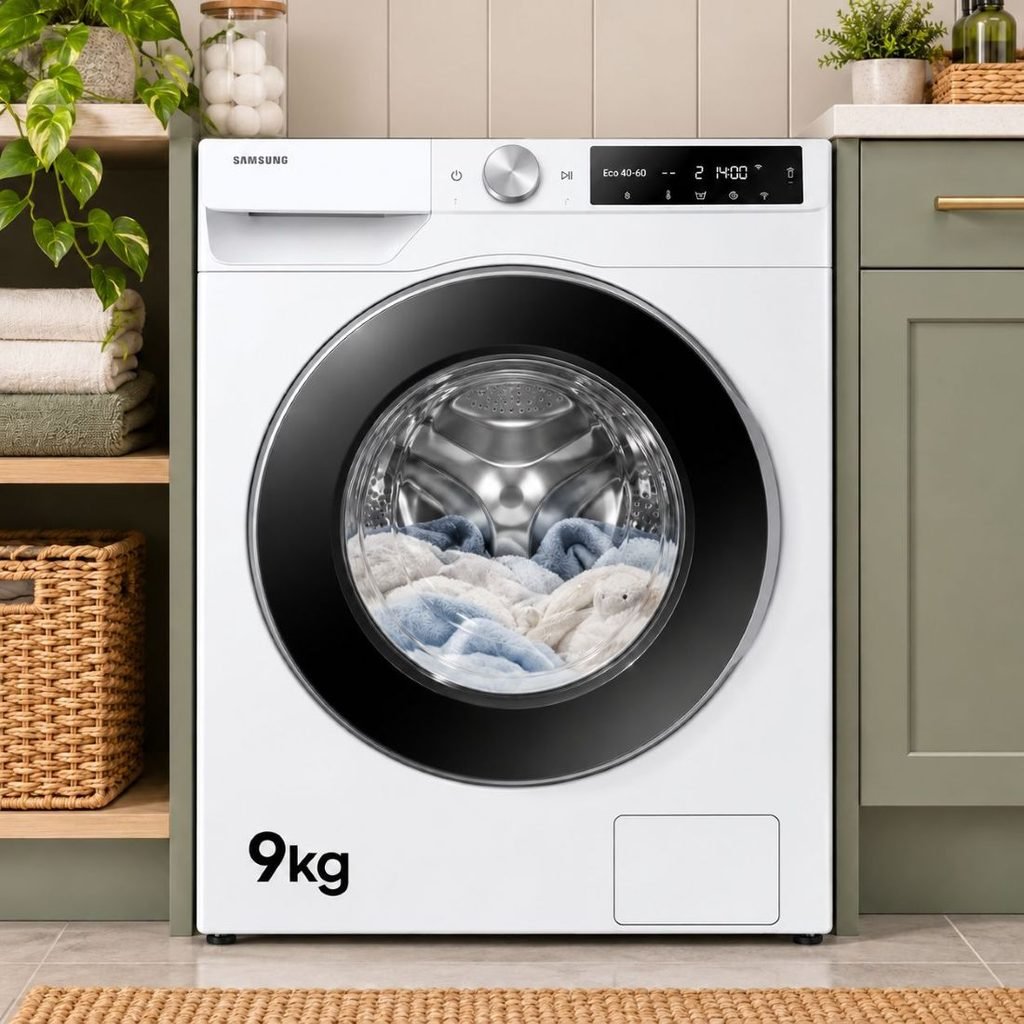
Samsung is for buyers who want Wi-Fi and a good spread of programmes, and it’s usually cheaper than the Bosch. Samsung lists Ecobubble, SmartThings, Hygiene Steam, Bubble Soak and Drum Clean+ for this exact model. Its Super Speed cycle is the best fast programme here on paper. Samsung’s 39-minute figure is based on a 5kg load, which is more than double the 2kg limit on the Bosch and Samsung 15-minute programmes.
It uses 44kWh per 100 Eco cycles, which puts it between the Miele and the Bosch. The SmartThings AI Energy mode helps you keep an eye on electricity use and can cut consumption in some situations, but it won’t save energy on every wash. This model doesn’t have AI Wash or Auto Dispense. Samsung’s UK spec lists both as “No”, even though at least one retailer mentions AI Wash, so go by the full model code and not the product title.
I picked it because you get the basics plus app control for less money. In early November 2026 it was listed at roughly £399 to £479, while most Bosch listings were around £599. Discounts can close that gap quickly, though. Also, don’t buy it just for the 55cm cabinet depth. At 63cm including protruding parts, it’s barely shallower than the other two.
| Specification | Details |
|---|---|
| Capacity / spin | 9kg / 1400rpm |
| Energy class | A |
| Energy / water | 44kWh per 100 Eco cycles / 50L per cycle |
| Eco 40-60 time | 3hr 48min (full load) |
| Spin-drying class | B |
| Spin noise / emission class | 72dB(A) / A |
| Fast programmes | Super Speed, 39 minutes (based on a 5kg load); 15′ Quick Wash for up to 2kg |
| Automatic detergent dosing | No (no Auto Dispense) |
| Wi-Fi | Yes, SmartThings |
| Key features | Ecobubble, Hygiene Steam, Bubble Soak, Drum Clean+, AI Control, Delay End |
| Dimensions (H × W × D) | 85 × 60 × 55cm (cabinet); 63cm incl. protruding parts |
| Manufacturer’s warranty | 2 years; 5 years for purchases from 1 October to 1 December 2026 at participating UK retailers, registered within 90 days of the invoice date |
Pros and cons
- Usually the cheapest of the three
- SmartThings connectivity and energy monitoring
- Super Speed washes a 5kg load in 39 minutes
- Lower labelled Eco electricity use than the Bosch
- No Auto Dispense or AI Wash on this model
- AI Energy savings depend on supported programmes and settings
- Some connected benefits require the SmartThings app
- 5-year cover depends on buying within the offer period and registering
Verdict: Plenty of programmes and Wi-Fi for less than the Bosch at most retailers. Check the model number carefully, because similar Samsung models have different automation features.
Buy it if: you want Wi-Fi, a 39-minute cycle that takes a proper load and good features without paying premium prices.
Skip it if: automatic dosing is essential, or you dislike app-based features and prefer simpler controls.
3. Miele WWG880 WCS PWash&TDos&Steam: Best Premium
Score: 9.2/10
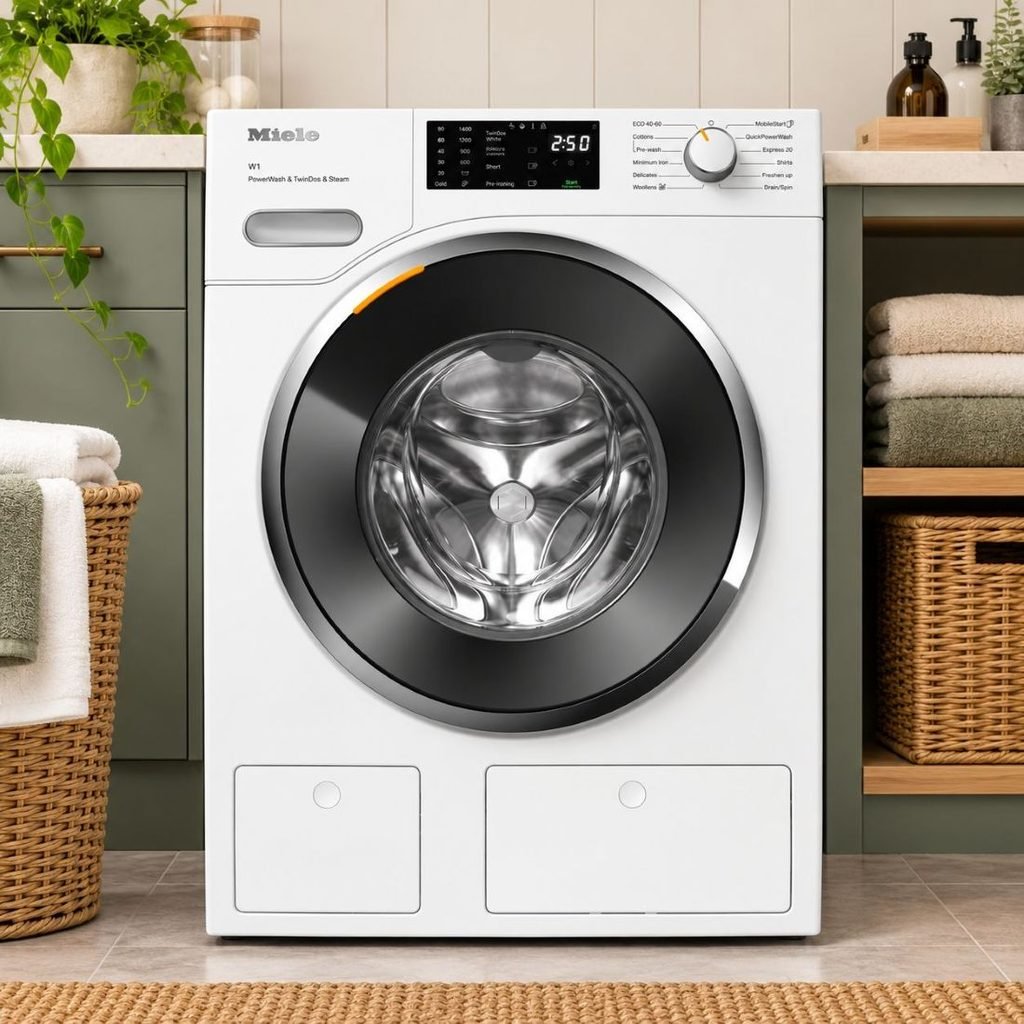
Miele’s higher price buys you more than the badge. TwinDos adds Miele’s UltraPhase 1 and 2 detergent automatically, PowerWash is designed for efficient day-to-day washing and SteamCare can refresh some clothes or reduce creasing. You also get the Honeycomb drum, Miele@home app control and a Water Control System that watches for leaks.
QuickPowerWash takes 49 minutes for up to 4kg of moderately soiled cottons. Express 20 takes up to 3.5kg of clothes that have barely been worn. Neither is a full-drum wash. At 40kWh per 100 Eco cycles, it uses the least electricity here. The downside is detergent. If TwinDos adds both UltraPhase phases every wash, you’re paying roughly 69p a wash at current cartridge prices. You can turn TwinDos off and use the drawer with normal detergent, but then you lose the main reason to buy it.
I picked it because there’s a real reason to pay more, not just nicer styling. When I checked, Miele’s UK shop had it at £999 in its Black Friday sale, down from £1,479. Until 1 December 2026, Miele is also giving a voucher for six months of UltraPhase detergent with TwinDos machines. There isn’t much owner feedback on this exact model yet. The door also opens on the right, so check that if it’s going in a tight corner.
| Specification | Details |
|---|---|
| Capacity / spin | 9kg / 1400rpm |
| Energy class | A (20% more economical than the A threshold, per Miele) |
| Energy / water | 40kWh per 100 Eco cycles / 50L per cycle |
| Eco 40-60 time | 3hr 49min (full load) |
| Spin-drying class | B |
| Spin noise / emission class | 72dB(A) / A |
| Fast programmes | QuickPowerWash, 49 minutes for up to 4kg; Express 20 for up to 3.5kg |
| Automatic detergent dosing | Yes, TwinDos (Miele UltraPhase 1 and 2 only) |
| Wi-Fi | Yes, Miele@home |
| Key features | PowerWash, SteamCare, Honeycomb drum, Water Control System, AddLoad, CapDosing |
| Dimensions (H × W × D) | 85 × 59.6 × 64.3cm; 107.7cm with door open; right-hand door hinge |
| Manufacturer’s guarantee | 2 years (register with Miele to activate) |
Pros and cons
- TwinDos takes the measuring out of frequent washing
- SteamCare, QuickPowerWash and Express 20 are useful week to week
- Lowest labelled Eco electricity use in this shortlist
- Leak monitoring through the Water Control System
- Significantly more expensive than the other two, even when discounted
- UltraPhase detergent adds a noticeable ongoing cost
- Shorter standard guarantee than the other two’s current offers
- Limited exact-model owner feedback
Verdict: A great premium choice if you’ll actually use TwinDos and SteamCare. For simpler laundry the price is hard to justify, and the Miele name alone doesn’t prove it’ll last.
Buy it if: you wash most days, like the idea of automatic dosing and steam care, and don’t mind paying more for the convenience.
Skip it if: the standard programmes are enough for you, you like buying cheaper detergent, or you’re hoping energy savings will cover the extra cost (they won’t).
Running costs: how much will each machine cost?
To compare running costs, I’ve assumed 220 Eco 40-60 cycles a year (roughly four washes a week) at 26.32p/kWh. That’s Ofgem’s average Direct Debit electricity rate for England, Scotland and Wales from 1 October to 31 December 2026. It currently has no VAT on it, because VAT has been taken off electricity bills until 31 March 2027. The sum is kWh per 100 cycles ÷ 100 × 220 cycles × 26.32p.
| Model | kWh/100 Eco | kWh a year | Electricity per cycle | Annual cost | 5-year cost |
|---|---|---|---|---|---|
| Bosch WGG244ZCGB | 49 | 107.8 | 12.9p | £28.37 | £141.86 |
| Samsung WW90DG6U25LEU1 | 44 | 96.8 | 11.6p | £25.48 | £127.39 |
| Miele WWG880 WCS | 40 | 88.0 | 10.5p | £23.16 | £115.81 |
- Over five years, the Miele saves about £26 on electricity compared with the Bosch, and the Samsung about £14. That’s nowhere near the difference in purchase price.
- The Eco 40-60 figure is an average of full, half and quarter loads on one long programme. Hotter, quicker or fuller washes will use different amounts.
- All three use 50L per Eco cycle, so water bills won’t separate them.
- Tariffs change. Ofgem resets the cap every three months, and the January to March 2027 level is due on 25 November 2026. If 5% VAT came back at the same underlying price, 26.32p would become about 27.6p.
These are estimates, not guaranteed household costs. They only cover electricity, not standing charges, water or detergent, and the five-year figures assume your tariff and usage stay the same. Your real costs will depend on your tariff, how often you wash and which programmes you use.
Don’t forget detergent
With the Bosch and Samsung you can carry on using whatever detergent you buy now. Miele’s TwinDos is designed for its own UltraPhase cartridges, and the cost soon adds up.
| Miele TwinDos detergent | Washes per 1.4L cartridge | Approx. cost per wash | 220 washes a year |
|---|---|---|---|
| UltraPhase 1 only | Around 37 | About 40p | About £87 |
| UltraPhase 1 and 2 | Around 37 and up to 50 | About 69p | About £152 |
These figures use £14.69 per cartridge from a UK retailer when I checked, and real usage depends on load size, how dirty things are and your water hardness. Even so, a year of TwinDos detergent with both phases can cost more than five years of the Miele’s Eco electricity. So the lowest energy use doesn’t make it the cheapest machine to own.
Which one should you choose?
| Model | Best for | Why choose it? |
|---|---|---|
| Bosch Series 6 WGG244ZCGB | Best Overall | Good all-round programmes, AntiStain, SpeedPerfect and simple controls with no app needed. |
| Samsung Series 6 WW90DG6U25LEU1 | Best Value | SmartThings, a 39-minute cycle for 5kg and a wide choice of programmes, usually for less than the Bosch. |
| Miele WWG880 WCS | Best Premium | TwinDos dosing, SteamCare and extra fabric care, if you’re happy to pay more upfront and per wash. |
- If you do lots of quick top-up washes on busy evenings, Samsung’s Super Speed is the most useful fast option here.
- If your laundry includes plenty of stained school or work clothes, go for the Bosch and its AntiStain options.
- If you wash every day and hate measuring detergent, the Miele makes sense, as long as you’re happy with the UltraPhase cost.
- If your utility room is tight, check door clearance and hinge side before you worry about cabinet depth.
If all three are above your budget, our guide to the best washing machines under £400 covers cheaper options.
Final verdict
For most people buying a 9kg washing machine, the Bosch Series 6 WGG244ZCGB is the one I’d go for. AntiStain, SpeedPerfect and Iron Assist deal with real laundry problems, and you aren’t paying for connected features you may never use.
The Samsung WW90DG6U25LEU1 is great value. It’s usually cheaper than the Bosch, has a good range of programmes and app control, and has the best fast cycle of the three. The Miele WWG880 WCS earns its premium price with TwinDos, SteamCare and QuickPowerWash, as long as you allow for the detergent costs.
In the end, it comes down to your budget, how you wash and which features you’ll actually use. And whichever one you buy, register the warranty in time.
Frequently asked questions
Is a 9kg washing machine enough for a family of four?
For many families, yes. A 9kg drum handles substantial everyday laundry, although bedding size, washing frequency and programme-specific load limits also matter.
Which 9kg washing machine is best overall?
The Bosch WGG244ZCGB, thanks to AntiStain, SpeedPerfect, Iron Assist and controls that are easy to use day to day.
Which 9kg washing machine is cheapest to run?
On electricity alone, the Miele, at 40kWh per 100 Eco cycles. Once you add detergent and the purchase price, it’s unlikely to be the cheapest to own, because TwinDos cartridges can cost far more each year than the electricity it saves.
Does the Samsung WW90DG6U25LEU1 have automatic dosing?
No. Samsung’s UK specifications list Auto Dispense and AI Wash as unavailable on this exact model.
Is Miele TwinDos worth the extra cost?
It can be worth it if you wash a lot and like not having to measure detergent. Budget for roughly 40p to 69p a wash in UltraPhase detergent, depending on whether both phases are used, on top of the higher purchase price.
Can a 15-minute programme wash a full 9kg load?
No. Rapid programmes restrict load size and soil level. The 15-minute programmes on the Bosch and Samsung both allow up to 2kg.
Are all three washing machines energy class A?
Yes. However, their Eco 40-60 electricity consumption differs, so kWh per 100 cycles is the more useful figure for comparing efficiency.
Does 1400rpm leave clothes equally dry?
Not necessarily, though these three are closely matched because all are spin-drying class B. Programme settings, fabric type and how evenly the load is spread also affect how much moisture is left.
Should I prioritise Wi-Fi or washing programmes?
Go for the features you’ll use every week. Samsung is the one for smart connectivity, Bosch focuses on its washing programmes, and Miele gives you both connectivity and automatic dosing.
What dimensions should I check before ordering?
Measure the width, height and full depth including the door and anything that sticks out. Allow space behind for hoses, and about 1.1 metres in front for the open door. Cabinet depth on its own won’t tell you if it fits.
Do I need to register for the 5-year warranty?
Yes. Bosch requires registration within 3 months of purchase, and Samsung within 90 days of the invoice date. Without it, the standard 2-year cover applies.