How to Clean a Washing Machine Properly: Step-by-Step UK Guide
A washing machine can leave clothes looking spotless while it quietly collects detergent residue, lint and damp in places you rarely look. Give it a few months and you’ll notice. The door seal turns grubby, the drawer never quite rinses clean and there’s a musty smell when you open the door.
Learning how to clean a washing machine properly isn’t difficult, and you don’t need a cupboard full of products. What catches people out is that manufacturers don’t agree on the details. Samsung tells you to put nothing in the drum during a cleaning cycle, while Bosch tells you to add washing powder. This guide walks through each part in a sensible order and points out where your brand’s advice might differ. If your manual says something different, go with the manual.

Quick answer: how to clean a washing machine
Clean the detergent drawer and door seal by hand first. Then run your machine’s drum-clean programme with nothing in the drum. If there isn’t one, most manufacturers suggest an empty cotton wash at 60°C or hotter, and Beko and Miele both say 90°C.
Once everything has cooled down, clean the pump filter if your machine has one you can reach. Wipe the outside, then leave the door and drawer open a little so they dry out.
Check the manual before you add anything to the drum. Depending on the brand, the right answer can be nothing, a machine cleaner or washing powder.
What the main brands recommend
Every brand gives its cleaning programme a different name, and they don’t agree on what goes in it either. Here’s what each manufacturer’s UK guidance or manual currently says.
| Brand | Cleaning programme | How often | What to add |
|---|---|---|---|
| Samsung | Eco Drum Clean or Eco Drum Clean+ (heats to roughly 60 to 70°C) | Eco Drum Clean+ reminds you every 40 washes | Nothing. Samsung says not to use ordinary laundry detergent |
| Bosch | Drum Clean (on models such as the WAV28KH9GB) | If you often wash at 40°C or below | Washing powder or a detergent with bleach, at half the usual dose. No liquids or softener |
| Miele | Cottons 90°C when the Hygiene info light comes on | Monthly, with at least one 60°C+ wash a month | Miele machine cleaner or a multi-purpose powder |
| Beko | DrumClean+ (70°C) or Cottons 90 | Every 3 to 6 months, more often if you mostly wash cool | A drum cleaner, but no detergent |
| AEG | Machine Clean, or a cotton wash at 60°C or above | When the machine or app asks for a maintenance wash | A specialist cleaner such as AEG Clean and Care 3 in 1 |
| LG | Tub Clean (some models flash “tcL” as a reminder) | Around once a month | Washing machine cleaner as directed, and no bleach |
Models from the same brand can differ too, so use this as a rough guide and check your own manual. If you’ve moved house and inherited a machine with no manual, you can usually find it online by searching the model number.
How often should you clean a washing machine?
It depends on how you use it. A family running a wash every day, mostly at 30°C, needs to keep on top of things more than someone doing two hot loads a week. Many newer machines will also remind you when a drum clean is due. As a starting point:
| Area | How often | What to look for |
|---|---|---|
| Door seal | A quick wipe after washes, plus a proper look in the folds every few weeks | Lint, standing water, dark residue |
| Detergent drawer | Every few weeks, or sooner if you see residue | Sticky detergent, conditioner film, black spots in the housing |
| Drum | When prompted, or as your manufacturer advises | Stale smells, visible residue |
| Pump filter (if accessible) | Every few months | Slow draining, water left in the drum, error codes |
| Inlet hose filter | Once or twice a year | Slow filling, water supply errors |
| Door glass and exterior | Whenever it needs it | Splashes, detergent marks |
What you need before you start
- A soft microfibre cloth and an old towel
- A soft brush, plus a bottle brush or old toothbrush for the drawer
- A shallow container such as a baking tray, and a bowl or bucket to tip it into
- Warm water and a little washing-up liquid
- Rubber gloves
- Your manual, or the model number so you can look it up
That’s really all. Only use a washing machine cleaner if it suits your model and its cleaning programme, and steer clear of scouring pads, sharp tools and homemade chemical mixtures.
For safety, switch the machine off and unplug it before you clean anything by hand, and especially before you open the filter. If you’ve just run a hot wash, let it cool first. Plug it back in when you’re ready to run a cleaning cycle.
Step 1: Remove and clean the detergent drawer

The drawer is usually where problems show up first. Powder cakes in the corners and fabric conditioner leaves a slippery film. On most machines there’s a release catch you press while pulling the drawer out, but the catch isn’t in the same place on every brand. If yours won’t come free, don’t force it. Look in the manual.
Rinse the drawer under warm running water and work at any deposits with a soft brush. Then check two places that get missed:
- The siphon cap. In the fabric conditioner compartment there’s a small plastic cap that normally pulls straight off, and gunk collects underneath it. If you use liquid starch, it can block this cap altogether.
- The drawer housing. With the drawer out, shine a torch up into the space it came from. The water jets in the roof are often black with residue and limescale, and a bottle brush gets into them easily.
Dry everything, push the drawer back in firmly and run an empty rinse and spin to flush away whatever you’ve loosened.
If your machine doses detergent automatically, as Bosch’s i-DOS models do, follow the specific instructions for that system. Bosch says the dosing pump unit shouldn’t go in the dishwasher or be soaked in water. Wipe it with a damp cloth instead.
Step 2: Clean the rubber door seal

Gently peel back the folds of the rubber seal. This is where coins, hair grips, lint and dark residue end up, and water sits in there long after the wash has finished. Pick out anything loose, then wipe inside the folds and around the edge that meets the door glass. A damp cloth with a drop of washing-up liquid copes with most seals.
Don’t scrub hard. The seal is what keeps the water inside your machine, and abrasive pads or harsh chemicals can damage it. Samsung mentions diluted bleach for stubborn mould, but it also warns that bleach can damage the seal. Keep it as a last resort, and only if your manual allows it.
Dry the folds when you’ve finished. If there’s mould all through the seal, a split in the rubber or a smell that comes straight back, contact the manufacturer or a repairer. A cleaning cycle won’t fix torn rubber.
Step 3: Clean the drum with the correct programme
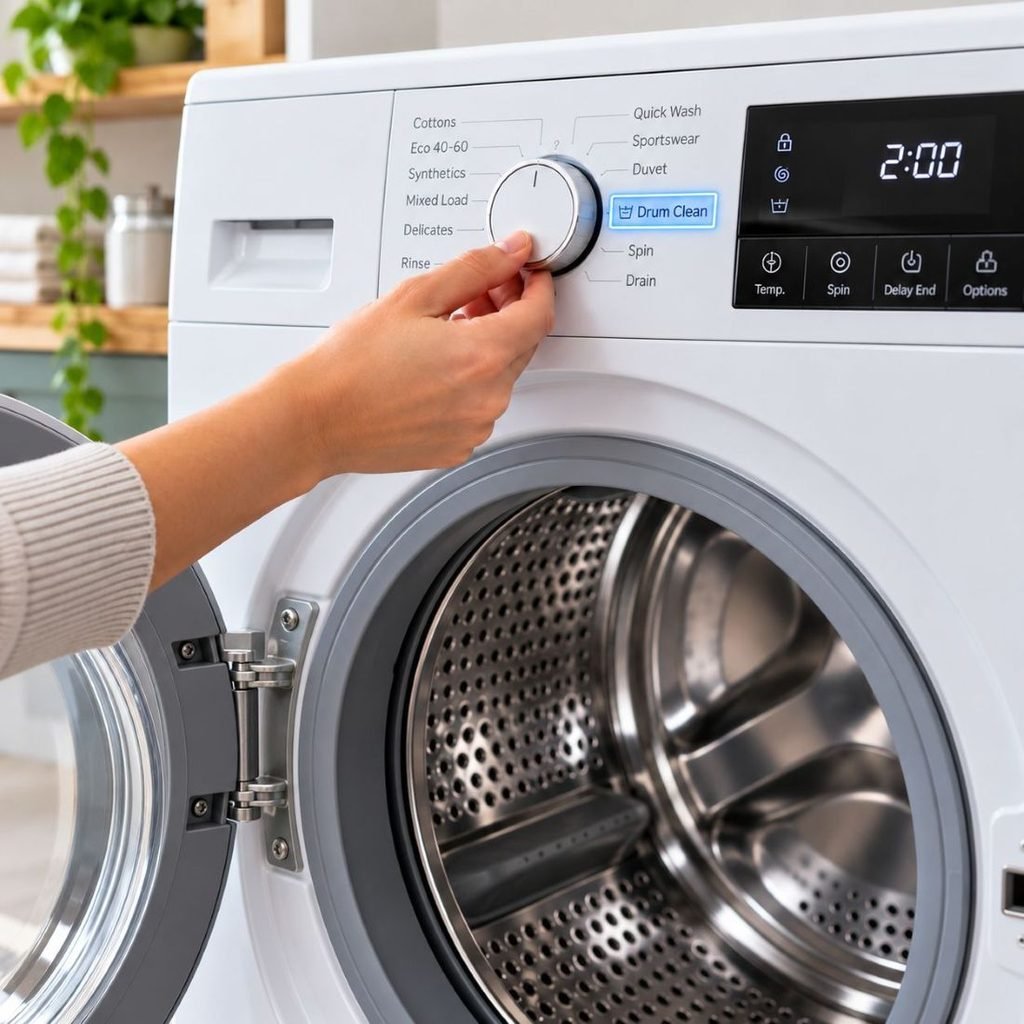
Look on the dial or in the manual for something called Drum Clean, Eco Drum Clean, Tub Clean or Machine Clean. Take everything out of the drum (yes, check for that stray sock) and run it as instructed.
What you put in depends entirely on the brand. Samsung’s Eco Drum Clean needs nothing, and Samsung warns against using ordinary laundry detergent with it. Beko, AEG and LG want a dedicated washing machine cleaner instead, and Beko specifically says not to add detergent. Bosch goes the other way. Its Drum Clean programme uses washing powder, or a detergent with bleach, at half the usual dose so it doesn’t foam up. Miele is happy with its own cleaner or a multi-purpose powder.
Wherever your brand sits, leave out the fabric conditioner and the liquid detergent. Bosch rules out both, and Miele asks for powder rather than liquid. Most multi-purpose powders contain an oxygen-based bleach and liquids don’t, which is probably why.
If there’s no cleaning programme at all, an empty cotton wash at a high temperature does the job. AEG says 60°C or above, while Beko and Miele go for 90°C. When it’s finished, let the drum cool and wipe out any bits left behind in the drum or seal.
Step 4: Clean the drain pump filter, if your model allows it
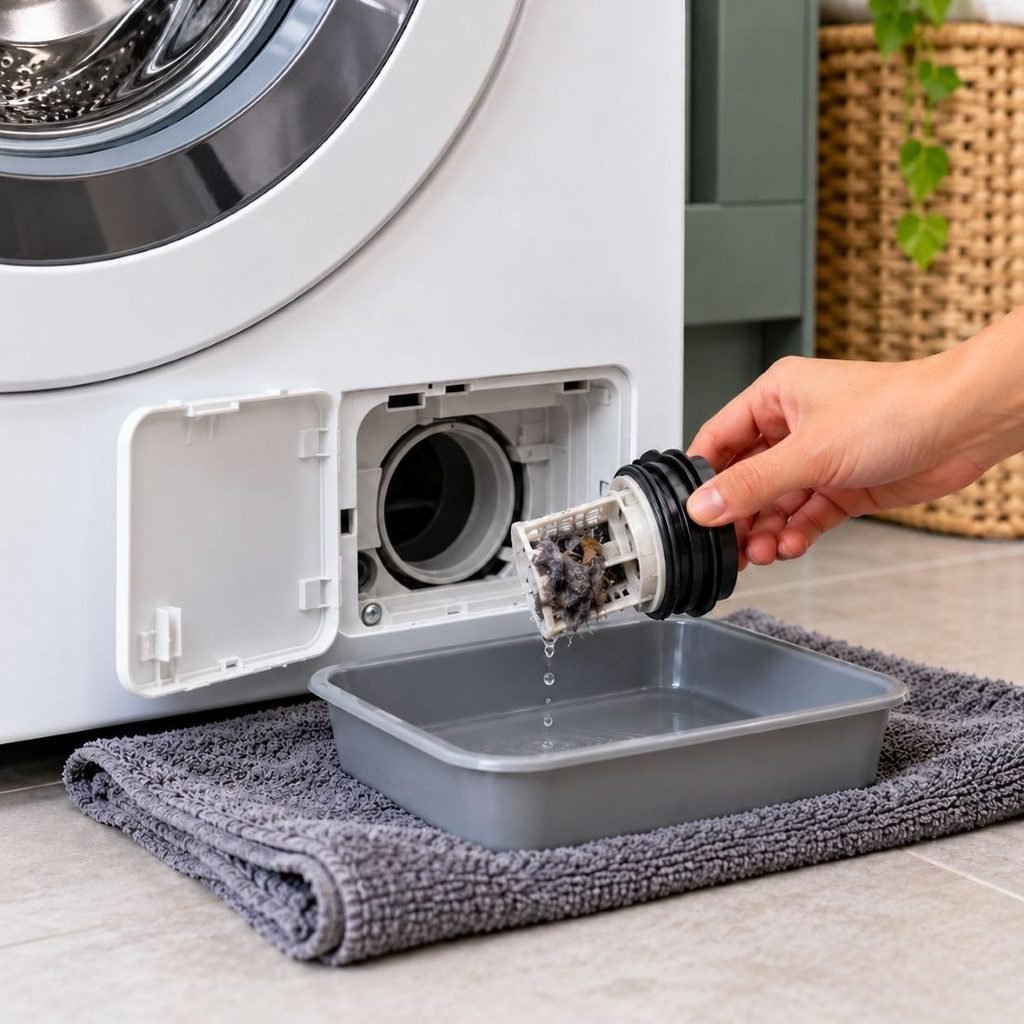
Nobody enjoys this job, but the pump filter is where lint, buttons, coins and hair grips end up. A blocked one can leave the machine draining slowly or water sitting in the drum. Not every machine has a filter you can get to, so check the manual before you start prising panels off. Samsung suggests cleaning it five or six times a year and Beko every three months. If you rarely find much in it, checking it every few months is plenty.
- Switch off, unplug and wait for the water to cool. Water from a hot wash can scald.
- Put a towel down and slide a shallow tray under the access flap, which is usually at the bottom of the front panel. A coin is handy for prising the cover open.
- If there’s a small drain hose tucked in beside the filter, pull it out, take the plug off and let the water run into the tray. There’s usually more water than you expect, especially if the filter’s blocked, so be ready to empty the tray a few times.
- When the water stops, unscrew the filter slowly, usually anticlockwise. Leave the towel where it is, because a bit more water will come out.
- Pull out whatever’s caught in the filter, rinse it and wipe the opening. If you can see the small pump impeller inside, turn it by hand to check it spins freely.
- Screw the filter back in firmly so it seals, push the hose plug back in and keep an eye out for drips.
Bosch and Siemens owners have one more step. Their manuals say to pour about a litre of water into the detergent drawer and run the Drain programme before the next wash. If you skip it, detergent from your next load can go straight down the drain. Some other brands include a similar step in their manuals.
If the filter won’t budge, hot water keeps coming or you can’t work out where the access point is, stop. Don’t force it. A leaking filter cap can cause a much bigger problem than trapped lint. And if the drum still won’t empty after you’ve cleared the filter, our guide to a washing machine not spinning covers what to check next.
Step 5: Clean the door glass and exterior
Wipe the inside of the door glass, the handle and the control panel with a soft, slightly damp cloth, then dry them. Don’t spray anything straight onto the controls. Miele advises against solvents, abrasive creams and glass or multi-purpose sprays on the casing, and a damp cloth honestly does the job. While you’re there, wipe away any drips around the drawer.
Step 6: Check visible hoses and the inlet filter
Look for kinks in the drain hose, damp patches or signs of a leak anywhere you can see the connections without moving the machine. Don’t drag a heavy washing machine out or start undoing plumbing just for routine cleaning. If you spot a damaged hose, a leak that keeps coming back or water under the machine, get it repaired.
There’s also a small mesh filter where the water inlet hose connects to the machine. Samsung suggests cleaning it once or twice a year, as a blocked one can slow the water coming in. You’ll need to turn off the water supply and unscrew the hose to get to it, so only tackle it if you’re comfortable doing that.
Which cleaning method should you use?
| Method | Good for | Watch out for |
|---|---|---|
| Your machine’s drum-clean programme | Routine cleaning inside the machine | What you add varies by brand |
| A machine cleaner your manufacturer approves | Regular or prompted maintenance washes | It won’t reach the seal folds, drawer housing or filter |
| Washing powder on a hot empty wash | Brands that recommend it, such as Bosch and Miele | Not for Samsung’s Eco Drum Clean, and never use liquid instead |
| Warm water, washing-up liquid and a cloth | Drawer, door seal and surfaces | Keep water away from the controls |
| White vinegar | Beko suggests it for an empty hot wash | Bosch says it can damage rubber parts |
| Bicarbonate of soda | Beko suggests a cup in an empty hot wash | Only if your manufacturer approves it |
| Bleach | Only where your manual allows it | Bosch and LG both warn against it, and it must never be mixed with vinegar |
Can you clean a washing machine with vinegar or bicarbonate of soda?
Plenty of cleaning tips online swear by vinegar, bicarbonate of soda or both together. The manufacturers can’t agree on it. Beko’s own guidance suggests white vinegar, or a cup of bicarbonate of soda, in an empty wash on the hottest setting. Bosch says don’t, because vinegar is aggressive enough to attack the rubber parts, and it warns against citric acid for the same reason.
With brands split like that, only use vinegar if your manufacturer says it’s fine. The popular trick of pouring vinegar and bicarbonate in together also does less than you’d think. One is an acid and the other an alkali, so they mostly cancel each other out. The fizzing is that reaction happening, not extra cleaning.
Never mix bleach with vinegar or any other acidic cleaner, as the combination can give off chlorine gas. The same goes for cleaning products in general. Even ones that look similar can produce harmful fumes when mixed.
Do you need to descale in a hard water area?
Not always. Bosch and Miele both say you’ll rarely need to descale if you use the right amount of detergent for your water hardness. If you do descale, both say to use their own descaler. Beko takes a different line and recommends descaling every month with its limescale remover, particularly in hard water areas. Have a look at the dosing chart on your detergent, because most give a higher dose for hard water.
How to stop a washing machine smelling between cleans
Smells creep back when damp and detergent residue are left to sit. A few habits make a big difference. Take the washing out as soon as the cycle finishes, wipe any water out of the door seal and leave the door and drawer slightly open afterwards. If you have young children or pets, keep the door shut. Measure detergent by the load size, how dirty it is and your water hardness, because more detergent doesn’t mean cleaner clothes.
Washing mostly at low temperatures with liquid detergent is the combination most likely to cause smells. Miele links both to odours and mould in the drawer, and Bosch recommends Drum Clean if you regularly wash at 40°C or below. Washing at 30°C is fine for most everyday loads, but it doesn’t replace a hot maintenance wash. Miele recommends at least one wash at 60°C or hotter each month, which is easy to remember.
Cleaning problems: what the symptoms may mean
| Symptom | Check first | Get help if |
|---|---|---|
| Musty smell | Seal folds, drawer housing and a hot maintenance wash | The smell survives a thorough clean |
| Water left in the drum | Pump filter and kinks in the drain hose | You get pump errors or it keeps failing to drain |
| Slow to fill | The tap is fully open; inlet hose filter | Water supply errors carry on |
| Water or residue in the drawer | Siphon cap, drawer jets and how much detergent you use | Water isn’t flowing or dispensing properly |
| Cleaning reminder light | Run the programme it’s asking for | The reminder comes back almost straight away |
| Water under the machine | Stop using it; check the filter cap if you’ve just cleaned it | The leak continues or you can’t find the source |
| Black marks on the seal | Clean the folds gently | The rubber is cracked, split or perishing |
If the cleaning reminder keeps coming back, think about how you use the machine. AEG says lots of short, low-temperature programmes cause build-up, and that’s what triggers the extra maintenance-wash requests.
If water is leaking, stop using the machine and turn off the power only if it’s safe to reach. Never touch electrical connections while you’re standing in water. And if a repairer finds a serious fault on an older machine, compare the quote with the price of a new one. Our guide to the best washing machines in the UK is a good place to start.
Mistakes worth avoiding
- Putting laundry detergent into a programme that says not to, such as Samsung’s Eco Drum Clean
- Using liquid detergent or fabric conditioner in a maintenance wash
- Following an online cleaning hack instead of your manual, especially one involving vinegar or citric acid
- Mixing bleach with vinegar, or with any other cleaning product
- Opening the filter straight after a hot wash, or forcing one that’s stuck
- Scrubbing the door seal with anything abrasive
- Running a cleaning cycle with clothes still in the drum
- Taking a fresh smell as proof there’s nothing wrong with the drainage or mechanics
A simple washing machine maintenance routine
| When | What to do |
|---|---|
| After every wash | Take the laundry out promptly, wipe the seal and leave the door and drawer ajar if it’s safe |
| Every few weeks | Clean the drawer, siphon cap, drawer housing and seal folds |
| Monthly, or when prompted | Run the drum-clean or maintenance wash your manual recommends |
| Every few months | Check and clean the pump filter, if you can reach it |
| Once or twice a year | Check the inlet hose filter and any visible hoses |
| If leaks or faults keep happening | Stop using the machine and get it looked at |
Final verdict: clean the parts the wash cycle misses
A clean drum is only part of the job. The detergent drawer, the door seal and the pump filter all need attention too, because no ordinary wash cycle reaches them properly. The real secret to how to clean a washing machine is routine: get the laundry out promptly, deal with residue when you see it and follow your manufacturer’s maintenance advice, particularly on what goes in the drum. That advice differs between brands more than most people realise. A few minutes of gentle care every couple of weeks does more good than an occasional heavy-handed deep clean, and it’s much kinder to the machine.
Frequently asked questions
How do I deep-clean a washing machine?
Do the drawer, its housing and the door seal by hand, then run your machine’s drum-clean or maintenance programme with an empty drum. When the machine is off, unplugged and cool, clean the pump filter if you can get to it. Finish with a wipe of the glass and exterior.
Should I run a washing machine empty to clean it?
Yes. Cleaning programmes are designed to run with an empty drum, and the same goes for a hot maintenance wash on machines without one.
What temperature should I use to clean a washing machine?
If there’s a cleaning programme, leave the temperature to the programme. Samsung’s runs at roughly 60 to 70°C and Beko’s DrumClean+ at 70°C. Without one, use an empty cotton wash at 60°C or more. Beko and Miele recommend 90°C.
Can I use normal laundry detergent for a drum-clean cycle?
That depends on your machine. Samsung and Beko say no. Bosch’s Drum Clean uses washing powder at half the usual dose, and Miele accepts a multi-purpose powder. None of them recommend liquid detergent for this.
Can I clean my washing machine with vinegar?
Only if your manufacturer approves it. Beko suggests it, but Bosch warns that it can damage rubber parts. If your manual doesn’t mention vinegar, stick with the recommended programme or a machine cleaner.
How often should I clean the washing machine filter?
Every three months or so is a good rule, and Samsung suggests five or six times a year. Check it sooner if the machine is draining slowly or showing a drain error.
Why does my washing machine still smell after cleaning?
Look under the siphon cap, up in the drawer housing and deep in the seal folds, because residue often hides there. Standing water or a partly blocked filter can also cause smells. If it still smells after a hot maintenance wash, it’s worth getting the machine checked.
How do I clean a washing machine filter?
Make sure your model has a filter you’re meant to access. Switch off, unplug and let the water cool, drain it into a shallow tray, then unscrew, rinse and refit the filter as the manual shows. On Bosch machines, pour about a litre of water into the drawer and run Drain before the next wash.