Where to Place a Dehumidifier in Your Home (UK Guide)
Most people decide where to place a dehumidifier by looking for a spare socket. That is not always the best spot. The position affects how quickly the room dries and how long the machine has to run. In a bathroom or a small cupboard, it also affects whether it is safe to use at all.
Below, we go through each room in turn, how much space to leave around the unit, what to do with doors and windows, and how to check the position is working.

Where should you put a dehumidifier?
The best position depends on what you want it to do. For damp concentrated in one bedroom, start in that room. To manage humidity across several connected rooms, a central hallway or landing is usually more practical. When drying washing indoors, put the dehumidifier in the same room as the clothes, with space for air to move around the airer. If the problem is bathroom steam, keep the unit on the landing outside rather than in the bathroom itself.
One rule applies everywhere: do not block the air inlet or outlet. The machine has to draw in moist air and push drier air back out. Squeeze it behind furniture or into a tight corner and it keeps processing the same small pocket of air. Both manuals we checked also warn that a blocked intake can cause overheating.
Best dehumidifier position at a glance
| Your aim | Where to put it | Doors and windows |
|---|---|---|
| Reduce damp in one room | In that room, on clear floor with the vents open | Room door and windows shut |
| Control humidity across your home | Central landing or hallway | Internal doors open, outside doors and windows shut |
| Dry clothes indoors | Same room as the airer, out of drip range | Room door and windows shut |
| Cut window condensation | In the affected room, not behind curtains | Windows shut while it runs (a few minutes of airing is fine when the glass is streaming) |
| Deal with bathroom steam | Landing or hallway outside the bathroom | Bathroom door open once you have finished showering |
1. Choose the position to match the moisture problem
For a single damp room
If condensation keeps forming in one bedroom, or a spare room smells musty, put the dehumidifier there first. Keep the door and windows shut while it runs. That way it is drying that room’s air and not pulling moisture in from the rest of the house.
Once that room is under control, you can move the unit to a landing or hallway to look after the whole house. EcoAir suggests this order in its DD1 Simple MK3 manual, and it makes sense when one room is clearly worse than the others.
A dehumidifier can help reduce airborne moisture, but it cannot repair a leaking pipe, penetrating damp or a faulty extractor fan. Persistent staining, mould or wet patches need their cause found and fixed.

For several rooms or a whole flat
With one portable unit and several rooms, a central landing or hallway is a sensible compromise. Open the internal doors so humid air can move towards the machine, and keep outside doors and windows shut. Meaco and EcoAir both recommend this setup.
Meaco also suggests leaving the unit on all the time in its humidity mode. In that mode the compressor switches off once the target is reached and only restarts when humidity rises again, so it costs less to run than 24 hours at full power would suggest. Our dehumidifier running cost guide has the figures.
Do not assume one machine will control every room equally. Closed doors, long corridors, a second floor or one very wet room can all slow things down in the rooms furthest away. If one room stays damp, move the unit into it for a few days, or check that the machine is big enough for your home.
2. How far should a dehumidifier be from walls and furniture?
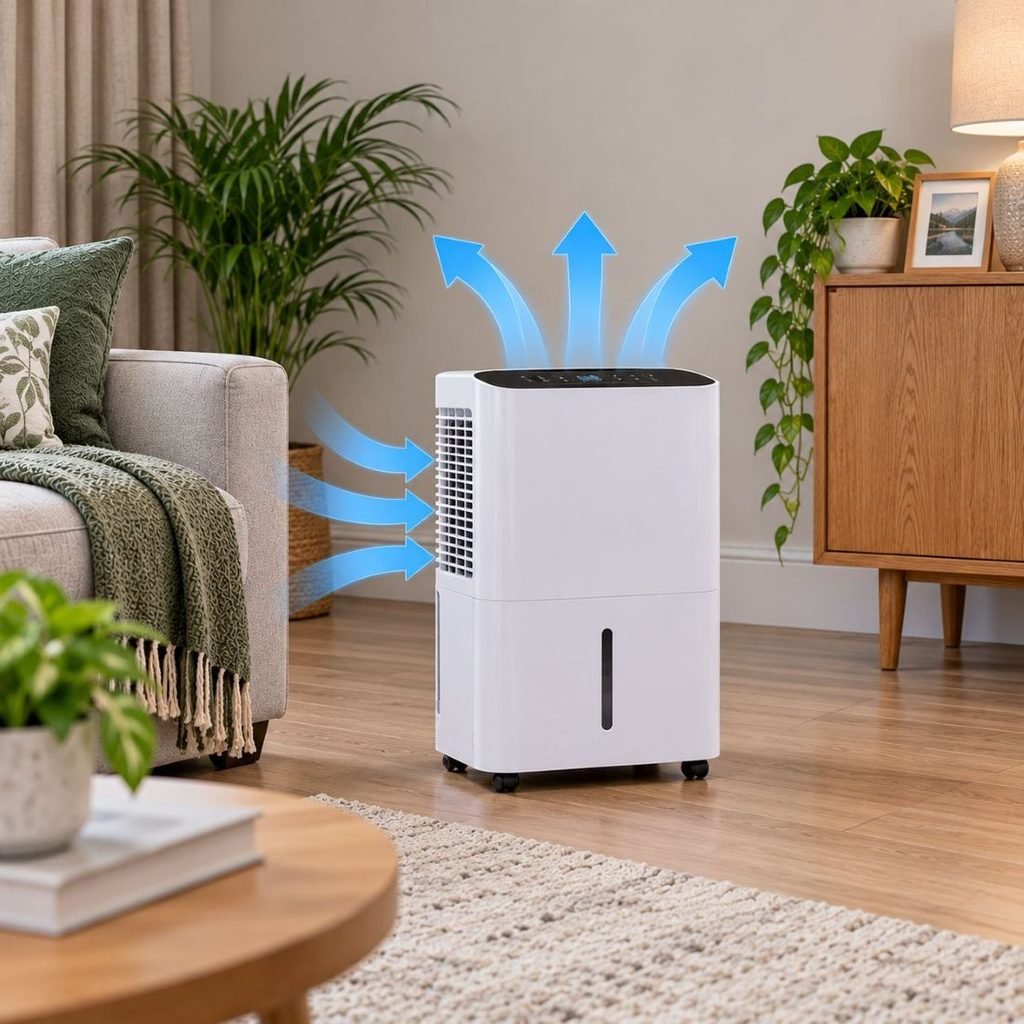
There is no universal clearance figure. Some models need a lot of space around them, while others are built to stand against a wall. The two manuals below are a good example of how much this varies.
| Model | Type | What the manual says |
|---|---|---|
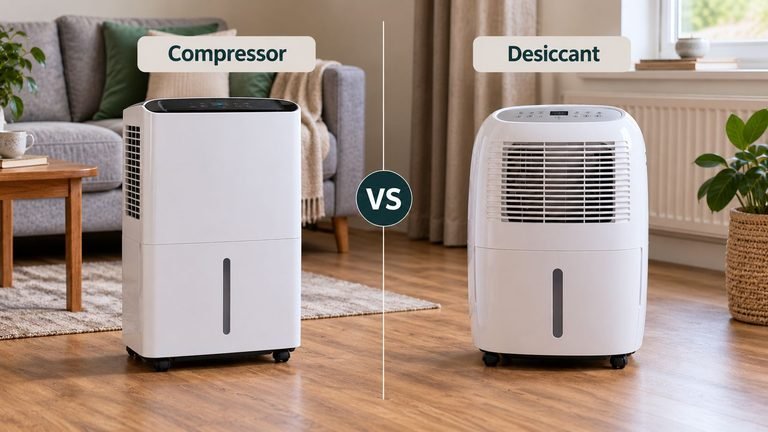
| EcoAir DD1 Simple MK3 | Desiccant | At least 40 cm clear on every side, nothing placed on or close to it, and drying laundry kept at least 40 cm away |
| Meaco Arete One 10L and 12L | Compressor | Can be placed as close to a wall as you like, as long as curtains, walls or furniture do not block the air intake |
A generic “20 cm from the wall” rule would be too little for the EcoAir and more than the Meaco needs. Go by your own manual. Most brands, including these two, publish manuals on their websites if you have lost the paper copy. If you cannot find yours, leave plenty of space on every side that has a vent.
| Placement point | What to check |
|---|---|
| Air inlet | Uncovered and clear of furniture, curtains and laundry |
| Air outlet | Free to blow into the room, not straight into a wall or the back of a sofa |
| Wall clearance | Your model’s figure, not a generic rule |
| Floor | Firm and level, so the tank sits properly and does not leak |
| On top | Nothing stacked on it, especially if the outlet faces upwards |
| Socket | Within reach of a wall socket. EcoAir rules out extension leads and multi-plug adaptors. Meaco allows a properly earthed extension lead |
| Access | Room to pull out the tank and reach the filter |
The centre of the room is not automatically best. A spot against a wall is fine if the design allows it and the vents stay clear. Hiding the unit behind a sofa to keep it out of sight is a different matter.
3. Best place for a dehumidifier in each room
| Room | Where to position it | What to watch |
|---|---|---|
| Bedroom | Open floor away from bedding and curtains | Noise at night, clear vents and a safe cable route |
| Living room | A clear spot near where the damp or condensation appears | Sofas and heavy curtains over the vents, and gas or open fires with some compressor models |
| Hallway or landing | Central, with internal doors open | Trip hazards and narrow walkways |
| Kitchen | Away from the sink, hob and oven | Gas hobs with some compressor models, and keep using the cooker hood |
| Utility or laundry room | Near the airer or main moisture source | Drips from wet washing and enough floor space for airflow |
| Bathroom | Outside, on the landing or in the hallway | Electrical safety |
| Box room or cupboard | Often unsuitable | Minimum room size and confined-space warnings in the manual |
Bedroom: airflow first, then comfort
Choose a clear area of floor, not the narrow gap between a wardrobe and the wall. If the noise keeps you awake, use the night or quiet setting, or run the machine for longer during the day so it has less to do overnight.
Meaco notes that its units sound louder on wooden floors than on carpet. On bare boards, a firm flat rug underneath can help, as long as the machine stays level and nothing covers the lower vents. Route the cable so nobody trips over it getting out of bed.
Living room and kitchen: keep away from heat and gas flames
Keep the unit away from radiators, heaters, cookers and tumble dryers. EcoAir lists all of these in its manual as places to avoid.
Gas is the less obvious problem. The Meaco Arete One uses R290 refrigerant, which is flammable, and its manual says it should not be used in a room with a continuous ignition source such as a gas hob, gas fire or open flame. Other compressor models may use the same refrigerant, so check the manual before using one in a kitchen with a gas hob or a living room with a gas fire.
For cooking steam, the cooker hood and pan lids do a better job than a dehumidifier in the corner, so use those first.
Bathroom: put it outside the room
Do not use a mains-powered portable dehumidifier inside a bathroom. EcoAir’s DD1 Simple MK3 manual rules out wet areas such as bathrooms, and Meaco advises against it because its units are not IP-rated for wet rooms. UK wiring regulations (BS 7671) also do not allow ordinary sockets within 3 metres of a bath or shower. Running the lead under the door from a landing socket brings the same risk back in, so avoid that too.
The landing or hallway just outside works well. Close the bathroom door and run the extractor fan while you shower. Afterwards, leave the fan on and open the door so the dehumidifier can deal with the moisture that comes out.
Small rooms, cupboards and cold spaces
Walk-in airing cupboards and box rooms are tempting spots, but check the manual first. Meaco says the Arete One should not be used or stored in a room smaller than 4 m² (roughly 2 m by 2 m) because of its refrigerant. EcoAir warns against confined spaces such as broom cupboards and boiler rooms.
Cold rooms are a separate issue. Compressor dehumidifiers lose performance as the temperature drops. The Arete One is rated to run from 5°C, but Meaco’s troubleshooting section lists rooms below 15°C as a common reason for low water collection. In an unheated spare room, garage or conservatory in winter, a desiccant model is usually the better choice. Our compressor vs desiccant guide explains why.
4. Where to place a dehumidifier when drying clothes

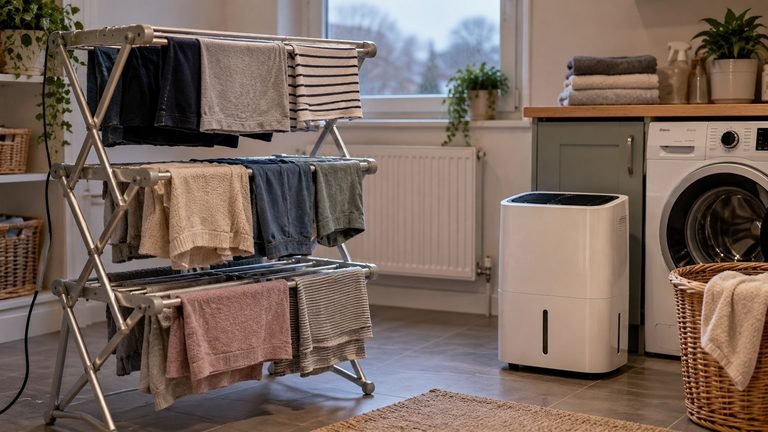
Put the dehumidifier in the room with the airer, not at the other end of the house. A small room with the door and windows shut dries clothes faster because there is less air to process. Meaco gives the same advice for laundry.
The safe distance from the clothes depends on the model. Meaco asks for the unit to be near the laundry but not close enough for water to drip on it. EcoAir wants at least 40 cm between the airer and the DD1 Simple MK3. Never hang washing on the machine itself.
Spread clothes apart on the airer instead of bunching them together. Air must circulate between garments for moisture to escape. If your model has an adjustable louvre, point the dry air towards the washing.
Laundry modes also differ between brands. The Arete One’s runs for six hours and then switches off. EcoAir says its laundry setting usually takes two to four hours and should not be left running unattended for long periods.
| Do | Avoid |
|---|---|
| Put the airer and dehumidifier in the same room | Running it in another room behind a closed door |
| Leave gaps between garments | Packing wet items tightly together |
| Keep the machine out of drip range | Placing it directly under wet clothing |
| Follow your model’s clearance figure | Draping washing over the dehumidifier |
| Keep windows shut during the session | Leaving a window open while it runs |
Our guide to the best dehumidifiers for drying clothes compares the models that handle laundry well.
5. Should doors and windows be open or closed?
It depends on the job. For whole-home control from a landing, open the internal doors. For one room or a laundry session, close that room’s door. In every case, keep outside windows shut while the unit is running.
| Situation | Internal doors | Windows and outside doors |
|---|---|---|
| Whole-home humidity control from a landing or hallway | Open | Closed |
| One damp room | That room’s door closed | Closed |
| Drying washing | Closed | Closed |
| Windows streaming with condensation | No change | Open for a few minutes to clear the worst, then close again |
| After a shower | Bathroom door open once you have finished | Keep the extractor fan running |
That does not mean keeping the house sealed all day. Extractor fans, trickle vents and opening a window after cooking or showering still matter, so leave permanent vents open. Ventilate when you are creating moisture, and use the dehumidifier to manage what remains.
6. Should it sit beside a damp wall or condensation-covered window?
Not necessarily. The goal is to lower moisture in the surrounding air, not to press the appliance against the wettest surface. Put it in the affected room where air can reach the intake and leave the outlet. Keep it out from behind curtains and away from window ledges where condensation can drip on it.
Moving furniture often makes a bigger difference. A wardrobe or sofa pushed tight against a cold outside wall traps still air behind it, and mould often starts there. Many UK council damp guides recommend leaving a gap behind large furniture or moving it onto an internal wall.
Single-glazed windows can still stream on very cold nights. Meaco’s manual says the glass can get too cold for any dehumidifier to keep clear, even on continuous mode. If windows clear and then fog up again as the temperature drops, set a lower humidity target overnight.
If a wall stays wet, paint is blistering or mould keeps returning even with lower humidity, investigate the cause rather than moving the dehumidifier closer. A wet patch that gets worse after rain usually points to penetrating damp, which needs a repair. Our guide to the best dehumidifiers for mould and damp covers what a dehumidifier can realistically fix.
7. Eight placement mistakes worth avoiding
- Blocking the air intake with a wall, curtain or piece of furniture.
- Using a generic clearance measurement instead of checking the model manual.
- Putting the appliance on an unstable or sloping surface, which can cause leaks.
- Plugging it into an extension lead or adaptor when the manual says not to.
- Running the cable under a rug or carpet.
- Using it in the bathroom, or trailing the lead in under the door.
- Squeezing it into a cupboard or box room, or placing it next to a heater, cooker or (with some compressor models) a gas flame.
- Ignoring persistent leaks or mould because the water tank is filling.
8. How to tell whether your chosen position is working
Check the relative humidity over several days rather than judging from one full water tank. A separate hygrometer in the problem area, ideally away from the dehumidifier, gives a more useful reading than the built-in display. That display measures the air around the unit itself, so it can reach the target before the far side of the room does.
A target of around 50–55% relative humidity is a reasonable starting point for most UK homes. The Meaco Arete One defaults to 55% in its humidity mode, and EcoAir describes 40–60% as the comfortable range.
Some models have no numbered setting. The EcoAir DD1 Simple MK3’s dial runs from Low (about 70%) to Medium (about 50%) and High (about 40%). For everyday damp control, Medium is the closest match. Low is unlikely to be enough in a damp or mouldy room.
Expect the tank to fill quickly at first and then slow down. Meaco says this initial period can last anything from a couple of days to four weeks. Collecting less water after that usually means the room is drier.
| What you notice | Likely reason | What to try |
|---|---|---|
| The display hits the target but the problem room still reads high | The unit is too far away, or a door is closed in between | Move it into the problem room, or open internal doors |
| Humidity barely moves after a few days | A window left open, a clogged filter or an undersized machine | Shut windows, clean the filter and check the sizing |
| Very little water in a cold room | A compressor model working below about 15°C | Warm the room slightly or consider a desiccant model |
| Windows clear, then fog again on cold nights | The outside temperature has dropped and the glass is colder | Lower the target and run it overnight |
| The tank still fills fast after several weeks | An ongoing moisture source | Look for leaks, indoor laundry or poor ventilation |
Frequently asked questions
Is it better to put a dehumidifier upstairs or downstairs?
Put it closest to the area you want to dry. An upstairs landing works well when bedrooms and bathrooms produce most of the moisture, but a damp downstairs room will benefit more from having the unit nearby. Do not rely on one position to give the same results on both floors.
Should a dehumidifier be in the middle of a room?
Only if that keeps the vents clear. Many models work nearer a wall as long as you follow the clearance in the manual, and the Meaco Arete One 10L and 12L can stand right against one.
Can I put a dehumidifier behind a sofa?
Generally, this is not a good choice if the sofa restricts the inlet, outlet or access to the tank. Pick a more open position and follow the manufacturer’s clearance instructions.
Can I leave a dehumidifier in the hallway?
Yes. A central hallway or landing can be effective for connected rooms when internal doors are open. Keep the machine out of walking routes and make sure the cable is not a trip hazard.
Can a dehumidifier go on carpet?
Usually, yes, if the unit stays stable and level. EcoAir allows carpet on that basis, and Meaco notes its machines are quieter on carpet than on wooden floors. Avoid deep-pile rugs that could tilt the unit or cover low vents, and never run the cable under the carpet.
Can I put a dehumidifier on a table or worktop?
Smaller units can go on a strong, level counter, which Meaco’s Arete One manual allows. Keep it away from the sink and from edges where it could be knocked off. Larger compressor models are heavy and belong on the floor.
Should I put a dehumidifier near a window?
It can be in the same room as a condensation-prone window, but avoid positioning it where curtains block airflow or water may reach the appliance. The machine works by reducing humidity in the room air, not by directly drying the glass.
Can I move one dehumidifier between rooms?
Yes. Switch it off before moving it, empty the tank and keep it upright. EcoAir recommends waiting five minutes after switching off before unplugging. If a compressor model has been laid on its side, for example in a car, let it stand upright for a while before turning it on. Meaco asks for six hours when one is first delivered.
Final verdict: put it where the moisture is, but give it room to breathe
For one damp room, start there. For humidity spread through several connected rooms, try a central landing or hallway with internal doors open. For drying washing, keep the appliance in the same room as the laundry, away from drips and with clear airflow. In a bathroom, keep it outside the door.
Whatever the location, the instruction manual takes priority over general rules about distance from walls, and a hygrometer in the problem room will show whether the position is working. Good placement helps a dehumidifier work effectively, but it does not replace ventilation or repairs to the underlying cause of damp. If you are still choosing a model, our best dehumidifiers UK guide compares the main options.