
Dehumidifier Running Costs UK: Per Hour, Day & Month (2026)
A dehumidifier is one of the cheaper appliances to run in a UK home, but how cheap depends on which type you have and how long it actually works each day. A small compressor model costs around 4p an hour at the current price cap. A desiccant model on its highest setting can cost more than four times that.
If you want to know what it’ll cost, look at the wattage on the spec sheet. The 10L, 12L or 20L on the box is how much water the machine can remove in a day under test conditions, and it doesn’t say anything about electricity use.
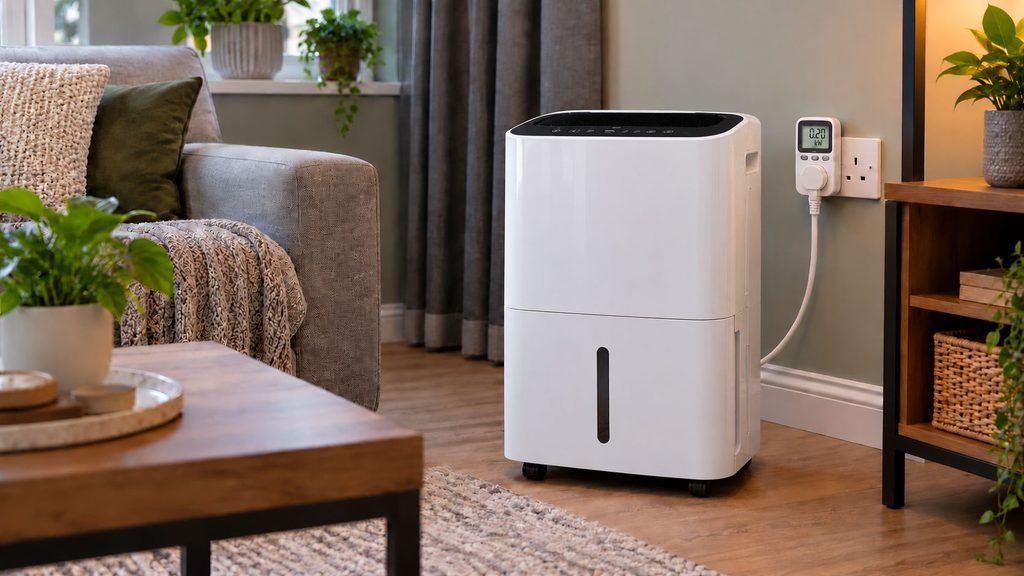
Below, we’ve worked out the dehumidifier running cost in the UK per hour, per day and per month. We’ve also explained why what you actually pay may not match the simple sums.
Quick answer
- 150W to 200W (smaller compressor models): about 3.9p to 5.3p an hour
- 250W to 350W (larger compressor models, or a desiccant on its low setting): about 6.6p to 9.2p an hour
- 500W to 650W (desiccant models on higher settings): about 13.2p to 17.1p an hour
These are maximum figures at 26.32p per kWh, assuming the machine draws its full rated power the whole time. With the humidistat doing its job, most dehumidifiers won’t do that all day.
The electricity rate we’ve used
Every figure in this guide uses 26.32p per kWh. That’s Ofgem’s price cap unit rate for electricity from 1 October to 31 December 2026, for households paying by Direct Debit on a standard variable (default) tariff. It’s an average across England, Scotland and Wales.
Your own rate could be a little higher or lower. It varies by region, and prepayment, Economy 7 and fixed tariffs all have their own prices. Northern Ireland isn’t covered by the Ofgem cap at all. VAT on household electricity is 0% from 1 October 2026 to 31 March 2027, so 26.32p is what you actually pay per unit on the capped tariff.
The cap changes again on 1 January 2027. It’s easiest to check the unit rate on your latest bill or energy app and use that in the sums below.
We’ve left the standing charge out. You pay it whether the dehumidifier is plugged in or not, so it isn’t part of the running cost.
How much does a dehumidifier cost per hour?
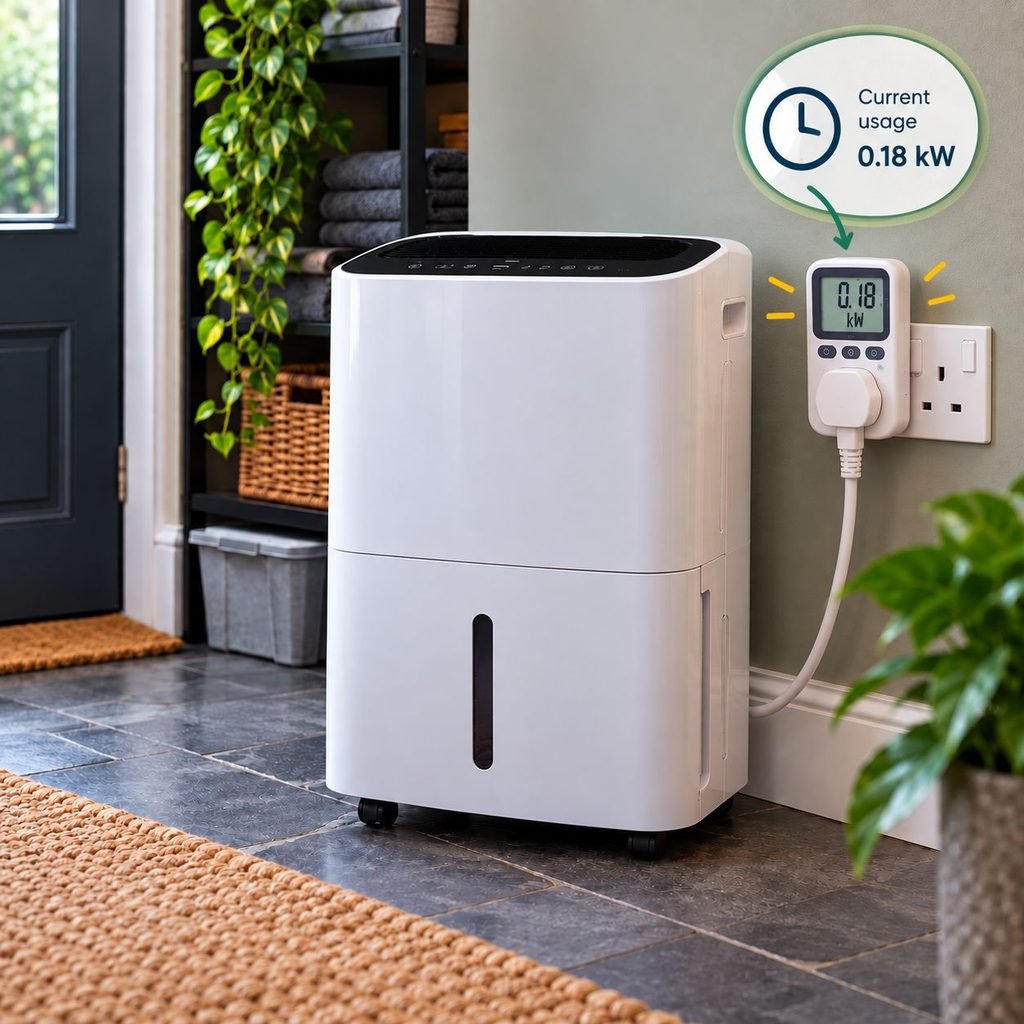
The calculation is straightforward:
Watts ÷ 1,000 × unit rate = cost per hour
A 200W dehumidifier is 0.2kW, so 0.2 × 26.32p = 5.26p. Call it 5.3p an hour.
A kWh (kilowatt hour) is 1,000 watts used for one hour, and it’s the “unit” you’re charged for on your bill. A 200W dehumidifier takes five hours to use one unit, while a 650W desiccant on full power uses one in about an hour and a half.
| Rated power | Per hour | 8 hours | 12 hours | 24 hours | Typical of |
|---|---|---|---|---|---|
| 150W | 3.9p | 31.6p | 47.4p | 94.8p | Small compressor |
| 200W | 5.3p | 42.1p | 63.2p | £1.26 | Compressor, 10L to 20L class |
| 250W | 6.6p | 52.6p | 79.0p | £1.58 | Compressor, or desiccant on low |
| 300W | 7.9p | 63.2p | 94.8p | £1.90 | Larger compressor |
| 350W | 9.2p | 73.7p | £1.11 | £2.21 | Larger compressor, or desiccant on low |
| 500W | 13.2p | £1.05 | £1.58 | £3.16 | Desiccant, higher setting |
| 650W | 17.1p | £1.37 | £2.05 | £4.11 | Desiccant, highest setting |
Wattages vary a lot from model to model, so the “typical of” column is only a rough guide. Check the rated power on your own machine’s spec sheet or rating label.
How much does a dehumidifier cost per day?
There’s no single daily running cost for a dehumidifier, because usage varies so much from one home to the next. Some people run one for a few hours while washing dries. Others leave it on a humidistat in a damp bedroom around the clock.
The 24-hour column in the table above is the worst case: the machine drawing full power non-stop. For a 250W model, that’s £1.58 a day.
In practice, a compressor dehumidifier with a humidistat stops the compressor once the room reaches the humidity you’ve set, then starts again when it creeps back up. If that 250W machine’s compressor ended up working half the time over 24 hours, the day would cost nearer 79p than £1.58.
We’ve used half the time just to illustrate the point. In reality, how often it cycles depends on the room, the weather outside, how much washing you dry indoors and the target you set.
How much does a dehumidifier cost per month?
Monthly costs depend heavily on how often you use it, but they help put the numbers into perspective. The table below assumes the dehumidifier draws its rated power for the hours shown, every day for 30 days.
| Rated power | 4 hours a day | 8 hours a day | 12 hours a day |
|---|---|---|---|
| 150W | £4.74 | £9.48 | £14.21 |
| 200W | £6.32 | £12.63 | £18.95 |
| 300W | £9.48 | £18.95 | £28.43 |
| 650W | £20.53 | £41.06 | £61.59 |
As an example, a 200W dehumidifier on for 8 hours a day uses 0.2 × 8 × 30 = 48kWh a month. At 26.32p per kWh, that’s £12.63.
If you mainly use yours from autumn to spring, when the windows stay shut and the washing dries indoors, multiplying a winter month by 12 will overstate the yearly cost, as you’ll probably use it much less in summer.
Why your real running cost can differ from the sums
Rated wattage tells you how much power a dehumidifier draws while it’s running, but it doesn’t necessarily reflect how much electricity it’ll use over a whole day. There are a few reasons for this.
The humidistat
Most dehumidifiers let you set a target relative humidity, such as 50% or 55%. Once the room gets there, a compressor model switches its compressor off and waits. This is the main reason a simple wattage × 24 hours sum can overstate what you’ll pay.
That doesn’t always mean it’s using no power at all. Depending on the model, the fan may keep running or switch on now and then to check the humidity. This uses much less electricity than the compressor, but it still adds a little to the total.
Room temperature and humidity
Room conditions also change how much power a compressor model draws. Meaco publishes figures for its Arete One 10L showing it drawing 129W at 10°C and 60% humidity, 151W at 20°C and 60%, and 199W at 30°C and 80%. In other words, it can use more than its rated wattage in a warm, very damp room. In a cold room it uses less power, but it also removes much less water.
How to find your actual figure
If you want an exact figure, you’ll need to measure it. A plug-in energy monitor, or a smart plug with energy reporting, will show how many kWh your dehumidifier uses over a day or a week. Multiply that by your unit rate and you have your real running cost.
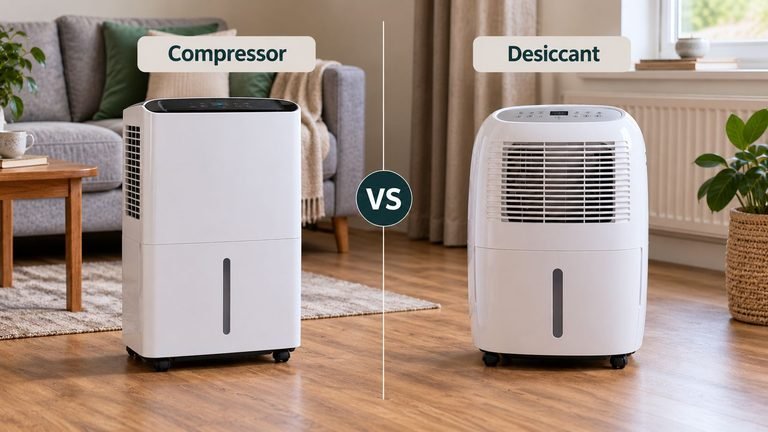
Compressor vs desiccant dehumidifier running costs
The type of dehumidifier can make a big difference to running costs.
Compressor dehumidifiers work a bit like a fridge. Air passes over a cold coil, moisture condenses and drips into the tank. Most home models are rated somewhere around 150W to 350W, depending on the model. They don’t work as well in cold rooms, though. Meaco’s Arete One 10L is rated at 4.34 litres a day at 20°C and 60% humidity, but only 1.41 litres at 10°C.
Desiccant dehumidifiers use a wheel of absorbent material to soak up moisture, plus a heater to dry the material out again. That heater is why they use more electricity. Going by the spec sheets for two popular desiccant models, the Meaco DD8L Zambezi and the EcoAir DD2 Simple, you’re looking at roughly 260W to 660W depending on the setting. On the plus side, they keep working well in the cold, and they give off a little warmth too.
On wattage alone, desiccant models look expensive. But what you’re really paying for is water removed, so we’ve worked out the cost per litre for three models using their published figures.
| Model | Room conditions | Power | Water per day | Cost per day | Cost per litre |
|---|---|---|---|---|---|
| Meaco Arete One 10L (compressor) | 20°C, 60% RH | 151W | 4.34L | 95p | 22p |
| Meaco Arete One 20L (compressor) | 20°C, 60% RH | 216W | 8.5L | £1.36 | 16p |
| Meaco DD8L Zambezi (desiccant, fan speed 2) | 20°C, 60% RH | 656W | 8.0L | £4.14 | 52p |
| Meaco Arete One 10L (compressor) | 10°C, 60% RH | 129W | 1.41L | 81p | 58p |
| Meaco DD8L Zambezi (desiccant, fan speed 2) | 10°C, 60% RH | 656W | 6.6L | £4.14 | 63p |
In a heated room at around 20°C, the compressor models remove water for well under half the cost per litre. In a cold space at around 10°C, the cost per litre is much closer, but the desiccant pulls out more than four times as much water a day. If you’re trying to dry out a cold garage, that matters more than the cost per litre.
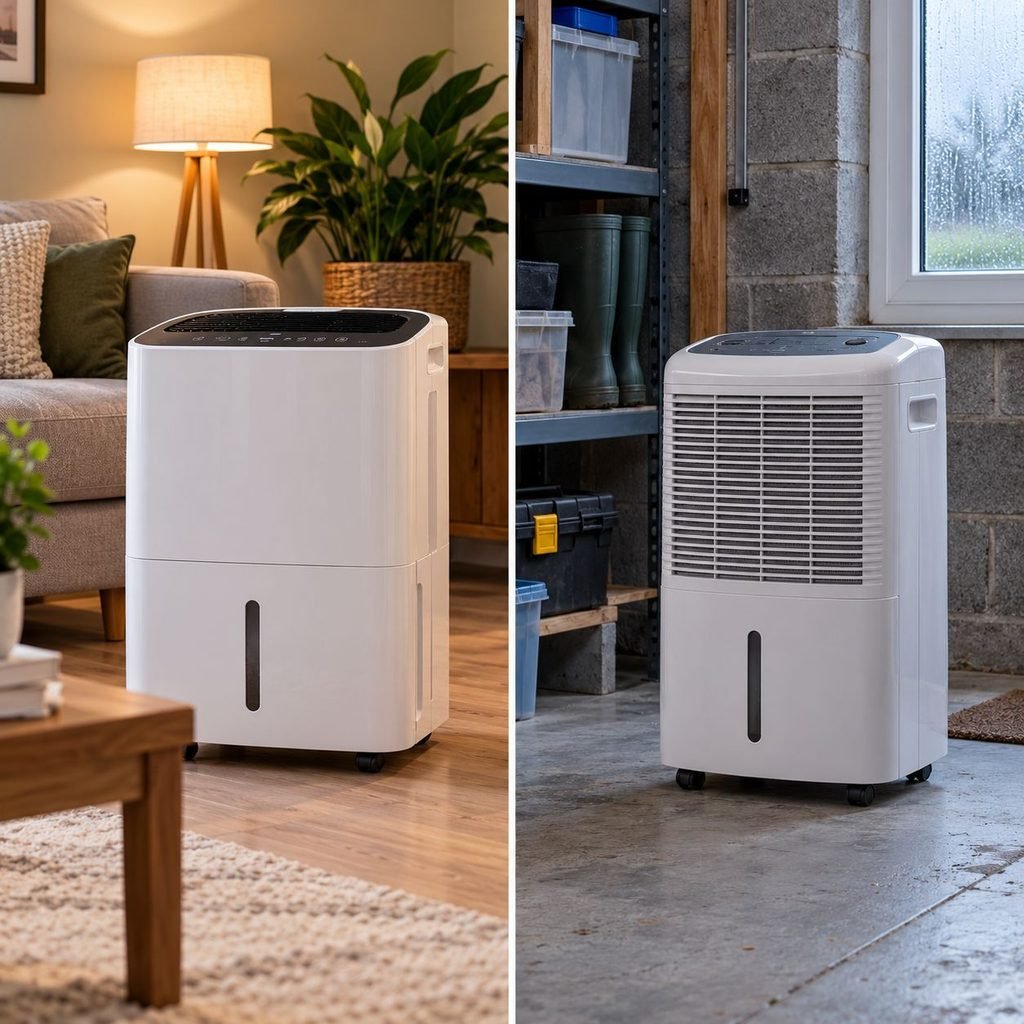
So the lowest wattage isn’t automatically the best choice. A compressor model makes more sense in a heated bedroom or living room, while a desiccant is often the more practical choice for a cold garage, conservatory or outbuilding. We cover the wider trade-offs in our compressor vs desiccant dehumidifier guide.
Does a bigger dehumidifier cost more to run?
Usually it draws more power, but not in proportion to how much water it removes.
It helps to remember that litres per day and watts measure different things. Litres per day is how much moisture the machine can remove, and watts is how much electricity it uses. The 10L, 12L or 20L headline is normally measured at 30°C and 80% relative humidity, which is far warmer and damper than a typical UK home. At a more realistic 20°C and 60%, Meaco rates its 20L Arete One at 8.5 litres a day.
The two Arete One models in the table above show this well. The 20L draws more power than the 10L (216W against 151W), but it removes nearly twice as much water, so each litre costs less: about 16p compared with 22p. In a properly damp room, the larger machine will also reach your target humidity sooner and spend more time idling.
Still, there’s no point buying a bigger model than you need. An oversized dehumidifier in a small room that’s only slightly damp just costs more to buy. A cheap, low-wattage model can be a false economy too, if it has to run all day to keep up. Match the extraction rate to the room and the problem you’re dealing with. Our guide to the best dehumidifiers in the UK covers models across these sizes.
How to reduce dehumidifier running costs
The easiest way to avoid wasting electricity is to use the dehumidifier efficiently. A few simple habits help:
- Use the humidistat rather than continuous mode, and don’t set the target lower than you need.
- Keep windows and doors closed while it’s running. Otherwise it’s trying to dry the air outside as well.
- Leave space around the air inlet and outlet, away from walls, curtains and furniture.
- Clean the filter as often as the manual says. A clogged filter cuts airflow.
- On a desiccant, the low setting roughly halves the power draw, but it roughly halves the water removed too. It’s fine for keeping a room ticking over and less useful when you need washing dry quickly.
- When drying washing, put the dehumidifier in a small room with the clothes and shut the door, rather than trying to dry the whole house.
- Tackle the cause where you can. Extractor fans, trickle vents and fixing leaks all mean less work for the dehumidifier.
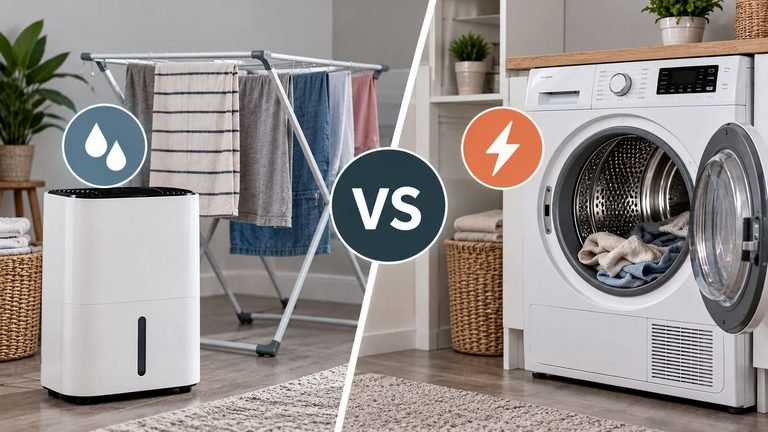
If drying clothes is the main job, it’s worth comparing a dehumidifier with the alternatives. We’ve done the sums in dehumidifier vs tumble dryer and dehumidifier vs heated airer, and picked out the best dehumidifiers for drying clothes. For condensation and black mould, see our best dehumidifiers for mould and damp.
Final verdict: are dehumidifiers expensive to run?
For most homes, no. At the October to December 2026 price cap of 26.32p per kWh, a 200W compressor dehumidifier costs about 5.3p an hour at full power, and a 300W model about 7.9p. With a humidistat cycling the compressor, the real figure is often lower.
Desiccant models cost more per hour, roughly 7p to 17p depending on the setting. In a heated room that makes them the pricier option. In a cold garage or unheated room, you’re paying extra for a machine that keeps removing water when a compressor would struggle.
What really decides your bill is how long the dehumidifier has to run to get the room to the right humidity and keep it there. Check the wattage, use your own unit rate and, if you want the exact figure, measure it with an energy monitor.
FAQs
How much does a 200W dehumidifier cost to run per hour?
About 5.3p an hour at 26.32p per kWh, if it draws the full 200W. Over 8 hours that’s 42.1p.
How much does a 300W dehumidifier cost to run for 8 hours?
About 63.2p at 26.32p per kWh, assuming it draws 300W the whole time. A humidistat cutting in and out would bring that down.
How much electricity does a dehumidifier use?
Divide the wattage by 1,000 to get kWh per hour. A 150W compressor model uses 0.15kWh an hour, or 1.2kWh over 8 hours. A 650W desiccant on full power uses 0.65kWh an hour, or 5.2kWh over 8 hours. These are maximums, and a humidistat-controlled model will often use less.
Is it expensive to leave a dehumidifier on all day?
At full rated power for 24 hours, a 150W model would cost about 94.8p, a 300W model about £1.90 and a 650W desiccant about £4.11. In practice, a compressor model on a humidistat switches its compressor off once the room reaches the target, so the actual cost is often lower than that.
How much does a dehumidifier cost per month?
Running 8 hours a day for 30 days at full rated power, a 150W model costs about £9.48, a 200W model £12.63 and a 300W model £18.95. A 650W desiccant on its highest setting would cost about £41.06. Your total depends on how many hours it actually works.
Do desiccant dehumidifiers cost more to run?
Per hour, yes. Desiccant models use a heater, so they typically draw more power than compressor models. In cold rooms the gap narrows on a cost-per-litre basis, because compressor models remove much less water when it’s cold while desiccant models keep working.
How do I work out the running cost of my own dehumidifier?
Find the rated power in watts on the spec sheet or label, divide by 1,000 and multiply by the unit rate on your electricity bill. For the real figure, use a plug-in energy monitor for a few days and multiply the kWh it records by your unit rate.
One Comment