Sage Barista Express Impress Review UK (2026)
Ask most people what puts them off a proper espresso machine and it usually isn’t the espresso. It’s the fiddly bit before it. Grinding the right amount into the basket, getting it level, tamping it evenly, then doing it all again tomorrow when you’re barely awake.
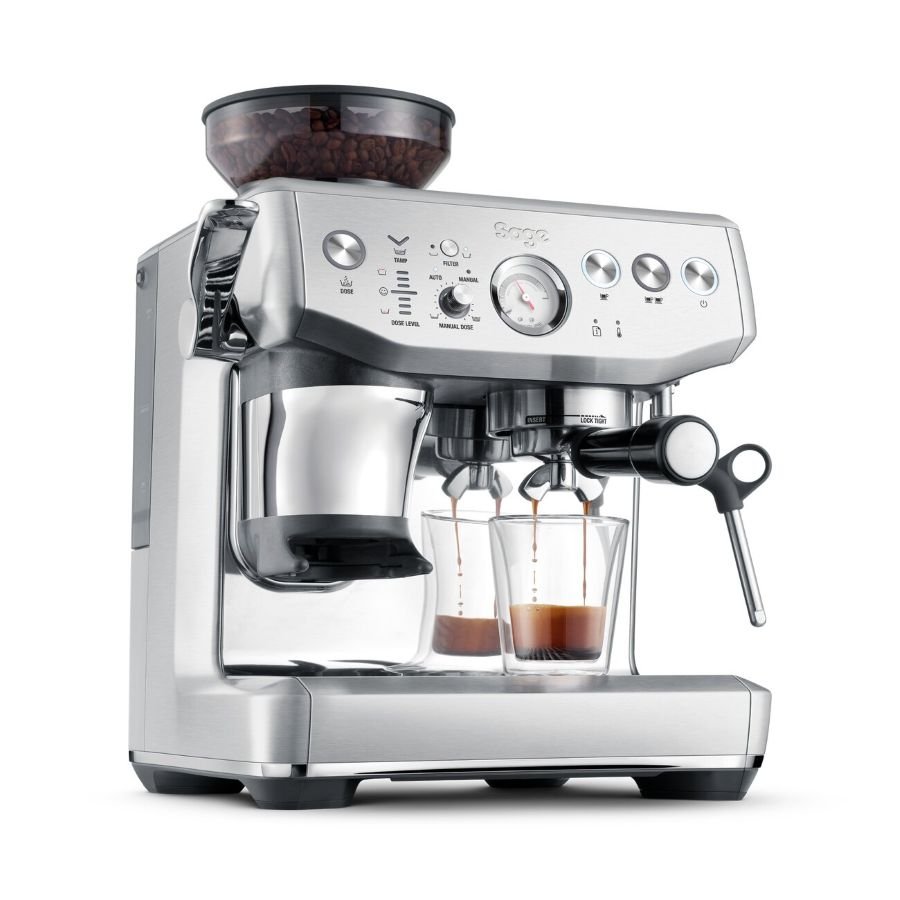
The Sage Barista Express Impress is Sage’s answer to that. It’s a traditional espresso machine with a built-in grinder, plus something Sage calls the Impress Puck System. The machine decides how much coffee to grind, tells you if it got it wrong, and tamps it for you when you pull a lever. You still brew the shot and steam the milk yourself. You just skip the step that trips most beginners up.
This Sage Barista Express Impress review looks at how that system works day to day, what it still leaves to you, and who should (and shouldn’t) buy one.
Quick verdict
If you want real, fresh-bean espresso at home but dosing and tamping by hand sounds like a chore, this is one of the easiest ways in. It takes most of the guesswork and mess out of preparing the coffee. It won’t make your drink for you, though. You’ll still need to find the right grind for your beans, and the steam wand is fully manual.
Buy it if: you want to learn espresso properly but find manual dosing and tamping off-putting, or you share the machine with someone who just wants a consistent flat white before work.
Skip it if: you want coffee at the press of a button, you don’t fancy steaming milk by hand, or you’re already confident weighing and tamping your own doses.
Sage Barista Express Impress: At a Glance
| Specification | Sage Barista Express Impress (SES876) |
|---|---|
| Machine type | Semi-automatic (manual) espresso machine with built-in grinder |
| Grinder | Integrated conical burr grinder |
| Grind settings | 25, plus an adjustable upper burr for extra range |
| Dosing and tamping | Impress Puck System: intelligent dosing, assisted tamping lever, dose level indicator |
| Tamp | 10kg, finished with a 7° twist |
| Portafilter | 54mm stainless steel |
| Filter baskets | 1 and 2 cup, in single-wall and dual-wall versions |
| Water tank | 2 litres, removable, with water filter |
| Bean hopper | 250g |
| Extraction | Low-pressure pre-infusion, then 9 bar extraction (15 bar pump) |
| Heating | Thermocoil with PID temperature control (93°C default, adjustable by up to 2°C either way) |
| Milk | Manual steam wand with 360° swivel |
| Hot water | Dedicated hot water outlet |
| Power | 1560 to 1850W |
| Dimensions | Approx. 41cm (H) x 33cm (W) x 38cm (D) |
| Weight | Approx. 11kg |
| Guarantee | 2 years |
| Finishes | Brushed stainless steel and black stainless steel are the easiest to find; other colours vary by retailer |
What Is the Sage Barista Express Impress?
First things first. This isn’t a bean-to-cup machine, even though some retailers list it alongside them.
A bean-to-cup does everything inside the box. You press a button for a cappuccino and wait. The Barista Express Impress is a portafilter machine, the kind you see behind a café counter. You grind into a handled basket (the portafilter), lock it in, start and stop the shot, steam your own milk and knock out the used coffee afterwards. It’s more involved, yes. But that’s also where your control over the flavour comes from.
The Impress Puck System looks after the fiddliest part, and it works in three stages.
- Dosing. The portafilter sits in a cradle under the grinder, and the machine works out how long to grind based on your last dose. Coffee lands in the centre of the basket, which helps it settle evenly.
- Tamping. There’s no hand tamper to master. You pull a lever on the side, and it presses the coffee with a steady 10kg before finishing with a small 7° twist to polish the top.
- Feedback. After tamping, an indicator shows whether there’s too little coffee, too much, or just the right amount. Short? Press the dose button for “A Bit More”. Over? Trim it with the supplied Razor tool. Either way, the machine remembers and adjusts the next dose.
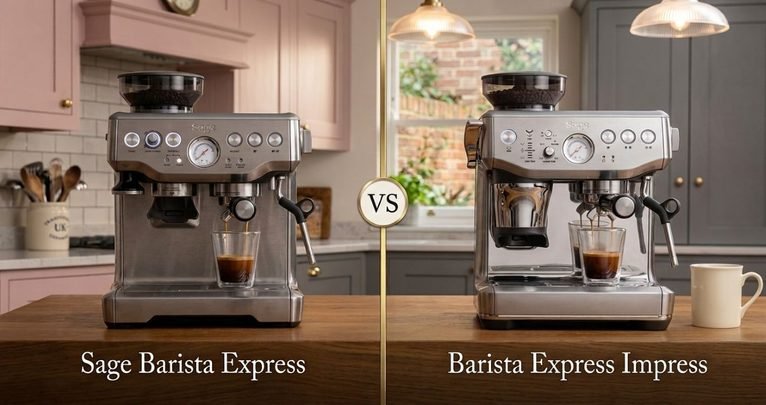
Underneath, it’s the same espresso machine as Sage’s long-running Barista Express, with the same thermocoil heater, PID temperature control, 54mm portafilter, pre-infusion and steam wand. If you’re stuck choosing between the two, our Sage Barista Express vs Barista Express Impress comparison looks at the price gap and who each one suits.
Sage Barista Express Impress: Key Features
Built-in conical burr grinder
Having the grinder built in saves you buying, and finding room for, a separate one. The dial has 25 settings. Lower numbers are finer, and Sage suggests starting at 16.
Run out of range at the fine end? You can move the upper burr inside the machine to shift the whole scale. Most owners will never need to, but it’s good to know it’s there before deciding the grinder can’t cope with a particular bean.
Automatic and manual dosing
Most of the time you’ll leave it in auto mode. There’s a manual mode too, where you set the grind time yourself with a dial on the front, which is handy if you want a particular dose or fancy experimenting. And if a dose ends up short, say because you pulled the portafilter out mid-grind, a top-up feature can fill it the rest of the way instead of making you bin it and start again.
54mm portafilter and four baskets
You get single and double baskets in two styles. Single-wall baskets are the ones to use with fresh beans. Dual-wall baskets are more forgiving, and Sage recommends them for pre-ground coffee or beans more than about a month past their roast date. The double basket holds 16 to 19g of coffee, and Sage puts the sweet spot at 18g.
Pre-infusion and a pressure gauge
Every shot starts with a gentle, low-pressure soak before the pump builds up to 9 bar. That helps water work through the coffee evenly instead of forcing its way through one weak spot. If you want a longer soak, hold the cup button down for as long as you like before letting go.
It’s easy to ignore the pressure gauge on the front at first. Try not to. When a shot is running too fast or too slow, the needle gives you a clue before you’ve even tasted it.
Thermocoil heating with PID control
Water is heated by a stainless steel thermocoil and held at 93°C by PID control, which is basically a precise electronic thermostat that keeps each shot at the same temperature. You can move it up or down by 1 or 2°C if a very light or very dark roast needs it. Plenty of owners never touch it.
Brewing and steaming share the same heating system, so you pull your shot first and then steam the milk. That’s fine for a couple of drinks and a bit slow if you’re making a round for four.
Programmable shots and hot water
The 1 cup and 2 cup buttons pour preset amounts, and you can reprogram both to suit your cups. There’s also a separate hot water outlet for americanos and warming cups, which gives you up to 240ml at a time.
Using the Sage Barista Express Impress
This is the bit you’re really paying extra for, so here’s how a milky coffee goes from start to finish, and who does what.
| Step | The machine | You |
|---|---|---|
| Grind | Grinds straight into the portafilter and works out the grind time | Pick the grind setting and change it when shots run too fast or slow |
| Dose | Centre-loads the coffee and remembers how the last dose went | Choose single or double, press Dose |
| Distribute | Centre loading helps the coffee sit evenly | Nothing extra in auto mode |
| Tamp | Applies the same 10kg tamp with a twist every time | Pull the lever down slowly until it beeps, trim if it’s over |
| Extract | Pre-infuses, then brews at 9 bar and a steady temperature | Lock in the portafilter, start the shot, keep an eye on time and taste |
| Steam milk | Supplies the steam | Everything else: positioning, stretching and heating the milk |
| Clean | Lets you know when a cleaning or descale cycle is due | Knock out the puck, rinse, purge and wipe the wand, empty the drip tray |
Is it easy for beginners?
Easier than most espresso machines, yes. On a fully manual machine you’re juggling grind, dose, distribution and tamp all at once, and when a shot tastes off, you can’t tell which one caused it. The Impress takes dose and tamp off that list. That leaves grind size as the main thing to learn, which is far less daunting.
It’s tidier too. The portafilter stays in one cradle while the machine grinds and tamps, so there’s no carrying a basket of loose grounds over to a tamping mat. Small thing, but you notice it on a busy morning.
Still not sure you want an espresso machine at all? Our guide to the best coffee machines for beginners includes some simpler options.
The part you still have to learn
That’s dialling in, which just means finding the grind setting that makes a particular coffee taste right. Sage’s guide gives you a handy starting point. Once you press the button, espresso should start dripping after about 8 to 12 seconds, and a balanced double usually takes 25 to 30 seconds in total. Gushing out and tasting sour? Go finer. Barely dripping and tasting bitter? Go coarser.
After each grind change, expect the indicator to ask for “A Bit More” or a trim for a shot or two. A finer or coarser grind packs differently, so the machine needs a couple of goes to recalibrate. The same happens with a new bag of beans. Totally normal.
Can experienced users still tinker?
More than you’d think. Manual dose mode lets you set your own grind time, and you also get manual pre-infusion, programmable shot volumes and adjustable brew temperature. If you’d rather weigh your doses and stop shots by weight on your own scales, go ahead. The one thing you can’t change is the tamp, which is always the lever’s fixed 10kg.
How long does a coffee take?
Not as long as you might think. From cold, the machine is ready in under a minute (the user guide says the power light flashes for up to 55 seconds while it heats), and Sage says you can go from beans to espresso in under a minute after that. Add steaming and a quick wipe-down, and a flat white takes a few minutes once you’re in the swing of it.
Coffee Quality
The Barista Express Impress is built for proper espresso from fresh beans, and it has the hardware that matters for that: freshly ground coffee, a sensible dose, steady temperature, pre-infusion and 9 bar extraction. Its espresso potential is essentially the same as the standard Barista Express. What the Impress improves is how often you actually hit it.
Because the dose and tamp don’t change, a good shot today should mean a good shot tomorrow, as long as you leave the grind alone.
The machine can only work with what you give it, though. A few habits will make more difference than any feature.
- Fresh beans. Sage recommends using beans roughly 5 to 20 days after their roast date. Bags with only a best-before date tend to give thin shots with very little crema.
- An easy-going roast to start with. Medium or medium-dark espresso blends are much easier to dial in than light single origins. Very dark, oily beans can leave residue in the grinder, and owners say the taste can hang around for a while afterwards.
- A proper warm-up. Run water through the group head and portafilter before your first coffee so the first shot tastes like the second.
- A quick purge. Sage suggests grinding a little and throwing it away before the first coffee of the day, so yesterday’s grounds sitting in the burrs don’t end up in your cup.
Get those right and it’s capable of lovely espresso and milky drinks that hold their own against a good high-street coffee shop.
Milk Steaming
If you mostly drink cappuccinos, lattes or flat whites, the steam wand matters as much as the espresso. And it’s entirely manual. There’s no automatic milk setting, no temperature sensor and no one-touch froth. The Impress system stops at the coffee.
A manual wand does give you full control, from airy cappuccino foam to the silky microfoam a flat white needs, and latte art if you catch the bug. It swivels a full 360°, so it’s easy to find an angle that gets the milk spinning, which is what gets rid of the big bubbles.
It is a skill, though, and most people’s first week or two of milk is a bit hit and miss. Owners often say the steam takes a few seconds to build and isn’t the quickest, but a slightly gentler wand can be easier to learn on. The 480ml jug in the box is a good size for one or two drinks. Sage’s tip for temperature is a simple one. The milk is ready at 60 to 65°C, which is roughly when the jug gets too hot to hold comfortably.
| Drink | Can it make it? | What’s involved |
|---|---|---|
| Espresso, ristretto, lungo | Yes | Shot volume and grind adjustments |
| Americano / long black | Yes | A shot topped up from the hot water outlet |
| Cappuccino | Yes | Manual steaming with more air for thicker foam |
| Flat white and latte | Yes | Manual steaming with less air for silky microfoam |
| Latte art | With practice | Needs well-textured milk and a steady pour |
| Iced coffee | Yes | Pull a shot over ice; there’s no cold brew setting |
What I Like
- It helps exactly where beginners struggle. Dose and tamp cause most early frustration, and those are the two jobs it takes on.
- The dose indicator teaches you as you go. You can see whether the basket was under or over, so you learn what a good dose looks like instead of guessing.
- Far fewer grounds on the worktop, because grinding and tamping happen in one spot.
- The grinder’s included, so there’s no separate grinder to budget for before you can start using fresh beans.
- You won’t outgrow it quickly. Manual dosing, manual pre-infusion, adjustable temperature and programmable shots leave plenty to play with.
- It works for the whole household. One person can tinker at the weekend while someone else just presses Dose, pulls the lever and gets the same result.
- Everything you need to get started is in the box, from the milk jug and Razor tool to cleaning tablets, descaler and a water filter.
What Could Be Better
- There’s no help with grind size. You still need to learn shot timing and trust your taste buds.
- Milk is entirely down to you. If learning to steam doesn’t appeal, this will annoy you every single day.
- The built-in grinder is convenient, but enthusiasts often point out that its steps are wider than a good standalone espresso grinder’s. That can make fussy light roasts harder to get spot on.
- Most café machines use 58mm portafilters, so there are fewer aftermarket baskets and tools for the 54mm size. Most owners won’t care, but it’s worth knowing if you like upgrading bits and pieces.
- It’s big. At around 41cm tall and 11kg, it needs a decent stretch of worktop, and because the water tank lifts out from the back, you need room behind and above it too.
- Knocking out pucks, wiping the wand and emptying the drip tray are part of daily life, and owners often mention the drip tray filling up quickly.
- Nothing goes in the dishwasher. Sage’s user guide says to wash all parts by hand, even though some retailer listings suggest otherwise.
- If you’re already happy weighing and tamping by hand, you’re paying extra for help you won’t use.
Who Is the Sage Barista Express Impress Best For?
| Buyer | Why it suits them |
|---|---|
| Beginners who want to learn espresso | It removes the two trickiest variables, so you can focus on grind and taste |
| Anyone nervous about tamping | The lever gives the same tamp every time, no technique needed |
| Home baristas who want a grinder included | A decent built-in grinder without buying and housing a separate one |
| Bean-to-cup owners wanting more control | Much more say over flavour, without the full manual learning curve |
| Regular milky coffee drinkers | A capable wand for cappuccinos, flat whites and lattes once you’ve got the hang of it |
| Households with mixed coffee interest | Simple enough for a quick morning coffee, deep enough for weekend tinkering |
Who Might Want to Look Elsewhere?
- If you want to press a button and walk away, a fully automatic machine will make you much happier. Our guide to the best bean-to-cup coffee machines in the UK is a better place to start.
- If steaming milk by hand sounds like hard work, look for a machine with automatic milk texturing. Sage makes some, and our Sage Bambino Plus vs Barista Express comparison looks at one of them.
- If your worktop is tight, measure the height under your wall cupboards and the space you’ll need to lift the tank out before you buy.
- If you just want a quick, consistent cup with no cleaning routine, a pod or capsule machine will suit you better.
- If you already own a good standalone grinder, you’d be paying for one you don’t need. A machine without a grinder makes more sense.
Cleaning and Maintenance
Every espresso machine comes with a small daily routine and a few bigger jobs now and then. The nice thing here is that the machine tells you when the bigger jobs are due. The maintenance light flashes when it wants a cleaning cycle and stays on when it’s time to descale.
| How often | Job |
|---|---|
| After every coffee | Knock out the puck, rinse the portafilter and basket under hot water, purge and wipe the steam wand straight away |
| Daily | Run a short flush through the group head, wipe the shower screen, empty the drip tray when the float pops up |
| Regularly | Brush out the grinder chute and the tamp area under the removable tamp cover |
| When the light flashes | Run the cleaning (back-flush) cycle with a cleaning tablet and the cleaning disc; it takes about five minutes |
| Every 3 months | Replace the water filter, or sooner in a hard water area |
| When the light stays on | Descale with a sachet of descaler dissolved in 1 litre of water |
| Now and then | Clean the conical burrs; replace the group head seal when it wears |
A couple of habits make it all easier. Purge the steam wand the moment you’ve finished, before any milk has a chance to dry inside. Keep the water filter fitted and changed on time, especially if you live somewhere with hard water, because it cuts down how often you’ll need to descale. And skip distilled or heavily filtered water, which Sage says can affect the taste.
One last reminder, because it catches people out. Sage says none of the parts should go in the dishwasher. Warm water, a drop of washing-up liquid and a soft cloth is all you need.
Sage Barista Express Impress Price and Value
Sage’s UK list price is £729.95, and for much of 2026 the Impress sat at or close to that. At the time of writing (early October 2026), Sage, Argos and Currys all have it for around £600. Sage prices move around a lot, so check before you buy.
| If it’s around… | What we’d think about |
|---|---|
| £730 (full list price) | You’re paying full price for convenience. Unless you need it now, keep an eye out for an offer. |
| £600 | A fair price for a machine with a built-in grinder and help that makes a real difference. |
| Under £600 | Very good value if assisted dosing and tamping appeal to you. |
So is it worth it? That depends on how much the help will matter to you. If the Impress system gets you to good coffee sooner, wastes fewer beans while you learn and means everyone at home can use it, the extra over the standard Barista Express is easy to justify. If you’d happily dose and tamp by hand, it’s a harder sell. For a wider look at what else is out there, see our guide to the best espresso machines in the UK.
Sage Barista Express Impress: Running Costs
The price tag is only part of it, so here’s what the Barista Express Impress costs to keep going. The bean prices are just examples, so swap in whatever you actually buy.
| Cost | Typical figure | Notes |
|---|---|---|
| Coffee beans (18g double shot) | About 36p at £20/kg, 54p at £30/kg | By far the biggest running cost |
| Electricity per drink | Under 3p | A deliberately generous estimate of three minutes at the full 1850W rating, at 26.32p/kWh (Ofgem cap, October to December 2026) |
| Water filter | £14.95 each from Sage | Every 3 months, so about £60 a year |
| Cleaning tablets | Around £15 for 8 | One per cleaning cycle, when the machine asks |
| Descaler | Around £15 to £19 for 4 sachets | One sachet per descale, when the machine asks |
Let’s say you run a cleaning cycle once a month and descale every three months. That’s about £60 on filters, £22 on cleaning tablets and £15 to £19 on descaler, so roughly £100 a year. If your household gets through two coffees a day, that’s about 14p a drink.
Add it all up and a double shot with mid-priced beans comes to somewhere around 50p to 70p before milk. The machine itself, at £600 spread over two years of two coffees a day, works out at roughly another 41p a cup, and less every year after that. The box also includes a water filter, cleaning tablets and descaler, so your first few months of supplies are covered.
Sage Barista Express Impress: Pros and Cons
- Assisted dosing and tamping make good shots repeatable
- Dose indicator gives clear feedback and corrects the next dose
- Built-in conical burr grinder with 25 settings
- Steady PID temperature, pre-infusion and a pressure gauge
- Much less mess than grinding and tamping separately
- Plenty of manual control when you want it
- Milk steaming is fully manual and takes practice
- No grind guidance, so you still have to dial in
- Built-in grinder is less precise than a good standalone one
- Big and heavy, with a water tank that lifts out from the back
- Hand-wash only
Frequently Asked Questions
Is the Sage Barista Express Impress good for beginners?
Yes. It’s one of the friendlier espresso machines with a built-in grinder, because it handles dosing and tamping for you. You’ll mainly need to learn grind adjustment and milk steaming. It’s still hands-on, so give yourself a week or two to settle in.
Is the Sage Barista Express Impress fully automatic?
No. It’s a semi-automatic espresso machine. It helps with grinding, dosing and tamping, but you lock in the portafilter, start the shot, steam the milk and clean up yourself.
Does it have a built-in grinder?
Yes, an integrated conical burr grinder with 25 settings and a 250g bean hopper. If you ever need more range, the upper burr can be adjusted too.
Does the Sage Barista Express Impress steam milk automatically?
No. The steam wand is manual, so you control the texture and temperature yourself. It’s perfectly capable of cappuccinos, flat whites and lattes, but silky milk takes some practice.
Does the Sage Barista Express Impress make good espresso?
It can make very good espresso, thanks to its steady temperature control, pre-infusion and decent grinder. How good depends mostly on fresh beans and getting the grind right, which is true of any machine like this.
Can you use pre-ground coffee?
You can. Sage’s user guide recommends the dual-wall baskets for pre-ground coffee, as they’re more forgiving of grind and freshness. But the machine is built around grinding fresh beans, and you’d be missing out on most of what you’ve paid for.
What size portafilter does it use?
54mm, in stainless steel. Single and double baskets come in both single-wall and dual-wall versions.
Is the Sage Barista Express Impress difficult to clean?
Not difficult, but it needs looking after. The daily jobs take a minute or two, and the machine lets you know when a cleaning cycle or descale is due. Everything should be washed by hand.
How long does it take to make a coffee?
It heats up in under a minute, and Sage says beans to espresso takes under a minute after that. A milky drink, including steaming and a quick tidy, usually takes a few minutes once you know the routine.
Is the Sage Barista Express Impress worth it?
It’s worth it if you want real espresso at home and like the idea of help with dosing and tamping, especially at around £600. If you’d rather have push-button coffee, or you’re already comfortable tamping by hand, other machines will suit you better.
Final Verdict
The Sage Barista Express Impress sits nicely between a fully manual espresso machine and a push-button bean-to-cup. It won’t make your coffee for you. What it does is take the messiest, least predictable part of the routine off your hands, so you can get on with the bits that are actually fun.
The people who’ll get the most from it are those who want to learn proper espresso but have been put off by dosing and tamping. Households with one coffee nerd and one person who just wants a flat white before work tend to get on well with it too. It’s also a sensible step up from a bean-to-cup if you want more say over the taste.
Just go in knowing the trade-offs. The milk is all you, each new bag of beans needs a little dialling in, it takes up a fair bit of room, and it needs a quick tidy every day. If none of that bothers you, and you can get it for around £600, it’s one of the easiest routes to really good espresso at home. Otherwise, something more automatic will probably suit you better, and our guide to the best coffee machines in the UK is a good place to start.