Washing Machine Not Spinning? 9 Common Causes and How to Fix Them
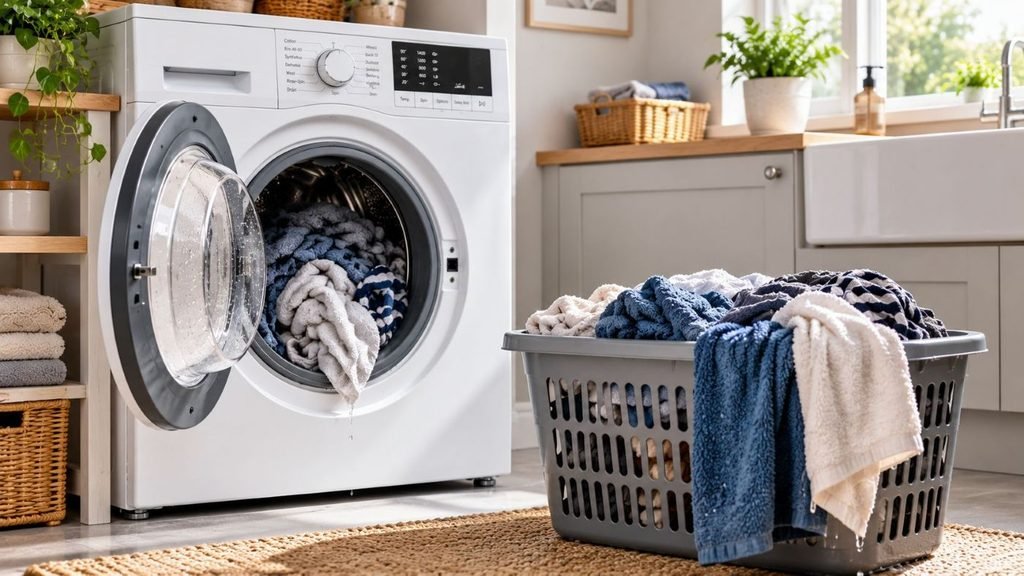
You open the door at the end of a wash and the clothes are dripping. No error code, no obvious reason. It’s annoying, but it doesn’t usually mean the motor has gone. A lopsided load, a blocked filter or the wrong programme can all stop a washing machine spinning, and they’re easy to sort out.
The best clue is what the machine actually does. Check whether the water has drained, whether the drum tries to spin and then gives up, or whether it doesn’t turn at all. Once you know that, you can work through the likely causes below and decide whether it’s something you can fix yourself or a job for an engineer.
Quick answer: why is my washing machine not spinning?
In most cases it’s the load, the programme or a drainage problem, and you can usually fix those yourself. A genuine fault is less common.
- If there’s water left in the drum, the machine won’t spin until it drains. Check the drain filter and waste hose first.
- If it drains but won’t spin, the load is probably unbalanced or too big. A low-spin or no-spin programme is the next thing to check.
- If the drum won’t turn at all, even during the wash, you’re more likely looking at a door-lock, motor or drive fault. Call an engineer.
- If you notice smoke, a burning smell or the electrics keep tripping, stop using the machine and switch it off at the wall if it’s safe to do so.
Washing machine not spinning: symptom checker
Find the row that matches what your machine is doing, then jump to the cause it points to.
| What happens | Likely cause | Can you fix it yourself? |
|---|---|---|
| Water left in the drum | Blocked drain filter or hose (causes 3 and 4) | Yes, usually. If it still won’t drain, the pump may be faulty (cause 7) |
| Drains, but never does the final spin | Load unbalanced or too big (causes 1 and 2), or a low-spin programme (cause 5) | Yes |
| Shakes or bangs, then stops spinning | Uneven load, machine not level, or transport bolts still in after delivery (cause 1) | Yes. Get it checked if it happens with normal loads |
| Clothes damp but not dripping | Probably normal for that programme (cause 5) | Nothing to fix |
| Lots of suds, cycle pauses or runs long | Too much detergent | Yes, use less next time |
| Timer stuck near the end | Machine trying to balance the load, or draining slowly | Try the checks below first |
| Clicks but won’t start, or shows a door code | Door not locking (cause 6) | Check for trapped fabric. Engineer if it keeps happening |
| Drum doesn’t move at all, or the motor hums but the drum stays still | Belt, motor or control fault (causes 8 and 9) | No, call an engineer |
Before you start: five safe checks
- Check the display. If there’s an error code, write it down and look it up in the manual.
- Check the load. Once the door unlocks, pull apart anything that’s tangled (sheets and duvet covers are the usual suspects) and take some items out if the drum is crammed full.
- Look for water in the drum. If there is some, drain it the way your manual describes. Don’t force the door.
- Check the filter and hose safely. Turn the machine off and unplug it first. If the wash was hot, give the water time to cool. Have old towels and a shallow tray ready, and don’t try to pull the machine out on your own.
- Run a spin on its own. With everything back in place, and no leaks or warning signs, run a spin-only or drain-and-spin programme and see whether it works this time.
Whatever you do, don’t try to override the door lock, take electrical parts apart or put your hand in a drum that’s still moving.
9 common reasons a washing machine won’t spin (and what to do)
The first five are the ones you can usually sort out yourself. Six to nine are more likely to need an engineer, though there are still a couple of things worth checking before you book one.
1. The load is unbalanced
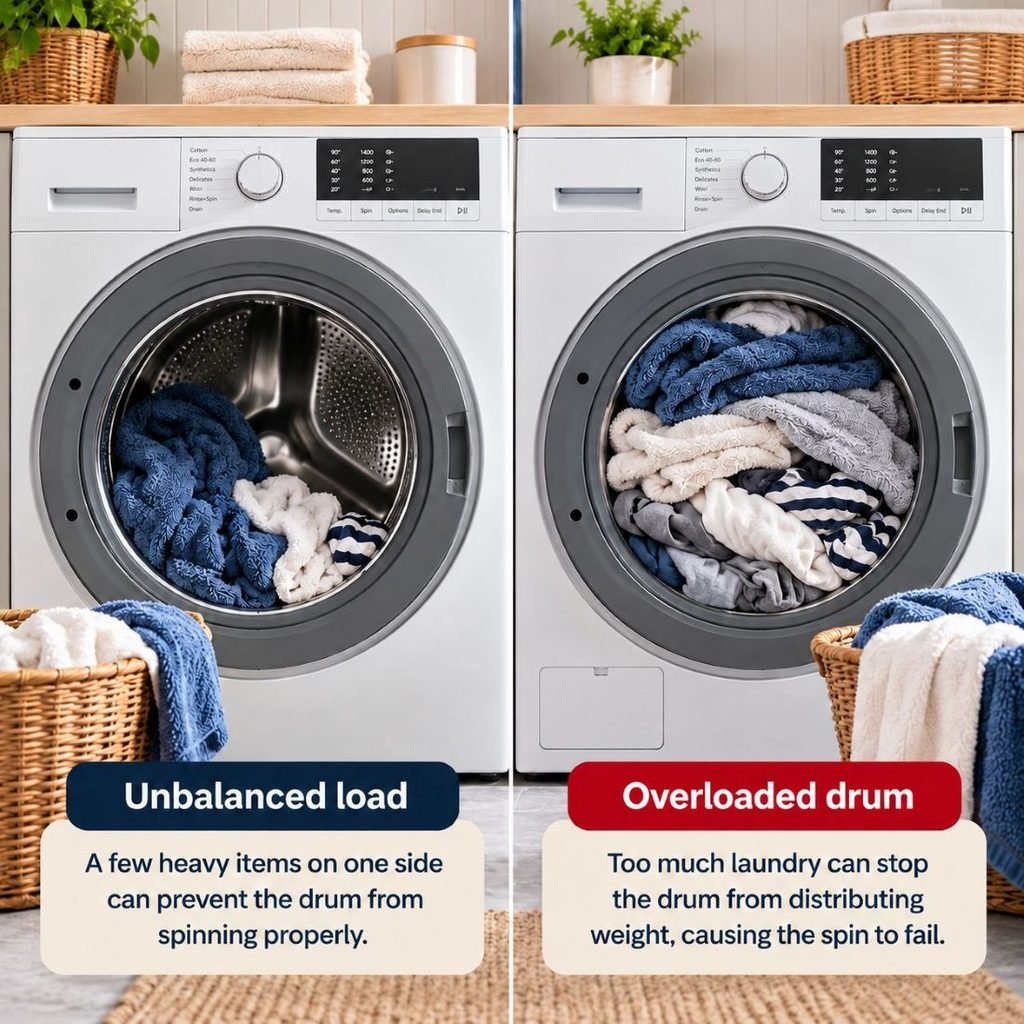
This is one of the most common reasons. When the washing bunches up on one side of the drum, the machine can’t spin it at full speed without shaking itself across the floor. Most machines will try to even things out by tumbling the load back and forth a few times. If that doesn’t work, they’ll either spin more slowly or skip the fast spin completely.
A single heavy item is often to blame, such as a bath mat, one big towel or a pair of jeans washed on their own. A duvet cover can do it too, once smaller things get wrapped up inside it. Samsung’s own advice for bulky items is to add two or three towels so the weight spreads more evenly.
What to try: Once the door opens, untangle everything and spread it around the drum. If you’re washing one heavy item, add a few towels to balance it. If the machine keeps complaining about ordinary loads, check it’s level and that all four feet are firm on the floor. And if it’s a new machine (or one that’s just been moved), make sure the transport bolts have come out of the back. They stop the drum moving in transit, and if they’re left in, the machine will shake badly as soon as it tries to spin.
Still happening after all that? The shock absorbers or springs might be worn, and that’s one for an engineer.
2. The drum is overloaded
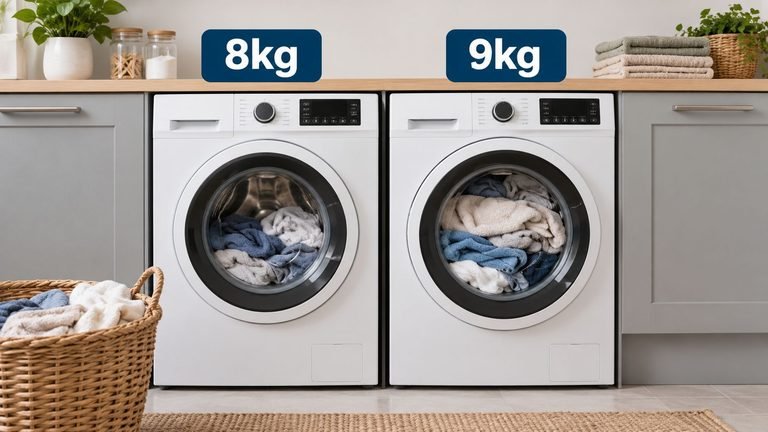
If the drum is packed tight, the clothes can’t move around and spread out, so the machine struggles to balance them. A 9kg capacity doesn’t mean you should cram 9kg of washing in on every programme, either. Quick washes, delicates and other special cycles often take a much smaller load than the maximum.
What to try: Take some washing out and look up the load limit for the programme you’re using. If it spins fine with less in, you’ve found your problem.
The old “leave a hand’s width at the top” rule is a decent rough guide, but the load limits in your manual are more reliable. If you find you’re overfilling every time because the drum just isn’t big enough for your household, our 8kg vs 9kg and 9kg vs 10kg comparisons will help you work out what size you actually need.
3. The drain pump filter is blocked

Most front loaders have a filter behind a small flap at the bottom front. It’s there to catch whatever escapes from pockets, including coins, hair grips, buttons, tissue and the odd bra underwire. When it clogs, the water drains slowly or not at all, and the machine won’t start the fast spin until the drum is empty.
What to try: Turn the machine off, unplug it, and let any hot water cool down. Then follow the filter-cleaning steps in your manual. Put towels down and have a tray ready, because more water comes out than you’d expect. Some machines have a thin drain hose next to the filter so you can empty the water into a bowl before you unscrew anything. Clear out the debris, screw the filter back in firmly and check it isn’t leaking before you run another wash.
Not every machine has a filter you can get to yourself. If yours doesn’t, or it won’t budge, don’t force it.
4. The drain hose or waste pipe is restricted
The hose behind the machine can get kinked or squashed when the machine’s pushed back into place. The connection under the sink can block up, and a standpipe that’s set up badly can cause problems too. A poorly fitted hose can even cause siphoning, where water drains out during the wash when it shouldn’t, and that can trigger drain errors.
If it has never drained properly since it was put in, or since a new kitchen was fitted, check the waste connection under the sink. New spigots often come with a blanking disc inside that has to be cut out before use, and it’s easy to miss.
What to try: With the machine unplugged, look along any part of the hose you can see and reach, and straighten out kinks or squashed sections. Compare the setup with the installation guide, as the right hose height and how far it goes into the standpipe vary between models. If you’d need to disconnect any plumbing and aren’t comfortable doing it, call a plumber or an appliance engineer.
5. The programme is limiting the spin
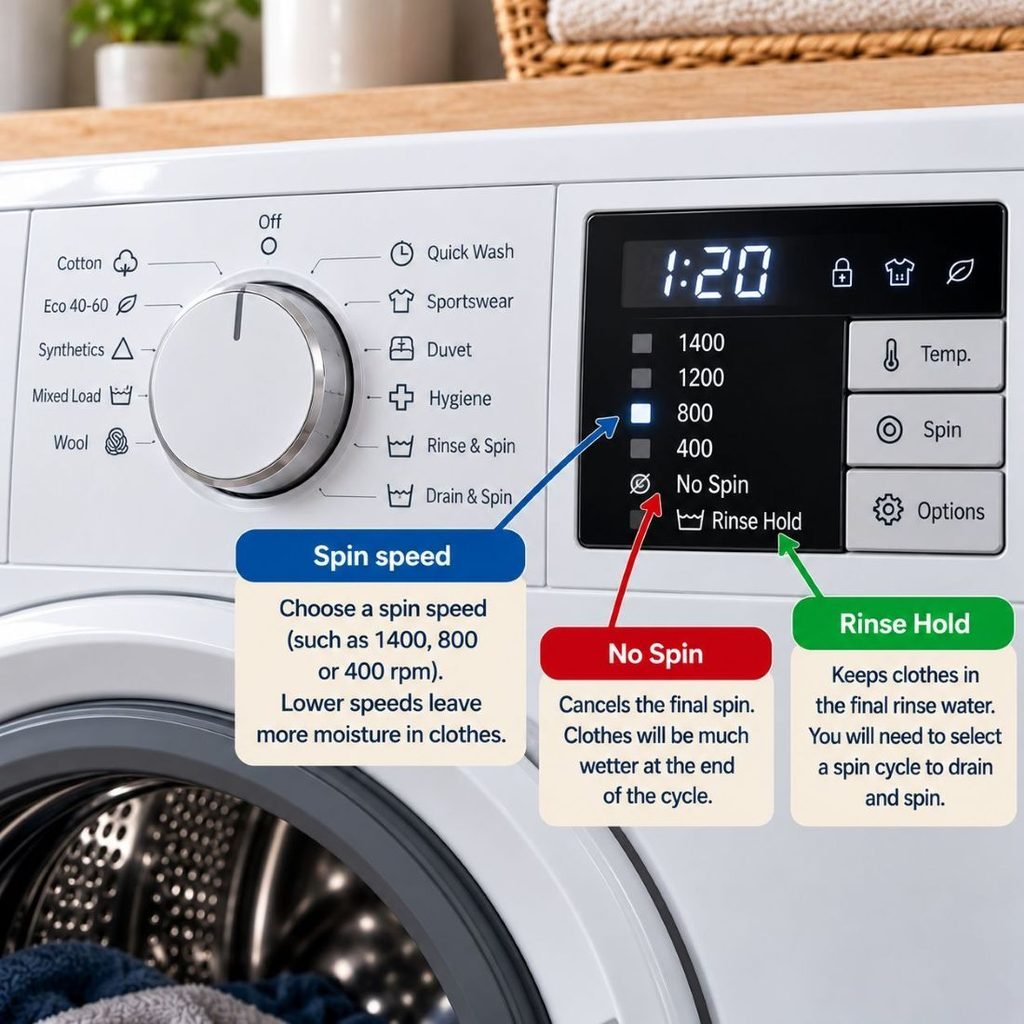
Sometimes nothing’s wrong at all. No Spin, Rinse Hold and some delicate or wool programmes are meant to leave clothes wetter. Rinse Hold (often called anti-crease) stops the machine with water still in the drum, on purpose, until you choose drain or spin. And a machine sold as 1,400rpm won’t necessarily spin that fast on every programme.
What to try: Check which programme and spin speed you’ve chosen. If the clothes can take it, run a separate spin or pick a programme with a higher spin speed. Just don’t ignore the care labels to get a bit more water out.
It helps to know what’s normal here, because clothes always come out damp. The energy label gives every machine a spin-drying class from A to G, based on how much water is left in the washing after a spin on the eco 40-60 programme. It’s measured as a percentage of the dry weight of the load. Class A machines leave less than 45%, and class B leaves between 45% and 54%.
To put that into real numbers, a 6kg load of dry cotton could still hold around 2.7 to 3.2 litres of water after a full spin in a class B machine. That’s 6kg × 45% to 54%, with 1kg of water being roughly a litre. Fabric and programme make a difference, but you get the idea. Damp washing is normal, but dripping washing isn’t.
If you’re wondering whether a faster spin is worth paying extra for, our 1200 vs 1400 vs 1600rpm comparison goes through the pros and cons.
6. The door isn’t locking properly
A front loader won’t tumble or spin until it knows the door is locked. A bit of fabric caught in the seal, a damaged catch or a faulty lock can all stop the cycle in its tracks.
What to try: Wait for the door to unlock, then check around the seal and catch for anything trapped. Close it firmly, but don’t slam it. Bear in mind the lock usually takes a minute or two to release at the end of a cycle, so a short wait isn’t a fault. If you keep getting a door error, or the lock looks broken, book a repair. Never try to bypass the lock.
7. The drain pump is faulty
If the filter and hose are both clear and the water still won’t go, the pump itself could be the problem. Humming with no draining, draining that comes and goes, or the same drain error over and over all point that way, but none of them proves it on its own.
What to try: Make sure you’ve ruled out the filter and hose first. After that, it’s a job for a qualified repairer, who can check the pump and its wiring. Don’t go poking around live wiring or try to swap the pump unless you really know what you’re doing.
8. The drive belt or motor has a problem
Some machines turn the drum with a belt, while others have a direct-drive motor with no belt at all. On a belt-driven machine, if you can hear the motor running but the drum isn’t moving, the belt has very likely slipped off or snapped. Machines with a traditional brushed motor also have carbon brushes that wear down over the years and can eventually stop the drum turning. If the drum won’t move during the wash either, not just the spin, this kind of fault is much more likely.
What to try: Watch whether the drum turns at all, and write down any motor error code. If you hear scraping or notice smoke or a burning smell, stop using it. An engineer can tell you whether it’s the belt, the motor or something else.
9. A sensor, wiring or control board fault
Modern machines rely on sensors and electronics to keep track of the water level and the motor speed. If one of those signals goes wrong, the machine can refuse to spin even when the drum, filter and hose are all fine. These faults are hard to pin down just from the symptoms.
What to try: Note the model number, the exact error message and the point where the cycle stops. A reset done the way the manufacturer recommends can clear a one-off glitch, but it won’t fix a part that’s failed. Don’t let anyone replace the control board without diagnosing it properly first, as it’s usually one of the more expensive parts.
Washing machine not spinning and making a noise?
The noise won’t tell you exactly what’s wrong, but it can narrow things down.
| What you hear | What it could be | What to do |
|---|---|---|
| Banging as the spin speeds up | Uneven load, machine not level, or worn suspension | Stop it and rearrange the load. If it keeps happening, look into it |
| Humming with water still inside | Blocked filter or a pump problem | Check the filter and hose |
| Grinding, scraping or a deep rumble | Worn bearings, or something stuck between the drum and the tub | Stop using it and call an engineer |
| Clicking by the door but nothing starts | Door lock or catch | Check for trapped fabric. Get it looked at if it carries on |
| Motor running but the drum isn’t moving | Belt slipped or snapped, or another drive fault | Get an engineer to diagnose it |
Samsung and LG error codes that stop the spin
Samsung and LG both list their codes online, so we’ve pulled out the main ones linked to spinning. Codes can vary between models, and some machines show symbols rather than letters, so always check against the manual for your exact model.
| Brand | Code | What it means | What to do first |
|---|---|---|---|
| Samsung | UE, Ub, Ur | Unbalanced load | Spread the washing out, or add a couple of towels to a single bulky item |
| Samsung | 5C, 5E | Drainage problem | Check the drain filter and waste hose |
| Samsung | 3C, 3E (including 3E1 to 3E4) | Motor problem | Restart it once. If the code comes back, contact Samsung or an engineer |
| Samsung | dC, dE (and variants) | Door problem | Check for trapped fabric and close the door firmly |
| Samsung | Sud | Too much foam | The machine pauses until the suds die down. Use less detergent next time |
| LG | UE | Unbalanced load (bunched up, too big, too small or machine not level) | Spread the washing out and check the machine is level |
| LG | OE | Not draining | Check for a kinked hose or blocked filter |
| LG | LE | Motor locked, often from overloading or something like a coin getting stuck | Take some washing out. Call an engineer if it keeps happening |
| LG | dE, dE1, dE2 | Door not shut or not locking | Check the seal for trapped clothes |
Samsung also points out that on some displays a 5 can look like an S. So if you see “SE” or “SC”, it’s probably 5E or 5C, which is a drainage error. You can find the full lists on Samsung UK’s washing machine codes page and in LG UK’s guide to the OE drain error.
When to stop and call an engineer
Book a repair if:
- the drum won’t turn at any point in the cycle
- the water still won’t drain after you’ve cleaned the filter and checked the hose
- a door, motor or control error keeps coming back
- it’s still grinding, scraping or banging after you’ve rearranged the load.
If there’s smoke, a burning smell, a hot plug or socket, water near anything electrical, or the circuit keeps tripping, stop using the machine straight away.
Before you call anyone, find the model number. It’s usually on a label around the door opening or on the back. Write it down along with the error code and the point where the cycle stops. The engineer will know what to bring, and you’re more likely to get an accurate quote. If the machine is still under the manufacturer’s warranty, go to them first, as using an independent repairer could affect your cover.
What affects washing machine spin repair costs in the UK?
It depends on what’s wrong, whether parts are easy to get, local labour rates and whether there’s a call-out or diagnostic fee. Clearing a blocked filter yourself costs nothing, while a motor or control board fault can run to a lot more. National “average price” lists aren’t much help here. Get an itemised quote from a local engineer and ask whether the diagnostic fee comes off the final bill if you go ahead.
| Repair | Who usually does it | What to ask before you agree |
|---|---|---|
| Blocked filter or kinked hose | You, most of the time | Nothing, if your own checks fix it |
| New drain pump | Engineer | What guarantee comes with the repair? |
| New door lock | Engineer (it’s a safety part) | Is it the right part for your exact model? |
| Drive belt or carbon brushes | Engineer | Is the motor itself OK? |
| Motor, drum or bearings | Engineer | Can the bearings be replaced on their own? |
| Control board | Engineer | How did you confirm it’s the board? |
Before you say yes to a quote, keep these two things in mind.
The first is sealed tubs. A lot of newer machines have an outer tub that’s sealed shut at the factory, so if the drum bearings wear out, they can’t be replaced on their own. The whole tub and drum has to be swapped instead, and that often costs more than the machine is worth. Ask the engineer whether your model’s bearings can be done separately.
The second is spare parts. Under GB ecodesign rules brought in in 2021, manufacturers have to keep the main washing machine parts available for at least 10 years after the last unit of that model went on sale. That’s from when the model was last sold, not from when you bought yours. They also have to deliver parts within 15 working days. Most parts, such as the motor, pump, bearings and circuit boards, are only supplied to professional repairers. Some, including the door, door seals, door lock and detergent drawer, have to be available to the public as well. So if you’re told the parts for a fairly new machine are “no longer made”, don’t just take that at face value.
Repair or replace: how to decide
Think about how old the machine is, how reliable it’s been, what state the drum and bearings are in, and how the quote compares with the price of a similar new machine. Paying for a sensible repair on a machine that’s otherwise been fine usually makes sense. If it’s one expensive fault after another, it’s probably time to move on.
| Repair is usually worth it if… | Replacing may make more sense if… |
|---|---|
| It’s been reliable until now | It’s already had a few expensive faults |
| It’s the pump, door lock, belt or brushes | The bearings have gone on a sealed-tub model |
| Parts are easy to get and the repair comes with a guarantee | Parts aren’t available, or the quote is close to the price of a similar new machine |
| The drum turns quietly, with no rumble | The spin has been getting louder for months |
If you do decide to replace it, have a look at our guides to the best washing machines in the UK, the best washing machines under £400 and the best washing machines under £300.
Your consumer rights if the machine is fairly new
Check whether you’ve got a manufacturer’s or retailer’s warranty before you pay anyone else to repair it. On top of any warranty, the Consumer Rights Act 2015 gives you legal rights if the machine is faulty. Those rights are against the shop or website you bought it from, not the manufacturer, so the retailer is the first place to go.
| Time since delivery | What you’re usually entitled to |
|---|---|
| Up to 30 days | Reject it and get a full refund |
| 30 days to 6 months | The retailer gets one chance to repair or replace it. If that doesn’t work, you can have a refund (normally with nothing taken off for use) or a price reduction. The fault is assumed to have been there from the start unless the retailer can prove otherwise |
| After 6 months | Still one repair or replacement first. If that fails, any refund can be reduced to reflect the use you’ve had. You’ll usually have to show the fault was there when it was delivered |
| Up to 6 years (5 in Scotland) | The time limit for taking a claim to court. It doesn’t mean the machine has to last that long |
These rights only cover genuine faults. Wear and tear, accidents and misuse aren’t included, so a coin jammed in the pump filter won’t count. If the retailer installed the machine for you, the installation is a service and has to be done with reasonable care and skill. If their installer left the transport bolts in or squashed the hose behind the machine, take that up with the retailer. This is only a general summary and not legal advice. Citizens Advice can help with your particular situation.
How to stop spin problems coming back
- Stick to the load limit for the programme you’re using, not just the machine’s headline capacity.
- Don’t wash one heavy item on its own. Bulk it out with a couple of towels.
- Measure your detergent. Too much foam can make some machines pause or drag the cycle out.
- Clean the filter as often as the manual says, and empty pockets before anything goes in.
- If the machine’s new or has just been moved, check it’s level and the transport bolts are out.
- If it starts vibrating or making a new noise, look into it early rather than waiting for it to get worse.
Frequently asked questions
Why does my washing machine drain but not spin?
If the water’s gone, the load is the first thing to look at, followed by the programme settings and the door lock. A machine that washes normally but gives up at the fast spin usually has an unbalanced load. If the drum doesn’t turn during the wash either, it’s more likely to be the door lock or the drive system. In that case, get it diagnosed rather than restarting it again and again.
Can too much detergent stop a washing machine spinning?
It can hold things up. A lot of modern machines can sense too much foam, and they’ll pause or add time to let it settle before they drain and spin. Samsung machines show “Sud” when this happens. It isn’t a fault, and measuring your detergent properly should stop it happening.
Why does my washing machine stop with nine minutes remaining?
Usually it’s the machine trying to rebalance an uneven load before the final spin. Slow draining can hold the programme up as well. The time on the display doesn’t tell you anything on its own, so look for an error code and check whether there’s still water in the drum.
Why is the drum spinning slowly?
The programme might be limiting the spin speed to protect the fabric, or the machine might still be trying to balance the load before it speeds up. Check your settings first. If it never gets up to speed, even with a normal mixed load on a standard programme, it’s worth looking into further.
Will resetting the washing machine fix a spin problem?
Sometimes. A reset done the way your manual describes can clear a one-off electronic glitch, but it won’t clear a blocked filter or fix a faulty pump, lock or motor. And if there are any electrical warning signs, don’t keep resetting it.
What can I do with soaking wet washing while I wait for a repair?
Wring out as much as you can by hand, and hang it outside if the weather’s on your side. A load that hasn’t been spun can hold several litres of water, and if you dry it indoors, all of that ends up in the air. Open a window or run a dehumidifier. Our guide to the best dehumidifiers for drying clothes covers the ones that handle washing best.
The bottom line
Most of the time, a washing machine that won’t spin has an uneven load, a blocked filter or the wrong programme selected, not a broken motor. Check those first. They’re free and only take a few minutes. If the problem’s still there, call an engineer and give them the model number and error code. Then weigh the quote against how old the machine is and what condition it’s in before you decide.