What Humidity Should Your House Be in the UK?
What humidity should your house be in the UK? For most homes, somewhere between 40% and 60% relative humidity is right, and around 50% is a good everyday figure to aim for. That’s damp enough to be comfortable and dry enough to keep condensation in check.
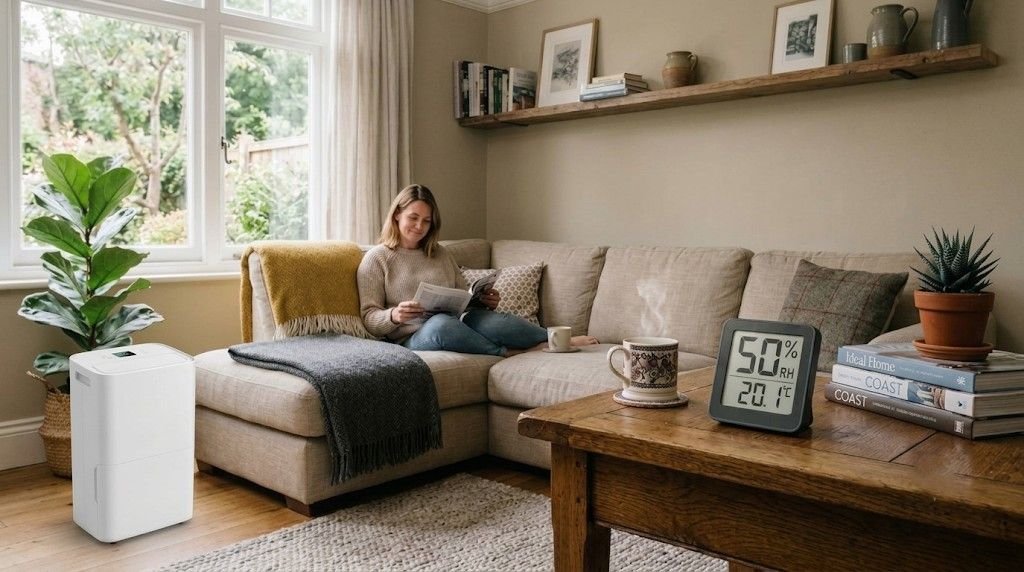
Your reading will move around during the day. A shower, a pan of pasta or a rack of washing can push it up quickly, and so can a night’s sleep with the bedroom door shut. Those spikes are normal. Problems start when humidity stays high for days at a time, which is usually when you begin to see wet windows, black spots in corners and that musty smell.
Below, we explain what your hygrometer reading actually tells you, why you can still get condensation when the number looks fine, and when a dehumidifier is worth buying.
Quick Answer: UK Home Humidity at a Glance
| Reading (RH) | What it usually means | What to do |
|---|---|---|
| Below 40% | On the dry side. Less common in UK homes than too much moisture. | If you run a dehumidifier, check it isn’t set too low. |
| 40–60% | Where most homes should be. | Nothing much. Keep an eye on cold rooms in winter. |
| 60–70% | A bit high. Fine for an hour or so after a shower or cooking. | If it sits here for days, ventilate more and check windows and corners for condensation. |
| Above 70% | Too high if it lasts. Cold surfaces will start getting wet. | Find out where the moisture is coming from. Ventilate, and think about a dehumidifier. |
What Is the Ideal Humidity Level for a UK Home?
For most UK homes, 40–60% relative humidity (RH) is the range to aim for. Relative humidity is the amount of water vapour in the air compared with the most the air could hold at that temperature. You measure it with a hygrometer, which usually costs less than £10.
The Centre for Sustainable Energy recommends keeping indoor humidity between 40% and 60%, and says the risk of mould growth goes up once it climbs above 60%. Around 50% is a good everyday target. Expect your readings to shift with the weather, the heating, how much you ventilate and what’s going on in the house.
Is one high reading a problem?
Usually not. Seeing 62% on the display once doesn’t mean you have a damp problem. How long it stays high is what counts.
Building Regulations ventilation guidance (Approved Document F) works the same way. It doesn’t set a single cut-off. It looks at averages instead, and treats a room as likely to be fine if humidity stays below 65% averaged over a month, 75% over a week and 85% over a day.
Those numbers were written for designing new homes, so we wouldn’t treat them as a target for your living room. They’re a good reminder to watch the trend, though. A home that sits above 60% week after week, with wet windows or a musty smell, needs attention. A home that hits 65% after Sunday dinner and drops back by bedtime is fine.
Why Condensation Can Form Even When Your Hygrometer Looks Fine
This catches a lot of people out. A hygrometer measures the air in the middle of the room. Condensation and mould form on surfaces, and in winter some of those surfaces are a lot colder than the air around them.
When room air meets a cold surface, it cools down and its relative humidity rises. Once the surface drops to the air’s dew point, water forms on it. Mould doesn’t even need it to get that far. Building standards commonly treat around 80% humidity at a surface as the point where mould risk becomes significant.
Here is the dew point for some typical room conditions. Any surface colder than this will get wet.
| Room temperature | Dew point at 50% RH | Dew point at 60% RH | Dew point at 70% RH |
|---|---|---|---|
| 18°C | 7°C | 10°C | 12°C |
| 20°C | 9°C | 12°C | 14°C |
A worked example
Say your living room is 20°C and the hygrometer shows 60%. That’s still inside the recommended range. Behind the sofa, the corner where two outside walls meet is 5°C colder, at 15°C.
Right at that corner, the air works out at roughly 82% humidity. That’s above the 80% mould-risk level, and you’d never know from the hygrometer. Get the room down to 50% and the same corner drops to about 69%.
How we worked it out: room air at 20°C, wall corner at 15°C, using the standard Magnus formula for saturation vapour pressure. Real surface temperatures depend on your insulation, the weather outside and how much air moves around the corner, so take this as an illustration of how it works, not a measurement of your home.
The usual trouble spots are window frames, external wall corners, ceilings under a cold loft and the back of wardrobes that stand against outside walls. If you live in an older or poorly insulated house, aim for the lower half of the 40–60% range in winter. It also helps to pull big furniture a few centimetres away from outside walls, so warm air can get behind it.
What Happens When Humidity Is Too High?
Too much moisture indoors leads to condensation, and condensation that keeps coming back leads to damp and mould. It shows up first on the coldest surfaces, such as windows, external walls and the areas behind furniture.
Signs to look out for:
Condensation on windows
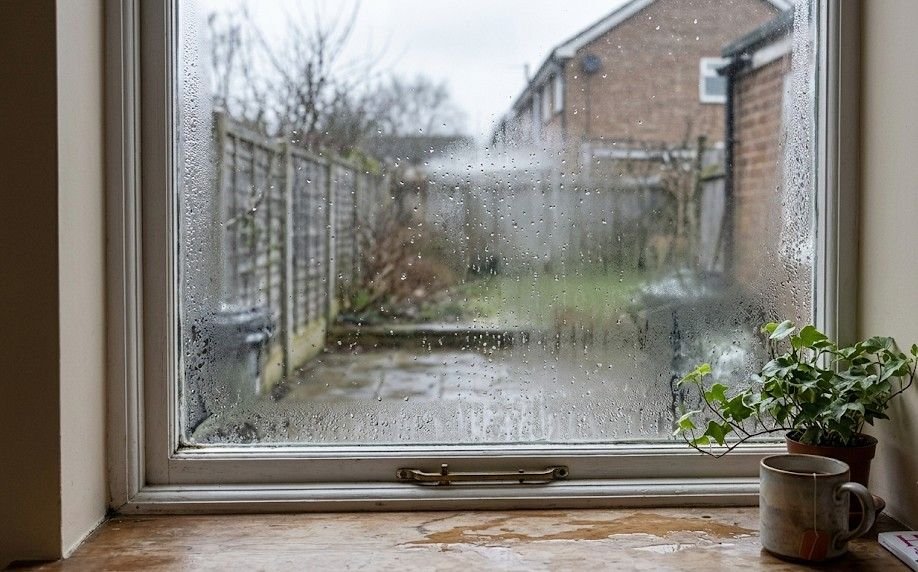
Water on the inside of the glass, especially first thing in the morning, means moist indoor air is meeting a cold surface. A bit of this on cold winter mornings is normal. If the sills are soaked every day, or the water runs down onto the frames, there’s too much moisture in the house.
Damp patches and mould
When surfaces stay damp, mould grows on walls, ceilings, window frames and soft furnishings. Mould from condensation usually looks like clusters of black or dark spots. A musty smell that doesn’t go away is another sign, even if you can’t see anything yet.
Humidity isn’t always to blame, though. Leaks, rain getting in and building defects can look very similar. There’s a table further down to help you tell them apart.
Health and comfort
Damp rooms feel stuffy and smell musty. UK government guidance says damp and mould mainly affect the airways and lungs, and can also affect the eyes and skin. Those at greater risk include people with asthma, allergies, COPD or other lung conditions, people with weakened immune systems, children, older people and pregnant women.
What Happens When Humidity Is Too Low?
Very dry air can leave your nose, throat, eyes and skin feeling uncomfortable, and you may notice more static shocks.
In UK homes it’s far more common to have too much moisture than too little. If your readings keep dropping below 40%, the usual culprit is a dehumidifier set too low or left running longer than it needs to be.
Don’t try to get the number as low as possible. You’re after a balance. Running a dehumidifier harder than you need to also costs money, which is covered in more detail in our dehumidifier running cost guide.
What Should Humidity Be in Different Rooms?
The same 40–60% target applies to most rooms, but they don’t all behave the same way. Most rooms will go over 60% now and then. What you want to know is whether it comes back down afterwards.
| Room | Normal for this room | Worth looking into |
|---|---|---|
| Bedroom | Climbs overnight from breathing, more so with the door and window shut | Heavy condensation most mornings, or mould on the window reveals or behind the wardrobe |
| Bathroom | Shoots well above 70% during a shower or bath | Still high an hour or two later, or mould on the ceiling or the sealant |
| Kitchen | Goes up when you cook, especially boiling or steaming | Mould around the window or on cold walls near the cooker |
| Living room | Usually the steadiest room in the house | Sitting above 60% for days with no obvious reason |
| Spare or unheated room | Often reads higher than everywhere else | A musty smell, or mould on stored boxes, furniture or walls |
Bathrooms and kitchens
High readings while you shower or cook are expected. Watch how quickly they fall afterwards. Many extractor fans have an overrun timer, and Building Regulations guidance says fans in rooms without an openable window should keep running for at least 15 minutes after you leave. If the bathroom is still well above 60% an hour or two after a shower, the fan or the ventilation isn’t keeping up.
Why cold spare rooms read higher
Relative humidity depends on temperature. Take air from a 20°C living room at 50% and let it drift into a 14°C spare room. With no extra moisture added at all, it will read about 73%.
That’s why unheated box rooms, and rooms where the washing gets dried, are often the first to grow mould. Keep the door shut and give the room a little heat during cold spells.
Does Indoor Humidity Change Between Summer and Winter?
Yes. Indoor humidity follows the weather, the heating, ventilation and everyday life in the house, so the same reading can mean different things in January and July.
Winter: watch cold surfaces, and keep ventilating
Winter is when condensation causes the most trouble, because windows and outside walls are cold. Aim for the lower half of the range at this time of year.
A lot of people keep the windows shut on grey, drizzly days, thinking the air outside is too damp to help. In winter that’s rarely true. Air at 5°C and 90% humidity actually holds very little water. Warm it up to 20°C indoors and its relative humidity drops to around 34%.
So opening a window for a few minutes after cooking or a shower still gets rid of moisture, even in the rain. GOV.UK ventilation guidance also says to leave trickle vents open and unblocked through the winter.
Summer: higher readings, lower condensation risk
Walls and windows are warmer in summer, so a slightly higher reading is less likely to turn into condensation. On warm, dry days, the Centre for Sustainable Energy says opening a window can work just as well as a dehumidifier. When it’s muggy outside, an open window may not bring the reading down much. Look at how the numbers move over a few days before deciding there’s a problem.
How to Check Humidity Levels in Your House
A digital hygrometer shows relative humidity and, on most models, room temperature too. These steps will get you more useful readings.
Place it sensibly
Put it in the room you want to check, away from direct sunlight, radiators, windows and anything that gives off heat or steam.
Look at trends, not one reading
Check it at different times over several days. Notice whether humidity rises after cooking, showering or overnight, and how long it takes to settle again. If you can, move it between rooms to find the ones that run highest.
Read temperature alongside humidity
55% in a 21°C room and 55% in a 15°C room are very different situations. The colder room is much closer to condensation forming on its walls and windows.
Check your hygrometer is accurate
Cheap hygrometers can be a few points out, and that matters when you’re watching for 60%. You can check yours with a simple salt test:
- Put a few teaspoons of table salt in a small cup or bottle cap.
- Add just enough water to turn it into a damp paste.
- Seal the cup and the hygrometer together in a food bag or airtight box, without letting them touch.
- Leave it somewhere with a steady temperature for at least 8 hours.
Damp salt keeps the air in a sealed space at about 75% humidity. If your hygrometer shows 70%, it’s reading roughly 5 points low, so add 5 to your readings from now on.
Is It High Humidity or Another Damp Problem?
A hygrometer can’t tell you where moisture is coming from, and it won’t pick up a leak, a blocked gutter or a building defect. Condensation is the most common type of damp in UK homes. Penetrating damp, rising damp and leaks can look much the same at first, but each one needs a different fix. UK government guidance also points out that rising damp is often misdiagnosed.
| Type of damp | What it usually looks like | Where you’ll find it | Will a dehumidifier help? |
|---|---|---|---|
| Condensation | Wet windows, black spotty mould, worse in winter and first thing in the morning | Cold surfaces: windows, outside wall corners, behind furniture, ceilings | Yes, along with ventilation and heating |
| Penetrating damp | Damp patches that spread or darken after heavy or wind-driven rain | Outside walls at any height, ceilings under the roof, around windows | Only to dry things out once the repair is done |
| Rising damp | A tide mark low on the wall, white salty deposits, crumbling plaster. Black mould is unusual | Ground-floor walls, usually within the bottom metre | No. Get it properly diagnosed |
| Leaks | A patch that stays wet whatever the weather, often with staining | Near pipes, under baths, sinks and showers, on ceilings below bathrooms | Only to dry things out once the repair is done |
Timing is often the giveaway. If a patch gets worse after rain, suspect penetrating damp. If it stays wet in a dry spell, look for a leak. Condensation comes and goes with the cold weather and gets better when you ventilate.
Rising damp only affects ground-floor walls. If you think you have it, get an independent assessment before paying for any treatment. And if the damp keeps coming back and you can’t work out why, it’s worth getting the property inspected properly instead of assuming humidity is the cause.
If you rent
Report damp and mould to your landlord in writing, and keep dates and photos. In England, social landlords now have to investigate and fix significant damp and mould hazards within set timeframes under Awaab’s Law, which came into force in October 2025. The government is consulting on how it will apply to private renting.
How to Reduce High Humidity in Your Home
If your readings are regularly above the recommended range, start with the moisture you’re creating and how it gets out.
Use extractor fans
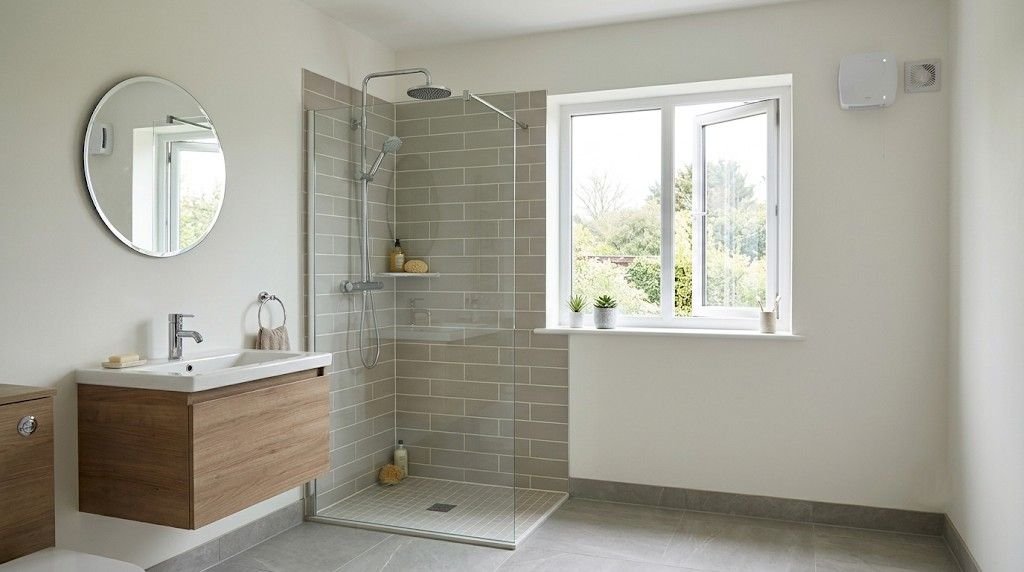
Switch on the kitchen or bathroom fan whenever there’s steam, and leave it running for a while afterwards. Clean the vents now and then, and get a faulty fan repaired.
Ventilate regularly
Keep trickle vents open. Open a window when it’s practical and safe, especially after cooking, showering or drying clothes. Don’t block air bricks or other permanent vents.
Keep doors closed during steamy jobs
Shut the kitchen or bathroom door while you cook, shower or dry washing. That keeps the moisture in one room, where the fan or open window can deal with it, and stops it spreading through the house.
Manage laundry and cooking moisture
Drying clothes indoors adds a lot of moisture. Research by the Glasgow School of Art found that a single load releases around 2 litres of water into the air as it dries. Dry washing outside when you can. When you can’t, give it an extra spin first, then dry it in one room with the door shut and either a window open or a dehumidifier running. Our guide to the best dehumidifiers for drying clothes covers models that suit this job.
Put lids on pans while you cook and use the cooker hood.
Keep the home adequately heated
Cold surfaces attract condensation. If you can afford to, don’t let rooms stay cold for long periods, and deal with any heating or insulation problems. Heating on its own won’t get rid of moisture, though, so ventilate as well.
Look for leaks and building defects
Check for dripping pipes, roof and gutter problems and failed seals around windows. The damp table above will help you work out whether humidity is really the cause.
When Should You Use a Dehumidifier?
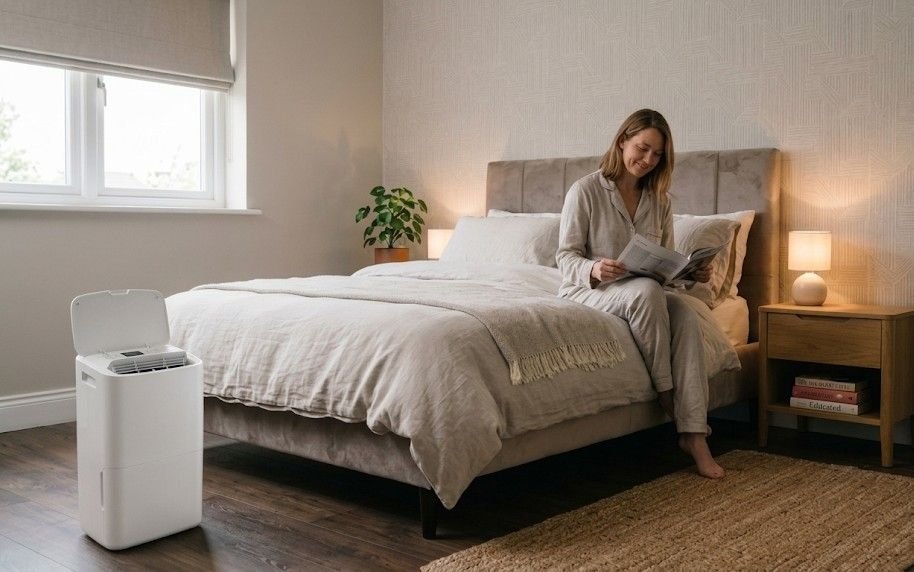
A dehumidifier pulls moisture out of the air. It’s most useful when humidity stays high even though you’re ventilating sensibly, or when you dry washing indoors a lot.
| A dehumidifier helps when | It won’t fix |
|---|---|
| Humidity stays above 60% for days despite ventilating | Leaks, penetrating damp or rising damp |
| You dry washing indoors regularly | A blocked or broken extractor fan |
| Condensation keeps coming back on windows and cold walls | Mould that’s already there (that still needs cleaning off) |
| You need to dry a room out after a leak has been fixed | A house that’s too cold most of the time |
Choosing and using one
- Capacity: The Centre for Sustainable Energy advises buying a model that removes at least 5 litres of water a day, and steering clear of the smaller, cheaper units. Our guide on what size dehumidifier you need explains how to match it to your home.
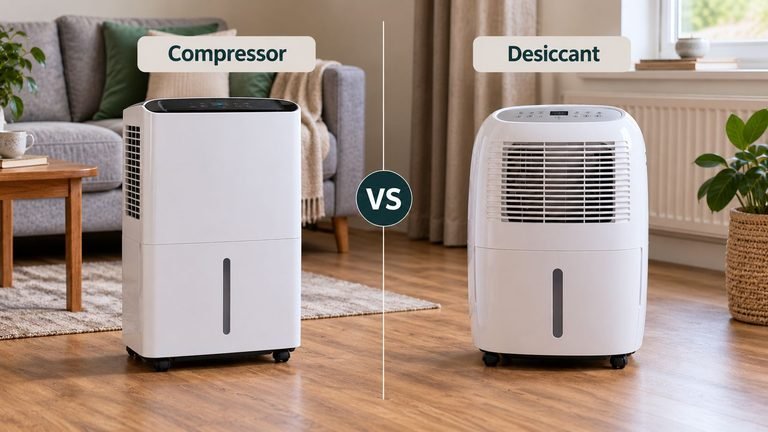
- Room temperature: Smaller compressor models struggle below about 15°C. In rooms that stay under 10°C, a desiccant model is usually the better buy. Our compressor vs desiccant dehumidifier comparison goes into this.
- Setting: Anything under 60% is enough for most rooms, and 50–55% suits everyday use. There’s not much point going lower unless you’re drying laundry.
- Doors and windows: Keep them shut while it runs. It works more efficiently that way.
- Placement: Where you put it makes a difference. See our guide on where to place a dehumidifier.
Empty the tank and clean the filter as the manufacturer recommends. If mould keeps coming back, or water is getting into the house, sort out the cause first. For an ongoing damp problem, our guide to the best dehumidifiers for mould and damp is a good place to start.
Frequently Asked Questions
Is 60% humidity too high for a house?
Not on its own. A short rise after a shower or cooking is normal. If your home stays above 60% most of the time, especially with condensation, damp or mould, look for where the moisture is coming from and ventilate more.
Is 70% humidity too high indoors?
If it lasts, yes. 70% is well above the recommended range, and at that level cold surfaces will start to get wet. Look at ventilation, possible leaks and any cold rooms. A single reading won’t tell you the cause.
Why do my windows have condensation when humidity is below 60%?
The glass and frames are much colder than the room. At 20°C and 55% humidity, anything below about 11°C will collect water, and windows often get colder than that on winter nights. Bringing humidity down a little and opening the windows for a few minutes in the morning both help.
What is the best humidity level for sleeping?
40–60% is a good range for a bedroom. Humidity often rises overnight, so check the reading when you wake up as well as before bed, and air the room in the morning.
Can a dehumidifier prevent mould?
It can cut condensation, which makes mould much less likely, but it can’t guarantee none. It won’t fix leaks, rain getting in or poor ventilation, and any mould already there still has to be cleaned off.
Does opening windows reduce humidity, even when it’s raining?
Usually, yes, especially after cooking or bathing. In winter, cold outside air holds very little moisture even when it’s raining, so once it warms up indoors the humidity drops. Open them for short bursts so you don’t lose too much heat, and use your extractor fans and trickle vents too.
Conclusion
Aim for 40–60% relative humidity, with around 50% as a good everyday figure. Short spikes are nothing to worry about. Readings that stay high, windows that are wet every morning and mould that keeps coming back are a different matter.
Keep in mind that a hygrometer only measures the air. In winter, a cold wall or window can be damp enough for mould while the room reading looks fine, so in a colder home it pays to aim a little lower. Most condensation problems come down to ventilation, moisture from daily life and heating. If damp keeps returning, find out why before you rely on a dehumidifier. And if a dehumidifier does turn out to be the answer, our best dehumidifiers UK guide compares the options.