What Size Dehumidifier Do I Need? 10L vs 12L vs 20L Explained
Most people choose a dehumidifier by the number on the box. 10L sounds small, 12L sounds about right and 20L sounds like something for a flooded cellar. That number is far less useful than it looks.
It’s an extraction rating, measured in warm, very humid test conditions. It isn’t the size of the tank, and it isn’t anywhere near what you’ll empty out of a heated British house in January. What you actually need depends on how much moisture your household puts into the air, how warm you keep the place and whether the washing gets dried indoors. Floor area comes into it, just not as much as the sizing charts on product pages suggest.

To put proper numbers on it, we’ve used Meaco’s published data for the 10L, 12L and 20L versions of the same dehumidifier. It shows what each size removes at normal room temperatures. From there we’ve worked out what that means for laundry, damp and your electricity bill.
What size dehumidifier do I need? The quick answer
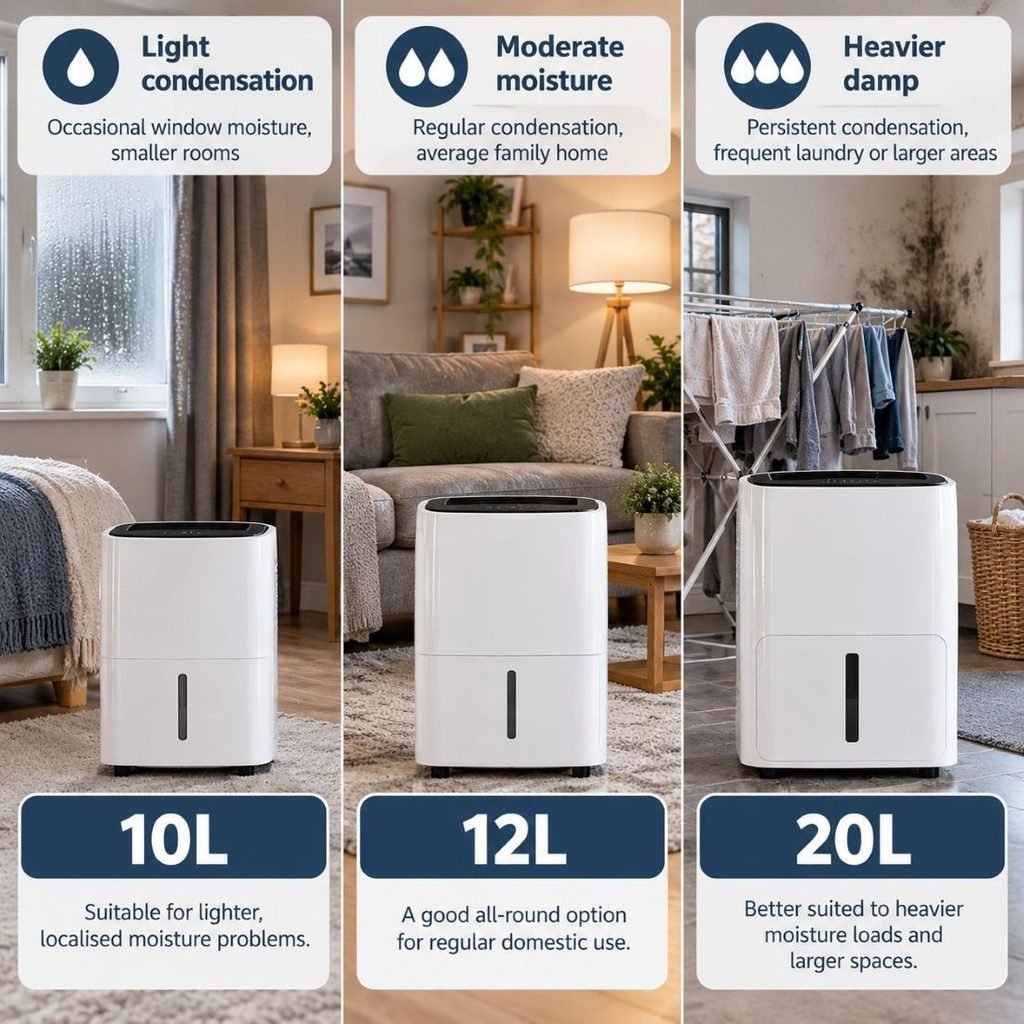
If you’re not sure, get a 12L. It suits most flats and small to mid-sized houses. A 10L is fine for one room or a small flat with a bit of window condensation. Go for a 20L if washing is dried indoors most days, or if you’ve got damp or mould that won’t stay away.
| Your situation | Size to start with | Why |
|---|---|---|
| One bedroom or studio, occasional window condensation | 10L | A light job. A small machine copes without running all day. |
| One or two-bed flat, regular condensation | 12L | More extraction than a 10L, and in some ranges no extra running cost. |
| A load of washing dried indoors a few times a week | 12L | Dries a load in a closed room well within a day. |
| Family home, washing dried indoors most days | 20L | Two loads a day will keep a 10L or 12L running almost constantly. |
| Damp or mould in more than one room | 20L | Pulls humidity down faster and needs less runtime to keep it there. |
| Cold garage, unheated room or conservatory | Check the type first | In a cold space, compressor or desiccant matters more than litres. |
These aren’t hard rules. Two houses with identical floor plans can need different machines, depending on who lives there and how they use the place.
What does 10L, 12L or 20L actually mean?

A 10L dehumidifier can remove up to about 10 litres of water from the air in 24 hours, in the conditions the manufacturer tested it in. The same goes for 12L and 20L.
Most compressor dehumidifiers sold in the UK get their headline figure at 30°C and 80% relative humidity (RH). That’s a humid summer’s day somewhere much warmer than here, not a living room in Leeds. At normal indoor temperatures the machine pulls out far less, because cooler, drier air holds less water. Nothing’s wrong with the dehumidifier when this happens. It’s just physics.
A “12L” from one brand isn’t always a 12L from another
Rating conditions vary between listings, which makes comparing brands trickier than it should be.
| Rating condition | Where you’ll see it | What it means for you |
|---|---|---|
| 30°C / 80% RH | The usual headline figure on UK listings | Expect well under half this in a heated home. |
| 32°C / 90% RH | Used by some brands, including Ebac | Warmer, wetter test air flatters the number. A 12L rated this way is a smaller machine than a 12L rated at 30°C/80%. |
| 27°C / 60% RH | Often listed as a second, lower figure | Closer to real life. Meaco quotes 6L, 7.5L and 12L at this condition for its 10L, 12L and 20L Arete Two. |
No conditions listed at all? Then treat the litre figure as a rough size class and look for another model with proper data.
Extraction rate isn’t tank size
People mix these up all the time. Extraction rate is how much water the machine removes in a day. Tank capacity is how much the bucket holds before you have to empty it. Most 20L machines have a tank of four or five litres, and 10L and 12L models usually hold about 2.5 litres.
A bigger tank means fewer trips to the sink and that’s all. If the dehumidifier can sit near a drain or sink, you can run a hose and forget about the tank altogether.
How much water does each size really remove in a UK home?
Meaco publishes full extraction tables for the MeacoDry Arete Two, which comes in 10L, 12L and 20L versions of the same design. That makes it about as fair a comparison as you’ll get of what the extra litres actually buy.
| Room conditions | Arete Two 10L | Arete Two 12L | Arete Two 20L |
|---|---|---|---|
| 30°C / 80% RH (the box figure) | 10.75 L/day | 11.99 L/day | 20.45 L/day |
| 20°C / 80% RH (very humid room, wet washing) | 6.99 L/day | 8.51 L/day | 13.85 L/day |
| 20°C / 60% RH (typical heated room) | 4.19 L/day | 5.40 L/day | 8.50 L/day |
| 10°C / 60% RH (cold spare room) | 1.38 L/day | 1.97 L/day | 3.35 L/day |
| Power draw at 20°C / 60% RH | 136 W | 136 W | 207 W |
Read across the 20°C/60% RH row, because that’s the one closest to most homes in winter. Each machine manages only 42 to 45% of the number on the box. The “20L” is really an 8.5 litre machine in your living room, and the “10L” is closer to 4.
The 10L and 12L are worth a second look. They share the same body and both draw 136 W at those conditions, yet the 12L removes about 29% more water. Not every brand works this way, but it’s a good reason not to write off 12L as a marketing step.
The jump from 12L to 20L is bigger again, about 57% more water. That’s where the real difference in capacity is.
These are figures for one compressor range, so other models will land in different places. The overall picture doesn’t change, though. Headline figures shrink at room temperature, and they shrink a lot more in a cold room.
How much moisture does your home actually produce?
Breathing, cooking, showers and washing all put water into the air. A family of four typically produces somewhere around 10 to 14 litres a day, according to figures from BS 5250, the British Standard on condensation. A good chunk of that escapes through extractor fans, trickle vents and opened windows. The dehumidifier only has to deal with what’s left.
Laundry is the part that catches people out. Research from the Glasgow School of Art found an average load of washing releases around 2 litres of water as it dries indoors. Put two loads on the airer in a day and that’s about 4 litres on top of everything else.
Worked example: can each size keep up with two loads a day?
Take that 4 litre figure and the 20°C/60% RH extraction rates from the table above. This is how long each machine would need to run:
| Size | Extraction at 20°C / 60% RH | Hours needed to remove 4 litres | In practice |
|---|---|---|---|
| 10L | 4.19 L/day | About 23 hours | On almost all day, every day |
| 12L | 5.40 L/day | About 18 hours | Copes, but nothing spare for a wet week |
| 20L | 8.50 L/day | About 11 hours | Comfortable, with time to spare |
Our rule of thumb from this: if a machine would have to run more than about 16 to 18 hours a day at normal room conditions just to keep up, buy the next size up. A dehumidifier that’s always on full has nothing left for a rainy week, and you’ll be living with the fan noise most of the day.
Choose dehumidifier by moisture level, not just room size
Room size gets you started, but it’s a poor way to make the final call. A bedroom with one person in it and the odd misty window is a different job from the same-sized room with two people, a clothes airer and wet windowsills every morning.
| Moisture level | Typical signs | Size direction |
|---|---|---|
| Light | Occasional condensation on one or two windows, no mould, washing mostly dried outside or in a tumble dryer | 10L for one room, 12L for a flat |
| Moderate | Condensation most winter mornings, a musty smell in one room, washing dried indoors a few times a week | 12L |
| Heavy | Streaming windows, black mould in corners, washing dried indoors daily, humidity above 70% that comes straight back after airing | 20L |
A few questions worth answering before you buy:
- Is the problem in one room, or all over the house?
- How often does washing get dried indoors, and where?
- How warm is the room when the machine will be running?
- Will it be shut in one room, or sat on a landing with the doors open?
- Does the humidity shoot back up after you’ve had the windows open?
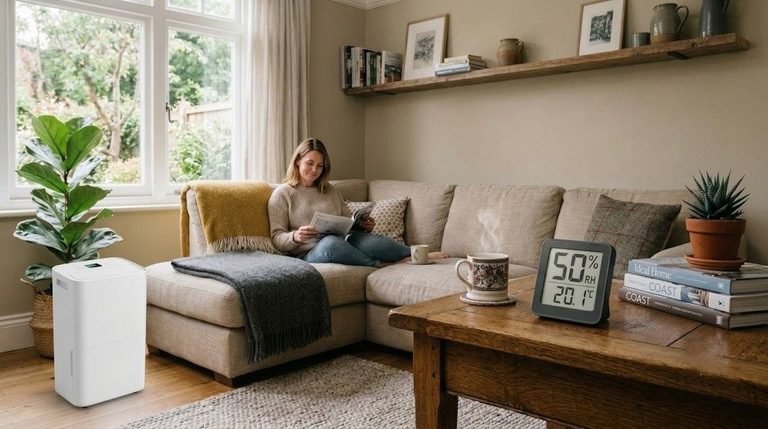
A cheap digital hygrometer is worth having for this. A week of readings tells you more than guesswork, and later on you can use it to see whether the dehumidifier is doing its job.
10L vs 12L vs 20L: which size suits which home?
| 10L | 12L | 20L | |
|---|---|---|---|
| Best fit | One room, studio or small flat | Most flats and 1 to 3-bed homes | Busy family homes, frequent laundry, persistent damp |
| Realistic output in a heated room | About 4 L/day | About 5 to 5.5 L/day | About 8 to 9 L/day |
| Typical tank | Around 2.5 L | Around 2.5 L | Around 4.5 to 5 L |
| Size and weight (Arete Two example) | 47 cm tall, 10.7 kg | 47 cm tall, 10.9 kg | 62 cm tall, 15.1 kg |
| Quietest setting (Arete Two example) | From 35 dB | From 35 dB | From 38 dB |
| Price (Meaco list price, Oct 2026) | £179.99 | £199.99 | £299.99 |
10L dehumidifiers: for one room or light condensation
A 10L works when the job is small: a bedroom with winter condensation on the windows, a box room that smells a bit musty, a studio where nobody dries washing indoors. These are usually the cheapest and most compact machines, and most of the compressor models in our best dehumidifiers under £100 guide are in this class.
The trouble starts when you ask more of it. At room temperature you’re getting around 4 litres a day, so regular laundry or damp in several rooms will keep a 10L running flat out for most of its life.
- Choose 10L if it’s for one room, the moisture is light, and money or space is tight.
- Skip 10L if washing gets dried indoors more than now and then, or the condensation is all over the house.
12L dehumidifiers: where most homes should start
For most households, 12L is the one to buy. You get a proper step up in extraction over a 10L without the bulk and price of a 20L. In some ranges it uses no more electricity than the 10L next to it on the shelf, either.
It handles winter condensation and a load of washing indoors a few times a week. In a flat or smaller house it can sit in the hallway or on the landing and look after the rooms around it. Don’t assume every 12L beats every 10L, though. Airflow, controls and the rating conditions all vary, so compare the published figures rather than the number on the front.
- Choose 12L if you want one machine for condensation plus occasional laundry in a typical flat or small house.
- Skip 12L if you’re drying a family’s washing indoors every day, or dealing with mould that’s already established in several rooms.
20L dehumidifiers: when the extra capacity is worth it
A 20L compressor model makes sense when there’s a lot of moisture to shift: washing dried indoors every day, four or more people in the house, a bigger property, or damp that’s back within hours of airing. At room temperature it removes 8 to 9 litres a day. That’s enough to bring humidity down quickly and then keep it there, with the compressor clicking on and off rather than running all day.
The downsides are mostly physical. It’s taller and heavier (the Arete Two 20L weighs 15.1 kg), a little louder on its lowest setting, and dearer to buy. If you’ll be carrying it up and down the stairs, castors and a decent handle matter more than a few extra litres.
- Choose 20L if most of your washing is dried indoors, the house is big or busy, or damp and mould keep coming back.
- Skip 20L if it’s for one small bedroom with a bit of condensation. You’d be paying for capacity you’ll hardly use.
What size dehumidifier for drying clothes?
Laundry is usually the reason people end up needing a bigger machine than they planned for. A load gives off around 2 litres of water as it dries, and most of it comes out in the first few hours, so the air round the airer gets very damp very quickly.
Meaco’s 20°C/80% RH figures are a fair stand-in for a closed room with wet washing in it. On those numbers, this is the quickest each size could pull 2 litres out of the air:
| Size | Extraction at 20°C / 80% RH | Best-case time to remove 2 litres |
|---|---|---|
| 10L | 6.99 L/day | About 7 hours |
| 12L | 8.51 L/day | About 5.5 hours |
| 20L | 13.85 L/day | About 3.5 hours |
For a load a few times a week in a heated room, a 12L is plenty. Drying most days, or doing two loads back to back? That’s when a 20L earns its keep.
Where you put things makes a big difference too. Shut the door so you’re drying one room and not the whole house. Leave gaps between clothes on the airer, and point the airflow across the washing rather than at the wall. A laundry mode helps. We cover the machines that do this best in our guide to the best dehumidifiers for drying clothes.
What size dehumidifier for a bedroom?
A 10L or 12L is plenty for a bedroom with light condensation. There’s not much point buying a 20L because the number’s bigger, especially when it’s going to sit a few feet from your bed.
Noise matters at least as much as size in here. Check the dB figure on the lowest fan speed, whether there’s a night mode that dims the display, and whether it beeps when the tank’s full. A small machine ticking over quietly usually makes a better bedroom dehumidifier than a big one switching on and off through the night.
Bear in mind the bedroom might just be where the condensation shows. If the moisture is really coming from washing or cooking elsewhere in the house, a machine sized for that one room won’t fix it.
What size dehumidifier for a flat or a whole house?
The bedroom counts on product listings are a reasonable guide, but they’re based on an average household. How many people live there, how the washing gets dried and how warm you keep things can easily push you a size either way.
- Studio or one-bed flat: 10L if the moisture is light, 12L if you dry washing indoors.
- Two or three-bed flat or house: 12L for most households, 20L if laundry is a daily job or there’s established damp.
- Four-bed house or bigger: a 20L in a central spot, or two smaller machines if the layout is very broken up.
Position counts. One portable dehumidifier on a landing or in a hallway can make a difference to the rooms around it, as long as the doors are open. It won’t do much for a shut room at the other end of the house.
Does temperature change the size you need?
More than you’d think. Go back to the 10°C row in the table further up. The 12L Arete Two drops from 5.40 litres a day at 20°C to 1.97 litres at 10°C. Any compressor machine loses most of its output in a cold room, and many aren’t designed to run below about 5°C at all.
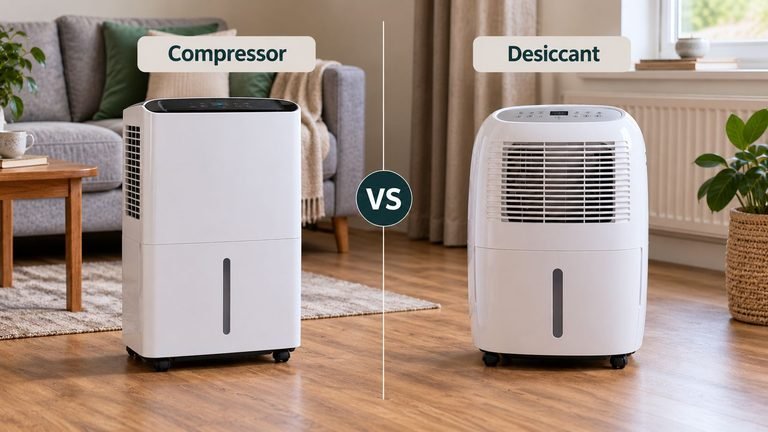
So buying bigger isn’t always the fix. For a garage, an unheated conservatory or a spare room that sits in single figures all winter, a desiccant dehumidifier is often the better choice, because its output holds up much better in the cold. It does use more electricity in a warm room. Our compressor vs desiccant dehumidifier guide explains where the line falls.
Does a bigger dehumidifier cost more to run?
Per hour, usually. Per litre of water removed, not necessarily, and per litre is what tells you whether you’re getting your money’s worth.
We’ve worked these out from Meaco’s power figures at 20°C/60% RH. The electricity price is the Ofgem price cap rate of 26.32p per kWh, which covers direct debit customers in England, Scotland and Wales from 1 October to 31 December 2026.
| Size | Power at 20°C / 60% RH | Cost per hour | Cost per litre removed | Cost to remove 4 litres a day for 30 days |
|---|---|---|---|---|
| 10L | 136 W | About 3.6p | About 20.5p | About £24.60 |
| 12L | 136 W | About 3.6p | About 15.9p | About £19.10 |
| 20L | 207 W | About 5.4p | About 15.4p | About £18.50 |
The 20L costs half as much again per hour, but it shifts so much more water in that hour that each litre works out slightly cheaper than on the 12L. Over a month of heavy use it comes out a little ahead, because it gets the job done and then sits idle.
The 10L is the poor value one here. Same power draw as the 12L, less water out, so every litre costs more. The gap won’t be the same for every brand, but don’t assume the smallest machine is automatically the cheapest to run.
Real bills will be lower than these figures suggest, because a humidistat switches the compressor off once the room reaches your target. Our dehumidifier running costs guide has hourly, daily and monthly costs for more models. Your own rate depends on your tariff and region, and Ofgem publishes the current price cap unit rates every quarter.
Is a bigger dehumidifier always better?
No. A 20L in a small flat with light condensation will hit its target quickly and then spend most of its time doing nothing. You’ll have paid more for it, and it takes up more floor space. Buying too small is usually the worse mistake, though. An undersized machine runs flat out for hours, costs more per litre, and on wet days it may never get the room down to where you want it.
Whatever you buy, set the humidistat rather than leaving it on continuous. Somewhere around 50 to 55% RH is a good everyday target for a UK home. Council damp and mould guidance commonly flags long spells above 70% as the point where mould becomes a real risk, so if your readings sit up there, that’s the first number to bring down. If damp or mould is the main reason you’re buying, our pick of the best dehumidifiers for mould and damp covers machines suited to heavier moisture.
FAQs
Is a 10L dehumidifier big enough?
For one room or a small flat with light condensation, yes. In a heated room a 10L compressor model removes around 4 litres a day. That’s fine for a few misty windows, but it’s stretched by regular indoor laundry or damp in several rooms.
Is a 12L dehumidifier enough for a whole house?
Often, in a flat or a smaller two or three-bed house with moderate moisture. Put it somewhere central and leave the internal doors open. A bigger house, a busy family or daily indoor washing calls for a 20L.
Is a 20L dehumidifier too big for a bedroom?
It’ll do the job, but it’s more machine than most bedrooms need. It’s bigger, heavier and a touch louder on its quietest setting. A 10L or 12L with a decent night mode is usually the better fit.
What does 20 litres per day actually mean?
That’s the most the machine can extract in 24 hours in the manufacturer’s test conditions, usually 30°C and 80% RH. In a heated room at 20°C and 60% RH, expect closer to 8 or 9 litres. It has nothing to do with the tank.
Does a bigger dehumidifier use more electricity?
Per hour, yes. Per litre of water removed, it can be about the same or even a bit less. On Meaco’s figures a 20L costs about 15.4p per litre against 15.9p for a 12L.
Should I get a 12L or 20L for drying clothes?
A 12L will handle a load a few times a week in a closed, heated room. If you’re drying most days, or two loads at once, get the 20L. It’s much quicker and leaves capacity for the rest of the house.
Is it better to have two small dehumidifiers or one big one?
In an open-plan home, or one with a central hallway, one bigger machine is simpler and cheaper. If the problem rooms are at opposite ends of a house with lots of closed doors, two smaller ones where they’re needed can beat one big one in the wrong place.
Final verdict
Still not sure what size dehumidifier you need? Buy a 12L. It covers more UK homes than any other size, removes noticeably more than a 10L, and in some ranges costs no more per hour to run.
Move up to a 20L if laundry or damp is an everyday problem rather than an occasional one. At room temperature it removes around 57% more water than a 12L for about the same cost per litre, so you’re not wasting money on capacity you’ll use. A 10L only really makes sense for a single room or a small flat with light condensation.
When you compare models, ignore the headline figure as far as you can and look for what each one extracts at about 20°C and 60% RH. That tells you far more about how it’ll cope in your home than the number on the box. Our best dehumidifiers in the UK guide is a good place to start comparing.