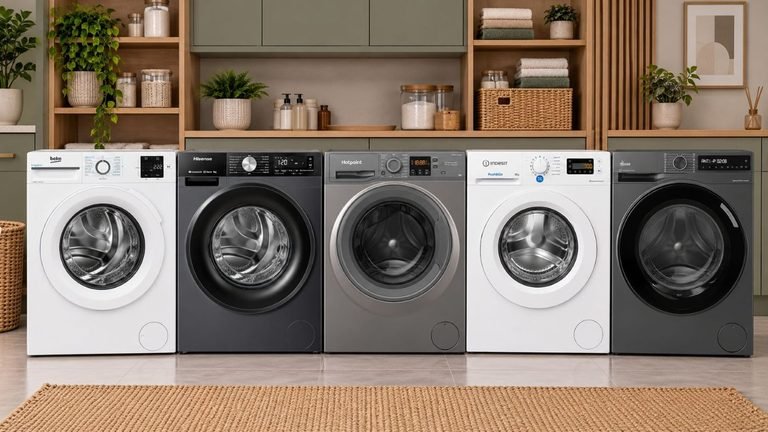
1200 vs 1400 vs 1600 RPM Washing Machine: Is Faster Worth It?
Spin speed is usually the second number on a washing machine’s spec list, right after drum size, and it’s easy to assume higher is better. Sometimes it is. Often it makes less difference than the price gap suggests. A 1600rpm machine won’t always leave your washing drier than a 1400rpm one, and a lot of 1200rpm and 1400rpm machines get exactly the same spin result on their energy labels.

We went through the UK energy label rules and a pile of manufacturer product sheets to see what a faster spin really gets you. That means how much water stays in a load, what it’s worth if you tumble dry, and whether a faster machine is a louder one.
Quick answer
- Most households: go for 1400rpm. Plenty of budget machines have it, so you’re not paying much extra for it.
- Mostly air-drying everyday clothes: 1200rpm is fine. Several of the 1200rpm machines we looked at got the same spin-drying class as 1400rpm models.
- Lots of tumble drying or indoor drying: 1600rpm can help, but only if the model is spin-drying class A. Even then, the dryer saving is roughly £9 to £29 a year.
- Whatever you buy: check the spin-drying class on the energy label. It tells you more than the rpm does.
1200 vs 1400 vs 1600 rpm washing machine at a glance
| 1200rpm | 1400rpm | 1600rpm | |
|---|---|---|---|
| Spinning force compared with 1200rpm | Baseline | About 36% more | About 78% more |
| Spin-drying class in the UK examples we checked | B (53%) | B (53%), with some class A models | A (44%), but some are B |
| Water left in a full 8kg load at those figures | About 4.2 litres | About 4.2 litres (about 3.6 at class A) | About 3.5 litres |
| Best for | Everyday mixed washing, mostly air-dried | Most households | Frequent tumble drying, indoor drying, towels and bedding |
| Watch out for | A spin class lower than B | Paying more just for the rpm | A 1600rpm machine that’s still class B |
The force row is basic physics, since force goes up with the square of the speed. The spin classes and moisture figures come from manufacturer product sheets for the models listed further down. Two machines with the same rpm can still leave different amounts of water in the clothes.
What does rpm mean on a washing machine?
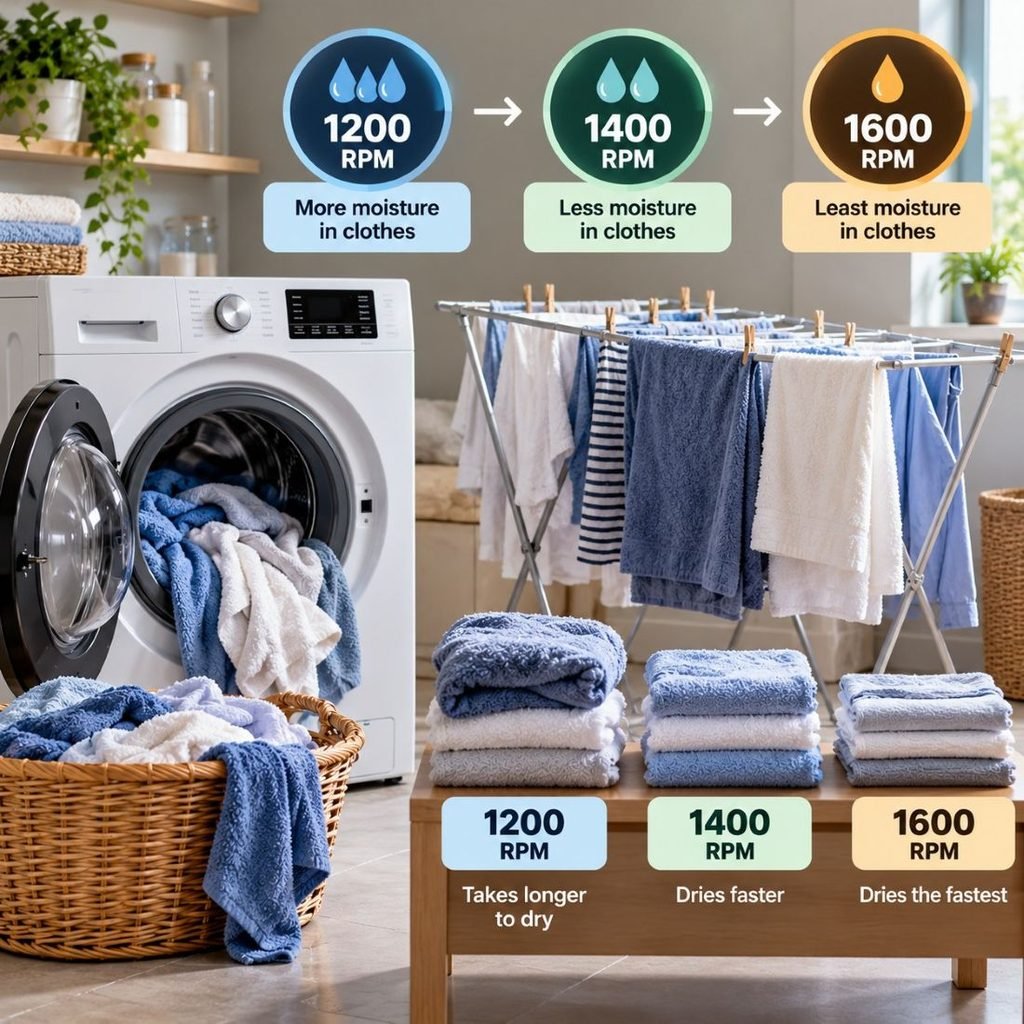
RPM stands for revolutions per minute, the number of times the drum turns in a minute when it’s spinning. Faster spinning throws more water out of the fabric and through the holes in the drum.
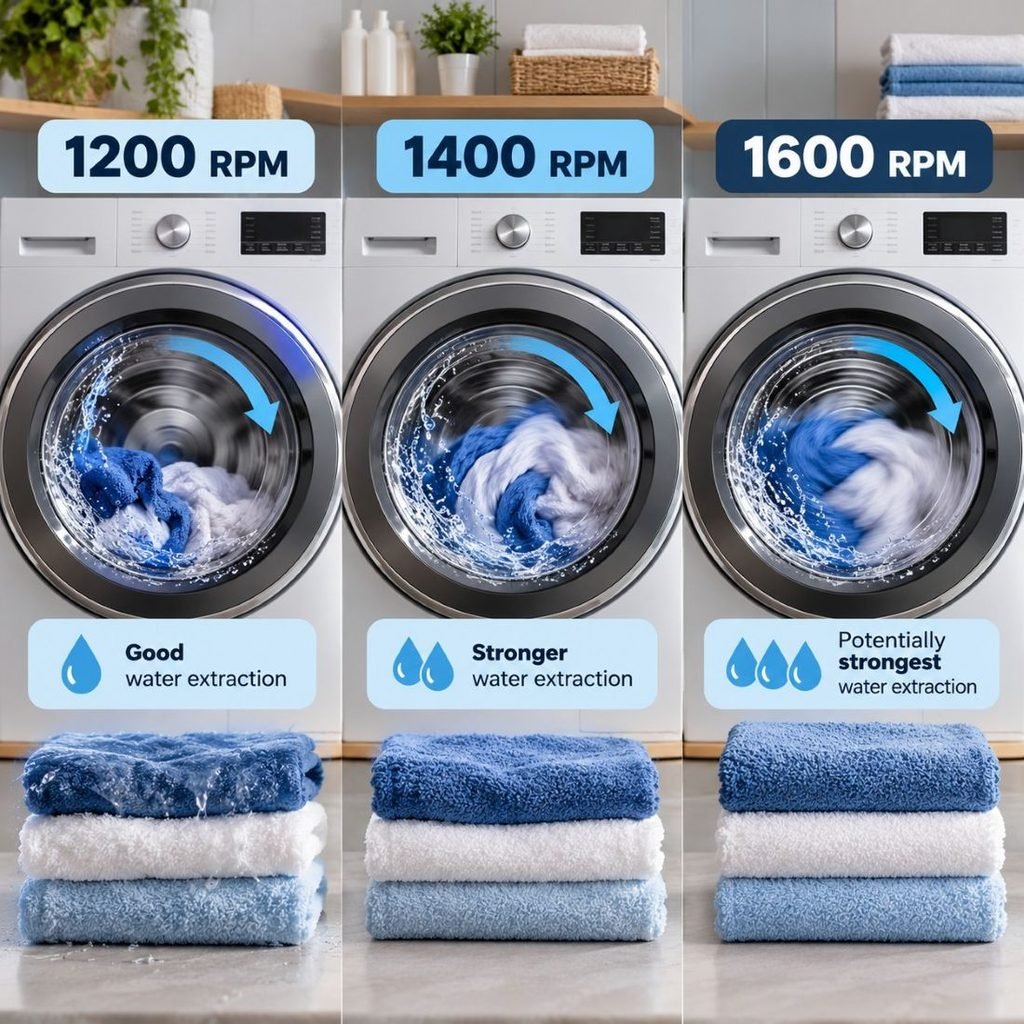
The force goes up more steeply than the numbers suggest, because it rises with the square of the speed. 1400rpm gives about 36% more force than 1200rpm, and 1600rpm adds roughly another 31% on top. For a drum with a 25cm radius, that works out at around 400, 550 and 715 times the force of gravity.
Your clothes won’t come out 36% drier, though. The loose water goes first, and whatever’s left in the fibres is much harder to get out. That’s why the label results further down barely move between some speeds.
Don’t expect every wash to hit the top speed either. Plenty of programmes limit the spin to protect fabrics, and the machine will slow down or skip the fast spin if the load won’t balance. Even Eco 40-60 doesn’t always run at full speed.
Spin-drying class: what to check instead of rpm
Every new washing machine’s energy label has a spin-drying efficiency class, from A to G, printed near the noise figure. It’s based on remaining moisture content, which is how much water is still in the washing after the spin, worked out as a percentage of what the laundry weighs dry. It has nothing to do with the energy class.
| Spin-drying class | Remaining moisture content |
|---|---|
| A | Below 45% |
| B | 45% to below 54% |
| C | 54% to below 63% |
| D | 63% to below 72% |
| E | 72% to below 81% |
| F | 81% to below 90% |
| G | 90% or more |
Source: Regulation (EU) 2019/2014, Annex II, Table 3, which still applies in Great Britain in its UK form.
The lower the percentage, the drier the washing. 53% doesn’t mean the drum is half full of water. It means an 8kg load comes out holding about 4.2kg of water, which is 4.2 litres.
How the test works
A few details in the rules explain most of the oddities you’ll come across when comparing machines.
- The class only covers the Eco 40-60 programme. It’s tested at the highest spin speed Eco 40-60 allows, with a full load, a half load and a quarter load, and the three results are averaged with a weighting.
- That Eco spin speed is sometimes lower than the speed on the front of the machine, and the product information sheet has to list it. Indesit sells the BWE 111496X WV UK as a 1400rpm machine, but its sheet shows 1,351rpm on Eco 40-60 at all three load sizes.
- 53% comes up again and again. It’s just under the 54% cut-off for class B, and we found it on 1200rpm and 1400rpm machines.
- You can look all of this up yourself. Scan the QR code on the energy label and it takes you to the model’s product information sheet.
What the labels say: UK examples
| Model (UK) | Max spin | Spin-drying class | Remaining moisture | Spin noise |
|---|---|---|---|---|
| Beko WTK82011 (8kg) | 1200rpm | B | 53% | 74dB, class B |
| Beko WTIK84121 (8kg, integrated) | 1400rpm | B | 53% | 67dB, class A |
| Indesit BWE 111496X WV UK (11kg) | 1400rpm (1,351rpm on Eco 40-60) | B | 53% | 76dB, class B |
| Beko WTIK86151F (8kg, integrated) | 1600rpm | A | 44% | 71dB, class A |
Figures from each manufacturer’s UK product page or product information sheet, Eco 40-60 programme. The Beko figures are for a full load and the Indesit figure is the weighted average across load sizes. The Beko WTIK86151F has since been discontinued, but it’s a useful example of a class A 1600rpm machine.
Look at the first two Bekos. The 1200rpm and 1400rpm models have the same spin result, so on Eco 40-60 the extra 200rpm makes no measurable difference. Only the 1600rpm Beko gets into class A.
That isn’t a rule, though. In our best washing machines under £400 guide, the 1600rpm Hoover is class B and a 1400rpm LG is the only class A machine on the list. So a high rpm figure on its own doesn’t tell you much. The spin-drying class comes from an actual test, which makes it the better guide.
Is 1200rpm enough?
For a lot of homes, yes. Shirts, trousers, school uniform and everyday family washing are all fine at 1200rpm. And as the Beko pair above shows, a 1200rpm machine can get the same label result as a 1400rpm one.
Heavy cotton is where it might lag behind, so think towels, jeans and bedding. That’s more of an issue if you use a tumble dryer a lot or you’re short on space to hang things. Some budget machines also have a spin class below B, so check the label.
A lower spin speed isn’t a reason to rule a machine out. If the 1200rpm model is cheaper and has the programmes you’ll use, it could easily be the better buy.
Why 1400rpm is a sensible middle ground
1400rpm suits most people, and it doesn’t cost much to get. As our best washing machines under £300 guide shows, £300 is enough for an A-rated 1400rpm machine from a well-known brand. That’s a strong enough spin for towels and cottons, and you can turn it down for anything delicate.
A 1400rpm machine isn’t automatically quieter, gentler or cheaper to run than a 1600rpm one. That depends on the model. What it does do is take spin speed out of the decision, so you can concentrate on size, programmes, running costs and price.
When is 1600rpm worth considering?
It’s worth a look if most of your washing is heavy cotton, like towels, sheets and jeans, and you either tumble dry a lot or dry indoors over the winter. Less water in the load means less time on the airer or in the dryer.
Check the spin-drying class first. A 1600rpm machine in class B is in the same class as most 1400rpm machines, and some 1200rpm ones, so you’d be paying for speed that doesn’t show up on the label.
1200 vs 1400 rpm: will you notice a difference?
Maybe not. In the label data we looked at, going from 1200 to 1400rpm often made no difference to the declared result. Both came out at 53%. You might see a small benefit with thick cotton on a programme that runs at full speed, but there’s no way to tell how much from the rpm, and on a quick wash with a capped spin you may not see any.
If you wash mostly lighter clothes and dry them on an airer in a well-ventilated room, a good 1200rpm machine is plenty. If you’re doing several loads a week with not much space to dry them, compare the spin class and moisture figure on both machines. If they match, the 1400rpm one won’t get your washing any drier.
1400 vs 1600 rpm: is the extra speed worth paying for?
Only if the 1600rpm machine has a better spin class. When both machines are in the same class and have similar noise figures, there’s little reason to pay more for the faster one. It’s a different story if the 1600rpm model is class A, the 1400rpm one is class B and you tumble dry a lot of cotton. We’ve worked out what that’s worth below.
What a class A spin saves on a tumble dryer
Start with a full 8kg load. At 53% remaining moisture it holds about 4.24 litres of water after the spin. At 44% it holds about 3.52 litres. That leaves the dryer 0.72 litres less to get rid of, about 17% less.
To turn that into money, we used tumble dryer energy labels. The standard cotton test starts with the washing at 60% moisture and dries it to 0%, so an 8kg dryer’s full-load figure is the energy it takes to remove 4.8 litres of water. Divide the kWh by 4.8 and you get the electricity per litre.
| Tumble dryer (8kg, label figure) | Full-load energy | Per litre removed | Saved per load (0.72 litres) | Saved per year (3 loads a week) |
|---|---|---|---|---|
| Condenser, class B (Beko DTLCE80121W) | 4.75kWh | 0.99kWh | About 19p | About £29 |
| Heat pump, A++ (Siemens iQ300 WT45M232GB) | 1.87kWh | 0.39kWh | About 7p | About £12 |
| Heat pump, A+++ (Beko B3T4824D) | 1.44kWh | 0.30kWh | About 6p | About £9 |
Assumptions: electricity at 26.32p per kWh, the Ofgem price cap average for Direct Debit customers in England, Scotland and Wales from 1 October to 31 December 2026. 156 full dryer loads a year. Formula: (label kWh ÷ 4.8) × 0.72 litres × 26.32p. We’ve assumed dryer energy goes up in line with the water removed, which is a simplification, so take these as rough guides.
Say the class A 1600rpm machine costs £100 more than a similar class B 1400rpm one. With a condenser dryer, the savings would take about three and a half years to cover that. With a heat-pump dryer it’s nearly nine years for an A++ model and around 11 for an A+++. And if you hardly ever use a tumble dryer, you won’t save anything.
How spin speed affects drying time
Less water in the clothes means less drying. You’ll notice it most in a wet British winter, when the washing line’s no use and a full airer can take all day.
It’s easier to picture in litres than percentages:
| Load (dry weight) | Class A (44%) | Class B (53%) | Mid class C (60%) |
|---|---|---|---|
| 8kg | 3.5 litres | 4.2 litres | 4.8 litres |
| 10kg | 4.4 litres | 5.3 litres | 6.0 litres |
Water left in a full load = dry load weight × remaining moisture percentage. 60% is an example figure from the middle of class C.
If you do four full 8kg loads a week, a class A machine leaves almost 3 litres less water to dry out of your home each week than a class B one. Drum size changes the sums as well, which we’ve looked at in our 8kg vs 9kg washing machine guide.
The label can’t tell you how much drying time you’ll save. That depends on the fabric, how warm the room is, ventilation, humidity, how crowded the airer is and how you dry. If you see a claim like “1600rpm dries clothes 20% faster”, check how it was measured before you believe it.
When you dry indoors, all that water goes into the air in your home. A faster spin helps, but it won’t fix that by itself. A dehumidifier for drying clothes pulls the moisture out of the room and speeds up drying. We’ve also compared a dehumidifier vs tumble dryer and a dehumidifier vs heated airer if you’re still working out how to dry.
Does a faster spin use more electricity?
Not enough to matter. The fast spin is a small part of a long programme, and the Eco 40-60 figure on the energy label already includes it. A 1600rpm machine doesn’t automatically cost more, or less, to run than a 1400rpm one. The 1200rpm Beko WTK82011 and the 1600rpm Beko WTIK86151F are both energy class C, for example, and lots of 1400rpm machines from other brands are class A.
To compare running costs, use the kWh per 100 cycles on the energy label. It’s measured on Eco 40-60, so it won’t match every wash you do, but every machine goes through the same test. If you use a tumble dryer, the spin class will affect your bills more than any small difference in the washing machine’s own electricity.
Are higher spin speeds noisier?
Not always. A faster spin can make vibration and wobble more noticeable, but the way the machine’s built makes more difference. Suspension, the motor, the cabinet, whether it’s level and what kind of floor it stands on all play a part.
The energy label shows spin noise in decibels, with a class from A to D. Class A is under 73dB, B is 73 to 76dB, C is 77 to 80dB and D is 81dB or above. Going back to the Bekos, the 1400rpm WTIK84121 is 67dB and the 1600rpm WTIK86151F is 71dB, both class A. The 1200rpm WTK82011 is 74dB, class B. So the slowest of the three is the loudest on paper.
A couple of things to bear in mind with these numbers. Decibels go up on a log scale, so 3dB more is about double the sound energy. And the label figure is sound power, measured a set way in a test, so it’ll be higher than what a phone app picks up next to the machine. It’s for comparing machines, not for predicting what you’ll hear in your kitchen. Put any machine on an uneven floor without adjusting the feet and it’ll be louder than its label.
Can a high spin speed damage clothes?
It depends on the fabric. Cotton towels and bedding can take a fast spin. Wool, silk, delicate knits and anything that creases easily are better on a slower one, and turning the spin down also means fewer creases in shirts and synthetics.
So what you want is control. Pick a machine that lets you lower the spin speed and has programmes for the fabrics you wash. Don’t leave it on maximum for everything, and check the care labels and the manual.
Which spin speed should you choose?
| Your situation | What to look for |
|---|---|
| Mostly everyday clothes, dried on a line or airer | 1200 or 1400rpm; put programmes, size and price first |
| Mixed family washing | 1400rpm, spin class B or better |
| Lots of towels and cotton bedding | 1400 or 1600rpm, ideally spin class A |
| Indoor drying through winter | Spin class A if you can; the moisture figure matters more than rpm |
| Tumble dry most loads | Spin class A; the saving is biggest with a condenser or vented dryer |
| Open-plan kitchen or flat | Spin noise class A or B, and a level, solid floor |
| Lots of delicates and knitwear | Adjustable spin and good fabric-specific programmes |
Five checks before you buy
- Look for the spin-drying class on the energy label. You want A or B.
- Scan the QR code for the product information sheet and check the remaining moisture and the Eco 40-60 spin speed.
- If the machine’s going near a living area, compare the spin noise in dB and the noise class.
- Use kWh per 100 cycles to compare running costs. The rpm won’t tell you.
- Only pay extra for 1600rpm if it’s class A and you tumble dry or dry indoors a lot.
Final verdict: 1200, 1400 or 1600 rpm?
For most households, 1400rpm is the safe choice. It’s on plenty of affordable machines, and once you have it, spin speed isn’t really something you need to think about. A 1200rpm machine makes sense if it’s better value overall and still gets a B for spin drying. Go for 1600rpm if you tumble dry or dry indoors a lot, and only if the model is class A.
Whichever way you go, look at the spin-drying class on the label before the number on the front. The right drum size, programmes and running costs will make more difference day to day than a few hundred extra rpm.
Frequently asked questions
Is 1400rpm better than 1200rpm?
On paper it’s faster, and it can help a bit with heavy cotton. But a lot of 1200rpm and 1400rpm machines get the same label result, 53% and class B. If that’s true of the two you’re comparing, the faster one won’t dry your washing any better.
Is 1600rpm worth it on a washing machine?
Only if the model is spin-drying class A and you tumble dry or dry indoors a lot. At current electricity prices, a class A spin saves somewhere between about 6p and 19p per full 8kg load on tumble drying, depending on your dryer.
Does 1600rpm damage clothes?
The speed itself isn’t the problem. Using a fast spin on fabrics that can’t take it is. Check the care labels and use gentler programmes for delicates.
What spin speed is best for towels and bedding?
Cotton towels and sheets usually do best on the highest spin their care label allows. Duvets and other bulky items can unbalance the drum, so stick to the load limits in the manual. The machine may slow the spin down by itself if the load’s lopsided.
Does a higher spin speed save tumble dryer electricity?
It can, if it leaves less water in the load. A class A machine (44%) leaves about 0.7 litres less in a full 8kg load than a class B one (53%). At three dryer loads a week, we worked that out at roughly £9 to £29 a year, depending on your dryer.
Why doesn’t my washing machine reach its full spin speed?
A lot of programmes limit the spin, including synthetics, delicates and some quick washes. The machine also slows down if it can’t balance the load. Even Eco 40-60 can run under the maximum, and one 1400rpm Indesit lists 1,351rpm for it.
Is a 1200rpm washing machine too slow?
Not for normal washing. Some 1200rpm machines get the same spin result as 1400rpm ones on their labels. What matters is whether the spin class works for the way you dry your clothes.
Does spin speed affect how clean clothes get?
No. It only affects how much water comes out after the wash. How clean things get depends on the programme, detergent, temperature, how the drum moves and how full you load it.