Best Dehumidifiers Under £100 in the UK (2026): 3 Compressor Picks
Under £100 is a tricky price for dehumidifiers. Spend £30 to £50 and you’ll usually end up with a little Peltier unit that pulls a few hundred millilitres of water out of the air each day. Fine for a wardrobe. Not much use against streaming bedroom windows in January, or a rack of wet jeans in the spare room.
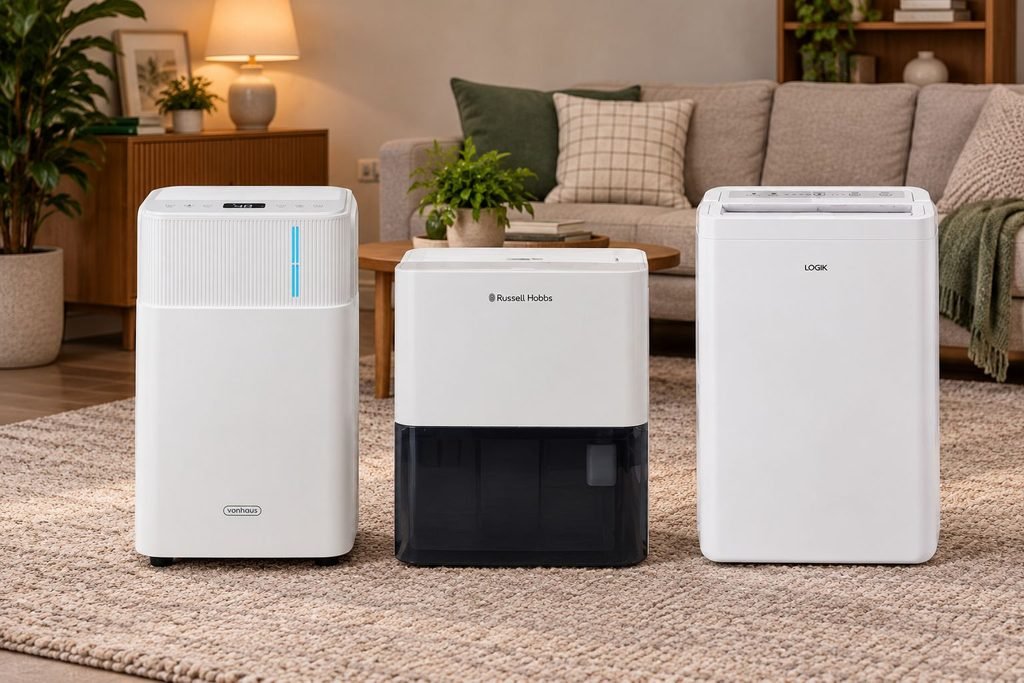
Get closer to £100, though, and you can buy a proper compressor dehumidifier rated at 10 to 12 litres a day. This guide is for anyone in a flat or a smaller house who wants one of those without paying for a 20L machine they don’t really need. All three picks were at or just under £100 when we checked prices in October 2026.
Quick verdict
The VonHaus 12L Low Energy is the one to buy if it’s still £100 or less. It has the highest extraction rating of the three and the lowest power draw (200W), and it’s the only one with a dedicated Laundry mode. You also get two years of warranty cover rather than one.
The Russell Hobbs RHDH1001 is for people who like to fine-tune things. You can set humidity in 5% steps, there’s a Silent mode for bedrooms and the timer’s more flexible. It’s also the hungriest on power at 340W, so it costs the most to run. The LOGIK L10DH24 is the simplest of the lot, with four preset humidity levels, continuous drainage and auto restart. It’s cheaper to run than the Russell Hobbs, but it’s the noisiest on paper and you don’t get many controls.
The best dehumidifiers under £100 at a glance
| Model | Best for | Extraction | Power | Noise | Price (Oct 2026) | Score |
|---|---|---|---|---|---|---|
| VonHaus 12L Low Energy | Best overall | 12L/day | 200W | 39dB | £94.99 | 9.3/10 |
| Russell Hobbs RHDH1001 | Precise humidity control | 10L/day | 340W | Not published | £99.99 | 9.0/10 |
| LOGIK L10DH24 | Simple, set-and-forget use | 10L/day | 245W | 45dB(A) | £99.00 | 8.6/10 |
How we chose
We left out the mini thermoelectric units completely. They’re cheap and quiet, but they don’t remove enough moisture to deal with condensation, damp or indoor laundry. So we stuck to full-size compressor models at or under £100 that still give you a decent extraction rate.
We then went through the specs that matter day to day: extraction, power draw, humidity controls, drainage, noise, timers, weight and warranty. Where a retailer’s marketing copy said one thing and the technical spec said another, we went with the spec. The scores are our editorial judgement of how well each one suits a typical UK home on this budget. They’re not lab results, and we haven’t tested these machines ourselves.
1. VonHaus 12L Low Energy: Best Overall Dehumidifier Under £100
Score: 9.3/10 | Best for: bedrooms, small flats and drying clothes indoors | Price checked: £94.99 (usual price £119.99)
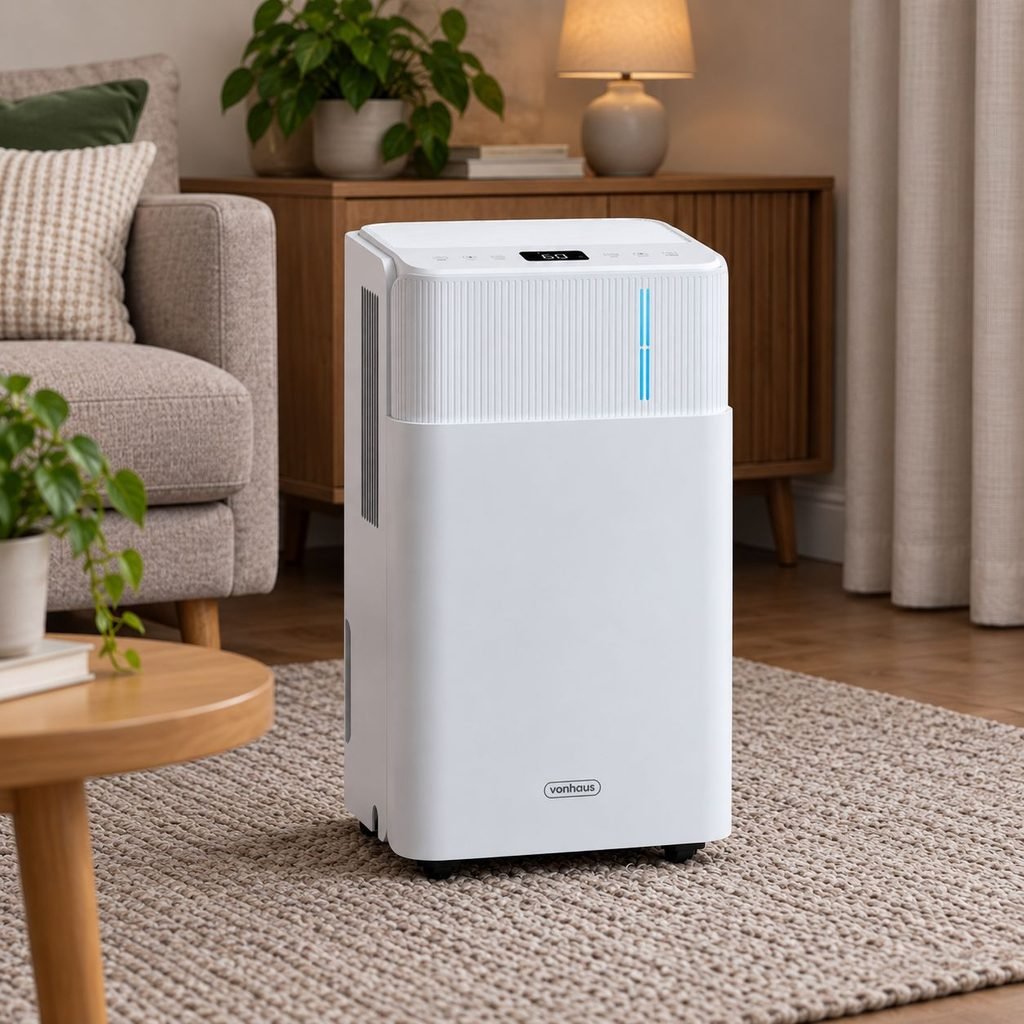
The VonHaus takes the top spot because it simply has the most going for it. It’s rated at 12 litres a day but only draws 200W, which is a good combination at this price. The three modes are all ones you’ll actually use. Auto reads the room’s humidity and holds it at whatever level you’ve set, Laundry keeps it running continuously while your washing dries, and Sleep dims the display and quietens it down for the night. VonHaus quotes 39dB, the lowest noise figure in this guide. Oddly, VonHaus doesn’t call it a compressor model anywhere on its product page, but the auto-defrost function, the 10kg weight and the wattage give it away.
Be careful when you order, though. VonHaus also sells a 12L Auto Dehumidifier with Laundry Mode for the same £94.99, and the names are close enough to mix up. That one’s a different machine, rated at 240W and 42dB, with a smaller 1.5L tank and a 15m² room recommendation. Look for 200W and a 2L tank in the listing and you’ll know you’ve got the right one. And £94.99 is a sale price. At the usual £119.99, it wouldn’t have made this list.
| Type | Compressor |
| Rated extraction | Up to 12L/day |
| Tank | 2L, auto shut-off when full |
| Power | 200W |
| Noise | 39dB (manufacturer figure) |
| Modes | Auto, Laundry, Sleep |
| Recommended room size | Up to 20m² |
| Timer | 24 hours |
| Continuous drainage | Yes, drain hose included |
| Other features | Auto defrost, child lock, built-in filter, wheels and handle |
| Dimensions (H × W × D) | 45.9 × 25.5 × 22.3cm |
| Weight | 10kg |
| Warranty | 2 years, no registration needed |
Pros and cons
- Highest rated extraction here (12L/day) from the lowest power draw (200W)
- Dedicated Laundry mode, plus a Sleep mode for bedrooms
- Quietest on paper, at 39dB
- Two-year warranty, against one year on the other two
- Only under £100 while it’s on offer; the usual price is £119.99
- Easy to confuse with the less efficient 12L Auto model sold at the same price
- VonHaus only recommends it for rooms up to 20m², so it’s a one-room machine
Verdict: The most well-rounded dehumidifier you’ll find under £100 right now, provided you buy the Low Energy version while it’s on offer.
Buy it if you want one machine for condensation, general damp and drying clothes in a bedroom, spare room or small flat, and you’d like to keep running costs low.
Skip it if you’re dealing with a large open-plan space or damp throughout the house. A 20L-class machine is a better fit there, although you’ll usually pay more than £100.
2. Russell Hobbs RHDH1001: Best for Precise Humidity Control
Score: 9.0/10 | Best for: bedrooms and anyone who likes to fine-tune the settings | Price checked: £99.99
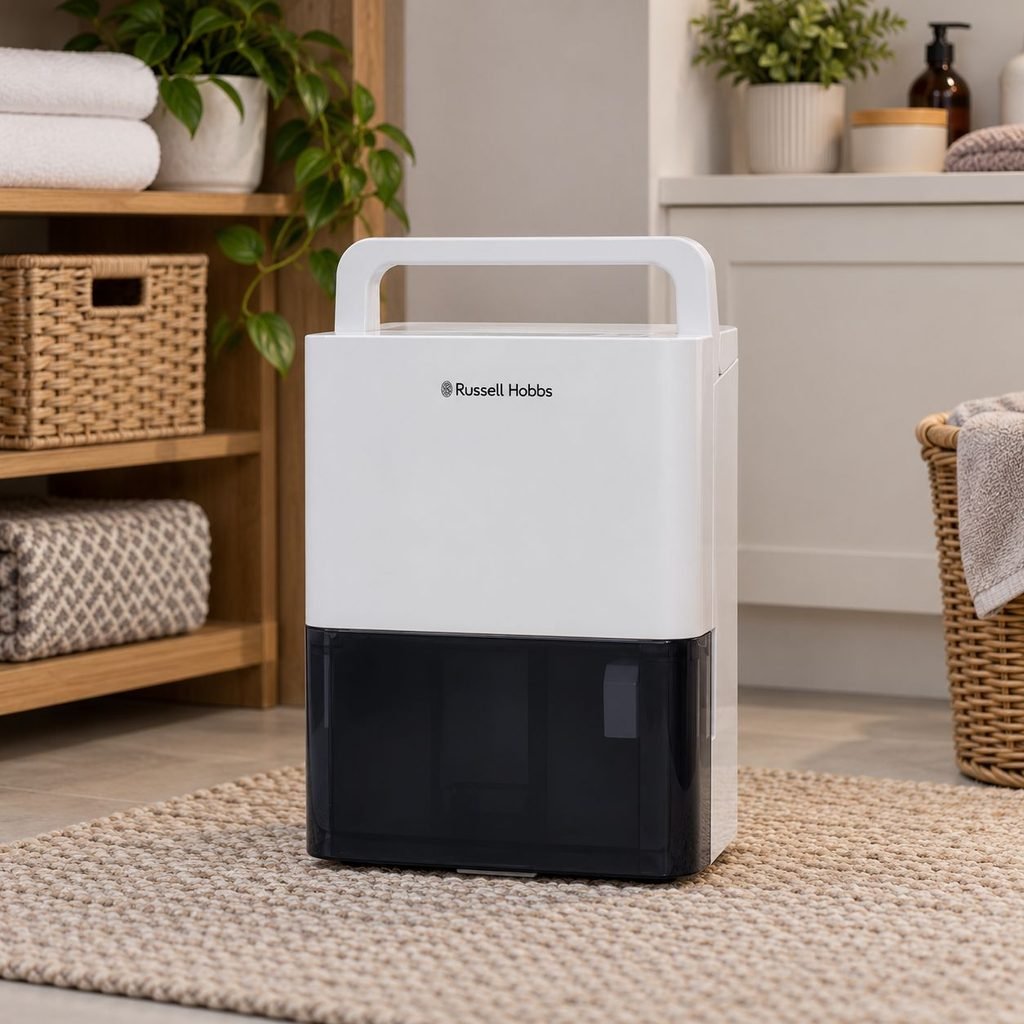
If you like setting things exactly, this is the one. Rather than a handful of presets, you pick a target humidity anywhere between 35% and 85% in 5% steps. The timer works both ways too, so you can have it start later or switch off after a set time, up to 24 hours. There’s a Continuous mode that runs at full extraction until the tank’s full (useful on washing days) and a Silent mode that drops to a slower fan overnight. Russell Hobbs doesn’t give a decibel figure, though, so we can’t say how it compares with the other two on noise. Dig into the manual and you’ll also find auto defrost, auto restart after a power cut and a working range of 5°C to 35°C.
Where it loses out is running costs. At 340W, it draws 140W more than the VonHaus and nearly 100W more than the LOGIK, and that adds up if it’s on for hours every day (there’s a cost table further down). It’s the heaviest one here too, at 11.4kg. On the plus side, it’s only 40cm tall, so it’ll tuck under most windowsills. Russell Hobbs rates it for rooms up to 30m². At £99.99, it’s right on the edge of this budget, and even a small price rise would push it over.
| Type | Compressor (R290 refrigerant) |
| Rated extraction | Up to 10L/day (at 30°C, 80% RH) |
| Tank | 2L, removable, full-tank indicator |
| Power | 340W |
| Noise | Not published (Silent mode available) |
| Humidity settings | 35-85% RH in 5% steps |
| Modes | Humidity control, Continuous, Silent |
| Recommended room size | Up to 30m² |
| Timer | Delayed start or auto stop, up to 24 hours |
| Continuous drainage | Yes, via drain-hose connection |
| Other features | Auto defrost, auto restart, washable filter, wheels |
| Operating temperature | 5°C to 35°C |
| Dimensions (H × W × D) | 40 × 32 × 21cm |
| Weight | 11.4kg |
| Warranty | 1 year |
Pros and cons
- Humidity adjustable in 5% steps, not just a few presets
- Silent mode for bedrooms and Continuous mode for laundry days
- Most flexible timer here, with both delayed start and auto stop
- Only 40cm tall, so it fits under most windowsills
- 340W makes it the most expensive to run here
- Heavy at 11.4kg, so stairs are a chore
- No published noise figure and only a one-year warranty
Verdict: The best-equipped machine here for controls, held back mainly by its higher power draw.
Buy it if you want to set an exact humidity level, need a quieter mode for a bedroom or like having a delayed-start timer.
Skip it if you’ll be running it for long hours most days and want to keep your electricity bill down. The VonHaus covers similar ground on 200W.
3. LOGIK L10DH24: Best Simple, Set-and-Forget Option
Score: 8.6/10 | Best for: living rooms, hallways and anyone who doesn’t want to fiddle with settings | Price checked: £99.00
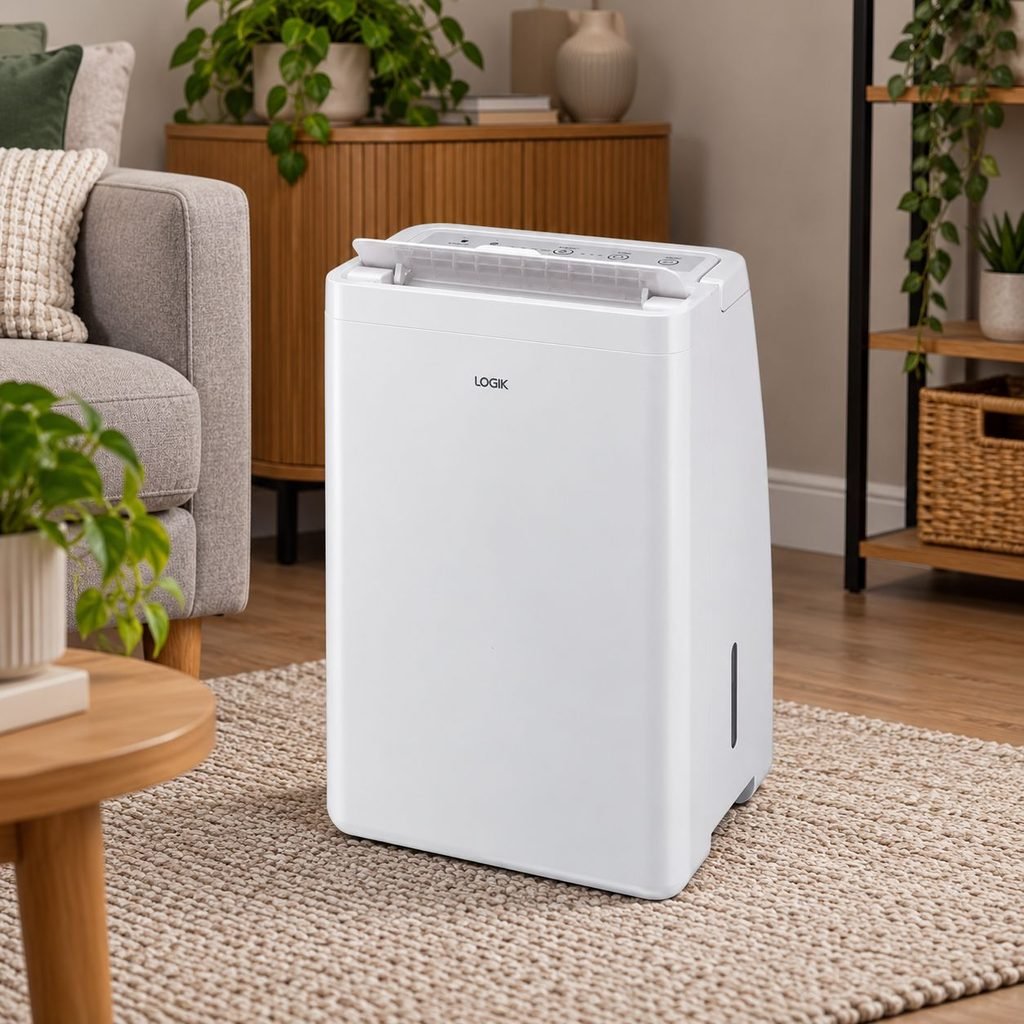
The LOGIK is Currys’ own-brand 10L compressor model, and it keeps things basic. You pick one of four humidity settings and leave it to get on with it. It switches itself off when the 2L tank is full, defrosts automatically and starts up again by itself after a power cut. If you’d rather not empty the tank at all, there’s a continuous drainage option too. At 245W, it’s cheaper to run than the Russell Hobbs, though not as cheap as the VonHaus.
There’s only one fan speed listed in the spec, no laundry or sleep mode, and the timer can only switch it off. At 45dB(A) it’s also the noisiest on paper, which is worth thinking about if it’s going in a bedroom. Currys says it’s suitable for rooms up to 50m². That seems generous for a 10L machine when VonHaus only recommends 20m² for its 12L model, so we’d ignore that figure and keep the LOGIK to one normal-sized room.
| Type | Compressor |
| Rated extraction | Up to 10L/day |
| Tank | 2L, auto shut-off when full |
| Power | 245W |
| Noise | 45dB(A) |
| Airflow | 102m³/h |
| Humidity settings | 4 presets |
| Fan speeds | 1 (per Currys spec) |
| Recommended room size | Up to 50m² (retailer claim) |
| Timer | Timer off |
| Continuous drainage | Yes |
| Other features | Auto defrost, auto restart, wheels |
| Dimensions (H × W × D) | 47.6 × 29 × 24cm |
| Weight | 10.17kg |
| Warranty | 1 year |
Pros and cons
- Very easy to use, with four preset humidity levels
- Auto restart, auto defrost and continuous drainage mean you rarely need to touch it
- 245W is noticeably cheaper to run than the Russell Hobbs
- Noisiest on paper at 45dB(A), with no quiet or sleep mode
- One fan speed, no laundry mode and an off-only timer
- Only a one-year warranty, and the tallest here at 47.6cm
Verdict: A sensible, no-frills 10L machine for a living area where you just want it ticking over. For the same money, though, the other two give you more.
Buy it if you want a set-and-forget dehumidifier for a hallway, living room or home office, and you don’t need laundry or sleep modes.
Skip it if it’ll be running next to your bed. The VonHaus has a lower published noise figure and a proper Sleep mode for about the same money.
Which one should you buy?
| If you mainly want to | Go for | Why |
|---|---|---|
| Dry clothes indoors | VonHaus 12L Low Energy | Only one with a dedicated Laundry mode, and the highest extraction rating |
| Run it in a bedroom overnight | VonHaus or Russell Hobbs | Both have a quiet mode; the VonHaus has the lower published noise figure |
| Keep running costs as low as possible | VonHaus 12L Low Energy | 200W, against 245W and 340W for the others |
| Set an exact humidity level | Russell Hobbs RHDH1001 | 35-85% in 5% steps, plus delayed start |
| Set it once and leave it | LOGIK L10DH24 | Four presets, auto restart and continuous drainage |
Running costs: what will they cost to use?
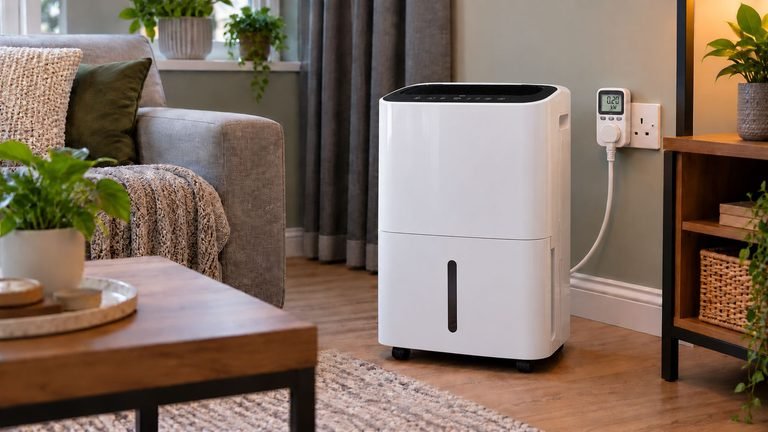
A dehumidifier tends to run for hours at a time, so a few extra watts add up quicker than you’d think. The figures below use Ofgem’s price cap rate of 26.32p per kWh, which is the average for Direct Debit customers in England, Scotland and Wales from 1 October to 31 December 2026. Standing charges are left out because you pay those whether the dehumidifier is on or not.
| Model | Power | 1 hour | 4 hours | 8 hours | 8 hours a day for 30 days |
|---|---|---|---|---|---|
| VonHaus 12L Low Energy | 200W | 5.3p | 21.1p | 42.1p | £12.63 |
| Russell Hobbs RHDH1001 | 340W | 8.9p | 35.8p | 71.6p | £21.48 |
| LOGIK L10DH24 | 245W | 6.4p | 25.8p | 51.6p | £15.48 |
Treat these as the most you’re likely to pay rather than what you’ll actually see on your bill. When you set a target humidity, the compressor switches off once the room reaches it, so the real cost is usually lower. Your tariff makes a difference too. Over a month of eight-hour days, the gap between the VonHaus and the Russell Hobbs comes to around £9. Run them hard all winter and that can easily end up bigger than the £5 difference in their price tags.
For a closer look at the maths, including how to estimate costs from your own tariff, see our guide to how much a dehumidifier costs to run in the UK.
What to look for in a dehumidifier under £100
Is 10 or 12 litres a day enough?
For a bedroom, a small flat or a single room with condensation, usually yes. The litres-per-day figure is a maximum, though, measured in warm and very humid test conditions. Russell Hobbs, for example, rates the RHDH1001 at 30°C and 80% humidity. A typical UK room in winter is a lot cooler and drier than that, so expect your machine to collect noticeably less than its rating. If you’ve got damp in several rooms, or a large open-plan space, it’s worth stretching to a 20L-class machine.
Why room temperature matters
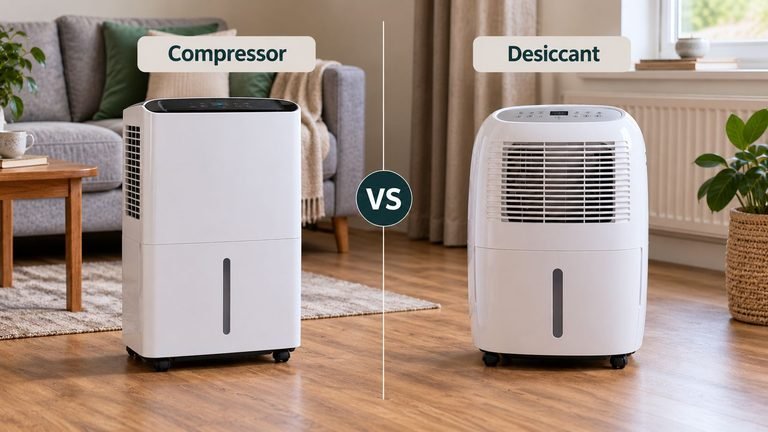
All three of these are compressor models. They work well in a heated home but lose efficiency as the room gets colder, which is why they all have auto defrost. If the machine is going in an unheated garage, conservatory or cold utility room, a desiccant dehumidifier usually copes better, although it costs more to run. Our compressor vs desiccant dehumidifier guide covers the difference in more detail.
Tank size and continuous drainage
All three have a 2L tank. For everyday condensation, emptying it once or twice a day isn’t a big job. On a heavy laundry day it might need emptying more often, and that’s when continuous drainage earns its keep. All three let you attach a hose, but the water has to run downhill to a drain or sink, so where you put the machine matters.
Noise in bedrooms
No compressor dehumidifier is silent. Expect a steady, fridge-like hum rather than a whisper. If you’re a light sleeper, a sleep or silent mode is more useful than a single dB number, because brands don’t always measure noise in the same way. The VonHaus quotes 39dB and the LOGIK 45dB(A). Russell Hobbs doesn’t publish a figure.
Drying laundry
A laundry mode just keeps the dehumidifier running rather than stopping once it hits a humidity target. The VonHaus has one, and the Russell Hobbs’ Continuous mode does much the same job. To get the best results, put the clothes and the dehumidifier in a small room with the door closed. If laundry is your main reason for buying, our best dehumidifiers for drying clothes guide covers models built specifically for it.
Getting the most out of a budget dehumidifier
- Keep doors and windows in the room shut while it’s running, or it’ll just keep drawing in damp air from outside.
- Use the humidity setting rather than leaving it on full all day. That’s the easiest way to keep running costs down.
- Leave space around the vents. Russell Hobbs, for example, asks for at least 20cm on each side and 40cm above.
- Clean the filter regularly. Russell Hobbs recommends checking it at least every 30 days.
- Keep it away from radiators and heaters, and only use a drain hose where it can slope safely down to a drain.
Frequently asked questions
Can you get a good dehumidifier for under £100?
Yes. At the time of writing, you can buy compressor dehumidifiers rated at 10 to 12 litres a day for £100 or a little less, including all three models in this guide. Just keep an eye on the price, because these models move around a lot. The VonHaus is only under £100 while it’s on offer.
Is a 10L dehumidifier enough for a bedroom?
For most bedrooms, yes. A 10L compressor model can keep on top of normal condensation in a room of average size. If the walls are visibly damp, or the room is cold, you may need either a bigger machine or a desiccant model.
Are cheap mini dehumidifiers worth buying?
Only for very small spaces such as wardrobes, cupboards or a caravan. They remove a fraction of the water a 10L compressor model can, so they won’t make much difference to a damp bedroom or a load of wet washing.
What humidity should I set it to?
For most homes, somewhere between 50% and 60% works well. If you still see condensation on the windows in the morning, try going a step lower. Going much drier than that just costs more to run without making much difference.
Should I run a dehumidifier all day?
Usually not. If you set a target humidity, the machine will cycle on and off by itself. Longer runs make sense on laundry days or when you’re drying out a room with a damp problem.
Is a dehumidifier better than a heated airer for drying clothes?
They do different jobs. A heated airer warms the clothes, while a dehumidifier pulls moisture out of the air so it doesn’t settle on your walls and windows. Plenty of people use both together. Our dehumidifier vs heated airer comparison goes through the costs and trade-offs.
Will a dehumidifier stop mould?
It can help by keeping humidity and condensation down, and both of those encourage mould. It won’t fix a leak, rising or penetrating damp, or poor ventilation, and it won’t get rid of mould that’s already there. For rooms with an ongoing problem, see our guide to the best dehumidifiers for mould and damp.
Can I compare room-size claims between brands?
Not really. In this guide alone, VonHaus recommends 20m² for a 12L machine, while the 10L LOGIK is listed for up to 50m². Different brands make different assumptions, so it’s more useful to compare extraction rate, room temperature and how damp the room actually is.
Final verdict
£100 is enough for a proper compressor dehumidifier, so there’s no need to settle for a mini one. The VonHaus 12L Low Energy is our first choice. It’s rated to extract the most while drawing the least power, and you get a proper Laundry mode and twice the warranty on top. Just make sure you’re buying the Low Energy version, and check it’s still on offer.
If you’d like more control over humidity and timings, and don’t mind paying a bit more to run it, the Russell Hobbs RHDH1001 is the better-equipped machine. The LOGIK L10DH24 suits anyone who wants something simple to switch on and forget about in a living space. If your damp keeps coming back however much you run a dehumidifier, the cause is probably structural, such as a leak or poor ventilation, and that needs fixing first. For bigger budgets and larger homes, our main best dehumidifiers UK guide has more options.